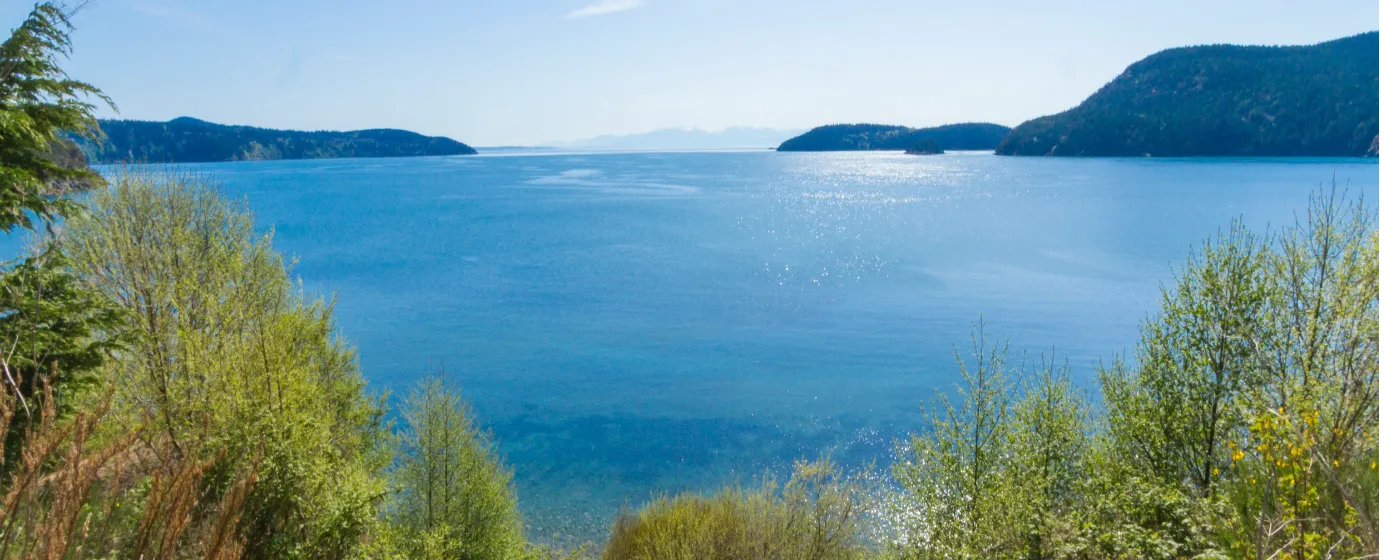
Puget Sound · Washington
Moving to Anacortes from California: The Honest Comparison (2026)
The Bay Area software engineer who finally got tired of paying $4,200 a month for a two-bedroom in San Jose didn't move to Anacortes for the scenery — though that part surprised her. She moved because she could keep her remote salary, eliminate California's 9.3% income tax bracket, and buy a four-bedroom house on Fidalgo Island for less than her Sunnyvale condo sold for. The Sacramento family who stopped dreading wildfire smoke every August and $400 utility bills in September found that Anacortes summers are genuinely spectacular — dry, mild, with 11 hours of sunlight per day in July and water views that would cost three times as much in Marin County. These aren't edge cases. Tens of thousands of Californians have relocated to Washington state in recent years, and Anacortes represents one of the most distinct landing spots: a small coastal city with a working waterfront, ferry access to the San Juan Islands, and a housing market that still offers meaningful relative value even as prices have climbed.
What this guide will not do is pretend the transition is seamless. Anacortes is not California. The winters are gray in a way that's different from anything you've experienced in the Central Valley or San Diego — not particularly cold, not especially snowy, but persistently overcast from November through March in a way that genuinely catches people off guard. The food scene is smaller than what you left. The social energy is quieter. The population skews older, with a median age of 50.5, and the pace is island-tempo in a way that some people find deeply restorative and others find disorienting after six months.
This guide covers the full financial picture — cost comparisons by California region, what different equity levels actually buy here, the tax math your accountant in Walnut Creek probably hasn't run for you yet, and the specific lifestyle realities that distinguish Anacortes from generic Pacific Northwest suburb. There's also an interactive tool to compare your specific California city directly to Anacortes. Use all of it before you make an offer.

| Anacortes, WA | Bay Area | Southern CA | Sacramento Metro | Central Valley | |
|---|---|---|---|---|---|
| Median Home Price (approx. 2026) | $740,000 | $1.3M–$1.8M+ | $750K–$1.1M | $480K–$600K | $320K–$420K |
| Property Tax Rate (effective) | ~0.70% | ~1.1–1.2% | ~1.1–1.2% | ~1.1–1.2% | ~1.1–1.2% |
| State Income Tax | None | Up to 13.3% | Up to 13.3% | Up to 13.3% | Up to 13.3% |
| State Sales Tax (combined) | ~8.6% | ~9–10.25% | ~8–10.25% | ~7.75–8.75% | ~7.75–8.75% |
| Avg Utilities (monthly est.) | ~$130 | ~$200–$250 | ~$220–$280 | ~$190–$240 | ~$210–$270 |
| Avg 1BR Rent | ~$1,400–$1,700 | ~$2,800–$3,800 | ~$2,200–$3,200 | ~$1,500–$1,900 | ~$1,000–$1,400 |
Washington's no-income-tax advantage is where many California buyers undersell themselves. A transplant earning $150,000 annually in California is paying somewhere between $11,000 and $14,000 per year in state income tax depending on their deductions. That money disappears entirely when they establish Washington residency. Over a ten-year horizon, that's $110,000 to $140,000 in cumulative savings — enough to fund a kitchen renovation, a boat slip at the Port of Anacortes, and a college fund contribution simultaneously. Most California buyers focus on the mortgage payment comparison and miss the ongoing monthly cash flow improvement that starts the moment they stop filing a California return.
Washington has no state income tax — one of only nine states in the country with this structure, and the only one on the West Coast. For a California transplant, this single policy difference is worth more than any negotiation they'll have on a home purchase price.
| Tax Item | California | Washington | Net Impact for Transplant |
|---|---|---|---|
| State Income Tax ($120K income) | ~$7,900/yr | $0 | +$658/month take-home |
| State Income Tax ($150K income) | ~$11,200/yr | $0 | +$933/month take-home |
| State Income Tax ($200K income) | ~$16,800/yr | $0 | +$1,400/month take-home |
| Long-Term Capital Gains Tax | Up to 13.3% | 7% on gains over $262K/yr | Significant savings for most transplants |
| Sales Tax (combined avg) | ~9–10% | ~8–9% | Modest WA advantage or neutral |
| Property Tax (on $740K home) | ~$8,140/yr at 1.1% | ~$5,180/yr at 0.70% | ~$247/month savings |
| Senior Property Tax Exemption | Limited | Yes, age 61+, income-based | Meaningful for retirees |
Property taxes in Skagit County run approximately 0.70% effective rate — meaningfully lower than the 1.1% California buyers typically pay on a recently purchased property at California reassessed values. On a $740,000 home, that difference is roughly $247 per month. The senior property tax exemption for residents 61 and older adds another layer of relief for retirees — the program is income-based and administered through Skagit County, and it's one of the first things buyers in that age bracket should look into after closing.
A buyer leaving San Jose, Walnut Creek, or Redwood City with $1.4 million or more in equity is entering Anacortes's market from a position of extraordinary leverage. At the $740,000 median, they can purchase outright and invest the remainder — or step into the Cap Sante neighborhood's waterfront and view-lot properties, where prices run $1.2 million to $2.5 million, and still carry a smaller mortgage than they left behind. The Old Town neighborhood offers beautifully restored craftsman homes in the $600,000 to $850,000 range, and buyers at this equity level often find themselves choosing between a waterfront property with a boat slip and a fully remodeled historic home with walking distance to Commercial Avenue — a problem that didn't exist in their California zip code.
For Bay Area buyers specifically, the psychological shift is significant: the $740,000 median here buys a detached single-family home with a yard, a garage, and in many cases views of the Guemes Channel or Fidalgo Bay. What that same figure bought in Sunnyvale in 2024 was a small condo or a teardown on a narrow lot. The math is stark, and most Bay Area transplants arrive having intellectually understood it — but still find themselves emotionally unprepared for how much more physical space they're standing in.
A buyer leaving Irvine, Pasadena, or Carlsbad with $900,000 in equity lands at the top tier of Anacortes's market. The San Juan Passage and Skyline neighborhoods represent strong value at this equity level — both offer newer construction, territorial views, and neighborhood settings that feel comparable in polish to what buyers left behind in coastal Southern California, at meaningfully lower prices. With $900,000 in equity, a SoCal buyer can purchase one of these properties outright or use a modest portion as a down payment and invest the balance.
The lifestyle parallel is also real: Southern California coastal culture revolves around water access, outdoor activity, and a certain unhurried energy that Anacortes genuinely shares — just with different weather. The ferry to Orcas Island from the Anacortes terminal feels, to many San Diego transplants, like the Catalina day trip they used to take, except it goes somewhere more remote and the wine is better.
Sacramento and Inland Empire buyers are working with a closer relative gain — their equity typically puts them at the median price point or slightly below, meaning they'll need a mortgage for most properties but a manageable one. The no-income-tax advantage is actually where this group feels the most immediate monthly relief: a Sacramento household earning $130,000 and paying California income taxes is likely recovering $800 to $1,000 per month in take-home pay from day one of Washington residency, which effectively subsidizes a mortgage payment they might have been hesitant about.
Neighborhoods like The Orchards, Village Park, and Parkside tend to appeal to this buyer profile — more recently developed, family-oriented, with homes in the $500,000 to $700,000 range that offer more square footage and land than Sacramento buyers were getting in comparable East Sacramento or Elk Grove neighborhoods.
Central Valley buyers — Fresno, Stockton, Modesto — have the most modest relative advantage in terms of raw equity, but they often find the lifestyle improvement disproportionate to the financial math. A $400,000 equity position in Anacortes doesn't buy a waterfront property, but it puts a buyer well into consideration for Hillcrest, Westside, or Central Anacortes neighborhoods, where detached homes with yards are available in the $500,000 to $650,000 range. A 20–30% down payment leaves them with a conventional mortgage on a home that, in Fresno, they simply could not have accessed in terms of location quality or setting.
The income tax relief for a Fresno family earning $100,000 is roughly $5,500 to $7,000 per year — money that funds the mortgage difference. Combined with significantly lower utility costs compared to Central Valley summers, the monthly budget picture often compares more favorably than buyers initially project.

Here's what a good friend who moved from Santa Cruz three years ago would actually tell you: Anacortes summers are legitimately stunning. From late June through mid-September, the city averages fewer than six rainy days per month, July brings 11 hours of daily sunshine, and the combination of mild temperatures in the low 70s, water views, and access to some of the most spectacular boating and hiking in the Pacific Northwest creates an outdoor lifestyle that feels comparable in richness to what California offers — just compressed into a shorter window. The Tommy Thompson Trail, the Anacortes Community Forest Lands trails, and Cap Sante Park are genuinely world-class in summer. Washington Park at the western tip of the island is where locals spend their August evenings, and the energy feels nothing like a gray Pacific Northwest stereotype.
November through February is the honest counterpoint. Anacortes averages 158 sunny days per year — compared to 284 in Los Angeles, 266 in San Diego, and 259 in San Francisco. December averages 2.3 hours of sunshine per day. The rain is less than Seattle (Anacortes receives about 26 to 29 inches annually versus Seattle's 38), but the cloud cover is pervasive and the darkness is real. California transplants who've lived in coastal Oregon or the Pacific Northwest before tend to adapt comfortably. Those arriving from San Diego or Sacramento, where even the winters offer bright blue skies and 60-degree afternoons, often find the January-through-March stretch harder than they anticipated. A SAD lamp and a good rain jacket are not optional gear here.
What transplants genuinely love after a year, and consistently say aloud: the traffic is gone. The summer Saturday drive to Washington Park takes four minutes from most of the city. The sense of community in a town of 18,000 is qualitatively different from anything a former San Jose or Long Beach resident has experienced — people know their neighbors, the Anacortes Farmers Market on Commercial Avenue brings genuine community ritual, and the pace is not suburban-quiet but island-deliberate. What they miss: year-round beach access in the California sense — jumping in the ocean in October isn't a local practice. The food scene, while good, is smaller than any major California metro. And the social energy of a large California city — the spontaneity, the diversity of nightlife and cultural events — is simply not replicated in a city of 18,000, no matter how charming the waterfront.
If you want to see how Anacortes compares directly to the city you're leaving, use the tool below — it covers the 120 largest California cities with current housing and tax data.
Home prices: Redfin median sale data, Q1–Q2 2026. Select your city to compare.
Ready to talk through what your specific California equity could do in Anacortes? Todd can model your exact scenario in a single call.

Anacortes tends to reward buyers who understand how neighborhood character connects to long-term value. Waterfront-adjacent areas like Cap Sante and Skyline consistently attract strong demand, and well-priced homes there — often listed under $750,000 — can move within days rather than weeks. Old Town draws buyers who want walkability and historic character, and that appeal tends to hold up well over time. If you're relocating from California, you may find the price points more accessible than what you left behind, but don't let that create a false sense of time — desirable Anacortes homes don't sit around waiting.
That's exactly why talking to a lender before you start touring matters. Your approval amount and your comfortable budget are genuinely two different numbers, and the real monthly payment — once you factor in property taxes, homeowner's insurance, any HOA dues, and your specific loan structure — often looks meaningfully different than the purchase price suggests. California transplants sometimes underestimate those carrying costs. Getting clear on your numbers first means that when the right home appears in a neighborhood you love, you're ready to move with confidence rather than scrambling to catch up.
Mistake 1: Treating Anacortes like a cheaper California coastal town. Buyers from Santa Barbara or Laguna Beach arrive expecting a California-style resort-town amenity set — a dense walkable commercial strip, multiple restaurant options open past 9 pm, year-round beach culture — and are surprised to find a working waterfront city with a maritime industrial core. The Marathon Anacortes Refinery is a major employer visible from parts of the city. This isn't a negative — the blue-collar authenticity is part of what gives Anacortes its grounded character — but buyers who've been comparing listing photos without visiting in January sometimes feel the gap.
Mistake 2: Underestimating the income tax cash flow shift. Most California buyers run the home price comparison and stop. They calculate their new mortgage payment, note it's lower, and feel satisfied. What they miss is that the income tax elimination shows up in every single paycheck starting month one of Washington residency. A couple earning a combined $180,000 is suddenly taking home $1,200 to $1,500 more per month. That changes what mortgage payment is comfortable, what renovation budget is realistic, and what retirement contribution rate is feasible — and buyers who don't model this ahead of time often leave money on the table in their early Anacortes years.
Mistake 3: Assuming the whole island drives like California traffic. Anacortes is accessed via the Deception Pass Bridge on Highway 20 and the Swinomish Channel corridor — there is one primary way on and off the island heading south toward Burlington and I-5. In summer, this corridor carries ferry traffic, tourist volume, and commuter flow simultaneously. A buyer who chooses a Westside or Skyline neighborhood without understanding that their southbound commute to Burlington or Mount Vernon will route through this corridor during summer peak hours may find the drive meaningfully slower than they projected in winter test runs. Know your neighborhood's relationship to Highway 20.
Mistake 4: Expecting California-speed market conditions everywhere. In California's strongest markets, buyers have trained themselves to submit offers sight-unseen and waive everything. Anacortes is not that market — with 4.5 months of inventory and homes averaging about 9 days on market (which is fast, but not California-frantic), there is often time to do a proper inspection and negotiate. California buyers who over-apply their battle-hardened instincts and waive inspection on a 1960s-era home near Commercial Avenue to "win fast" are making a mistake that the local market doesn't require. Use the inspection. This isn't the South Bay in 2021.
Bay Area sellers arriving with $1.2 million or more in equity are frequently buying all-cash or at loan-to-value ratios so low that the rate conversation becomes almost secondary to terms and speed. A seller who closes in Danville in early September and needs to close in Anacortes before year-end may benefit from a bridge loan or a 1031 exchange if the California property was an investment — the Anacortes 1031 Exchange guide covers the timeline and qualified intermediary requirements specific to this market. For primary residence sellers, a portfolio or DSCR lender can sometimes offer cleaner terms than conventional for large-equity, asset-heavy buyers whose income profile is non-traditional.
Southern California sellers from markets like Irvine, Pasadena, or Temecula typically arrive with enough equity for a substantial down payment on a mid-range Anacortes property — often 40% to 60% down — placing them firmly in conventional loan territory at most price points. Anacortes's $740,000 median sits below the 2026 conforming loan limit in most scenarios, meaning buyers aren't automatically pushed into jumbo products. A SoCal buyer putting 40% down on a $750,000 property is financing approximately $450,000 — a straightforward conventional transaction.
Sacramento and Inland Empire buyers working with $400,000 to $650,000 in equity may qualify for Washington State Housing Finance Commission programs including Home Advantage, which offers down payment assistance and competitive rates for buyers whose purchase price falls within program limits. Income limits and purchase price caps apply and change periodically, so verifying current thresholds directly with a WSHFC-approved lender is the right move. For buyers at this equity level, even a modest DPA layer can preserve cash reserves while keeping their down payment strong enough to avoid PMI.

Local Expert Takeaway: The single thing California buyers most consistently underestimate about Anacortes is the compounding effect of the no-income-tax advantage on their monthly household budget. Run the math on your specific income before you finalize a maximum purchase price — for a dual-income household earning $160,000 to $200,000 combined, Washington residency typically adds $1,100 to $1,600 per month in take-home pay starting with your first Washington paycheck. That figure changes what mortgage payment is genuinely comfortable versus what felt like a stretch in California. In practical terms: the home that looked like a financial reach in your spreadsheet may be the one you can comfortably afford once you stop writing a check to Sacramento every April.
Is moving from California to Anacortes worth it?
For most California buyers — particularly those with significant equity and remote or flexible work — the financial case is genuinely strong. The elimination of state income tax alone delivers hundreds to over a thousand dollars per month in additional take-home pay, the housing cost differential for Bay Area and Southern California sellers is dramatic, and the lifestyle quality in summer is legitimately excellent. The honest caveat is the winter light, the smaller social scene, and the island-access logistics that don't exist in any California city. Buyers who visit in winter and still want to live here tend to thrive; those who only visit in July sometimes feel caught off guard by February.
How much cheaper is housing in Anacortes vs. California?
Compared to the Bay Area, Anacortes homes at the $740,000 median cost 40% to 60% less than comparable properties in San Jose, Walnut Creek, or Palo Alto. Against Southern California markets like Irvine or Carlsbad, the differential narrows to roughly 10% to 30% depending on neighborhood and product type — still meaningful. Against Sacramento or the Inland Empire, the price comparison is closer to neutral or slightly above, meaning the financial logic for those buyers rests more heavily on the income tax advantage than on the home price gap itself.
What do I need to know about moving from California to Washington?
Establishing Washington residency requires changing your driver's license within 30 days, registering your vehicle, and updating your voter registration — the process is straightforward but needs to happen promptly to lock in the income tax advantage for that tax year. California has been known to audit former residents who claim Washington residency while maintaining California ties, so breaking those ties cleanly (closing California bank accounts, changing your primary address everywhere, updating professional registrations) matters. A CPA familiar with CA-to-WA residency transitions is worth the consultation fee, particularly in your first year.
Explore the full Anacortes series: The Ultimate Anacortes Relocation Guide · Is Anacortes Safe? · Cost of Living in Anacortes · Best Neighborhoods in Anacortes · Anacortes Schools & Family Life · Anacortes Youth Sports · Anacortes Parks & Recreation · Retiring in Anacortes · 1031 Tax-Deferred Exchange in Anacortes · Anacortes First-Time Homebuyers Guide · Anacortes Down Payment Assistance Guide · Moving to Anacortes from California