
Puget Sound · Washington
Cost of Living in Bellevue: Housing, Taxes, Utilities & Lifestyle (2026)
The first thing most people get wrong about Bellevue is assuming the median home price tells the whole story. The Zillow index sits around $1.3 million because it averages in every condo, townhome, and studio in the city — a figure that can make Bellevue sound almost attainable by Seattle-area standards. The actual median sold price for all property types runs closer to $1.5 million, and if you're shopping for a single-family home with a yard, you're entering a market where $2 million is closer to the starting line than the ceiling.
What shapes that price picture is a combination of geography, employer density, and tax structure that exists almost nowhere else in the country. Bellevue sits 20 minutes from Seattle, hosts the headquarters of Microsoft, T-Mobile, Valve, and Pokémon, and has watched Amazon commit to 14,000 local employees with a stated goal of 25,000. Washington has no state income tax, which means high earners who might pay 13% to California or 10% to Oregon are keeping significantly more of their paychecks — and they're spending it here.
This guide walks through what it actually costs to live in Bellevue in 2026: what you can buy at different price points, what rents look like, what your property tax bill will be, and what a realistic monthly budget looks like for a household buying at the median. If you're deciding between Bellevue and a neighboring city, the comparison table toward the end will help you see exactly where the cost gap opens up — and where it's smaller than you might expect.
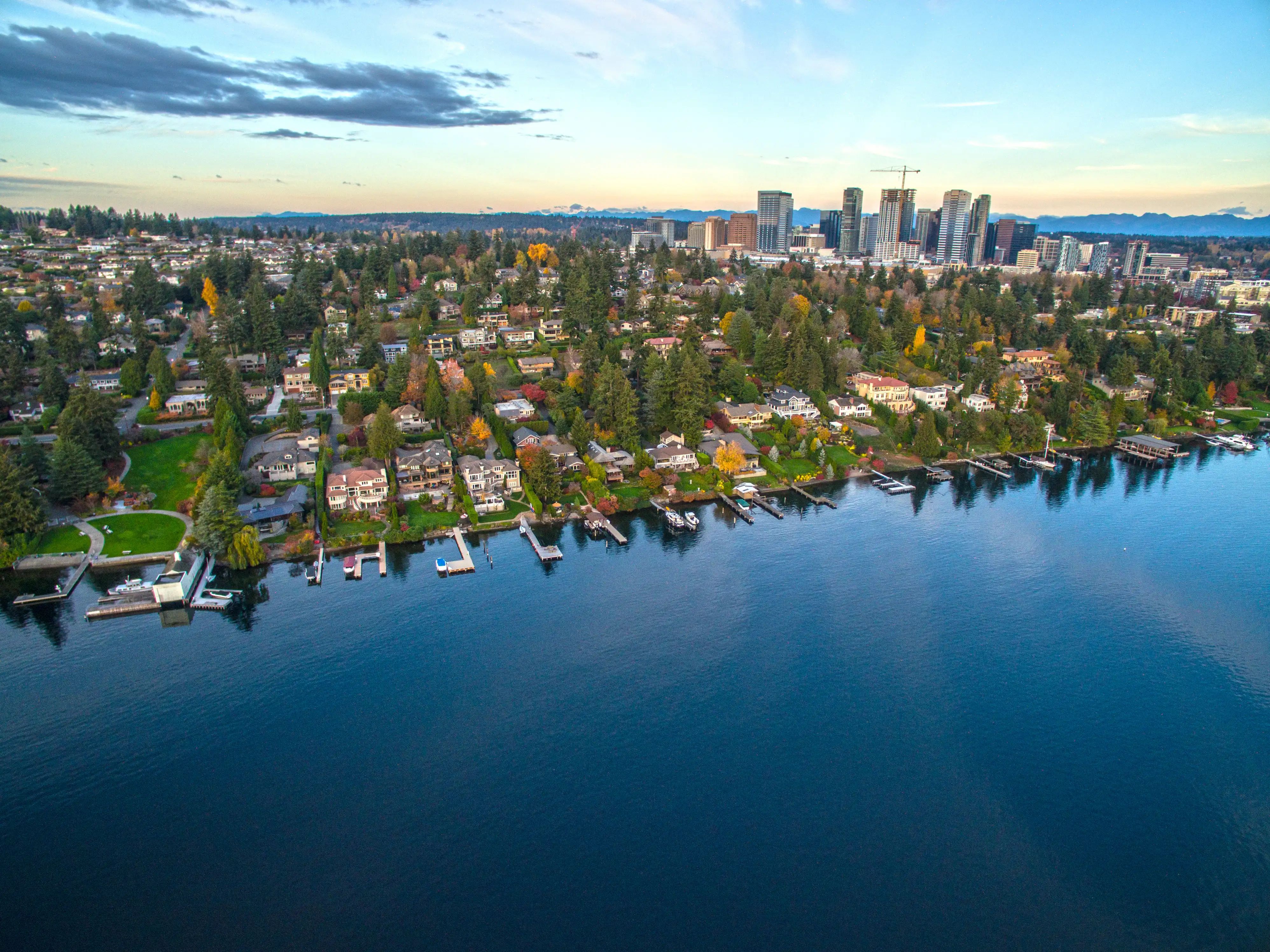
The citywide median sold price across all property types sits at approximately $1.5 million as of mid-2026, with homes averaging just 7 days on the market before going under contract. That 7-day window is not an invitation to take your time — homes are still closing at roughly 102% of list price, meaning competitive offers remain the norm in most price brackets. The condo market offers a relative pressure valve: units in neighborhoods like Factoria and Eastgate can be found starting in the high $500,000s, while Downtown towers like The Bravern and Bellevue Towers push past $1 million for premium floors.
For buyers focused on single-family homes, the picture sharpens considerably. Most established SFH neighborhoods — Somerset, Bridle Trails, Newport, and Lake Hills — don't start below $1.1 million, and that lower bound typically reflects older construction with deferred updates. The middle of the SFH market runs $1.5 million to $2.5 million. Neighborhoods like West Bellevue and Meydenbauer operate in their own tier, where the March 2026 median sold price in West Bellevue crossed $3.1 million, up nearly 12% year-over-year.
The BelRed/Spring District represents Bellevue's newest buying opportunity — purpose-built urban condos and townhomes priced between $800,000 and $1.5 million, with East Link light rail running directly through the neighborhood. It's the one area where buyers can reasonably expect the neighborhood to appreciate further as the district fills in.
| Budget Range | What You Can Realistically Expect |
|---|---|
| Under $900K | Condos and townhomes in Factoria, Eastgate, or Crossroads; limited SFH availability |
| $900K–$1.4M | Entry-level SFH in Lake Hills or older Eastgate; updated condos near Downtown |
| $1.4M–$2.2M | Mid-range SFH in Somerset, Crossroads, Bridle Trails; strong school proximity |
| $2.2M–$5M+ | West Bellevue, Newport Shores, Meydenbauer, Enatai waterfront; premium finishes and lots |
King County's effective rate in Bellevue runs approximately 0.71%, which means the annual property tax on a home at the $1.5 million median works out to roughly $10,650. Washington operates under a statutory 1% annual levy limit, capping how fast local property tax revenue can grow regardless of how fast home values climb — which has meaningfully buffered long-term owners from the explosive appreciation of the past decade. Homeowners 61 and older may qualify for the state's senior property tax exemption program, which freezes the assessed value used for taxation and can reduce the bill substantially for fixed-income retirees.
Bellevue's rental market reflects the same bifurcation as its for-sale inventory. Downtown high-rises and new construction in the Spring District command premium rents, while older apartment stock in Crossroads and Eastgate runs meaningfully below the city average. Overall vacancy rates remain low, and turnover in the most desirable buildings is infrequent — especially in luxury towers where corporate relocation packages absorb the monthly cost without friction.
| Unit Type | Average Monthly Rent (2026) |
|---|---|
| Studio | $1,900–$2,400 |
| 1-Bedroom | $2,400–$3,100 |
| 2-Bedroom | $3,200–$4,200 |
| 3-Bedroom | $4,500–$6,500 |
| Luxury High-Rise (2BR+) | $5,000–$9,000+ |
Puget Sound Energy handles electricity and natural gas for most Bellevue households, and monthly utility bills — electricity, gas, water, sewer, and trash combined — typically run between $220 and $350 for a single-family home, varying with season and home size. Seattle City Light serves portions of western Bellevue, so the provider can differ by exact address. Internet service is competitive, with Comcast Xfinity and CenturyLink/Lumen both offering gigabit options in most neighborhoods; monthly internet costs run $65–$100 depending on plan.
Bellevue is car-dependent for most residents, even with East Link light rail now operational through BelRed and Downtown. The light rail is genuinely useful for commuters heading into Seattle's Capitol Hill or Downtown core, but day-to-day errands — school pickups, grocery runs, weekend activities — nearly always require a car. Gas stations and grocery stores are abundant: QFC, Whole Foods, Trader Joe's, H Mart, and Uwajimaya all have Bellevue locations, giving the city some of the best grocery diversity in the region. Dining out runs roughly 15–20% more expensive than the national average, with sit-down dinners in Downtown Bellevue commonly landing in the $60–$100 per person range at mid-tier restaurants.
Commute costs add up for households working outside Bellevue. A reverse commute to Seattle — 20 minutes by car during off-peak hours, potentially 40–50 minutes during the 7:30–9:00 AM window on I-90 or SR-520 — is manageable by metro-area standards, but SR-520 bridge tolls run $1.50–$7.50 depending on time of day and direction. Many tech workers in households with two earners find that one partner works in Bellevue and the other commutes to Seattle, making the toll a fixed line item on the monthly budget. The Eastgate Park & Ride and South Bellevue Park & Ride offer bus and light rail connections for commuters who want to avoid the bridge toll entirely.

One of the most common questions from relocating buyers is how Bellevue compares financially to the cities immediately around it. The answer depends almost entirely on what you're comparing — income tax savings versus home price premium, or commute time versus walkability.
| City | Median Home Price | State Income Tax | Avg Commute to Seattle | Property Tax Rate (approx.) |
|---|---|---|---|---|
| Bellevue | ~$1.5M (all types) | None | 20 min | 0.71% |
| Seattle | ~$900K–$1.1M | None | In-city | 0.90% |
| Kirkland | ~$1.1M–$1.3M | None | 30–40 min | 0.75% |
| Redmond | ~$1.0M–$1.2M | None | 30–40 min | 0.74% |
| Mercer Island | ~$1.8M–$2.2M | None | 15–25 min | 0.68% |
| Renton | ~$700K–$850K | None | 25–35 min | 0.85% |
| Newcastle | ~$950K–$1.2M | None | 30–40 min | 0.73% |

As someone who works with buyers across the greater Seattle area, I can tell you that location within Bellevue makes a real difference in long-term value. Neighborhoods like Downtown and West Bellevue command premium prices, and well-priced homes there can go under contract within days — sometimes over a weekend. If you're open to areas like Crossroads or Somerset, you'll generally find more opportunities, including some homes under $750,000, though inventory moves quickly there too. The neighborhood you choose affects not just your purchase price but your ongoing cost of living in meaningful ways.
Before you start touring homes, please talk to a lender first — and I mean really talk, not just get a pre-approval letter. There's a big difference between what you're approved for and what fits comfortably into your life. Your full monthly payment includes property taxes, homeowner's insurance, and potentially HOA dues depending on the community, and those numbers can shift your budget significantly. In a market like Bellevue, being prepared means you can move confidently when the right home appears rather than scrambling to catch up.
The table below reflects a household purchasing at the $1.5 million median, with 20% down ($300,000), at a 6.38% 30-year fixed rate. This is a representative scenario for a dual-income household earning near the city's median.
| Expense Category | Monthly Cost |
|---|---|
| Mortgage (P&I, 20% down, $1.2M loan) | ~$7,500 |
| Property Taxes | ~$888 |
| Homeowner's Insurance | ~$200–$280 |
| HOA (if applicable — condos/townhomes) | $400–$900 |
| Utilities (electricity, gas, water, trash) | $250–$350 |
| Internet & Streaming | $100–$130 |
| Groceries (family of 4) | $900–$1,200 |
| Dining Out (2–4x/week) | $600–$1,000 |
| Transportation (car payment, gas, SR-520 toll) | $800–$1,200 |
| Childcare or K–12 enrichment | $1,500–$3,500 |
| Total (estimated range) | $13,000–$17,000/month |
Washington is one of only nine states with no personal income tax, and that single fact drives an enormous amount of the relocation math for high earners considering Bellevue. A household earning $300,000 in California would owe roughly $28,000–$30,000 in state income tax annually; in Washington, that number is zero. Over a decade, that's a quarter-million dollars that stays in the household — which goes a long way toward explaining why West Bellevue prices have held their ground even as mortgage rates climbed.
Washington does impose a capital gains tax on profits exceeding $250,000 from the sale of certain long-term investments (not primary residences, which remain fully exempt). The state also collects sales tax at a combined city/county/state rate of approximately 10.2% in Bellevue — one of the ways the state funds public services in the absence of income tax. Buyers who relocate from income-tax states often find that the sales tax and property tax together are still far less than what they paid in combined state taxes previously. Senior residents should be aware of Washington's property tax deferral program, which allows qualifying homeowners 60 and older to defer property taxes until the property is sold, functioning effectively as a no-interest loan from the state.
Local Expert Takeaway: The buyers who build the most equity in Bellevue are the ones who buy into a neighborhood before a transit or development catalyst fully prices in. The Spring District is the most obvious current example — East Link is operational, Amazon's Bellevue campus is still filling in, and OpenAI's February 2026 lease commitment signals that the city's tech employment base will keep growing. Buyers who bought in BelRed two years ago at $850,000 are sitting on meaningful appreciation already. If you're priced out of Somerset or West Bellevue at today's numbers, don't rule out the neighborhoods that are still mid-ascent.
Looking to buy in Bellevue? Estimate your payment.
Enter your numbers to see an estimated monthly mortgage payment.
Estimate only. Excludes HOA fees and mortgage insurance.
Is Bellevue affordable compared to other Seattle-area cities?
Bellevue is among the more expensive cities in the region, with a median sold price around $1.5 million across all property types. Renton and Redmond offer meaningfully lower entry points — often $400,000–$600,000 less for comparable single-family homes — but without the same concentration of walkable amenities, employer proximity, and school district performance that Bellevue delivers.
What are property taxes like in Bellevue?
The effective rate is approximately 0.71%, which produces an annual tax bill of roughly $10,650 on a $1.5 million home. Washington's 1% annual levy cap prevents dramatic year-over-year increases, and seniors 61 and older may qualify for an exemption that freezes the assessed value used for tax calculation — a significant benefit for retirees on fixed incomes.
Does Washington's no-income-tax benefit really make a difference for Bellevue buyers?
For high-income households, the benefit is substantial — a $300,000 combined income that would trigger roughly $28,000–$30,000 in California state income tax costs nothing at the state level in Washington. Over time, that annual savings compounds into meaningful home equity and financial flexibility. The catch is that Bellevue's premium home prices require large down payments that many relocating buyers don't have pre-built, so the tax savings are most impactful for established earners making a planned relocation rather than first-time buyers stretching to enter the market.
Explore the full Bellevue series: Living in Bellevue · Is Bellevue Safe? · Cost of Living · Best Neighborhoods · Schools & Family Life · Youth Sports · Parks & Rec · Retiring in Bellevue