
Puget Sound · Washington
1031 Exchange & Investment Real Estate in Enumclaw (2026)
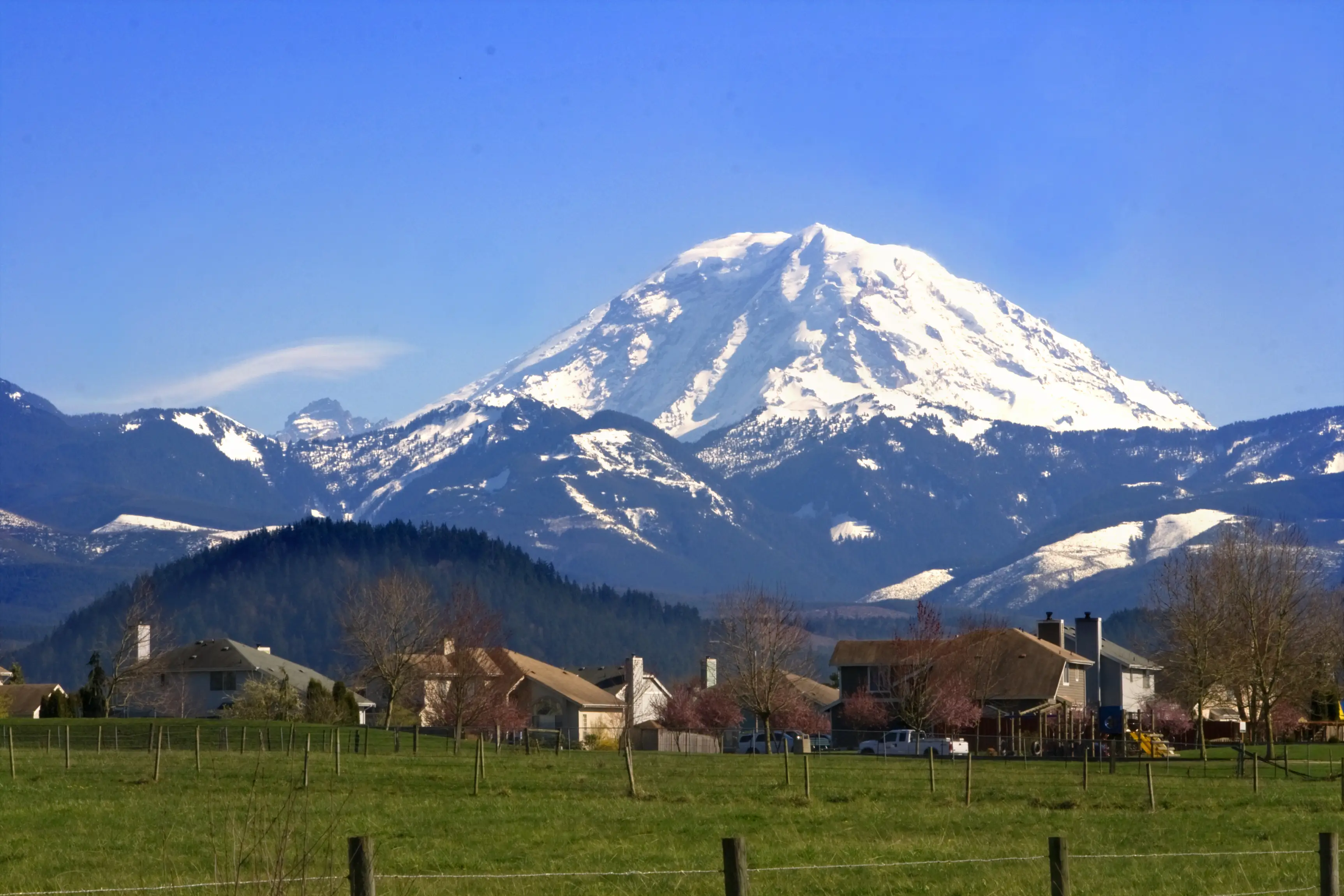
Not everyone doing a 1031 exchange is a professional investor with a management company on speed dial. A significant share of the capital flowing into Enumclaw right now comes from California homeowners — people who sold a primary residence or a long-held rental and are looking to redeploy proceeds into a market where prices are lower, the landlord environment is more predictable, and their equity can actually control multiple properties. Enumclaw, sitting at the base of Mount Rainier's western approach in King County, has quietly become one of the more compelling replacement property markets in the greater Seattle region.
Rental demand here is driven by workers connected to Enumclaw's healthcare, education, and government employers — people who need to stay close to St. Elizabeth Hospital, the Enumclaw School District, or the Expo Center corridor. The rental vacancy rate sits around 2%, and for every renter household in Enumclaw there are roughly 1.02 available rental units, a supply ratio that keeps landlords in a structurally favorable position. The properties that trade most often as investment vehicles are single-family rentals, older duplexes near the downtown core, and small commercial strips along Highway 410.
This guide covers the mechanics of a 1031 exchange, what the Enumclaw investment market actually looks like in 2026, why Pacific Northwest markets are pulling California capital, and the specific due diligence steps that out-of-state investors tend to skip — sometimes expensively.

The core mechanic is simple: sell a relinquished property, park the proceeds with a qualified intermediary (QI), and close on a replacement property using those proceeds — all within a strict timeline. The 45-day identification window starts the moment your relinquished property closes. You must identify potential replacement properties in writing to your QI within those 45 days, and you can name up to three properties regardless of value. The 180-day closing deadline runs concurrently from the same closing date — not from when you identify properties. Miss either deadline and the tax deferral collapses.
The qualified intermediary is non-negotiable. You cannot receive the funds personally — even briefly — without disqualifying the exchange. The QI holds the proceeds, facilitates the transfer, and prepares the required documentation. Choose one before your relinquished property closes, not after. Like-kind rules are more flexible than most investors realize: any real property held for investment or business purposes qualifies, which means you can exchange bare land for a duplex, a California commercial strip for a Washington single-family rental, or a long-term rental for a multifamily building.
The boot trap catches investors who over-identify or structure the replacement poorly. If you acquire a property worth less than the net sales price of the relinquished property, the difference — called boot — becomes taxable income in the year of the exchange. To fully defer, your replacement property's purchase price must equal or exceed the adjusted net sale price, and you must reinvest all of the equity proceeds, not just a portion.
The median sold price in Enumclaw runs approximately $610,000 across the city, with the Central Enumclaw submarket trading closer to $583,000 and Enumclaw Plateau — where larger lots and estate-scale properties dominate — posting medians around $700,000. For investors on a 1031 clock, the inventory picture matters as much as price. The market has shown absorption tightening: well-priced properties in Central Enumclaw moved in under two weeks on average in late 2025, while larger acreage properties on the Plateau can sit considerably longer.
Single-family rentals are the dominant investment vehicle here, and they're also the tightest-inventory category. Duplexes exist but rarely surface publicly — most change hands off-market or through local agent networks. Small commercial mixed-use properties along Cole Street and the Highway 410 corridor occasionally come available, and they tend to attract investors willing to underwrite a longer lease-up period for higher eventual returns.
| Property Type | Typical Price Range | Est. Cap Rate | Avg Days to Close |
|---|---|---|---|
| Single-Family Rental (3BR) | $540,000–$680,000 | 4.0%–5.5% | 30–45 days |
| Duplex / Small Multifamily | $625,000–$825,000 | 5.0%–6.5% | 45–60 days |
| Small Commercial / Mixed-Use | $700,000–$1,200,000 | 5.5%–7.0% | 60–90 days |
| Acreage / Rural Residential | $650,000–$950,000 | 3.5%–5.0% | 45–75 days |
The core math is hard to ignore. California investors selling appreciated assets in major metros can often buy one or more Enumclaw properties outright — with equity to spare — and immediately generate cash flow in a state with no income tax on their rental income.
A Bay Area seller closing a property at $1.4 million walks away with significant 1031 proceeds that could simultaneously close on a Plateau-area SFR and a Central Enumclaw duplex — potentially debt-free. That same capital in the Bay Area buys a single entry-level condo in San Jose. The price-to-rent dynamics in Enumclaw are meaningfully better, and the tenant pool is stable blue-collar and essential-worker households rather than tech-adjacent renters with volatile incomes.
Los Angeles and San Diego investors are accustomed to cap rates of 3% to 4% on SFRs, often lower. Enumclaw's small multifamily market can deliver 5.5%–6.5% cap rates on well-maintained duplexes, which represents a material yield improvement without taking on a 20-unit building and the operational complexity that comes with it. The psychological shift from an LA rental to a Pacific Northwest college-and-families market also tends to reduce management headaches.
Sacramento and Inland Empire sellers often arrive with exchange proceeds in the $600,000–$900,000 range — exactly the price band where Enumclaw's SFR market is most active. These buyers can typically acquire a clean, recently updated three-bedroom rental at the city-wide median and retain reserves for deferred maintenance or a capital improvement cycle. Many Sacramento investors are also attracted by Washington's structural landlord protections compared to California's increasingly tenant-favorable statutory environment.
Washington has no state income tax — one of only nine states in that position. Every dollar of net rental income you generate in Enumclaw goes directly to your bottom line, not split with Olympia. For a California investor in the top bracket, that means avoiding a 13.3% state income tax hit on every dollar of rental profit from the moment they close.
Washington does have a 6.5% state sales tax (plus local add-ons), which applies to materials and furnishings purchased for rental property rehabs. Factor that into renovation budgets — it's a meaningful line item on a $60,000 kitchen and bathroom update. Property taxes in Enumclaw run approximately 0.91% of assessed value. On a $610,000 acquisition, that translates to roughly $5,550 per year — compared to what a California buyer would pay at effective post-purchase rates on a newly acquired asset at the same price.
| Tax Item | California | Washington |
|---|---|---|
| State income tax on rental income | Up to 13.3% | None |
| Property tax rate (new purchase) | ~1.1%–1.2% (Prop 13 reset) | ~0.91% |
| Sales tax | 7.25%–10.75% | 6.5%–10.4% |
| Capital gains (long-term, state level) | Up to 13.3% | 7% on gains above $262,000/year |

When it comes to 1031 exchange activity in Enumclaw, location within the city genuinely matters for long-term appreciation and rental demand. Properties in Downtown Enumclaw and North Enumclaw tend to attract steady investor interest given their accessibility and community feel, while Northwest Enumclaw has seen growing attention from buyers looking to replace exchanged assets with something that holds value over time. Desirable investment properties here — many priced under $600,000 — move quickly once listed, sometimes within days, so being unprepared can mean losing a solid replacement property during your exchange window.
That's exactly why I encourage anyone exploring a 1031 exchange to connect with a lender before they start touring replacement properties. Your full monthly payment picture includes the loan itself, property taxes, insurance, and any HOA dues — and that combined number can look quite different from what an online calculator suggests. I'd rather help you find a comfortable, sustainable budget than simply tell you the maximum you qualify for. When the right replacement property appears, and your exchange clock is ticking, you want financing ready to move with you.
Washington's landlord-tenant code is one of the more tenant-protective frameworks in the western states, though it stops short of the statewide rent control that California investors are often fleeing. As of 2026, there is no statewide rent cap in Washington. Notice requirements have been extended in recent legislative cycles — landlords typically need to provide longer advance notice for rent increases and non-renewal than they would in, say, Texas or Idaho. Out-of-state owners who try to self-manage from California consistently underestimate how consequential a missed notice deadline can be under Washington's statutory framework.
Local property management companies serving the Enumclaw area include firms operating out of the greater South King County corridor, with some Enumclaw-area managers listing on platforms like Buildium and AppFolio. Typical management fees run 8%–10% of gross monthly rent, with leasing fees often adding one month's rent for tenant placement. On a $2,000/month rental, the operating cost of professional management runs roughly $160–$200 per month — a number that pencils in easily against the risk of navigating Washington's landlord statutes from out of state.
Vacancy stays low. The approximate 2% vacancy rate reflects genuine structural undersupply rather than a temporary condition. The Enumclaw rental market is characterized by working families, hospital and school district employees, and long-tenure tenants who value stability — a profile that tends to produce lower turnover than urban apartment markets.
| Item | What to Verify | Local Resource |
|---|---|---|
| Title search | Clean title, no undisclosed liens | Local title company (First American, Chicago Title) |
| Sewer vs. septic | City sewer connection or permitted septic system | City of Enumclaw Public Works |
| Flood zone status | FEMA flood map — 16% of Enumclaw properties face elevated 30-year flood risk | FEMA Flood Map Service Center |
| Rental permit requirements | Whether city requires rental property registration | City of Enumclaw, Code Compliance |
| HOA restrictions | Any restrictions on tenant occupancy, short-term rentals | HOA CC&Rs, property documents |
| ADU potential | Washington ADU laws are investor-favorable; verify lot size and zoning for additional unit | King County Assessor, City Zoning |
| School district | Enumclaw School District boundaries affect tenant pool quality | Enumclaw School District office |
| Current lease status | Month-to-month vs. fixed term; existing tenant rights | Review lease with WA-licensed attorney |
| Deferred maintenance | Roof, HVAC, plumbing age — Enumclaw rainfall accelerates exterior wear | Licensed WA home inspector |
| Zoning classification | R1/R2 and commercial overlay restrictions affect use | King County GIS / City Planning |
| Property management referral | Identify manager before close for immediate post-1031 transition | Local real estate agent network |
| Short-term rental ordinance | Enumclaw does not have a major STR economy — verify current regulations | City of Enumclaw Municipal Code |
| Property tax assessment | Current assessed value vs. purchase price — reassessment timeline | King County Assessor |
| Environmental / well water | Rural and Plateau properties may have private wells | WA Dept. of Ecology well records |

Local Expert Takeaway: The single most common mistake California 1031 buyers make in Enumclaw is targeting Plateau-area acreage properties because the prices look attractive relative to their proceeds — then discovering the lease-up timeline on rural properties runs 60–90 days longer than central-city SFRs. If your exchange timeline is tight, prioritize properties in Central Enumclaw or the Highway 410 residential corridor where tenant demand is immediate and vacancy windows are short. Save the acreage buy for a cash purchase outside the 180-day window.
✅ Enumclaw's approximately 2% vacancy rate and structural rental undersupply make it one of the more landlord-favorable small markets in King County — a meaningful advantage for investors deploying 1031 proceeds on a timeline.
⚠️ The 45-day identification window moves faster than you expect. Duplexes and SFRs in Central Enumclaw routinely go under contract within two weeks of listing — get your QI, financing, and agent in place before your relinquished property closes.
📍 Washington's lack of state income tax is the headline, but the ADU-friendly zoning laws may be the longer-term opportunity — adding a permitted accessory dwelling unit to a Enumclaw SFR can materially improve cap rate without changing the acquisition basis.
Does a 1031 exchange work for out-of-state property?
Yes — a 1031 exchange has no geographic restriction on the replacement property. You can sell a property in California and acquire a replacement in Washington, and the full tax deferral applies as long as both properties are held for investment or business use and the exchange complies with IRS timeline and QI requirements.
What is the cap rate on rental property in Enumclaw?
Cap rates in Enumclaw range from roughly 4.0%–5.5% on single-family rentals and 5.0%–6.5% on small multifamily or duplex properties, based on current market rents in the $1,959–$2,400/month range for SFRs. Acreage and rural residential properties tend to compress toward the lower end of that range due to longer vacancy windows and more limited tenant pools.
Do I need a local property manager for a 1031 investment in Washington?
For out-of-state owners, a local property manager is strongly advisable — not legally required, but practically essential. Washington's landlord-tenant notice requirements and evolving tenant protections create real statutory risk for owners managing remotely without familiarity with current state law. Management fees of 8%–10% of gross rent are standard and preserve the income stream more reliably than self-management from another state.
Explore the full Enumclaw series: The Ultimate Enumclaw Relocation Guide · Is Enumclaw Safe? · Cost of Living in Enumclaw · Best Neighborhoods in Enumclaw · Enumclaw Schools & Family Life · Enumclaw Youth Sports · Enumclaw Parks & Recreation · Retiring in Enumclaw · 1031 Tax-Deferred Exchange in Enumclaw · Enumclaw First-Time Homebuyers Guide · Enumclaw Down Payment Assistance Guide · Moving to Enumclaw from California