
Puget Sound · Washington
Is Kirkland Safe? Crime Rates, Safest Neighborhoods & Local Reality (2026)
Kirkland has a reputation that precedes it — lakefront homes, Google's Pacific Northwest campus, top-rated schools, and median prices that signal a city people fight to get into, not out of. But "expensive" and "safe" are not the same thing, and buyers moving from smaller markets often arrive with either inflated expectations or borrowed anxiety from broader Seattle-area headlines. The reality in Kirkland is genuinely encouraging for most of the city, with one important asterisk that this guide will walk you through honestly.
The numbers tell a reassuring story at the citywide level. FBI data from 2024 — the most current available — puts Kirkland's overall crime rate meaningfully below both the national average and the Washington state average, with violent crime running well below what you'd encounter in most comparably sized American cities. Property crime is the genuine variable here, and it's one worth understanding rather than dismissing.
What this guide will help you do is separate the statistical noise from the lived reality — which neighborhoods carry elevated risk, why certain areas look worse on apps than they feel on the ground, and what practical habits locals develop to keep their property and peace of mind intact.

FBI estimates from the 2024 calendar year show Kirkland's total crime rate sitting roughly 26% below the Washington state average and just slightly below the national rate — a meaningful spread for a city of nearly 97,000 people in one of the country's most economically active metro areas. What's particularly notable is that 2024 figures reflect a roughly 20% drop in overall crime compared to 2023, suggesting that recent investments in community policing and commercial corridor management are producing measurable results.
Violent crime is where Kirkland genuinely shines. Local police data suggests a violent crime rate in the range of 0.6 to 1.0 per 1,000 residents — depending on the methodology and source — which places Kirkland among the safer large cities in Washington State. For context, that figure runs roughly five to six times lower than the national average for violent offenses. Your statistical odds of being the victim of a violent crime in Kirkland are quite low in absolute terms.
Property crime is the honest complication. At roughly 19 to 23 per 1,000 residents — commonly reported across multiple tracking sources — Kirkland's property crime rate runs above the national average. Understanding why this is true matters more than the headline number. Kirkland's commercial density, high-traffic retail corridors, and proximity to major transit routes create conditions where opportunistic theft and vehicle break-ins concentrate in specific zones. The residential neighborhoods that most buyers are actually considering look substantially different from the aggregated citywide figures.
FBI-sourced estimates put Kirkland's violent crime rate well under 1 per 1,000 residents for most of the city, with one's chance of becoming a victim of violent crime estimated around 1 in 1,700 or better. In practical daily terms, this means Kirkland feels safe in the way that walkable, well-lit, economically stable communities tend to feel — not because crime is impossible, but because the conditions that generate violent crime are genuinely less present here. The one recorded homicide in 2024 underscores just how rare the most serious offenses are at the citywide level.
Larceny and motor vehicle theft are the dominant property crime categories in Kirkland, and they cluster predictably around the city's busiest commercial corridors — particularly the northeast section near Totem Lake's retail district and the downtown core. Locally reported figures suggest a roughly 1-in-50 chance of being a property crime victim when measured city-wide, but that average is heavily weighted by high-visitor commercial zones where per-resident calculations can look alarming even when residents themselves experience little personal impact. The west side of the city, where residential density is higher and retail foot traffic lower, carries substantially better odds.
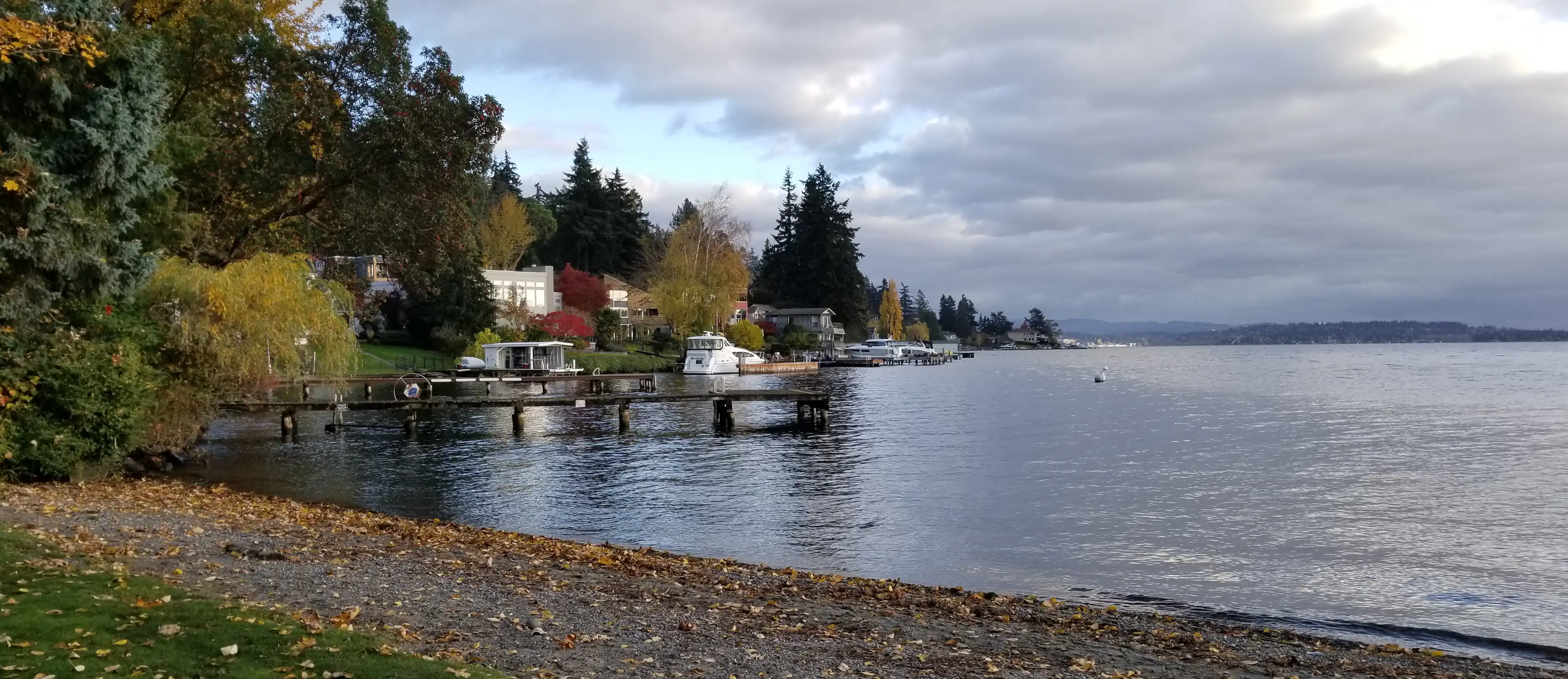
Consistently listed among Kirkland's safest neighborhoods by multiple tracking sources, Houghton benefits from a demographic mix of long-established families and working professionals who tend toward stable, owner-occupied housing. The neighborhood sits along the southwestern lakefront, with Houghton Beach Park providing a focal point for community activity. Vehicle break-ins do occur near park trailheads, as they do across most of King County, but the residential streets themselves carry a notably calm character that matches the data.
Norkirk sits close to downtown Kirkland without absorbing downtown's elevated property crime statistics — a geographic sweet spot that locals who've lived here for years understand instinctively. The neighborhood's older housing stock, tree-lined streets, and proximity to Lake Washington create an owner-occupied, community-watch culture that tends to suppress opportunistic crime. It's one of the neighborhoods where CrimeGrade's city-level D- rating feels most disconnected from on-the-ground experience.
Juanita covers a large stretch of Kirkland's northern lakefront, and its safety profile varies somewhat between its northern and southern sections. South Juanita includes a larger shopping district near I-405 access, which contributes to somewhat elevated property crime figures in the commercial zones — similar to the Totem Lake dynamic described below. The residential blocks backing toward the lake and toward Juanita Beach Park carry a quieter character, and the area's walkability and school quality draw families with school-age children who self-select for stable, community-oriented neighborhoods.
Totem Lake is Kirkland's most commercially dense neighborhood and the clearest example of why city-level crime statistics can mislead residential buyers. The retail-heavy western portion of the neighborhood — anchored by the Totem Lake retail complex and major arterials — generates property crime figures that land in the bottom percentile for safety nationally. The southeast quadrant of Totem Lake, however, is generally considered the quieter residential zone, and locals who live there report a noticeably different day-to-day experience than the raw numbers suggest. Buyers considering Totem Lake should look carefully at which side of the commercial corridor their specific street falls on.
North Rose Hill stands out as one of Kirkland's genuinely safer neighborhoods even when measured against the city's best-performing areas. Violent crime data for the neighborhood runs well below the citywide average, and the per-resident cost of crime — a useful composite measure — sits around $210 annually, compared to nearly $600 for the city as a whole. The neighborhood's mix of luxury construction and renovated Craftsman homes along the I-405 corridor attracts an owner-occupied buyer profile, and North Rose Hill Woodlands Park provides the kind of trail access that keeps residents outdoors and familiar faces visible in common spaces.
Finn Hill occupies the northeastern hillside above Lake Washington and operates with the quieter rhythm of a neighborhood where most residents arrive by car and know their immediate block well. Big Finn Hill Park and O.O. Denny Park provide significant green space that also creates natural separation between residential clusters. No specific violent crime designation separates Finn Hill from the city's safer areas in available data, and it's generally described by residents as one of the more peaceful corners of Kirkland — though the geographic distance from downtown means it rarely appears in news coverage that might otherwise raise concern.

| City | Violent Crime/1K | Property Crime/1K | Overall Safety Profile |
|---|---|---|---|
| Kirkland | ~0.6–1.0 | ~19–23 | Below state average overall; low violent crime |
| Bellevue | ~1.2 | ~22 | Similar profile; slightly higher violent crime |
| Redmond | ~0.8 | ~17 | Comparable violent crime; slightly lower property crime |
| Bothell | ~1.1 | ~20 | Slightly elevated violent crime vs Kirkland |
| Kenmore | ~0.9 | ~16 | Lower property crime; smaller commercial footprint |
| Seattle | ~6.5 | ~45 | Significantly higher across both categories |
| Woodinville | ~0.7 | ~14 | Lower property crime; less commercial density |

When buyers ask me about Kirkland, the conversation almost always turns to neighborhood differences pretty quickly. Areas like Houghton and Moss Bay consistently hold their value well — they're established, walkable, and the kind of places where homes rarely sit long before going under contract. Juanita attracts a lot of families for similar reasons, and inventory there moves fast too. If you're working with a budget under $750,000, you'll find the options narrower in these more sought-after pockets, but the long-term stability tends to reflect that demand. Safety perceptions absolutely factor into resale value, and in Kirkland, buyers clearly price that in.
What surprises a lot of people is the gap between what they're approved for and what actually feels comfortable month to month. Your full payment includes property taxes, homeowner's insurance, any HOA dues, and your loan structure — and those layers add up faster than most buyers expect. Getting pre-approved before you start touring means you already know your real number, not just the loan amount. When the right home in a neighborhood like Rose Hill or Totem Lake comes up, you want to be ready to move, not
Vehicle break-ins are the most common complaint you'll hear from Kirkland residents, and they concentrate in predictable places: trail parking lots along the Cross Kirkland Corridor, the Marina Park waterfront parking areas, and the Totem Lake retail parking structures. Locals who've been here a few years have developed an instinct that visitors don't have — leave nothing visible in a parked car, not even a phone charger cord. That habit alone eliminates most of the risk that the property crime statistics are actually measuring.
The CrimeGrade D- rating that sometimes surfaces in buyer research deserves specific context. That grade reflects the 14th percentile citywide, driven almost entirely by the commercial corridors in downtown Kirkland and Totem Lake. Buyers who search their specific target address on CrimeGrade — rather than looking at the city-level score — typically find their residential block graded significantly higher. Apps that aggregate crime by city boundaries rather than by block miss this distinction entirely, and it causes unnecessary concern among buyers who are looking at neighborhoods that locals consider genuinely safe.
What Kirkland does well that the data doesn't fully capture is community cohesion. High homeownership rates, strong school involvement, and active neighborhood associations in areas like Norkirk, Houghton, and the Highlands create informal safety networks that function independently of police response times. The city's median household income of $150,414 and high educational attainment — roughly 95% of residents hold a high school diploma compared to 83% nationally — correlate strongly with the community-stability patterns that suppressed violent crime in the first place.
Local Expert Takeaway: If safety is your primary filter in Kirkland, prioritize your search on the west side of the city — Houghton, Norkirk, and the Highlands neighborhood all carry the city's lowest residential crime footprints. Avoid forming impressions based on city-level app scores; pull the block-level data for your specific address before drawing conclusions. And regardless of neighborhood, treat trail and park parking lots the way locals do: nothing visible in the car, always.
✅ Kirkland's violent crime rate is well below both state and national averages, making it one of the safer large cities in Washington for day-to-day personal safety.
⚠️ Property crime — particularly vehicle break-ins and larceny — is above the national average and concentrates in commercial corridors and park parking areas. Residential neighborhoods track significantly better than the citywide figure.
📍 Neighborhood choice matters more than city-level scores. Houghton, Norkirk, and North Rose Hill consistently appear among Kirkland's safest residential areas, while Totem Lake's western retail zone drives disproportionate weight in aggregated city data.
Is Kirkland a safe place to live?
For most residents, yes — and particularly so when it comes to violent crime, which runs well below national averages. The more meaningful question for most buyers is where within Kirkland they're considering, since property crime rates vary substantially between the commercial corridors and established residential neighborhoods on the west side of the city.
What is the biggest crime concern in Kirkland?
Property crime, specifically vehicle break-ins and larceny, accounts for the majority of reported incidents. These tend to cluster around trail parking areas, the downtown waterfront, and the Totem Lake retail district. Residents who practice basic prevention — nothing visible in a parked car, motion-activated lighting — report very little direct impact on their daily lives.
How does Kirkland compare to Seattle for safety?
The difference is significant. Seattle's violent crime rate runs roughly six to seven times higher than Kirkland's, and Seattle's property crime figures are also substantially elevated by comparison. Buyers who've been nervous about the broader Seattle-area reputation often find Kirkland's numbers — and more importantly, its day-to-day feel — a meaningful departure from the city they're comparing it against.
Explore the full Kirkland series: Living in Kirkland · Is Kirkland Safe? · Cost of Living · Best Neighborhoods · Schools & Family Life · Youth Sports · Parks & Rec · Retiring in Kirkland