
Puget Sound · Washington
First-Time Home Buyer Guide for Bellevue (2026)
Buying your first home in Bellevue is the kind of decision that changes your financial life — and not in a small way. The moment most first-time buyers realize what this market actually requires, it hits somewhere between exciting and terrifying: we're talking about a city where the median sold price runs around $1.47 million and entry-level inventory moves in roughly eight days. But here's what that realization tends to obscure — there are real paths into Bellevue homeownership for first-time buyers, and the people who find them almost always started by understanding what they were actually working with.
The practical reality is that a $1.47 million median puts most single-family homes well beyond a conventional first-time buyer's reach. What that figure looks like on the ground is a 3-to-4-bedroom house in a neighborhood like Somerset or Newport Hills, typically in above-average condition with a well-maintained lot. At the entry level — condos, townhomes, smaller attached units — the picture shifts considerably. Condo listings in Bellevue currently have a median around $646,000, and the floor for any livable condo in decent condition runs somewhere in the high $300,000s. Renting a 2-bedroom in Bellevue runs $2,500 to $3,500 per month depending on location; for buyers who can get to a 5% down payment, the monthly ownership cost on a $550,000 condo can sit in the same range — and you're building equity instead of paying someone else's mortgage.
This guide covers everything a first-time buyer needs to navigate Bellevue specifically: the step-by-step process, what your budget realistically gets you at each price tier, which neighborhoods offer the best entry-point value, what down payment assistance programs are actually available here, and the five mistakes that cost Bellevue first-timers the most. Washington real estate has its own quirks — no state income tax, a buyer-agency landscape reshaped by recent commission changes, and a seller's market that doesn't behave the way national articles describe. We'll walk through all of it.
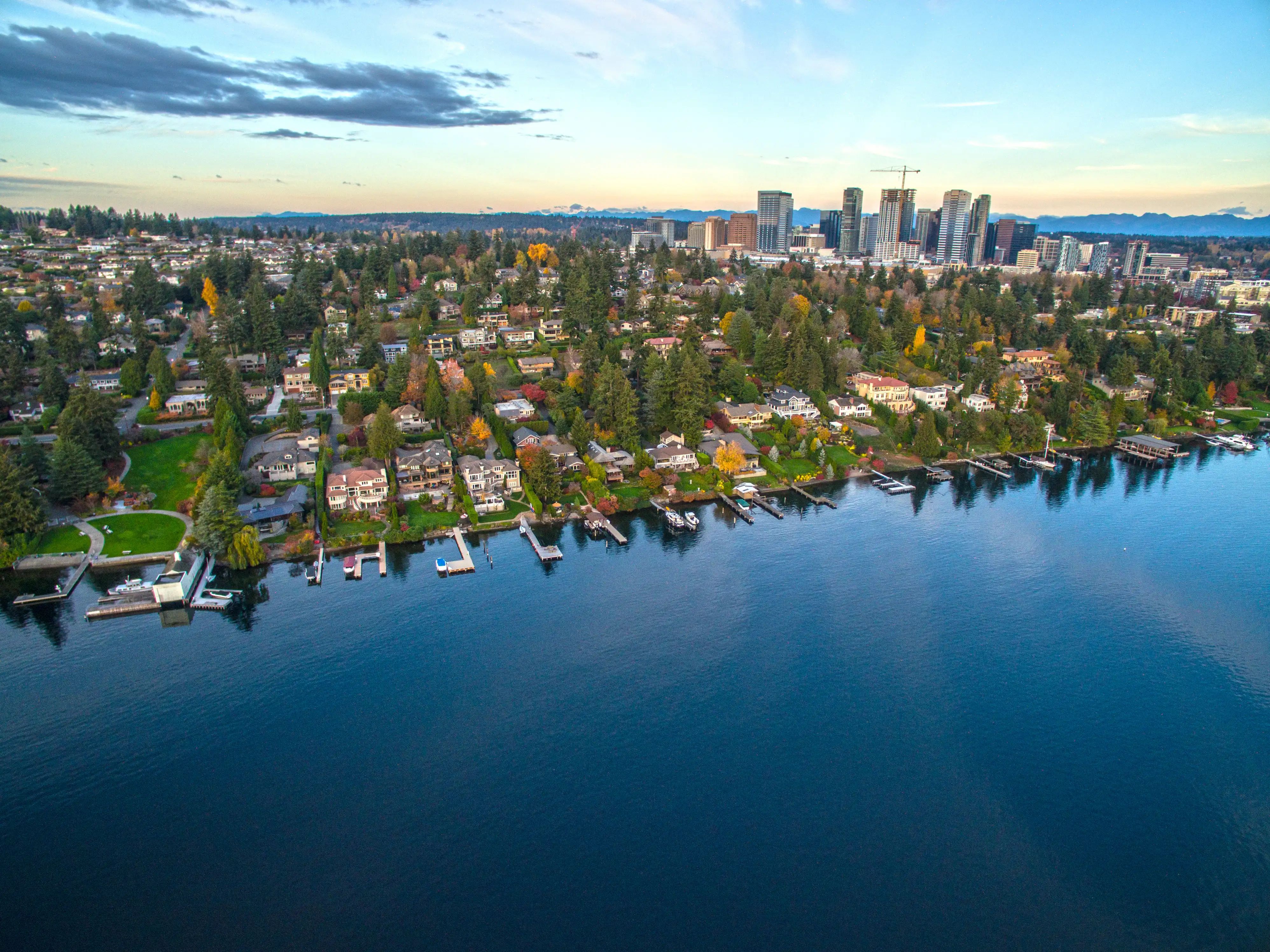
Bellevue is not the easiest place to buy your first home, but it may be the most rewarding. The school district alone — Bellevue School District consistently earns A+ ratings and ranks among the top districts in Washington State — represents long-term value that shows up directly in resale prices. Add a 20-minute commute to Seattle, major tech employers like Microsoft, Valve, and T-Mobile within 15 minutes, and some of the lowest violent crime rates in the Puget Sound region, and you understand why demand here stays compressed year-round.
The honest trade-off is that first-time buyers in Bellevue are almost always buying a condo or townhome rather than a single-family house. The realistic entry corridor runs from the upper $300,000s for a modest studio or 1-bedroom condo up through $650,000–$750,000 for a 2-bedroom townhome in neighborhoods like Crossroads, Lake Hills, or BelRed. Crossroads and Lake Hills are two of the most frequently cited entry-point neighborhoods for first-time buyers — prices run lower than West Bellevue or Downtown, inventory turns over more predictably, and both areas have solid transit access and grocery corridors. Buyers comparing Bellevue to Redmond or Kirkland will find that Bellevue's entry-level condo market is comparable in price but has stronger long-term appreciation history.
What works against first-time buyers here is pace. Homes at every price tier, including condos under $600,000, tend to receive multiple offers and often close above list price. Coming in pre-approved, financially organized, and with a clear sense of your target neighborhoods is not optional in this market — it's the baseline.
| Price Range | What You Typically Find | Neighborhood Examples | Competition Level |
|---|---|---|---|
| Under $400K | Studio or 1-bed condo, older construction, 400–650 sq ft | Crossroads, BelRed, older Wilburton corridors | Moderate — limited inventory |
| $400K–$550K | 1–2 bed condo, updated units, some newer construction | Lake Hills, Eastgate, Crossroads | High — multiple offers common |
| $550K–$700K | 2-bed condo or townhome, newer builds, better finishes | BelRed, Factoria, Lake Hills, Wilburton | Very high — often over asking |
| $700K–$900K | 2–3 bed townhome, some attached single-family | Northeast Bellevue, Lakemont, Newport Hills | Very high — waived contingencies common |
| $900K+ | Entry-level single-family detached, older stock | Somerset, Eastgate, Bridle Trails fringes | Extremely competitive |
Buyers who stretch to $600,000–$700,000 unlock 2-bedroom townhomes in Factoria and Lake Hills — both of which offer reasonable commutes, neighborhood-feel streets, and access to top-rated Bellevue schools. This tier represents arguably the best entry-point value in the city: you're crossing the threshold from condo living into attached single-family style ownership, and you're still well below the citywide median that gets quoted in every headline.
Understanding how the purchase process actually unfolds in Bellevue helps first-time buyers avoid surprises. The market moves fast — homes in the $700,000–$1.1M range routinely receive offers within days of listing — so having your financing buttoned up before you tour is essential, not optional.
Step one is getting pre-approved, which in Bellevue's competitive environment means a full underwritten pre-approval rather than a soft pre-qualification. Step two is identifying your neighborhoods and price range, ideally with a local buyer's agent who can alert you to new listings immediately. Once you find a home, expect to move quickly — inspection contingencies are sometimes waived in multiple-offer situations, though that carries risk a knowledgeable agent will help you weigh. Step three is the offer and negotiation phase, followed by a roughly 30-to-45-day escrow period covering inspection, appraisal, and final loan approval. Step four is closing, where Washington's escrow process is handled by a title company. Budget for closing costs of 2–3% of the purchase price in addition to your down payment.
The timeline from pre-approval to keys typically runs 60 to 90 days for buyers who are prepared. Buyers who start without financing in place often lose their first two or three homes before closing, which is costly in a market where prices don't dip while you regroup.

For a conventional loan, the minimum credit score is 620, but the difference between a 650 and a 740 score on a $450,000 loan is meaningful in your monthly payment — we're talking roughly $100 to $150 per month depending on current rate spreads, which adds up to $36,000–$54,000 over the life of a 30-year loan. If your score is in the 640s, spending 60 to 90 days paying down revolving balances before applying can move the needle significantly. FHA loans allow scores down to 580 with 3.5% down, though FHA carries ongoing mortgage insurance that adds to the monthly cost and doesn't drop off automatically until you refinance.
On income, the 28% front-end debt-to-income (DTI) rule is the standard lenders use for your housing payment. In plain English, this means your total monthly housing cost — principal, interest, taxes, insurance, and HOA if applicable — shouldn't exceed 28% of your gross monthly income. To qualify for a $400,000 home with 5% down at current rates, you'd generally need household income around $85,000–$90,000 per year. A $500,000 purchase bumps that threshold to roughly $105,000–$115,000, and a $600,000 purchase requires approximately $125,000–$135,000 in household income. These figures shift with interest rates, which is why locking your rate quickly after pre-approval matters.
Washington has no state income tax — a detail that matters enormously for buyers relocating from California, Oregon, or other income-tax states. A household earning $130,000 moving from California saves roughly $8,000–$11,000 per year in state taxes, which is money that can go directly toward a mortgage payment. For qualification purposes, that effective income boost can meaningfully expand what you can comfortably afford.

As someone who works with buyers across the Bellevue market regularly, location really does shape long-term value in ways first-timers don't always anticipate. Neighborhoods like Downtown Bellevue and West Bellevue tend to hold value exceptionally well due to walkability, employment proximity, and ongoing development — but entry-level opportunities there are increasingly limited, and well-priced homes routinely go under contract within days. Crossroads offers a more accessible price point, often under $750,000 for condos and smaller homes, while still sitting inside a market with strong appreciation history. Understanding where you want to be before you start seriously shopping saves a lot of heartbreak.
Before you tour a single home, please talk to a lender. Not because you need permission to look, but because your true monthly payment — including property taxes, homeowner's insurance, any HOA dues, and your loan structure — can look very different from the number a quick online calculator shows you. Maximum approval and comfortable budget are two separate things, and in a market like Bellevue, being financially clear and pre-approved means you're actually ready when the right home appears, not scrambling after
Confusing list price with closing price. In Bellevue's competitive corridors, well-priced condos and townhomes routinely close 3–8% above asking, particularly in the $500,000–$700,000 range. Buyers who anchor their budget to list price and then discover they're consistently losing to over-ask offers often feel like the market is impossible — when in reality, their budget ceiling just needs to reflect actual closing prices, not marketing prices.
Skipping inspection on older condo stock. Bellevue has a significant inventory of condos built in the 1980s and early 1990s, particularly in areas like Crossroads and Lake Hills. These buildings can carry deferred maintenance, special assessments, or HOA reserve fund shortfalls that don't show up on the listing sheet. Waiving inspection entirely on these properties is a meaningful financial risk — a $3,000 inspection that surfaces a $25,000 special assessment coming down the pipe is worth every dollar.
Shopping at the top of their qualification instead of the top of their comfort. A lender approving you for $650,000 doesn't mean $650,000 is a comfortable payment. In Bellevue, where HOA fees on condos can run $400–$700 per month on top of the mortgage, buying at the absolute top of your qualification can leave you stretched thin. Running your own payment math — mortgage plus HOA plus property taxes at 0.71% plus insurance — before you make an offer gives you a clearer sense of what your actual monthly obligation looks like.
Not understanding how school district boundaries affect resale value. Bellevue School District covers most of the city, but attendance boundaries for specific elementary schools create meaningful price variation between neighborhoods that look similar on a map. Buyers who plan to sell in 5–10 years and who are purchasing in a lower-priced pocket should verify whether their address feeds into the same high-demand schools that drive premium pricing elsewhere in the district.
Waiting for prices to drop. Bellevue's housing supply is structurally constrained — the city is largely built out, demand from the regional tech economy is persistent, and inventory runs around 2.4 months, which still leans seller. Buyers who spent 2022–2024 waiting for a meaningful correction largely sat on the sidelines through a period of continued appreciation. The more productive question is not "will prices drop?" but "what can I buy today that positions me to trade up in five years?"
For buyers working in the $400,000–$650,000 range, Crossroads is the neighborhood that comes up most consistently. It sits in the northeast quadrant of Bellevue near NE 8th Street and 156th Avenue NE, with a walkable retail core anchored by the Crossroads Shopping Center and genuine neighborhood density. Entry-level condos here run from the upper $300,000s to the mid-$500,000s, and the area's diversity, transit access, and proximity to tech corridors make it both livable now and resellable later.
BelRed is the other neighborhood to take seriously at first-time buyer price points. Situated along the BelRed Road and 130th Avenue NE corridor, this area has been actively redeveloped over the past decade, with light rail service and newer mixed-use construction bringing inventory that didn't exist five years ago. Two-bedroom condos and smaller townhomes here run $500,000–$700,000, and the transit-oriented nature of the neighborhood makes it a strong choice for buyers who commute to Seattle or Redmond without a car.
Lake Hills offers a different energy — quieter, more suburban in feel, with single-family homes starting in the low-to-mid $900,000s but a reasonable inventory of townhomes and attached units in the $600,000–$750,000 range. The neighborhood sits near Lake Hills Greenbelt and Robinswood Park, which gives it an outdoor character that's genuinely different from more urban Bellevue corridors. For first-time buyers who want something that feels more like a house neighborhood than a condo building, Lake Hills often delivers — at a price point that's still below the citywide median.
Factoria, at Bellevue's southeastern edge near I-90 and SE 36th Street, is sometimes overlooked by first-time buyers focused on more prominent Bellevue addresses. That's actually what makes it worth considering. Entry-level townhomes here trade in the $650,000–$800,000 range, the commute to Renton and Newcastle is straightforward, and the proximity to I-90 makes it one of the faster access points to Seattle from Bellevue. It doesn't carry the same cachet as West Bellevue or Downtown, but for buyers prioritizing space and value over address status, Factoria consistently delivers.
If the down payment is the obstacle standing between you and a purchase, one program worth understanding is ONE+ by Rocket Mortgage. It works like this: you put down 1% of the purchase price, and Rocket contributes a non-repayable 2% grant — up to $7,000 — that brings your total down payment to 3% without requiring you to come up with the full amount yourself. The maximum loan amount is $350,000, and to qualify in King County, household income must be at or below $114,800. There's no second mortgage, no lien on the property, and no repayment required at sale. The minimum credit score is 620, and the program is available to both first-time and repeat buyers.
To see if ONE+ might work for your income and purchase price, check out the full program details and eligibility guide →
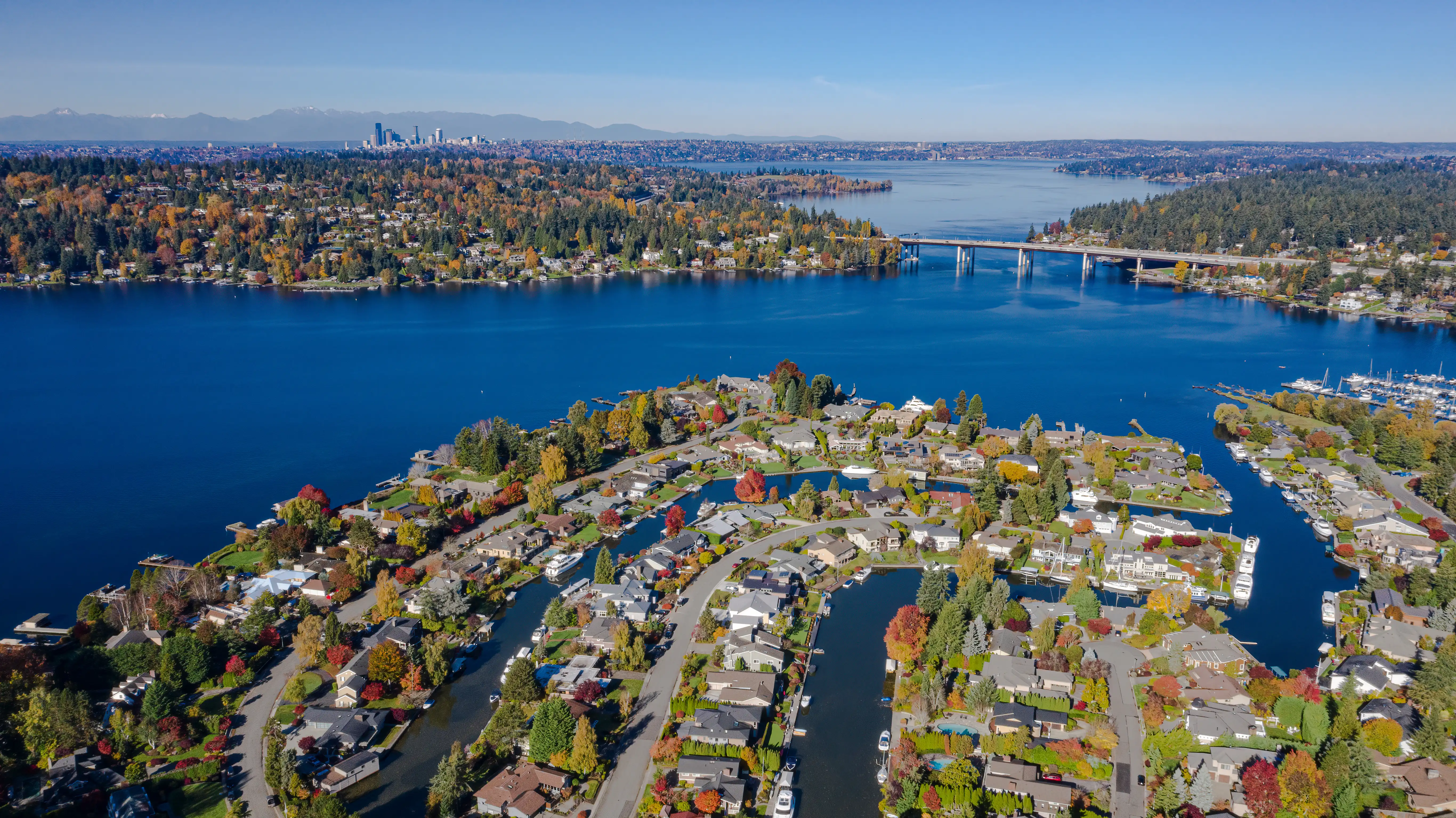
Local Expert Takeaway: The biggest mistake first-time buyers make in Bellevue is anchoring their search to single-family homes and then concluding the market is out of reach — when the real opportunity is in condos and townhomes in BelRed, Crossroads, and Lake Hills at $450,000–$700,000. Buy your first home there, build equity over five to seven years, and use that equity to trade up. The buyers who've done that successfully in Bellevue over the past decade look very smart right now.
✅ Bellevue's entry-level is the condo and townhome market — BelRed, Crossroads, and Lake Hills offer the most realistic first-time buyer opportunities in the $450,000–$700,000 range.
⚠️ Pre-approval is non-negotiable — well-priced homes under $650,000 move in under two weeks, and showing up without a current approval letter means losing to buyers who came prepared.
📍 Washington's no-income-tax advantage is real — buyers relocating from California or Oregon often qualify for more than they expect once their effective take-home pay is recalculated.
Can I buy a home in Bellevue as a first-time buyer?
Yes — but the path into Bellevue homeownership for most first-time buyers runs through condos and townhomes rather than single-family houses. With realistic budgets in the $450,000–$700,000 range, neighborhoods like BelRed, Crossroads, and Lake Hills offer genuine entry-level opportunities with solid resale fundamentals.
How much do I need to buy my first home in Bellevue?
With a 3% down payment on a $500,000 condo, you'd need roughly $15,000 down plus $8,000–$12,000 in closing costs, for a total cash-to-close figure in the range of $23,000–$27,000. Programs like ONE+ can reduce the down payment portion significantly for qualifying buyers. You'll also want 1–3% of the purchase price in liquid funds available for earnest money.
What credit score do I need to buy a house in Washington state?
Conventional loans require a minimum 620 credit score, though scores of 680 and above unlock meaningfully better interest rates. FHA loans allow scores down to 580 with 3.5% down. In a competitive market like Bellevue, the stronger your credit score, the more confident sellers are in your financing — which can actually affect whether your offer gets accepted in multiple-offer situations.
Explore the full Bellevue series: The Ultimate Bellevue Relocation Guide · Is Bellevue Safe? · Cost of Living in Bellevue · Best Neighborhoods in Bellevue · Bellevue Schools & Family Life · Bellevue Youth Sports · Bellevue Parks & Recreation · Retiring in Bellevue · 1031 Tax-Deferred Exchange in Bellevue · Bellevue First-Time Homebuyers Guide · Bellevue Down Payment Assistance Guide · Moving to Bellevue from California