
Puget Sound · Washington
Moving to Bellingham from California: The Honest Comparison (2026)
The Bay Area software engineer who finally has a yard and kept their salary. The San Diego family who opened their July electric bill and felt nothing — no sticker shock, no dread. The Sacramento buyer who sold a 1,400-square-foot townhome and bought a four-bedroom house with a view of Bellingham Bay for less money. These are real California transplant stories, and they're increasingly common. In 2022, Bellingham ranked as the second most moved-to city in the entire United States, and California has been the dominant driver. The math, at a certain equity level, stops being debatable.
But Bellingham is not California, and the people who arrived without accounting for that reality are the ones who give honest reviews on moving forums. The gray season is genuinely gray — 201 cloudy days a year, a November that delivers only 61 hours of total sunlight, and a social culture that moves at a pace that can feel either refreshing or isolating depending on where you're coming from. The food scene that felt exciting in week one feels smaller by month six. If you moved from Los Angeles or San Francisco expecting Pacific Northwest weather to behave like a cool coastal California spring, you got a surprise.
This guide covers the cost-of-living comparison by California region, what your California equity actually buys at current Bellingham price points, the full tax picture including the no-income-tax advantage, the honest weather reality, the mortgage scenarios by equity level, and the most common mistakes California buyers make in this market. Use it before you make an offer, not after.
| Bellingham, WA | Bay Area | Southern CA | Sacramento Metro | Central Valley | |
|---|---|---|---|---|---|
| Median Home Price (approx. 2026) | $630,000 | $1.3M–$1.8M+ | $750K–$1.1M | $500K–$650K | $340K–$480K |
| Property Tax Rate (effective) | ~0.81% | ~1.1%–1.25% | ~1.1%–1.25% | ~1.1%–1.2% | ~1.0%–1.2% |
| State Income Tax | None | Up to 13.3% | Up to 13.3% | Up to 13.3% | Up to 13.3% |
| State Sales Tax | 8.8% (Whatcom Co.) | 8.625%–10.25% | 7.25%–10.25% | 7.25%–8.75% | 7.25%–8.25% |
| Avg Utilities (monthly est.) | ~$175–$210 | ~$200–$280 | ~$220–$320 | ~$190–$260 | ~$180–$250 |
| Avg 1BR Rent | ~$1,600–$1,900 | $2,800–$3,800 | $2,200–$3,200 | $1,600–$2,000 | $1,100–$1,500 |
The income tax advantage is the other number worth sitting with. Washington has no state income tax — one of only nine states with that status. A California resident earning $150,000 per year pays somewhere between $10,000 and $13,000 annually to Sacramento in state income tax. On a $200,000 income, that figure climbs to $17,000 or more depending on deductions. The day you establish Washington residency, every dollar of that becomes take-home pay — and it compounds every year you stay.
Washington's no-income-tax status is the headline for a reason. At $120,000 in annual income, a California transplant was likely paying $7,000–$9,500 per year to the state. At $150,000, the figure runs $10,000–$13,000. At $200,000, it's in the $17,000–$19,000 range before deductions. These are real dollars that show up in your checking account every month starting the first paycheck after you establish Washington residency.
| Tax Item | California | Washington | Net Impact for Transplant |
|---|---|---|---|
| State Income Tax | Up to 13.3% | None | +$7K–$19K+/year depending on income |
| State Capital Gains Tax | Up to 13.3% (ordinary income) | 7% on gains over $262,000/year | Significant advantage at most income levels |
| Property Tax (effective rate) | ~1.1%–1.25% (on purchase price) | ~0.81% (Whatcom County) | Lower annual bill in WA on comparable value |
| State Sales Tax | 7.25%–10.25% | 8.8% (Whatcom Co.) | Slight CA advantage in low-tax CA counties |
| Estate / Inheritance Tax | None | WA estate tax starts at $2.193M | Relevant for high-net-worth transplants |
| Senior Property Tax Exemption | Limited | Yes — for 61+, income-based | Meaningful for retiring Californians |
Property taxes in Whatcom County run approximately 0.81% of assessed value. On a $630,000 home, that's roughly $5,100 per year — a figure that will feel low to anyone who owned property in the Bay Area or coastal Southern California, where the same assessment on a $1.3 million purchase generates $14,000–$16,000 in annual taxes.
A buyer selling in San Jose, Berkeley, or Marin County with $1.4 million in equity walks into Bellingham's market with the ability to pay cash for the median home and still have $700,000+ left over. That figure buys a waterfront or near-waterfront property in Edgemoor, a fully renovated Craftsman in Fairhaven's historic core, or a newer construction home in South Hill or Barkley with views, a three-car garage, and no mortgage. The upper tier of Bellingham's market — homes priced between $850,000 and $1.2 million — feels genuinely attainable to Bay Area sellers in a way it simply doesn't to local buyers earning $67,000 in median household income.
For the remote tech worker who kept their Bay Area compensation and is now spending $630,000 instead of $1.6 million, the monthly cash flow shift is dramatic. That gap doesn't just reduce debt — it funds the outdoor lifestyle, the travel, and the early retirement runway that made Bellingham appealing in the first place.
A buyer leaving Pasadena, Long Beach, or San Diego's Mission Hills neighborhood with $900,000 in equity has strong options in Bellingham. At the $630,000 median, they're buying with a significant down payment — likely 50–80% down — and carrying a modest mortgage at a low loan-to-value ratio. That equity level also reaches into Bellingham's upper tier: Edgemoor bungalows, updated colonials in the Lettered Streets district, or newer builds in Barkley typically price between $750,000 and $1.1 million, landing within reach for Southern California sellers with equity in that range.
The income tax gain is particularly valuable for SoCal transplants who are still working. A couple each earning $90,000 — $180,000 combined — saves roughly $15,000–$17,000 per year in California state income tax the moment they become Washington residents. Over five years, that's the cost of a boat, a renovation, or a significant retirement contribution.
Sacramento and Inland Empire sellers have a closer relative advantage, but it's still meaningful. A buyer exiting Elk Grove or Rancho Cucamonga with $500,000 in equity is likely putting 60–75% down on a Bellingham home and financing the remainder — or landing in Sunnyland, York, or Columbia with a well-priced property in the $480,000–$580,000 range and minimal debt. These neighborhoods offer solid bones, walkable corridors, and proximity to Bellingham's core without paying the Fairhaven or Edgemoor premium.
What often seals it for Sacramento buyers isn't the equity math alone — it's the income tax gain. A household earning $130,000 that moved from Sacramento to Bellingham is keeping an additional $8,000–$10,000 per year that previously went to California. That annual figure, compounded with the mortgage differential, adds up faster than most buyers model before they make the call.
Central Valley sellers — Fresno, Stockton, Modesto, Bakersfield — have the most modest relative equity advantage, but the lifestyle and tax math still adds up. At $350,000 in equity, a buyer is making a substantial down payment on a Bellingham home in the $480,000–$560,000 range, or purchasing a condominium or townhome outright. Neighborhoods like Birchwood, Cordata, and the Meridian corridor offer the most attainable entry points in the Bellingham market, with newer construction in Cordata and more established residential character in Birchwood.
The wildfire reality is increasingly driving this migration. A family in Fresno County paying rising insurance premiums, spending August breathing smoke, and watching neighbors lose homes is doing a different kind of math than a pure equity comparison. Bellingham doesn't have wildfire seasons. That's worth something that doesn't show up in a spreadsheet.
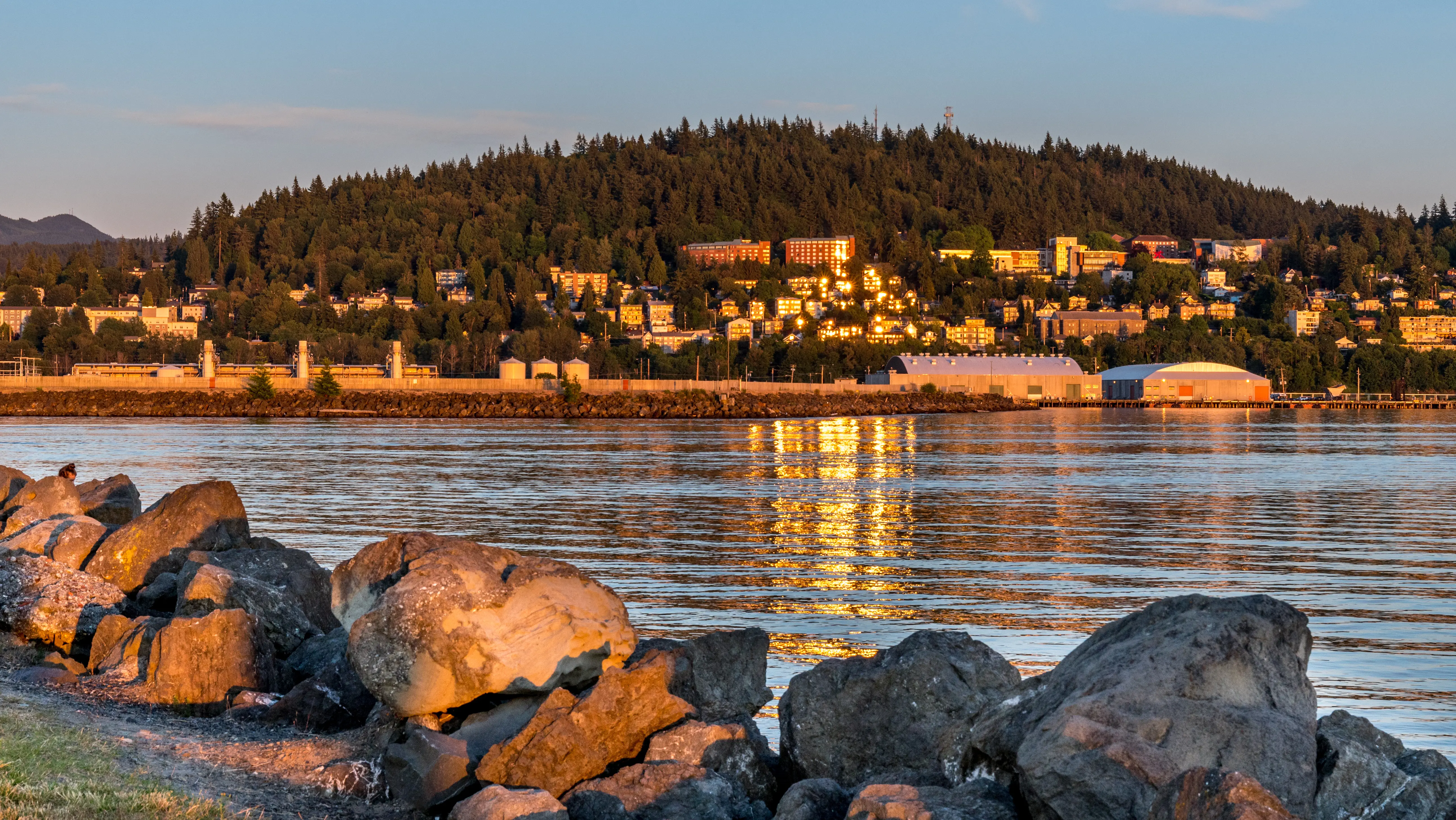
Here's what a friend who moved from Oakland three years ago would actually tell you: the summers are genuinely spectacular. June, July, and August in Bellingham are warm, dry, and bright — highs in the low-to-mid 70s, evenings cool enough for a hoodie, Bellingham Bay glittering in the afternoon. The farmers markets are packed, the trails are dry, and the entire city seems to exhale after a long gray stretch. If you base your decision on a summer visit, you will fall in love and possibly not fully believe what's coming.
What's coming is October through March. Bellingham logs roughly 201 cloudy days per year and 158 days of measurable rain. November delivers only 61 total hours of sunlight for the entire month. Los Angeles averages 3,254 annual sunshine hours; San Diego, 3,055; Sacramento, 3,607. Bellingham comes in around 1,865 hours. That isn't a minor difference — it's a fundamentally different relationship with daylight, and California transplants almost universally underestimate it. The Pacific Northwest coping mechanism is a real cultural trait: people invest in good rain gear, keep hiking year-round, and don't wait for perfect weather. If you're someone who needs sunshine to feel okay, this requires honest self-examination before you sign papers.
What transplants consistently say they love after a year: the housing space they gained, the vanishing of the hour-plus Bay Area commute, the genuine lack of traffic relative to what they left, and the sense that Bellingham is a city that prioritizes the outdoors in a way that matches their values. What they consistently miss: the food scene depth of a major California city, year-round beach access, the social energy of a larger urban environment, and — plainly stated — the sun. The cultural pace of Bellingham is slower and the city is smaller than most California transplants realize when they're researching. That can be exactly right for some buyers and quietly difficult for others.
If you want to see how Bellingham compares directly to the city you're leaving, use the tool below — it covers the 120 largest California cities with current housing and tax data.
Home prices: Redfin median sale data, Q1–Q2 2026. Select your city to compare.
Ready to talk through what your specific California equity could do in Bellingham? Todd can model your exact scenario in a single call.

When California buyers start exploring Bellingham, neighborhoods like Fairhaven and Sehome tend to generate the most interest — and the most competition. Fairhaven's walkable village feel and Sehome's proximity to the university create consistent demand that keeps well-priced homes moving fast, often within days of listing. Alabama Hill is worth watching too, as buyers discover it offers solid long-term value in a city where desirable inventory under $750,000 doesn't sit around. Understanding which areas fit your lifestyle before you start touring helps you move with confidence rather than scrambling to catch up.
The bigger conversation I have with California transplants isn't about the purchase price — it's about the full monthly payment reality. Property taxes, homeowner's insurance, and any HOA dues stack on top of your loan payment, and that complete picture can look meaningfully different from what your approval letter suggests you can spend. Getting pre-underwritten before you tour means you're shopping with a comfortable, honest budget rather than a theoretical maximum. In a market like Bellingham, the right home won't wait for you to figure out the financing.
Assuming Bellingham is uniformly affordable. The $630,000 median is a citywide average that includes modest inventory in Birchwood and Cordata alongside waterfront homes in Edgemoor and historic properties in Fairhaven. A California buyer arriving with a Bay Area mindset and touring Fairhaven or the Lettered Streets district will find prices between $700,000 and $1.1 million for renovated homes. The entry-level inventory — homes under $500,000 — tends to be in Cordata, Birchwood, or the northern Meridian corridor, and it moves quickly. Mapping Bellingham as a single market price point leads buyers to make lowball offers in the wrong neighborhoods and miss opportunities in the right ones.
Not accounting for winter driving. Bellingham averages about nine inches of snow per year, which sounds manageable to someone from San Diego or the Central Valley who has never driven in snow. The issue isn't the total snowfall — it's that Bellingham's hills are steep, that the city sits between sea-level waterfront and significant elevation changes, and that a single snowstorm in January can make streets like Meridian Street or the approaches to Alabama Hill legitimately treacherous. All-season or winter tires are not optional here. California transplants who delay buying them often regret it by February.
Underestimating what the no-income-tax advantage does to monthly cash flow. Most California buyers run their Bellingham budget as a housing comparison — mortgage payment here versus mortgage payment there. They leave the income tax gain sitting in a column on a spreadsheet. A household earning $160,000 combined who establishes Washington residency is netting an additional $900–$1,200 per month that previously went to Sacramento. That figure changes what's affordable, what's comfortable, and what timeline makes sense for a larger purchase. Run that number before you decide what price range to shop.
Expecting California-style year-round outdoor access. The North Cascades are world-class, and Whatcom Falls Park, Lake Padden, Chuckanut Mountain, and the Interurban Trail deliver remarkable outdoor options. But the California habit of hiking on a dry December trail, cycling year-round in shorts, or surfing in January doesn't translate. Bellingham's winter outdoor culture exists and thrives, but it requires gear, waterproofing, and a different mindset than California's essentially year-round outdoor lifestyle. Buyers who visit in summer and assume that pace continues find October an adjustment.
Bay Area sellers with large equity are frequently entering Bellingham's market with the ability to buy all-cash or at loan-to-value ratios below 30%. At that position, the rate conversation becomes secondary — terms, speed, and the ability to close without financing contingencies matter more. If the California property being sold is an investment or rental property rather than a primary residence, a 1031 tax-deferred exchange deserves serious consideration before the sale closes. The Bellingham 1031 Exchange guide covers the mechanics and timelines in detail. Cash buyers and low-LTV buyers should still work with a lender who can provide proof-of-funds letters quickly — Bellingham's competitive listings move in seven days on average.
Southern California sellers bringing $700,000–$900,000 in equity are often financing only $100,000–$300,000 in Bellingham — well within conventional loan territory without approaching jumbo thresholds. These buyers typically qualify for highly competitive rates and have significant flexibility in structuring the loan. If the purchase price stays under $806,500 (the 2026 conforming limit), conventional financing applies and pricing is favorable. Washington State Housing Finance Commission's Home Advantage program may also apply for buyers in the lower end of Bellingham's price range who want rate assistance on top of equity.
Sacramento and Inland Empire buyers closing with $400,000–$600,000 in equity are often making 60–80% down payments that create very low monthly obligations. For buyers in this equity range who are purchasing in the $480,000–$580,000 segment of Bellingham's market, WSHFC Home Advantage down payment assistance may layer on top of conventional financing if income falls within program guidelines — worth a conversation even for buyers who assume they don't qualify.

Local Expert Takeaway: California buyers almost universally underestimate how dramatically the no-income-tax shift changes their monthly budget — not just their mortgage. A Bellingham home at $630,000 financed at 80% LTV carries a monthly payment that already beats what most California buyers were paying on a smaller property. Add back $800–$1,300 per month in state income tax that stays in your pocket as a Washington resident, and the effective cost-of-living comparison shifts further in Bellingham's favor than the home price comparison alone suggests. Run both numbers before you settle on a price range — the combined effect often moves buyers one tier higher than they thought they could afford.
✅ Washington's no-income-tax advantage is worth $7,000–$19,000+ per year for most California transplants — a figure that changes monthly cash flow from day one of Washington residency.
⚠️ Bellingham's winters are genuinely gray — 201 cloudy days, 158 rain days, and a November that barely clears 60 hours of sunlight. California transplants consistently underestimate this; research it honestly before you commit.
📍 The $630,000 citywide median covers a wide range of neighborhoods and price points — Edgemoor and Fairhaven run $750,000–$1.1M+, while Birchwood and Cordata offer real inventory under $500,000. Know which neighborhoods match your equity level before you tour.
Is moving from California to Bellingham worth it?
For most California sellers with meaningful equity, the financial case is strong: lower home prices, no state income tax, and a cost structure that typically delivers more space for less money. The lifestyle case depends on whether you can genuinely embrace a smaller city with darker winters — transplants who research that honestly tend to stay and thrive, while those who arrive expecting coastal California weather patterns are more likely to find the adjustment difficult.
How much cheaper is housing in Bellingham vs. California?
Bellingham's median sold price sits at approximately $630,000 — roughly half the Bay Area median, 25–40% below most coastal Southern California markets, and broadly comparable to the Sacramento metro. The difference is most dramatic for Bay Area sellers, who can often purchase a Bellingham home outright with equity and still have six figures remaining. For Central Valley buyers, the price gap is smaller but still meaningful when paired with the income tax advantage.
What do I need to know about moving from California to Washington?
Establish Washington residency promptly — update your driver's license, voter registration, and vehicle registration within 30 days of arriving to begin your tax-free status. Washington has no state income tax, but it does have a 7% capital gains tax on long-term gains exceeding $262,000 per year. The sales tax in Whatcom County runs approximately 8.8%, which partially offsets the income tax gain but doesn't come close to erasing it. And budget for rain gear, good tires, and a light therapy lamp — they're not optional in Bellingham, they're infrastructure.
Explore the full Bellingham series: The Ultimate Bellingham Relocation Guide · Is Bellingham Safe? · Cost of Living in Bellingham · Best Neighborhoods in Bellingham · Bellingham Schools & Family Life · Bellingham Youth Sports · Bellingham Parks & Recreation · Retiring in Bellingham · 1031 Tax-Deferred Exchange in Bellingham · Bellingham First-Time Homebuyers Guide · Bellingham Down Payment Assistance Guide · Moving to Bellingham from California