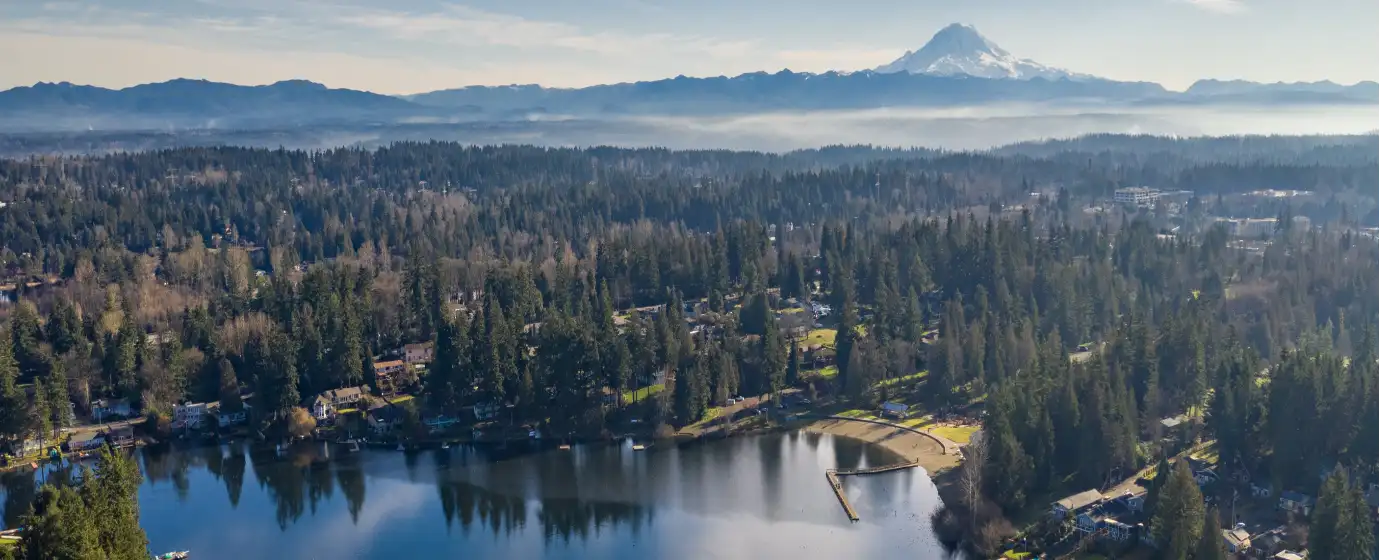
Puget Sound · Washington
Living in Federal Way: The Ultimate Relocation Guide (2026)
Maybe your company is relocating you somewhere in the South King County corridor and Federal Way keeps coming up in the search results. Maybe you've been watching Seattle home prices climb past $900,000 and someone mentioned that Federal Way — just 23 miles south — is where you can actually buy a house without liquidating your retirement account. Maybe you drove through on I-5 and it didn't look like much from the highway. That last impression is the one most likely to mislead you.
Federal Way sits at a genuine crossroads — geographically between Seattle and Tacoma, and socially between a working-class bedroom community and an increasingly connected urban suburb. It is one of Washington's most diverse cities, with nearly a third of residents born outside the United States and over 100 languages spoken in its school district. The December 2025 opening of the Federal Way Link light rail extension changed the city's commute math overnight, connecting downtown Federal Way to Sea-Tac Airport in 16 minutes and to Seattle in under an hour. That single infrastructure shift is reshaping who is looking at Federal Way and why.
This guide is designed to help you decide whether Federal Way is the right fit before you make an offer. You'll get honest assessments of the neighborhoods, a clear-eyed look at the tradeoffs, and the kind of local detail that doesn't show up in a Zillow listing — including what surprises most newcomers after six months, where traffic actually hurts, and which parts of the city deliver the most livable experience for the price.
Federal Way doesn't suit everyone equally, and the city works best when buyers are honest with themselves about what they actually need versus what looks good on paper.
| Best For | Why |
|---|---|
| Seattle commuters on a budget | Light rail now connects Federal Way Downtown to Seattle in under an hour. The median sold price of $610,000 is significantly below Seattle's market. |
| Families with school-age children | Federal Way Public Schools is Washington's most diverse district. Multiple community parks, sports facilities, and the Weyerhaeuser Aquatic Center provide structured activity options. |
| First-time buyers | Entry-level single-family homes and condos ($250,000–$400,000) offer purchase opportunities that have largely disappeared from closer-in suburbs. |
| Remote workers who want space | Larger lot sizes, access to nature at Dash Point State Park, and quiet residential neighborhoods like Twin Lakes and Adelaide make working from home genuinely comfortable. |
| Retirees seeking affordability | Lower price points than Bellevue or Renton, walkable retail near the Town Center, and proximity to St. Francis Hospital and medical services suit active retirees. |
| Diversity-seekers | Federal Way is one of the most ethnically and linguistically diverse cities in Washington — a meaningful quality-of-life factor for many buyers. |
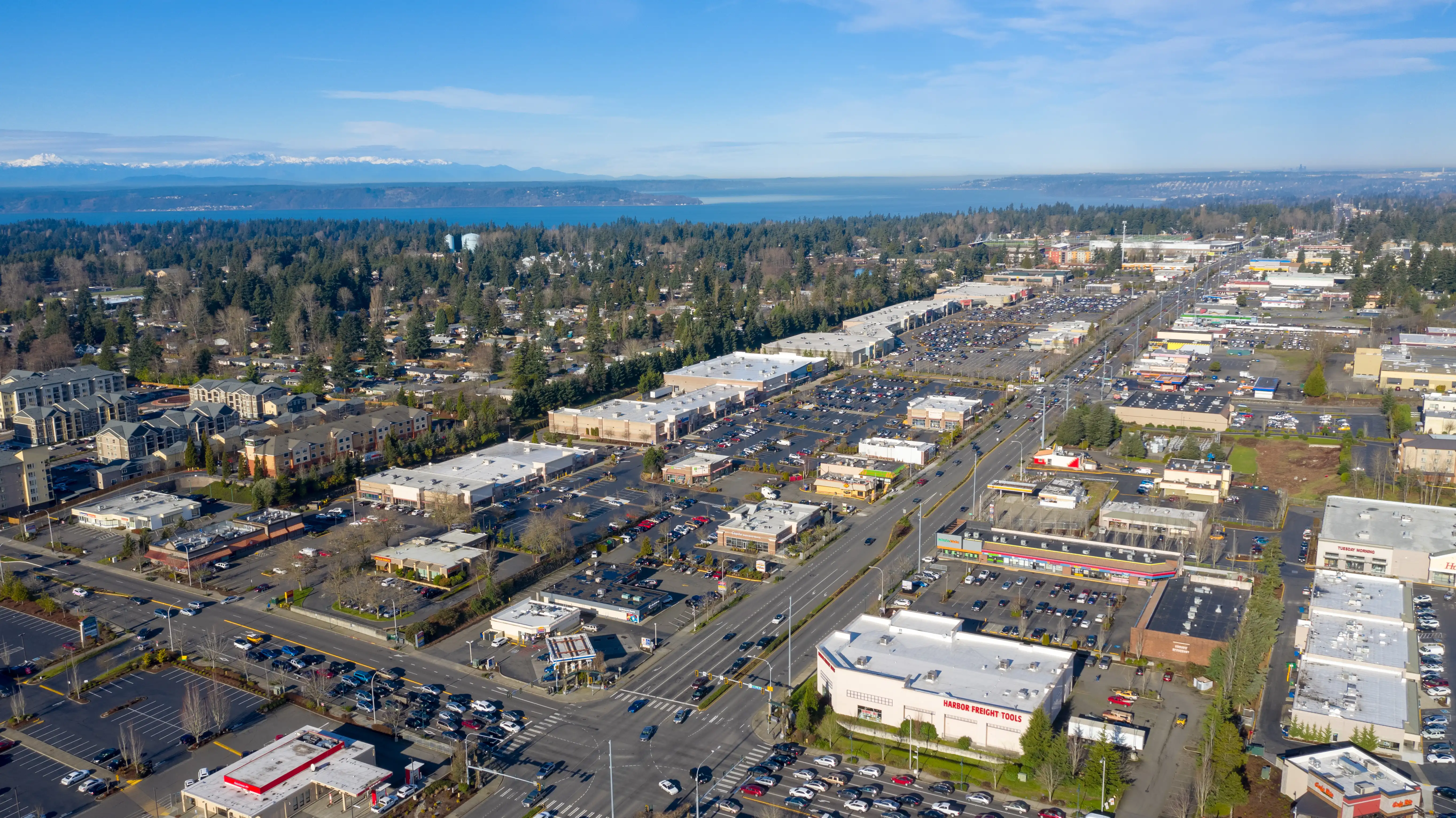
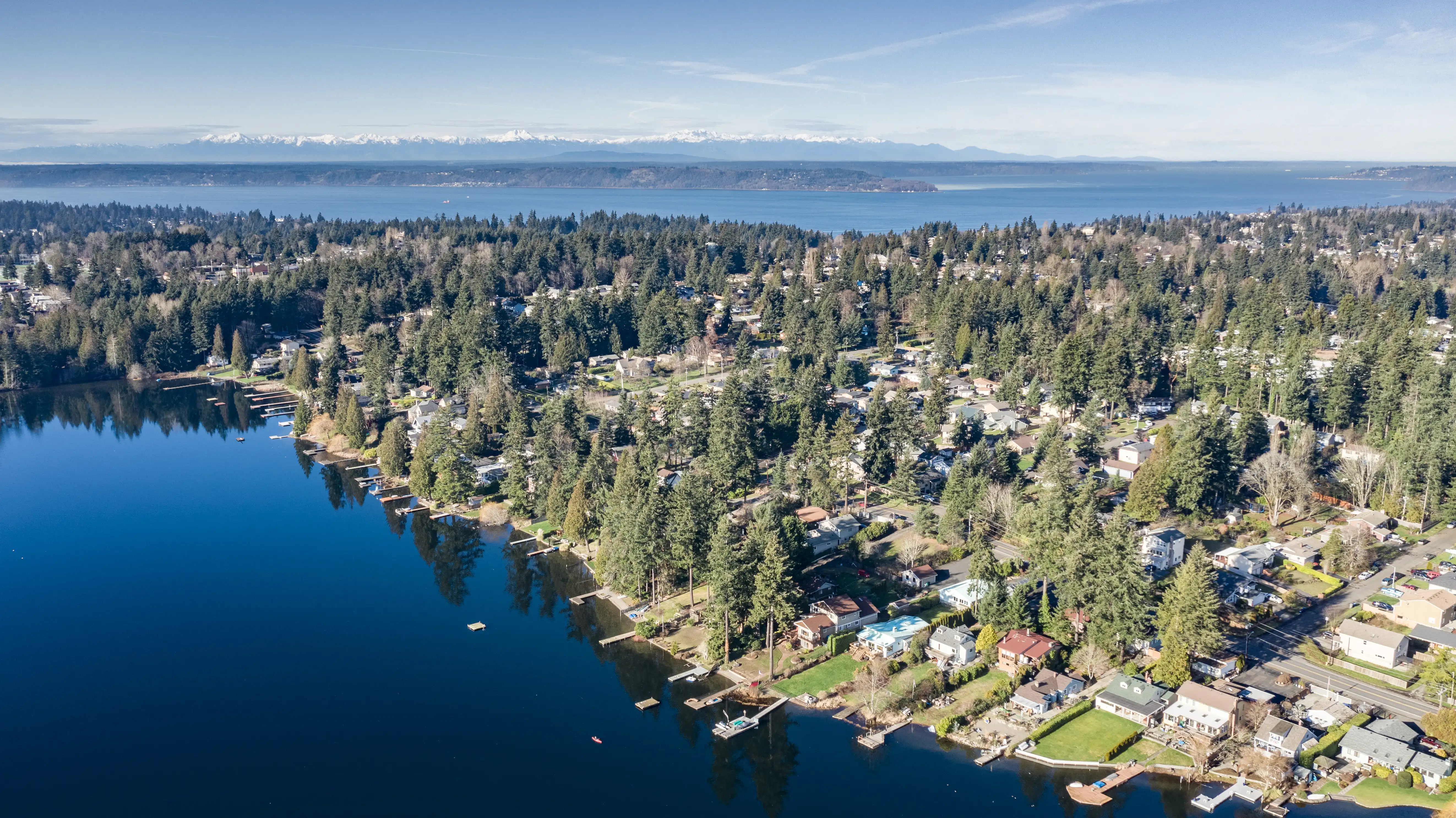
The most honest thing you can say about Federal Way is that it feels like two different cities depending on where you spend your time. The commercial spine along Pacific Highway South — known locally as "the Pac Highway strip" — is dense with big-box retail, fast food, and the kind of auto-oriented development that defines highway corridors throughout the Pacific Northwest. Driving it on a weekday afternoon, it does not feel like a destination. That impression fades fast once you turn off into the residential neighborhoods, where mature tree canopy, quiet cul-de-sacs, and views of Steel Lake or Puget Sound characterize daily life.
The geographic reality is that Federal Way is a 23-square-mile city built around a ridge and wetland system rather than a traditional town center. Streets don't follow a grid — they follow topography. Getting from one neighborhood to another often means returning to a main arterial, which means your neighbors in Dash Point and your neighbors in Madrona Meadows are technically in the same city but experience it quite differently. Locals navigate this intuitively; newcomers spend the first few months confused about why a city this size doesn't feel more cohesive.
The Town Center around S 320th Street and Pete von Reichbauer Way S is where Federal Way's civic identity is most concentrated. The Federal Way Performing Arts and Event Center anchors the area, and Town Square Park hosts community events including the annual Kickin' It Federal Way Festival — a three-day celebration returning in June 2026 with a FIFA World Cup watch party, live music, soccer tournaments, and free family programming. The Diversity Commission's August community festival draws thousands to the same park. These gatherings reveal something that doesn't show up in the demographic statistics: Federal Way has a genuine community culture that newcomers often don't expect.
The honest friction moment comes on I-5 northbound between 7:00 and 9:00 AM. That stretch from Federal Way to the S 200th interchange can add 20 to 35 minutes to what maps suggest is a 30-minute trip. The light rail extension eliminates that problem entirely for anyone commuting into Seattle proper — but if you're driving to a job in Renton or Tukwila, you're still subject to corridor congestion that has no easy workaround. SR-99, which parallels I-5 through the city, is usable for local errands but doesn't improve freeway commutes significantly.
The single biggest reason people stay in Federal Way is the price-to-space ratio. At a median sold price of $610,000, you are getting a detached single-family home — often with a yard, a garage, and a neighborhood with actual trees — at a price point that would buy you a one-bedroom condo in Capitol Hill or a townhouse without a yard in Renton. For households with children or anyone who needs dedicated workspace at home, that physical space matters in ways that are hard to quantify until you've spent three years in a Seattle apartment.
The light rail access is now a legitimate selling point rather than a future promise. The Federal Way Downtown Station connects to Sea-Tac Airport in 16 minutes and to the broader 1 Line system that serves the length of the urbanized corridor. Trains run every 8 minutes during peak hours. For a buyer who commutes to Seattle two or three days a week, Federal Way just became a fundamentally different proposition than it was in 2024.
Federal Way's diversity is not just a demographic statistic — it shapes where you eat, where your kids make friends, and how the city's retail and cultural landscape evolves. The concentration of East African, Southeast Asian, Pacific Islander, and Latin American communities has produced a food scene that consistently surprises newcomers, particularly along Pacific Highway corridors where Ethiopian, Vietnamese, Filipino, and Mexican restaurants serve food that is genuinely excellent rather than strip-mall generic.
Outdoor access is exceptional for a city of this size. Dash Point State Park offers 461 acres of Puget Sound waterfront, 11 miles of hiking trails, and a campground that feels a long way from suburban King County. Steel Lake Park provides swimming and kayaking within the city limits. West Hylebos Wetlands Park preserves a native wetland ecosystem with hiking trails and the Barker Cabin, built in 1883 — the city's oldest known structure. Wild Waves Theme and Water Park, the largest water park in Western Washington, makes summers genuinely fun for families with kids. The Rhododendron Species Botanical Garden and PowellsWood Garden round out an outdoor cultural landscape that most cities twice Federal Way's size couldn't match.
Federal Way does not have a walkable neighborhood center in the way that Tacoma's Proctor District or Des Moines's waterfront deliver. The Town Center area is improving, and the performing arts venue has changed the civic feel of S 320th Street, but you cannot walk from your house to a coffee shop, a wine bar, and a bookstore in Federal Way the way you can in some of the more established suburbs to the north. If that matters to you, Federal Way will disappoint — and no amount of listing photos will fix it.
The school district presents a nuanced picture. Federal Way Public Schools earns a B- rating on Niche and carries the distinction of being Washington's most linguistically and ethnically diverse district. That diversity is a genuine asset for many families. But test score metrics and resource distribution across a district this large and this diverse tend to vary significantly by school. Families who prioritize academic performance above all else typically do deeper research into individual school assignments before committing to a neighborhood — a step worth taking before you are in contract.
Why some people leave is worth addressing directly. Residents who relocate away from Federal Way most commonly cite the lack of a cohesive "town feel," concerns about property crime in the commercial corridors near Pacific Highway and downtown, and the school district's variable performance at the campus level. The property crime rate of 33.4 per 1,000 residents is higher than residents of quieter suburbs typically expect, and it is concentrated enough geographically that where you buy matters enormously. The neighborhoods near the transit center and Pac Highway strip experience different conditions than the residential areas near Dash Point or Twin Lakes.
The daytime population tells a story about Federal Way's identity. Approximately 15,000 people leave the city during work hours — a 15% daily drop — confirming that this is primarily a residential community where most employment anchors are outside the city. That isn't inherently a problem, but buyers who expect a city with a thriving downtown employment core will find Federal Way's commercial districts oriented more toward retail services than office or professional concentration.
Adelaide occupies the northwest corner of Federal Way, bordered by Burien to the north and with natural separation from the city's busier commercial corridors. Homes here run toward the higher end of the Federal Way range — Zillow estimates for the neighborhood cluster around the mid-$600,000s — reflecting larger lots, mature landscaping, and a residential character that feels more deliberate than much of the city. Adelaide Lake sits within the neighborhood, adding a natural anchor that keeps it feeling more like a retreat than a suburb.
Best for: Buyers who want Federal Way's price advantage but prefer a quieter, more secluded residential character with natural surroundings.
Alderbrook sits in the central-west portion of Federal Way and represents one of the city's most accessible mid-range neighborhoods, with Zillow estimates averaging around $610,000 — essentially at the citywide median. The neighborhood is well-established with tree-lined streets and a mix of ranch-style and split-level homes that reflect Federal Way's primary development era. Proximity to SR-99 and the S 320th Street corridor makes daily errands practical without requiring a long drive.
Best for: First-time buyers and commuters who want a livable, unpretentious neighborhood at the city's median price point without paying a premium for a lakefront address.
Steel Lake is one of Federal Way's most recognizable residential addresses, organized around the lake and park of the same name on S 312th Street. Homes near the water command a modest premium, but the neighborhood's overall pricing remains below the citywide average — Zillow data shows estimated values around the high-$520,000s. The park itself offers swimming, a boat launch, and picnic areas that serve as a natural community gathering point throughout summer.
Best for: Families with kids who want active outdoor access built into the neighborhood and don't need lakefront pricing to enjoy lake-adjacent living.
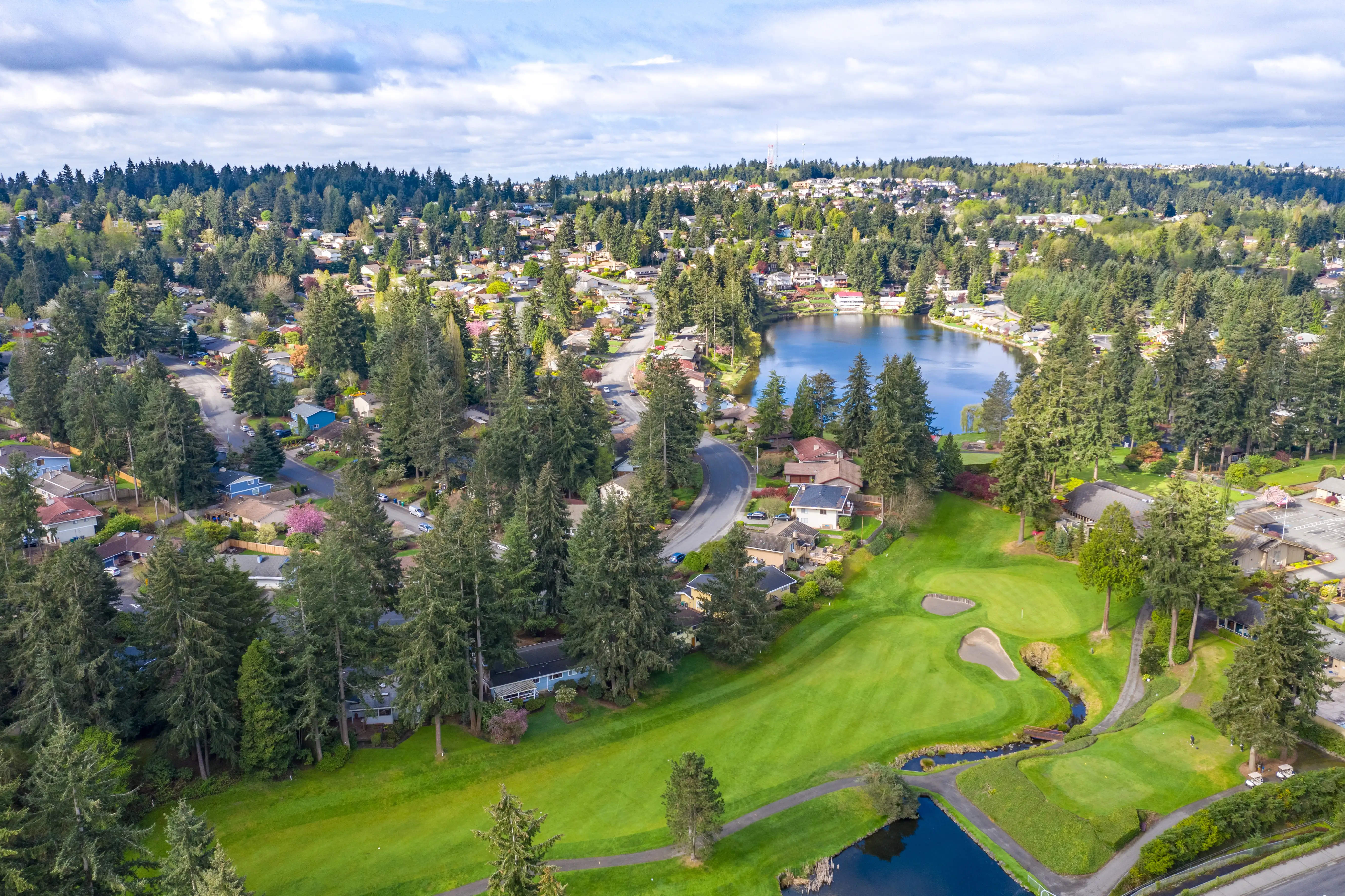
Twin Lakes is Federal Way's most prestigious residential enclave, anchored by two private lakes and home to Bayview Country Estates — where homes average $900,000 to $1.1 million. The neighborhood's overall character is defined by tree cover, curving streets, and a strong sense of community identity reinforced by voluntary neighborhood associations that maintain common areas. It's also home to the Twin Lakes Golf and Country Club, which gives the area a different social texture than Federal Way's more typical suburban neighborhoods.
Best for: Buyers seeking Federal Way's highest-end residential experience and willing to pay a significant premium for it, particularly households who value privacy and natural setting.
Madrona Meadows occupies terrain east of the Pacific Highway corridor, offering mid-range single-family homes in the low-to-mid $580,000s by Zillow estimates. The neighborhood is predominantly owner-occupied with good lot sizes and a quiet, family-oriented street character. Its central location puts it within easy reach of both the S 320th Street commercial district and the Weyerhaeuser King County Aquatic Center, which is a meaningful convenience for active households.
Best for: Families with school-age children who want a centrally located neighborhood at close to the citywide median without the premium of a lakefront address.
Lakota sits in the southwestern portion of Federal Way, between the city's commercial corridors and Dash Point State Park. The neighborhood's defining advantage is proximity to one of King County's best waterfront parks — within a short drive, residents can access Puget Sound beach, hiking, and camping that most Federal Way neighborhoods can't claim. Home prices are competitive, and the neighborhood's western position provides some insulation from the commercial density of the Pac Highway strip.
Best for: Outdoor-oriented buyers who want Puget Sound access in their backyard and don't need to be close to the Town Center or transit corridors.
West Campus is one of Federal Way's more polished suburban neighborhoods, with newer construction relative to the city's older stock and a character shaped by planned development rather than organic residential growth. Prices here trend toward the upper-middle range of the Federal Way market. The neighborhood's name references its proximity to Federal Way's office and institutional corridor, making it one of the more practical options for residents who work locally rather than commuting north.
Best for: Buyers who prefer newer construction and a more structured neighborhood layout, particularly those employed locally in Federal Way's healthcare or institutional sector.
Mirror Lake sits in the southern portion of Federal Way and is one of the city's more affordable lakefront-adjacent neighborhoods, with Zillow estimates in the high-$480,000s — notably below the citywide median. The lake itself provides a residential anchor, and the neighborhood's southern position puts it closer to Tacoma's employment base than Seattle's, which matters for buyers whose commute runs south rather than north. The honest tradeoff is that it's more removed from Federal Way's Town Center and the new light rail station.
Best for: Budget-conscious buyers who want a lake-adjacent address and either work locally or commute toward Tacoma rather than Seattle.

Relocating to Federal Way means thinking carefully about which pocket of the city fits both your lifestyle and your long-term investment goals. Neighborhoods like Twin Lakes and Steel Lake tend to draw strong buyer interest because of their waterfront access and established community feel, and well-priced homes there — many listed under $650,000 — can receive multiple offers within days of hitting the market. Areas like Alderbrook offer a quieter, more residential character that's attracting buyers priced out of closer-in Seattle suburbs, and values there have been steadily reflecting that demand.
Before you fall in love with a home during a tour, please talk to a lender first — and I mean that genuinely, not as a sales pitch. Your approval amount and your comfortable monthly payment are two very different numbers once you factor in property taxes, homeowner's insurance, any HOA dues, and how your loan is structured. Knowing your real budget before you walk through a door means you can move confidently and quickly when the right home appears, which in a market like Federal Way, matters a lot.
| City | Best For | Median Home Price | Commute to Seattle | Vibe |
|---|---|---|---|---|
| Federal Way | Affordability + light rail access | $610,000 | ~30 min (light rail ~46 min) | Diverse, suburban, improving |
| Des Moines | Waterfront access, quieter feel | $620,000–$680,000 | ~25 min | Small-town, waterfront-oriented |
| Kent | Blue-collar roots, manufacturing employment | $575,000 | ~40 min | Industrial suburb, value-driven |
| Auburn | Space and affordability, family-oriented | $540,000 | ~50 min | Sprawling, more rural edges |
| Burien | Walkability, community character | $650,000–$700,000 | ~20 min | Tighter urban suburb, arts-leaning |
| Tacoma | Urban amenities, restaurant scene | $400,000–$480,000 | ~35 min south | Gritty-cool, fastest appreciating |
| Metric | Detail |
|---|---|
| Population | Approximately 99,881 (2026 estimate) |
| Median Sold Home Price | $610,000 (mid-2026) |
| Median Household Income | $86,909 |
| Property Tax Rate | Approximately 1.11% |
| Commute to Seattle | ~30 minutes by car (off-peak); ~46 min by light rail |
| Light Rail Access | Federal Way Downtown Station (1 Line, opened Dec. 2025) |
| School District | Federal Way Public Schools — B- (Niche) |
| Violent Crime Rate | 3.2 per 1,000 residents |
| Diversity | 31.8% foreign-born; 111 languages spoken in schools |
| City Size | 22.32 square miles |
Federal Way has a handful of realities that locals know and newcomers take a few months to absorb. The first is the Kickin' It Federal Way Festival, which returns June 19–21, 2026 with a FIFA World Cup watch party, live soccer tournaments, and free family programming centered at the Town Center. It's become one of the better community events in South King County — the kind of thing that makes residents feel genuinely attached to a city they might have treated as purely transactional. The August Community Festival at Town Square Park, organized by the Diversity Commission, draws a similarly engaged crowd and reflects the city's cultural breadth in a way that a demographic table cannot.
The Rhododendron Species Botanical Garden — the largest collection of species rhododendrons in the world — sits on what was once Weyerhaeuser corporate land and remains one of the region's most underappreciated cultural destinations. It draws visitors from across the Pacific Northwest during spring bloom season, and Federal Way residents treat it as a neighborhood amenity. The Pacific Bonsai Museum, located nearby, operates on a similar principle: world-class cultural institution, local treasure, almost entirely unknown to people outside the area.
What I would not do if moving to Federal Way: I would not buy within four blocks of Pacific Highway South between S 300th and S 336th without spending a weeknight evening in the area first. The commercial density and traffic character of that corridor are genuinely different from the residential neighborhoods that surround it, and plenty of listings are priced attractively precisely because they sit adjacent to it. The stretch isn't dangerous — it's just not suburban-quiet, and that distinction matters enormously to buyers who are moving from calmer suburban environments.
Local Expert Takeaway: If you're choosing between Federal Way and Des Moines, the light rail connection tips the scale heavily toward Federal Way for anyone commuting north more than twice a week. Focus your neighborhood search in Adelaide, Twin Lakes, or the West Campus area if your priority is residential character; if you want the most practical transit access, neighborhoods within a mile of the Federal Way Downtown Station on S 320th Street are where the 2026 appreciation story is being written. Don't let the Pacific Highway corridor color your impression of the city — the residential neighborhoods east and west of it tell a completely different story.
✅ Federal Way's light rail connection, opened December 2025, fundamentally changes the commute math — Sea-Tac in 16 minutes and Seattle in under an hour make this a legitimate option for transit-dependent buyers who need affordability.
⚠️ Property crime is concentrated, not citywide — the 33.4 per 1,000 figure reflects conditions near the commercial corridors; residential neighborhoods like Twin Lakes, Adelaide, and Dash Point area experience meaningfully different conditions.
📍 Neighborhood choice matters more in Federal Way than in most comparably-sized suburbs — the city's topography and non-grid street layout mean that two neighborhoods with similar price points can feel entirely different in daily life.
Is Federal Way a good place for families?
Federal Way offers a strong case for families willing to do their neighborhood homework. The Weyerhaeuser King County Aquatic Center, Celebration Park sports fields, Wild Waves Theme and Water Park, and extensive trail systems at Dash Point State Park create a genuinely activity-rich environment for households with children. Federal Way Public Schools serves a remarkably diverse student body and earns a solid B- rating overall, though individual school quality varies enough that checking your specific school assignment before signing a purchase agreement is worth doing.
What is the crime rate in Federal Way?
The violent crime rate is approximately 3.2 per 1,000 residents — a figure that puts Federal Way in a moderate range for a city of its size and demographic complexity. The property crime rate of 33.4 per 1,000 is the more meaningful concern and is concentrated primarily in the commercial corridors near Pacific Highway and the downtown area. Residential neighborhoods away from those corridors — particularly Twin Lakes, Adelaide, and the Dash Point area — report substantially quieter conditions that don't reflect the citywide statistic.
How does Federal Way compare to nearby cities like Kent or Burien?
Federal Way's median sold price of $610,000 sits above Kent and Auburn but below Burien, making it a middle-ground option in South King County. What differentiates Federal Way from Kent or Auburn is the light rail access and the scale of its cultural and outdoor amenities — Dash Point State Park, the botanical gardens, and Wild Waves are not available in comparable form anywhere else in the immediate region. Buyers who prioritize walkability and a more cohesive town character may prefer Burien despite the higher price; buyers who prioritize space, diversity, and transit access will find Federal Way more compelling.
Explore the full Federal Way series: Living in Federal Way · Is Federal Way Safe? · Cost of Living · Best Neighborhoods · Schools & Family Life · Youth Sports · Parks & Rec · Retiring in Federal Way