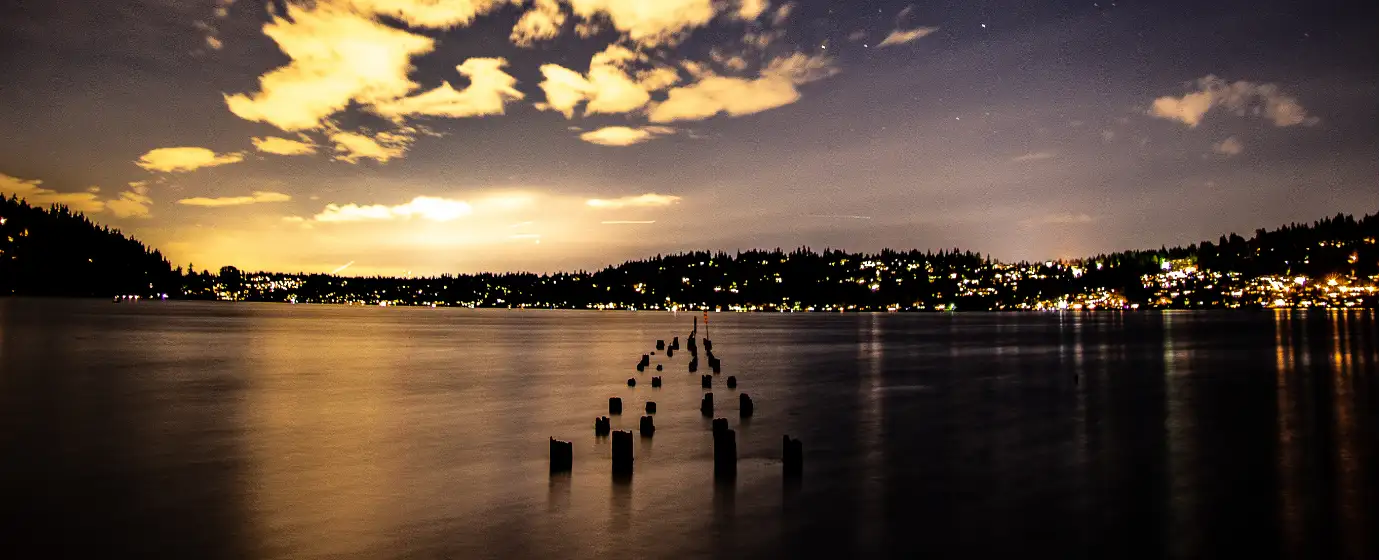
Puget Sound · Washington
Best Neighborhoods in Lake Forest Park: Where to Buy or Rent (2026)
Lake Forest Park is a small city where the wrong block can mean the difference between a treetop view of the Cascades and a house that backs up to a busy arterial. With a population just over 13,000 and a city footprint that barely stretches two miles in any direction, it would be easy to assume that neighborhood selection here doesn't matter much. It does — perhaps more than in larger cities, because the price gaps between Lake Forest Park's distinct pockets are substantial, and the lifestyle differences are even bigger.
The city's geography creates two dominant realities: the elevated hillside neighborhoods with westward views and tight-knit residential character, and the lower corridors closer to Lake Washington where waterfront access and century-old ranch architecture define the experience. Knowing which side of that divide aligns with your priorities — and your budget — shapes everything from your morning commute to your weekend routine.
This guide breaks down the neighborhoods where buyers and renters are actually looking in 2026, explains the trade-offs honestly, and flags the mistakes that commonly trip up people relocating to Lake Forest Park from outside the Seattle metro.
| Neighborhood | Best For | Price Range | Vibe |
|---|---|---|---|
| Horizon View | Luxury buyers, views | $1.1M–$1.5M+ | Competitive hillside enclave |
| Sheridan Beach | Lakefront lifestyle | $900K–$4M+ | Quiet, prestige, lake access |
| Sheridan Heights | Lake views, luxury | $1M–$1.6M | Upscale, serene, tree-lined |
| Brookside Triangle | Families, value within LFP | $700K–$1.1M | Residential, accessible |
| Edgewater-Riviera | Families, trail access | $850K–$1.2M | Established, neighborhood feel |
| North Lake Forest Park | Commuters, value | $800K–$1.1M | Quiet, practical |
| Ballinger | Entry-level LFP, renters | $700K–$980K | Dense, mixed owner/renter |
| Briarcrest | Mixed buyers, renters | $750K–$1M | Established, convenient |
| North City | Walkability, renters | $750K–$1M | Urban edge, commercial access |
| South Lake Forest Park | First-time buyers, trail access | $700K–$950K | Suburban, border-city access |
| Buyer Type | Best Neighborhood | Why |
|---|---|---|
| First-time buyer | South Lake Forest Park / Ballinger | Most accessible entry points in the city |
| Luxury buyer | Sheridan Beach | Waterfront, prestige architecture, top-end pricing |
| Walkability seeker | North City | Commercial strip access, closest to Shoreline Transit |
| Families with kids | Brookside Triangle | A-rated school pipeline, manageable pricing for LFP |
| Commuters | North Lake Forest Park | Straightforward SR-522 access, 21-minute Seattle run |
| Large lot buyers | Horizon View / Sheridan Heights | Hillside lots with setbacks and mature tree buffers |
| Renters | North City / Briarcrest | Highest rental inventory in the city |
Lake Forest Park is a compact city, but the range between its neighborhoods is wide enough that buyer priorities genuinely matter. A first-time buyer drawn to Ballinger or South Lake Forest Park for its lower entry point is navigating a very different market than a luxury buyer targeting Sheridan Beach or Horizon View — where lakefront access and hillside views push prices well past $1 million and competition is constant. Knowing which pocket you're shopping in before you start touring helps you set realistic offer strategies and financing timelines from the start.
The most consistent pattern local brokers see is buyers underestimating how fast the desirable mid-range inventory moves. Homes in the $700,000–$1.1 million range — Brookside Triangle, Edgewater-Riviera, North Lake Forest Park — tend to generate multiple offers quickly, particularly in spring. Buyers who arrive pre-approved with clear neighborhood priorities tend to move faster and win more often than buyers still deciding what they want once they're already in active competition.
Horizon View earns the highest Redfin competitiveness score in the city — a perfect 100 — and the market data backs that up completely. Homes here receive an average of five offers and sell in roughly five days, with a median sold price around $1.2 million. The hillside setting delivers genuine westward views toward the Cascades and Puget Sound, and some lots include deeded access to the Lake Forest Park Civic Club on Lake Washington. The catch is that this level of competition leaves almost no room for contingencies — buyers routinely waive inspection periods to stay competitive, which carries real risk on homes built in the 1970s and 1980s.
Best for: Luxury buyers willing to move fast and pay full price for views and prestige.
Sheridan Beach is the neighborhood that defines Lake Forest Park's upper ceiling. The architecture ranges from pastel-colored ranch-style homes from the 1930s and 1950s to modern construction, all woven together with mature Douglas firs and winding streets that largely lack sidewalks — a feature that feels charming until you're trying to walk with a stroller in the dark. The HOA here grants members access to a private beach on Lake Washington with a pier, boat launch, pool, and organized summer events, which is a meaningful amenity that non-members in adjacent neighborhoods simply don't have access to. Top-end lakefront properties here push toward $4 million, with non-waterfront single-family homes ranging from $900K to $1.5M — and the median sold price over the past 12 months has landed around $1.22 million, up roughly 7% year-over-year.
Best for: Buyers seeking lakefront lifestyle, architectural character, and a quiet residential environment with the budget to match.
Sheridan Heights sits in the upper tier of Lake Forest Park's residential fabric, with homes that frequently feature large windows oriented toward Lake Washington. It's quieter and less traffic-heavy than neighborhoods closer to the SR-522 corridor, and the lot sizes tend to be generous by city standards. Pricing runs consistently in the $1 million to $1.6 million range, with little available below that threshold. The practical downside is that daily errands require a car — this is not a neighborhood where you walk to anything, and the hilly terrain makes biking to the Town Center less than intuitive.
Best for: Buyers prioritizing privacy, lake views, and upscale residential character over walkability.
Brookside Triangle is where families with school-age children tend to land when they've run the numbers on Lake Forest Park and decided they want in without anchoring to the highest price points. The architectural mix of split-levels and midcentury ramblers gives buyers options across a range from the high $600s to just over $1.1 million. The school pipeline here is genuinely strong — Brookside Elementary feeds into Kellogg Middle and then Shorecrest High, with each school carrying A-range ratings from Niche. Third Place Books and the Town Center are accessible without a significant drive. The catch is that the neighborhood's entry-level appeal is relative: $700K still requires significant financial firepower, and the older housing stock means buyers should budget for deferred maintenance.
Best for: Families with school-age children who want quality schools and community character without stretching to the $1.2M+ tier.
Ballinger sits on the northern edge of Lake Forest Park and functions as the city's most accessible price point for buyers who want a Lake Forest Park address without a seven-figure budget. The median real estate price runs around $981,000, and the neighborhood includes a mix of single-family homes and apartment complexes — most of them built between 1970 and 1999. The vacancy rate here is remarkably tight at around 2.2%, which means rental competition is real and inventory turns over quickly. One distinctive trait: Ballinger has a notably high concentration of residents with Yugoslav and Russian ancestry, reflecting immigration patterns that shaped this corridor decades ago and contribute to a cultural texture that's different from the rest of the city. The downside for buyers is that the density and mixed-use character feel more urban than the rest of Lake Forest Park — which suits some buyers perfectly and disappoints others who came expecting quiet suburban streets.
Best for: Buyers seeking the most accessible entry point into Lake Forest Park's ownership market, and renters who need apartment-style options.
North City sits at Lake Forest Park's southern boundary with Shoreline and functions as the most walkable corner of the city — commercial access along 15th Avenue NE puts grocery runs, coffee, and services within a short drive or bike ride. Redfin identifies it as one of the most searched neighborhoods in Lake Forest Park, and the rental market here is more active than elsewhere in the city, with median rent figures in the range of $1,900 per month for apartments. Home prices run from the mid-$700s to around $1 million. The reality check for buyers is that North City's border-city location means you're technically in Lake Forest Park but functionally living in the Shoreline commercial zone — great for convenience, less distinctive as a residential experience.
Best for: Renters and first-time buyers who prioritize convenience and commercial access over neighborhood quiet.
Briarcrest blends into Sheridan Beach on the map but functions independently as a more affordably priced alternative to its lakeside neighbor. The median real estate price runs around $978,000, and the housing stock mirrors much of the rest of the city — single-family homes from the 1970s through the 1990s alongside a modest number of apartment units. Owner and renter households are roughly balanced here, which creates a more transient feel than the deep-rooted residential character of Sheridan Beach or Horizon View. The school access is solid — Briarcrest Elementary feeds the same Kellogg and Shorecrest pipeline — but the neighborhood lacks a defining walkable anchor or distinctive architectural identity.
Best for: Buyers who want proximity to Sheridan Beach's character at a step below its price premium.
South Lake Forest Park sits along the city's border with Seattle's Lake City neighborhood, which is either a feature or a concern depending on what you're looking for. The Burke-Gilman Trail corridor runs nearby, making this one of the better access points for cyclists heading into Seattle. Pricing here tends to come in below the city median — buyers can find single-family homes and condominiums in the $700K to $950K range with more room to negotiate than in competitive hillside neighborhoods. The trade-off is twofold: the commercial amenities just across the border in Lake City aren't uniformly appealing, and the southern location means commutes to Shoreline or Kenmore run in the wrong direction.
Best for: Commuters to Seattle, trail-oriented buyers, and households looking for the most accessible price points in the city.

From a lending standpoint, location within Lake Forest Park genuinely matters for long-term value. Neighborhoods like Horizon View and Edgewater-Riviera tend to hold value well thanks to their lake access, views, and established character — and buyers feel that. Desirable homes in these areas, particularly anything priced under $900,000 with water proximity or strong lot appeal, rarely sit more than a week or two before offers come in. Sheridan Heights offers a slightly different profile but still sees consistent demand from buyers who want more space without sacrificing the community feel Lake Forest Park is known for. Knowing what each neighborhood typically delivers helps you focus your search before you ever step through a door.
That's exactly why I encourage buyers to connect with a lender before touring homes. Your pre-approval number is a ceiling, not a target — and the full monthly payment picture, once you factor in property taxes, homeowner's insurance, any HOA dues, and your specific loan structure, often looks different than people expect. Getting that clarity early means you can move confidently when the right home appears, rather than scrambling to catch up in a fast market.
Assuming the city is uniform because the footprint is small. Lake Forest Park spans just a few square miles, and buyers from outside the area sometimes treat it like a single neighborhood rather than a collection of distinct pockets with dramatically different price points, school feeds, and lifestyles. A home on a hillside street in Horizon View and a condominium near Ballinger Way are both technically Lake Forest Park, but they represent entirely different buying decisions. Understanding which pocket you're actually purchasing in — and what that means for your daily life — is the foundational work that many relocating buyers skip.
Underestimating SR-522 during peak hours. The 21-minute Seattle commute is accurate under good conditions, and it genuinely is one of Lake Forest Park's strongest selling points. But SR-522 can back up meaningfully between 7:30 and 9:00 a.m. heading westbound toward Seattle, and again in the late afternoon coming back. Buyers in North Lake Forest Park or Ballinger tend to navigate this most effectively — neighborhoods closer to the Lake City corridor on the south end occasionally add time depending on surface street routing. Test your actual commute at actual commute times before you commit.
Buying on square footage without confirming the HOA situation. Several of Lake Forest Park's most desirable neighborhoods — particularly Sheridan Beach — carry HOA memberships that govern access to key amenities like the private beach and boat launch. Buyers sometimes discover after closing that the amenities that attracted them to a particular block are actually tied to an HOA that has a waitlist, or that a neighboring property they toured had access that the home they purchased doesn't. Confirm HOA boundaries explicitly, not by assumption.
Overlooking the difference between lake-view lots and lake-access lots. This is a meaningful distinction in Sheridan Heights and along the Sheridan Beach periphery. A home with lake views and a home with deeded lake access are priced very differently, and buyers from outside the Seattle metro often conflate the two. A hillside home with a partial lake view might list at $1.1 million; a waterfront parcel with dock rights is a different market entirely, often starting above $2 million. Know which one you're actually shopping for before you start touring.
| Area | Ideal For | Typical Rent Range | Trade-off |
|---|---|---|---|
| Ballinger Corridor | Affordable entry, apartment options | $1,600–$2,200/mo | Dense, less residential feel |
| North City | Walkability, commercial access | $1,800–$2,400/mo | Shoreline border character |
| Briarcrest | Families, school access | $2,200–$3,200/mo | Limited inventory, high turnover |
| South Lake Forest Park | Trail access, Seattle commuters | $2,000–$2,800/mo | Lake City adjacency |
| Sheridan Beach single-family | Lifestyle renters, luxury market | $4,000–$6,500+/mo | Very limited availability |
Local Expert Takeaway: If you're buying in Lake Forest Park with a family and a budget in the $800K to $1.1M range, Brookside Triangle and the lower Edgewater-Riviera corridor give you the most for that money without forcing you into a bidding war every weekend. Horizon View is genuinely exceptional — but the five-day selling cycle and waived-inspection culture there makes it a difficult market for buyers who need any runway at all. Start in Brookside, understand what you're giving up relative to Horizon View, and make that trade-off consciously.
Looking to buy in Lake Forest Park? Estimate your payment.
Enter your numbers to see an estimated monthly mortgage payment.
Estimate only. Excludes HOA fees and mortgage insurance.
Is Lake Forest Park a good place for families?
Yes, Lake Forest Park is well-suited for families with school-age children. The Shoreline School District carries an A- rating, and neighborhoods like Brookside Triangle feed directly into an A-rated school pipeline through Kellogg Middle and Shorecrest High. The city's relatively low traffic volume, tree-lined streets, and access to the Burke-Gilman Trail add to its family-friendly profile.
What are the best neighborhoods in Lake Forest Park for buyers on a budget?
Within Lake Forest Park's context, Ballinger, South Lake Forest Park, and the Briarcrest corridor represent the most accessible price points — with single-family homes occasionally available in the $700K to $980K range. That said, the city's overall median sold price of $1,042,500 means "budget" here still requires significant purchasing power relative to most Seattle suburbs.
How does Lake Forest Park compare to neighboring Shoreline for home buyers?
Lake Forest Park tends to price higher than much of Shoreline while offering more residential quiet and larger lots on the hillside sections. Shoreline has stronger commercial infrastructure and more rental inventory. Buyers who prioritize walkability and access to retail typically find Shoreline more practical; buyers who prioritize neighborhood character, lot size, and lake proximity tend to prefer Lake Forest Park — often at a meaningful premium.
Explore the full Lake Forest Park series: The Ultimate Lake Forest Park Relocation Guide · Is Lake Forest Park Safe? · Cost of Living in Lake Forest Park · Best Neighborhoods in Lake Forest Park · Lake Forest Park Schools & Family Life · Lake Forest Park Youth Sports · Lake Forest Park Parks & Recreation · Retiring in Lake Forest Park · 1031 Tax-Deferred Exchange in Lake Forest Park · Lake Forest Park First-Time Homebuyers Guide · Lake Forest Park Down Payment Assistance Guide · Moving to Lake Forest Park from California