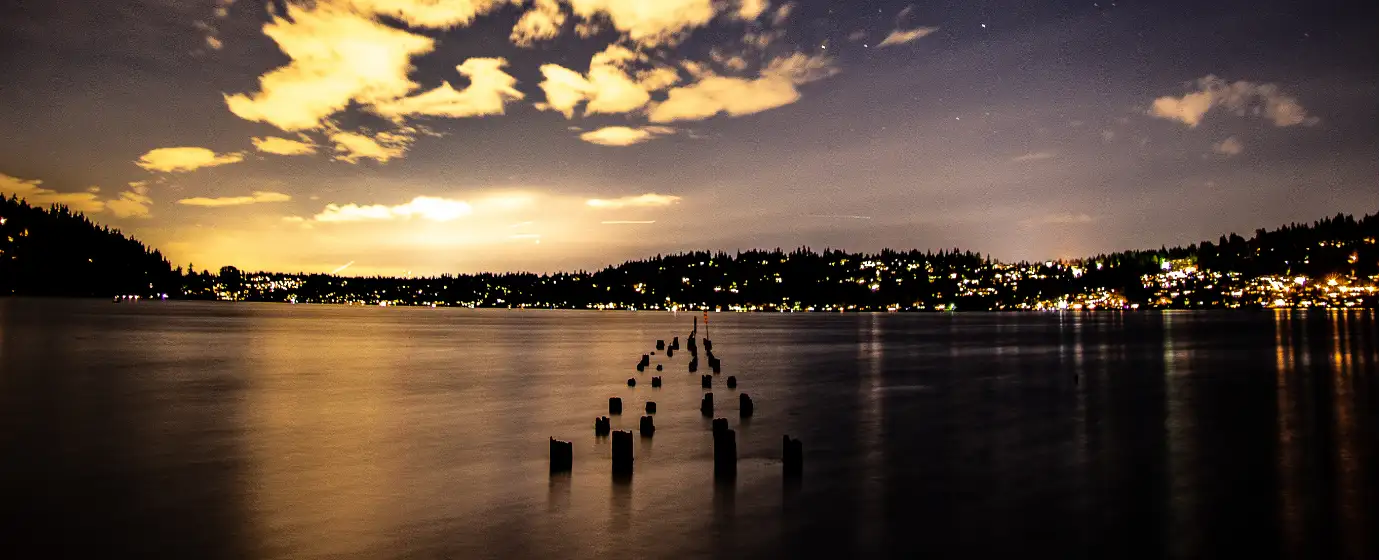
Puget Sound · Washington
Living in Lake Forest Park: The Ultimate Relocation Guide (2026)
Maybe your company is relocating you to the Seattle metro and someone on the team mentioned Lake Forest Park as "the quieter alternative to Kirkland." Maybe you've been tracking Zillow listings north of Seattle and noticed that the homes here photograph like Pacific Northwest architecture magazines — mature firs, Lake Washington glimpses, mid-century bones with serious renovation budgets behind them. Or maybe you just drove SR 522 and caught a glimpse of Third Place Books and a trail entrance and thought: who actually lives here, and is this real? The central tension in Lake Forest Park is this: it is a genuinely small city — 3.5 square miles, roughly 13,000 people — wrapped inside a premium price tag that reflects what people are actually paying to live within 21 minutes of downtown Seattle while feeling like they are not in a city at all.
Geographically, Lake Forest Park occupies a narrow band between Lake Washington's northeastern shore and the hillside ridgelines that push north toward Kenmore and Bothell. The city is shaped by its topography more than its streets — which wind around ravines, creek corridors, and stands of old-growth Douglas fir that survived suburban development. SR 522, locally called Bothell Way NE, forms the city's commercial spine and its main artery south to Seattle, while the Burke-Gilman Trail threads through the city as the most important piece of non-car infrastructure in the whole place. Daily life here is organized around the Town Center at Lake Forest Park, a mixed-use hub anchored by Third Place Books and a handful of restaurants and retailers — not a dense urban node, but more than most suburbs of this size can claim.
This guide will help you decide whether Lake Forest Park actually fits your life — not just your Pinterest board. We'll walk through the neighborhoods, the real commute numbers, the school district, who thrives here, who tends to leave, and the handful of things longtime locals know that new buyers typically discover too late. If you are comparing LFP against Shoreline, Kenmore, or the northern Seattle neighborhoods, the decision framework at the end will help you sort it out.
| Best For | Why |
|---|---|
| Seattle commuters | 21-minute average drive to downtown; Burke-Gilman Trail access for bike commuters heading south |
| Families with school-age children | Shoreline School District rated A-; strong elementary and middle school options within city |
| Remote workers | Large wooded lots, home office-friendly floor plans, high household incomes signal fast internet infrastructure |
| Move-up buyers from Seattle | Seattle-adjacent without Seattle density; step up in lot size and quiet without sacrificing city access |
| Outdoor lifestyle buyers | Burke-Gilman Trail, Lyon Creek Waterfront Preserve, Grace Cole Nature Park, and Lake Washington all within reach |
| Near-retirement households | Walkable Town Center, single-level ranch options, low crime relative to Seattle, and no state income tax |
The first thing people notice after moving to Lake Forest Park is the quiet. Not the enforced quiet of a gated community, but the organic quiet that comes from streets that dead-end at ravines, neighborhoods designed around mature tree preservation, and a city small enough that cut-through traffic has nowhere productive to go. The second thing they notice is that the Town Center is both better and smaller than they expected — Third Place Books is a genuine community institution with an events calendar that draws people from across the north Seattle metro, but the retail footprint surrounding it is modest. You will still drive to Shoreline, Kenmore, or Seattle proper for most grocery runs and errands.
The Burke-Gilman Trail is the city's most underappreciated asset for daily life. It runs through the city's southern section and connects directly south to the University of Washington, Fremont, and Lake Union — which means bike commuting to Seattle is genuinely practical, not aspirational. On weekend mornings the trail section near Lakefront Park fills with cyclists, runners, and dog walkers moving at a pace that signals something about what residents here prioritize. It is a functional piece of infrastructure that also happens to double as the city's social corridor.
The traffic reality that matters most is the SR 522 corridor at peak hours. Bothell Way NE between Lake City Way and the LFP Town Center can compress a 21-minute average commute to 35–40 minutes when southbound traffic backs up in the 7:30–8:30 AM window. Buyers purchasing in the northern neighborhoods near Kenmore face this full stretch; buyers in South Lake Forest Park or near the Lake City border have a meaningful advantage. The back-road option through Sand Point Way adds mileage but avoids the worst of the 522 congestion for buyers willing to experiment with routing.
The community feels most alive around Town Center on weekend afternoons and during the summer season when Lakefront Park draws families down to the Lake Washington shoreline. The city does not have a traditional downtown, but the Third Place Books node creates a gravitational center that most comparable small cities lack entirely. Residents who need dense walkability or transit frequency will find the lack of light rail access and limited bus service a genuine friction point — King County Metro routes serve the city, but frequency is not comparable to Seattle's urban core.
The combination of lake access and forest density at this price tier does not exist anywhere closer to Seattle. Kirkland offers Lake Washington access but at significantly higher median prices and with considerably more density. Kenmore offers the trail and the lake but lacks LFP's tree canopy density and neighborhood character. What Lake Forest Park has — and what keeps long-term residents from leaving even when life circumstances might push them to consider it — is the specific feeling of living inside a forest that happens to be 21 minutes from a major city.
The Shoreline School District's A- rating reflects a consistently high-performing system, and for families with kids, this is often the deciding factor. The district serves Lake Forest Park through schools that feed into Shorecrest High School, and the combination of strong academics and manageable class sizes draws families who might otherwise stretch their budgets toward Bellevue or Kirkland school districts. Parents who have relocated from out of state frequently cite the school district as the primary reason they chose LFP over comparable neighborhoods in Shoreline.
Washington's lack of a state income tax is not an LFP-specific advantage, but at the household income level that characterizes this city — a median of approximately $159,904 — the savings are material. Households earning well above that figure, which is common here given the $204,000 average annual household income, are keeping meaningfully more of their earnings than counterparts in California, Oregon, or New York. For relocating professionals, this calculus often softens the initial sticker shock of the $1,042,500 median sold price.
The Lyon Creek Waterfront Preserve, Grace Cole Nature Park, and Pfingst Animal Acres Park give the city a nature infrastructure that punches well above its 3.5-square-mile footprint. These are not manicured suburban parks with plastic play equipment — they are genuine natural corridors with creek habitats, bird populations, and trail systems that feel more like regional parks than city amenities. For households where weekend activity centers on outdoor time rather than restaurant hopping, the park system alone justifies the premium.
The price is the most obvious tradeoff, and it compounds beyond the purchase. A $1,042,500 home at a 1.07% property tax rate generates approximately $11,155 per year in property taxes — a line item that surprises buyers who moved from lower-tax states or from less expensive Pacific Northwest markets. Combined with King County's overall cost of living index sitting around 121.5 against the U.S. baseline, Lake Forest Park is genuinely expensive to own and operate daily life in, regardless of how the purchase price compares to Seattle proper.
The car dependency is real and should not be minimized. Outside of the Burke-Gilman Trail corridor for bike commuters, Lake Forest Park is not a walkable city by any measure that matters for daily errands. The Town Center covers some needs, but grocery shopping, medical appointments, and most retail requires driving. Households without two vehicles, or buyers who relocated from walkable urban neighborhoods expecting to reduce car dependency, commonly find this a more significant adjustment than they anticipated.
Buyers who value nightlife, restaurant density, or cultural programming within walking distance will not find those things in Lake Forest Park. The city's strength — quietness, nature, proximity to Seattle without being Seattle — is structurally incompatible with the density required to support a vibrant local dining and entertainment scene. Third Place Books fills a meaningful niche, but the honest description of LFP's social life is that most of it happens in Seattle, not within the city limits.
Why some people leave: The most common departure pattern in Lake Forest Park is life-stage driven. Young professionals who moved here during the remote-work era sometimes find the social isolation from urban Seattle harder to absorb than expected once in-office requirements return. Families whose children have graduated move toward smaller, lower-maintenance properties — often in Shoreline or further south in Seattle — when the school district calculus is no longer the primary factor. And buyers who stretched their budgets to hit the entry price sometimes find the carrying costs of ownership in King County more demanding than projected.
Brookside Triangle sits adjacent to the Lyon Creek Waterfront Preserve, and the creek corridor shapes daily life here in ways that show up in the landscape rather than on a brochure. Streets follow natural grades, mature trees are the default rather than the exception, and the neighborhood consistently earns recognition for its school access within the Shoreline School District. City-wide median pricing applies here, with homes generally landing in the $950,000–$1.1 million range depending on lot size and update level.
Best for: Nature-oriented families who want established neighborhood character and strong school proximity.
Edgewater-Riviera occupies the near-lakefront section along Lake Washington's shoreline in LFP's central zone, where original mid-century construction sits alongside substantially renovated homes. Access to the water runs through private beach rights or Lakefront Park nearby, and the neighborhood's quiet residential character reflects streets that were laid out to serve residents rather than connect corridors. Pricing here runs from the mid-$900,000s to above $1.2 million for homes with direct water proximity.
Best for: Buyers seeking water adjacency without full lakefront premiums, in a quiet established setting.
Horizon View sits at an elevated position within the city, which translates to a slightly more open feel than the deeper wooded pockets lower in LFP's topography. Horizon View Park anchors the neighborhood and serves as the primary gathering point for walking, kids' play, and casual outdoor time. Homes here generally list around $1.02 million, with the range climbing toward the upper end for properties with genuine lake view corridors through the tree line.
Best for: Families who want park proximity, hillside character, and a neighborhood that feels more open than the ravine pockets.
Lower Horizon View shares the wooded, hillside DNA of its upper counterpart but typically comes in at slightly more accessible price points — making it one of the more practical entry points into the LFP market for buyers whose budget sits just below the citywide median. Burke-Gilman Trail access and proximity to Horizon View Park remain intact, and the neighborhood's established tree canopy and curving streets maintain the character buyers associate with the broader Horizon View corridor.
Best for: Buyers who want Horizon View's feel with a marginal price advantage and strong trail access.
North Lake Forest Park borders Kenmore and occupies the northern edge of the city where lots tend to run larger and the canopy runs deeper. Entry price points here generally come in below the citywide median, which makes this one of the more accessible corners of LFP for buyers working with a tighter budget. The downside is that SR 522 commuters from this area face the full southbound gauntlet through Bothell Way, which adds meaningful time during peak hours.
Best for: Buyers prioritizing larger lots and lower entry pricing who are prepared for the longer SR 522 commute window.
Sheridan Heights sits on the hillside above Sheridan Beach, and some homes here fall within the Sheridan Beach Club's service area — which means potential access to the Club's pool, tennis courts, and waterfront amenities without paying the full lakefront premium. The neighborhood blends views-oriented properties with wooded lots depending on precise positioning on the ridge, and pricing generally runs in the $900,000–$1.1 million range. It is the neighborhood that comes up most often when buyers ask about getting close to the lake experience without committing to the $1.26 million Sheridan Beach median.
Best for: Value-oriented buyers who want proximity to lake amenities and hillside character without the full lakefront price.
Southern Gateway runs along Bothell Way NE at LFP's southern border with Seattle's Lake City neighborhood, and its proximity to that boundary gives it the most accessible price points in the city alongside the most traffic exposure. Town Center, Third Place Books, and the Burke-Gilman Trail trailhead are all within close reach, which matters for daily convenience. Buyers who can absorb the SR 522 noise and activity level in exchange for the lowest entry point in Lake Forest Park will find this neighborhood's location advantage hard to replicate elsewhere in the city.
Best for: Buyers seeking the lowest LFP entry price who prioritize Town Center walkability and trail access over quiet.
South Lake Forest Park sits between Southern Gateway and the higher-priced Sheridan Beach and Horizon View zones — a transition neighborhood with established ranch and split-level stock under a mature tree canopy. Town Center access is strong, the Shoreline School District feeds are consistent with the rest of the city, and the neighborhood's mid-century bones tend to offer more square footage per dollar than the lakefront-adjacent options north of it. This is the neighborhood where buyers who have lost offers in Sheridan Heights or Brookside Triangle often find their footing.
Best for: Buyers wanting Town Center access, established neighborhood character, and mid-range LFP pricing without lakefront competition.

Neighborhoods like Horizon View and Edgewater-Riviera tend to hold their value exceptionally well, largely because of the waterfront access, mature tree canopy, and proximity to Lake Washington. Sheridan Heights also draws steady buyer interest given its quieter streets and strong community feel. Across Lake Forest Park, well-priced homes — particularly those coming in under $900,000 — often receive multiple offers within days of listing, sometimes before relocating buyers have even landed their first showing appointment. Understanding where you want to land geographically, and why, genuinely shapes your long-term equity story here.
Getting pre-approved before you start touring isn't just about knowing your ceiling — it's about understanding what your full monthly obligation actually looks like. Property taxes, homeowner's insurance, and any HOA dues stack on top of principal and interest, and that combined number is what determines whether a home fits your life comfortably or just technically qualifies on paper. The right home in Lake Forest Park can move fast, and sellers take offers more seriously when financing is already sorted. I'd rather help you build a realistic budget upfront than watch you lose a home you loved to someone
| City | Best For | Median Home Price | Commute to Seattle | Vibe |
|---|---|---|---|---|
| Lake Forest Park | Lake-adjacent quiet, trails, strong schools | $1,042,500 | ~21 min | Wooded, residential, low-density |
| Shoreline | More walkability, slightly lower prices | ~$850,000–$950,000 | ~20–25 min | Suburban, growing, light rail access coming |
| Kenmore | Larger lots, SR 522 access, Lake Washington north end | ~$875,000 | ~28 min | Suburban, more commercial |
| Bothell | Tech corridor jobs, newer construction | ~$875,000–$950,000 | ~30–35 min | Planned suburban, growing retail |
| Kirkland | Waterfront premium, dense town center, tech proximity | ~$1.2M–$1.4M | ~25–30 min | Upscale, walkable core, polished |
| Seattle (Lake City/Meadowbrook) | Urban amenities, walkability, transit | ~$750,000–$900,000 | ~15 min | Urban, denser, more services |
| Metric | Data |
|---|---|
| Population | ~13,112 |
| City Area | 3.5 square miles |
| Median Sold Home Price | $1,042,500 (April 2026) |
| Median Household Income | ~$159,904 |
| Property Tax Rate | ~1.07% |
| School District | Shoreline School District (A-) |
| Average Commute to Seattle | ~21 minutes |
| Violent Crime per 1,000 | 2.7 |
| Property Crime per 1,000 | 20.3 |
| State Income Tax | None |
Third Place Books is not just a bookstore. The Town Center location at Lake Forest Park is one of the most active independent bookstores in the Pacific Northwest — running author readings, community forums, children's events, and programming that the neighborhood has built social rituals around. Longtime residents describe it the way people in other cities describe their local coffee shop: the place you run into your neighbors by accident and stay longer than you planned. Moving here without understanding its role in community life is like moving to a town with a weekly farmers market and never going.
The Aqua Club in Sheridan Beach has been a community institution since 1959. Membership is required and historically sought-after, offering a pool, clubhouse, and lighted tennis courts in a setting that feels more like a private retreat than a community amenity. For families buying in the Sheridan Beach or Sheridan Heights corridor, asking about Aqua Club access during the purchase process is worth the conversation — it is part of what makes waterfront-adjacent living here different from simply buying near water.
The Burke-Gilman Trail's character changes seasonally in ways that affect daily routines. Winter months on the trail section through Lake Forest Park can be genuinely wet and slippery under the tree canopy, and the trail's popularity compresses sharply to the dry-weather months. Buyers who are trail-access motivated should time their neighborhood visits to a November or February morning rather than a July afternoon to get an accurate read on the experience they are buying into.
What I would not do if moving here: I would not buy in the SR 522 corridor — specifically the blocks directly adjacent to Bothell Way NE between NE 165th Street and NE 175th Street — without spending a Tuesday evening at the property during the 5:30 PM southbound backup. The noise and traffic exposure in those blocks is materially different from properties one street removed, and the difference does not show up in listing photos or weekend open house visits.
Local Expert Takeaway: If your budget is right at $1,042,500 and you want the best combination of school access, trail proximity, and resale stability, South Lake Forest Park and Sheridan Heights are the two neighborhoods worth prioritizing — both offer proximity to the amenities that define the city without competing directly against Sheridan Beach's lakefront premium. Buyers stretching toward the upper end of their budget should focus on Horizon View or Brookside Triangle, where the Shoreline School District access and Lyon Creek corridor create the kind of long-term lifestyle alignment that holds value regardless of market cycles. Whatever neighborhood you target, plan to move quickly — 14-day average days on market means hesitation is costly.
✅ Lake Forest Park delivers genuine Pacific Northwest forest character within a 21-minute commute of downtown Seattle — a combination that is harder to find at any price point than the map suggests.
⚠️ The entry price is not negotiable by neighborhood. Even the most accessible corners of LFP sit in the high $800,000s to low $900,000s, and the market's 100.8% average sale-to-list ratio means budgeting above asking is standard practice, not strategy.
📍 Third Place Books at Town Center is the social anchor of daily life here. Before making an offer, spend a Saturday afternoon in the Town Center corridor — it will tell you more about whether this community fits your life than any market report will.
Is Lake Forest Park a good place for families?
Lake Forest Park consistently draws families with school-age children because of its access to the Shoreline School District, which carries an A- rating and feeds into Shorecrest High School. The combination of safe, low-traffic residential streets, park infrastructure including Lyon Creek Waterfront Preserve and Grace Cole Nature Park, and the Town Center's family-friendly programming at Third Place Books gives households with children a daily environment that is genuinely hard to replicate at comparable price points north of Seattle.
What is the crime rate in Lake Forest Park?
Lake Forest Park reports a violent crime rate of approximately 2.7 per 1,000 residents and a property crime rate of approximately 20.3 per 1,000 — both of which compare favorably to Seattle and to most King County suburbs of similar density. The city's low-traffic residential street layout and strong community cohesion are frequently cited by residents as contributing factors to the neighborhood safety profile.
How does Lake Forest Park compare to Shoreline?
The core difference comes down to price, density, and transit trajectory. Shoreline typically offers lower median home prices in the $850,000–$950,000 range, a more commercially active street network, and light rail development that will change its accessibility profile over the next several years. Lake Forest Park is quieter, more wooded, more lake-adjacent, and consistently more expensive — the premium reflects the combination of Shoreline School District access, Lake Washington proximity, and the forested residential character that Shoreline's denser development pattern does not replicate.
Explore the full Lake Forest Park series: The Ultimate Lake Forest Park Relocation Guide · Is Lake Forest Park Safe? · Cost of Living in Lake Forest Park · Best Neighborhoods in Lake Forest Park · Lake Forest Park Schools & Family Life · Lake Forest Park Youth Sports · Lake Forest Park Parks & Recreation · Retiring in Lake Forest Park · 1031 Tax-Deferred Exchange in Lake Forest Park · Lake Forest Park First-Time Homebuyers Guide · Lake Forest Park Down Payment Assistance Guide · Moving to Lake Forest Park from California