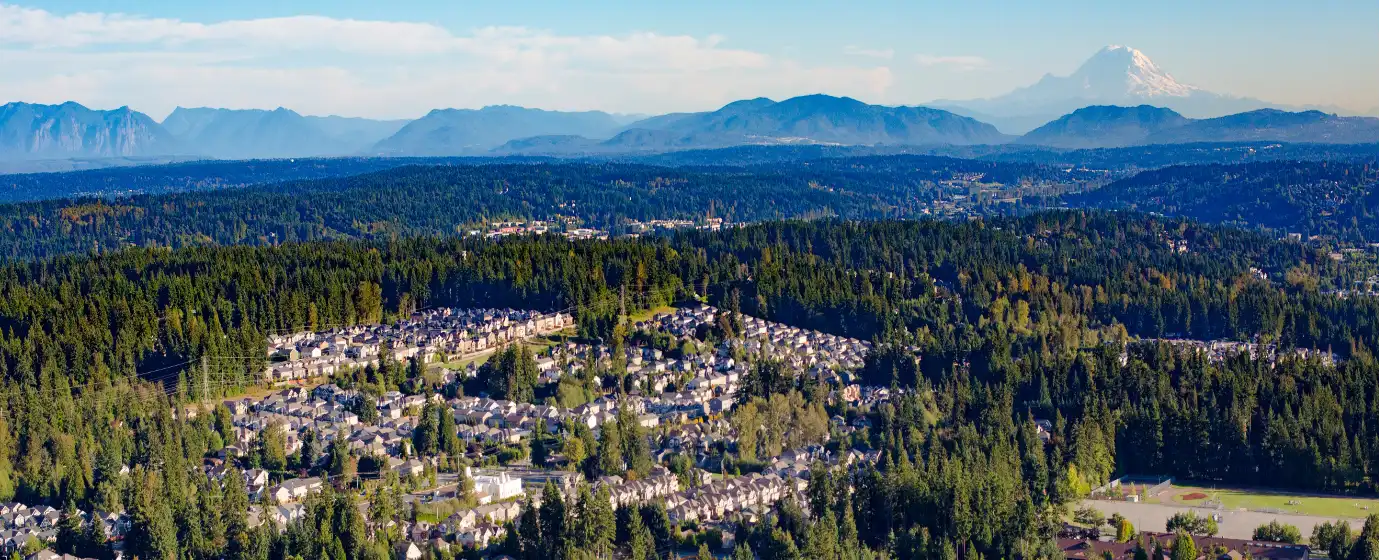
Puget Sound · Washington
1031 Exchange & Investment Real Estate in Bothell (2026)
Not everyone doing a 1031 exchange is a seasoned portfolio investor. A meaningful share of the California capital flowing into the Pacific Northwest right now belongs to homeowners who sat on a Bay Area or Southern California property for a decade, sold at peak equity, and are now staring down a six-figure tax bill unless they redeploy within 180 days. Bothell keeps surfacing in those conversations — and for good reason. It sits at the intersection of two major biotech and tech employment corridors, serves one of the strongest-rated school districts in Washington, and offers single-family homes and small multifamily properties at prices that still look reasonable compared to where that California money came from.
The rental demand here is structural, not cyclical. UW Bothell and Cascadia College anchor a permanent tenant base of students and faculty on the west side of the city, while the Canyon Park and North Creek corridors attract working professionals employed at companies like AGC Biologics, Seagen, and FUJIFILM Sonosite. About 34% of Bothell households rent, and the largest share of those rentals falls in the $2,001–$2,500 range — a sweet spot that aligns well with what a thoughtfully acquired single-family rental or duplex can realistically command. Vacancy windows here run short: properties typically lease in 9 to 23 days when priced correctly.
This guide walks through the core mechanics of a 1031 exchange, what the Bothell investment property market actually looks like in 2026, the tax advantages Washington offers compared to California, and the practical due diligence checklist every out-of-state buyer needs before the clock starts running.

The core premise is deceptively simple: sell an investment property, reinvest the proceeds into a like-kind replacement, and defer the capital gains tax indefinitely. The rules that govern that transaction are where buyers get into trouble. Once escrow closes on your relinquished property, you have exactly 45 days to identify potential replacement properties in writing to your qualified intermediary (QI). You must name up to three properties under the standard three-property rule, or follow the 200% rule if you're identifying more. Missing this deadline by a single day — for any reason — voids the exchange.
The 180-day closing window runs concurrently with the identification period, not sequentially. You don't get 45 days plus 180 days — you get 180 total, with identification locked by day 45. Your QI holds the proceeds during this period; if those funds touch your bank account at any point, the exchange is immediately disqualified. Like-kind is broader than most people assume: any real property held for investment or business purposes qualifies as like-kind to any other, which means a California commercial building can exchange into a Bothell single-family rental without issue.
The boot trap is the most common way investors accidentally generate a tax event. If you receive any cash back at closing, take on less debt than you carried on the relinquished property, or purchase a replacement with a lower total value, the difference is taxable in the year of exchange. The cleanest way to avoid boot: purchase equal or higher in value, reinvest all net proceeds, and match or exceed the debt load from your old property.
The Bothell investment market in 2026 is defined by tight inventory and strong fundamentals — a combination that favors long-term holders and creates real challenges for 1031 buyers on a 45-day identification clock. With only 1.5 to 2.5 months of available inventory citywide, properties that pencil out as rentals get multiple offers fast. Single-family rentals dominate the transaction landscape, but Canyon Park condos starting in the $500,000s have emerged as a more accessible entry point, and the occasional duplex or triplex in older neighborhoods near downtown trades for investors willing to move quickly.
Median sold prices for single-family homes in Bothell run approximately $970,000 to $1.03 million citywide in mid-2026, with meaningful variation by submarket. The Bothell West side (King County) trades around $932,000 for a 90-day sold median, while the Bothell East side skews considerably higher — estate-style homes push medians past $1.5 million in upper-tier pockets. For investors, the Canyon Park corridor and North Creek area represent the most active rental acquisition zone, where a $950,000 to $1.1 million single-family home can realistically command $3,000 to $3,400 per month in rent.
| Property Type | Typical Price Range | Est. Cap Rate | Avg Days to Close |
|---|---|---|---|
| Single-Family Rental (3–4 BR) | $900K – $1.1M | 3.0%–3.8% | 21–35 days |
| Condo / Townhome | $480K – $750K | 3.5%–4.5% | 21–30 days |
| Duplex / Small Multifamily | $1.1M – $1.6M | 3.8%–5.0% | 30–45 days |
| ADU + Primary (House Hack) | $950K – $1.2M | Blended 4.0%–5.5% | 25–40 days |

The arithmetic that drives California capital north is straightforward: depreciated basis, deferred gains, and a replacement market that offers landlord-friendly laws, no state income tax, and rents that hold up in economic downturns because the underlying employment base is in biotech and aerospace — not hospitality or retail.
A Bay Area investor selling a primary or investment property at $1.4 million has enough equity — after a 1031 — to acquire a Bothell duplex outright and still have capital remaining for a condo near UW Bothell. That's two income-producing assets generating a combined $5,500 to $6,500 monthly in gross rent, with no California income tax eating into returns. The cognitive shift required is accepting that a $970,000 Bothell SFR is not a downgrade — it's a different market with better cash flow math.
Los Angeles and San Diego investors are often exchanging commercial or mixed-use property into residential rentals for the first time, drawn by Washington's lack of state income tax and simpler landlord-tenant dynamics than California's AB 1482 rent cap regime. A $1.2 million replacement purchase in Bothell fits comfortably within most SoCal exchange proceeds, and the tenant pool here — tech workers, healthcare professionals, university staff — is far more stable than anything comparable in price near coastal California.
Inland Empire investors are often coming in at lower exchange values — $600,000 to $900,000 — which puts a Canyon Park condo or a smaller SFR in Bothell West squarely in range. These buyers tend to be most surprised by Washington's competitive market pace. Properties that pencil out in Bothell can go pending in under a week, which means arriving without a pre-approved acquisition strategy is a real risk to the 45-day identification window.
Washington's absence of a state income tax is the headline — and it's legitimate. Every dollar of net rental income stays with the investor rather than being divided with a state revenue department. For a California investor accustomed to the top bracket of 13.3%, moving rental income into Washington is worth thousands annually on a single property.
| Tax Item | California | Washington |
|---|---|---|
| State income tax on rental income | Up to 13.3% | $0 |
| Property tax rate (new purchase) | Prop 13: 1.0–1.2% (reset at purchase) | Approx. 1.0%–1.1% effective |
| Sales tax (materials/renovations) | 7.25%–10.75% | 6.5% + local (8.5%–10.5% in Bothell area) |
| Long-term capital gains (state) | Up to 13.3% on all gains | 7% on gains over $262,000/year |
| Annual rental income tax (state) | Ordinary income rates | No state income tax |
Property taxes in Bothell run approximately 1.0% to 1.1% of assessed value — essentially equivalent to what a California buyer would face on a newly acquired property under a Prop 13 reset, but without the ongoing tax escalation tied to California's supplemental assessment process. Washington's system resets assessments regularly, but local levies in both King and Snohomish counties have remained relatively predictable for investment property holders.
Two additional tax items worth understanding: depreciation basis does not reset in a 1031 exchange. The accumulated depreciation from the relinquished property carries into the replacement, which affects future depreciation deductions and the eventual depreciation recapture calculation. Investors who want to exit the active management side entirely should be aware of the Delaware Statutory Trust (DST) structure — a passive 1031-qualified option that allows fractional ownership in institutional-quality properties without landlord obligations, though it trades liquidity for simplicity.
Washington's sales tax on construction materials and renovation supplies — roughly 8.5% to 10.5% in the Bothell area — should be factored into any rehab budget. Unlike Oregon, which has no sales tax, a $60,000 renovation in Bothell carries a meaningful materials tax load that California investors sometimes forget to model.

When it comes to 1031 exchange activity in Bothell, location within the city genuinely shapes long-term investment value. Areas like Canyon Park and North Creek have seen consistent demand from both owner-occupants and investors, thanks to proximity to major employers and solid rental appeal. Downtown Bothell has also attracted attention as the corridor continues to mature with dining, walkability, and transit access. Desirable investment properties in these pockets move quickly — sometimes within days of hitting the market — so having your financing strategy mapped out before you start identifying replacement properties is critical to meeting exchange deadlines.
Before you tour a single replacement property, sit down with a lender who understands investment financing. Your full monthly obligation includes not just principal and interest, but also property taxes, insurance, and any HOA dues — and those numbers together tell a very different story than the purchase price alone. I always encourage investors to think about a comfortable, sustainable budget rather than stretching to maximum approval. When the right property appears in a time-sensitive exchange, being fully prepared means you can move with confidence instead of scrambling.
Washington operates under a landlord-tenant framework that is more balanced than California's but has been evolving. As of 2026, Washington has no statewide rent control — landlords can raise rents between tenancies without a cap, though proper notice requirements apply. For month-to-month tenancies, landlords must provide 20 days' notice for rent increases under 10% and 180 days for increases of 10% or more. Eviction for nonpayment requires a 14-day pay-or-vacate notice, and just-cause eviction protections apply in Seattle proper but are not citywide law in Bothell.
Bothell sits across two county lines, and that matters for investors. King County portions of Bothell are subject to some supplemental tenant protections for unincorporated areas; most of the City of Bothell itself is governed by state law and city code. Out-of-state owners should verify which county their specific parcel falls in — it affects applicable notice requirements and any future regulatory changes at the county level.
Professional property management in Bothell runs approximately 8% to 10% of gross monthly rent for a standard residential unit, plus leasing fees typically equal to one month's rent for tenant placement. For an out-of-state investor who cannot respond quickly to maintenance calls or lease renewals, this is not optional — it's the cost of running a business from a distance. Local firms with presence in the Bothell/Kenmore/Woodinville corridor include options affiliated with national platforms, and the market has enough activity that referrals from a local real estate attorney or title officer are the most reliable sourcing method.
| Item | What to Verify | Local Resource |
|---|---|---|
| Title search | Clear title, no undisclosed liens or easements | Washington-licensed title company (First American, Chicago Title have local offices) |
| Sewer vs. septic | Older Bothell neighborhoods may be on septic — verify connection status | City of Bothell Public Works / SSWM |
| Flood zone status | Properties near Sammamish River or North Creek corridors may carry FEMA flood designation | FEMA Flood Map Service Center |
| Rental permit requirements | City of Bothell requires rental registration; verify current compliance | City of Bothell business license office |
| HOA rental restrictions | Many Canyon Park and Westhill communities cap rentals at 20–30% of units | HOA governing documents / management company |
| ADU potential | Washington's ADU laws are among the most permissive nationally — check lot size, setbacks, utility capacity | City of Bothell Planning & Development |
| Zoning verification | Confirm R-4, R-5, or multifamily zoning if considering future development or conversion | King County or Snohomish County assessor |
| School district confirmation | King County side: Northshore SD; some parcels may fall in different district — verify by parcel | Northshore School District enrollment office |
| Current lease status | Verify lease term, rent amount, deposit held, any pending disputes | Request estoppel certificate from seller |
| Deferred maintenance inspection | Roofs, HVAC, and crawl space conditions in 1980s–2000s-era homes are the most common surprises | Independent inspector (not seller-referred) |
| Short-term rental ordinance | Bothell currently requires a business license for STRs; King and Snohomish county rules vary | City of Bothell permitting; check county overlay |
| County line verification | Confirm whether the parcel is in King or Snohomish County — affects landlord-tenant code | Parcel number lookup via county assessor |
| Property management referral | Establish management relationship before close — good firms have waitlists | Title company, local attorney, or agent referral |
| Qualified intermediary confirmation | QI must be designated before the relinquished property closes — not after | National 1031 exchange QIs with WA familiarity |

Local Expert Takeaway: The single most common mistake California 1031 buyers make in Bothell is arriving at the 45-day identification window without a pre-screened shortlist. At $970,000 median, properties that genuinely cash-flow are not abundant — they require knowing which corridors (Canyon Park, North Creek) produce durable tenant demand versus which neighborhoods are priced purely for appreciation. Identify your target property type, run your numbers at a 3.5% cap rate minimum, and have a QI already engaged before your relinquished property hits the market. The investors who succeed here are the ones who treat the acquisition like a business decision on day one, not after the 45-day clock is already ticking.
✅ Bothell's rental demand is employer-anchored. The concentration of biotech, medical device, and tech employers — plus UW Bothell and Cascadia College — creates a tenant base that persists through economic cycles. Vacancy windows of 9 to 23 days are the norm, not the exception.
⚠️ The 45-day window is the real risk. In a market with 1.5 to 2.5 months of inventory, investment-grade properties move in days. Investors who start the identification process after closing on the relinquished property frequently run out of suitable options. Have your shortlist built before you sell.
📍 HOA restrictions can kill a 1031 plan. Canyon Park and some planned communities in Bothell cap rental percentages at the community level. A property that appears to pencil out perfectly can become non-rentable if the HOA has already hit its rental cap. Verify before you make the offer.
Does a 1031 exchange work for out-of-state property?
Yes — the like-kind requirement applies to the nature of the property (real estate held for investment), not its location. A California investment property can exchange into a Washington replacement property without restriction. The rules around identification windows, qualified intermediaries, and boot apply exactly the same way regardless of which states are involved.
What is the cap rate on rental property in Bothell?
Single-family rentals in Bothell typically yield estimated cap rates in the 3.0% to 3.8% range at current price levels. Condos and townhomes run slightly higher at 3.5% to 4.5%, and duplexes or small multifamily properties can approach 5.0% depending on condition and rent in place. Bothell is a long-term appreciation and stability market — investors expecting 6%–7% cap rates will not find them here without significant value-add upside baked into the acquisition.
Do I need a local property manager for a 1031 investment in Washington?
Out-of-state owners who cannot personally respond to maintenance requests, lease renewals, and legal notices within required notice windows should have professional management in place before the tenant relationship begins. Washington's landlord-tenant code has specific notice deadlines — missing them can expose owners to legal liability regardless of intent. Management fees of 8%–10% of gross rent are the standard range, and establishing that relationship before closing is part of a well-structured acquisition plan.
Explore the full Bothell series: The Ultimate Bothell Relocation Guide · Is Bothell Safe? · Cost of Living in Bothell · Best Neighborhoods in Bothell · Bothell Schools & Family Life · Bothell Youth Sports · Bothell Parks & Recreation · Retiring in Bothell · 1031 Tax-Deferred Exchange in Bothell · Bothell First-Time Homebuyers Guide · Bothell Down Payment Assistance Guide · Moving to Bothell from California