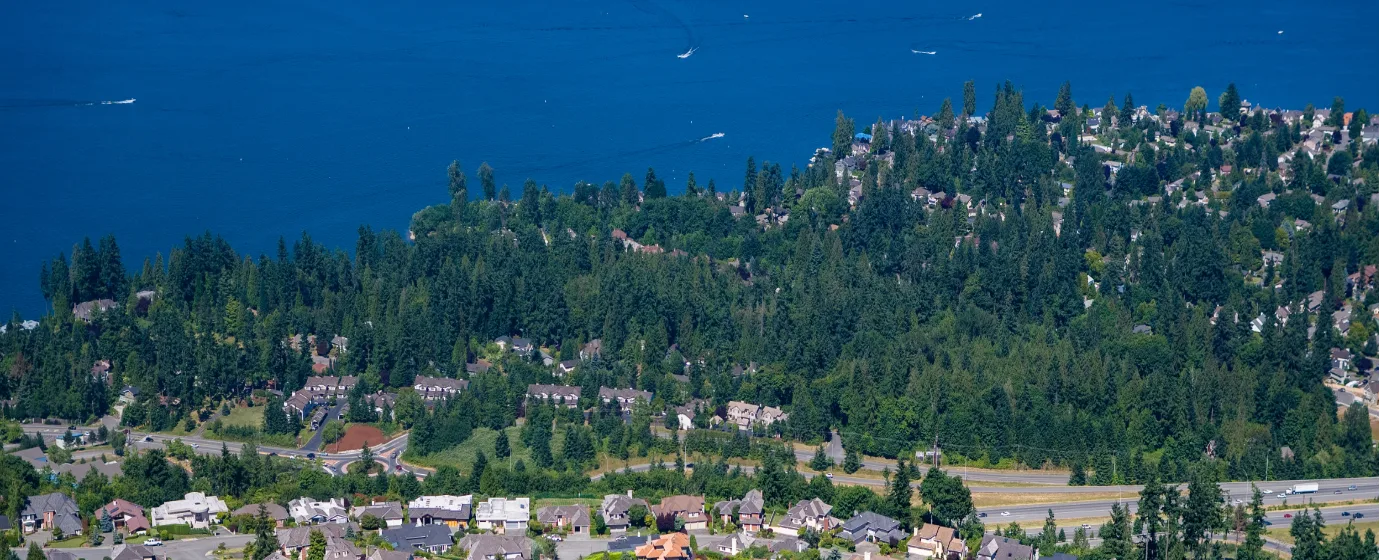
Puget Sound · Washington
Down Payment Assistance in Issaquah (2026)
Saving for a home in 2026 feels like running on a treadmill someone keeps speeding up. Groceries cost more than they did two years ago — meaningfully more, not rounding-error more. Rent absorbs the raise that was supposed to go toward a down payment fund. Gas settled at a new normal that still stings. The savings account climbs slowly, then a car repair or a medical bill knocks it back. The math keeps almost working, and then it doesn't.
One program changes that math in a concrete way. ONE+ by Rocket Mortgage lets the buyer put down 1% of the purchase price while Rocket contributes 2% — up to $7,000 — as a grant. Not a deferred second mortgage. Not a lien that surfaces at closing when you sell years from now. A grant, contributed by the lender, that never gets repaid. A buyer who was $10,000 short suddenly needs a fraction of that. ONE+ also carries no first-time buyer requirement — repeat buyers qualify as long as household income falls within King County's limit. For buyers whose income or purchase price puts them outside ONE+'s parameters, Washington's WSHFC Home Advantage program steps in with an income ceiling of $215,000 — far higher than most buyers expect.
ONE+ does carry a purchase price ceiling, and in a market where the median home sits at $1,070,000, that ceiling matters. This guide explains both programs honestly, maps out where ONE+ fits in Issaquah's inventory, and helps you figure out which path actually matches your situation before you talk to a lender.

Every other down payment assistance option in Washington functions as a deferred second mortgage. You borrow the money, it sits quietly as a second lien on your title, and you pay it back when you sell or refinance. That's not a criticism — deferred loans are genuinely useful tools, and Washington's programs are among the better ones in the country. But ONE+ is structurally different in a way that matters. Rocket Mortgage contributes 2% of the purchase price as a grant with zero strings attached. The buyer puts in 1%. The result is a 3% down payment at closing, with the buyer's actual out-of-pocket contribution being half of what a standard 3%-down conventional loan would require — and the grant portion never comes back.
The $350,000 loan limit is the honest constraint that shapes this entire conversation in Issaquah. The city's median home price sits at $1,070,000 — a figure that reflects a real estate market where single-family homes simply don't trade anywhere near ONE+'s ceiling. At $350,000 and below, what you'll find in Issaquah is condominiums, primarily in older complexes in Downtown or Olde Town Issaquah, and units within Providence Point, the 55+ community on the east side of the city. No verified active single-family home listings exist in this price range. The entry point for attached housing — condos and townhomes — runs closer to $500,000–$600,000.
| Price Range | What's Typically Available in Issaquah | ONE+ Eligible? |
|---|---|---|
| Under $320K | Rare older condos; very limited inventory | ✅ Yes |
| $320K–$350K | Select condos in Olde Town, Downtown, Providence Point (55+) | ✅ Yes |
| $350K–$600K | Condos, townhomes; some attached homes in Klahanie, North Issaquah | ❌ Loan ceiling exceeded |
| $600K–$1M+ | Single-family homes; the broad Issaquah market | ❌ Well above ceiling |
For buyers whose purchase price or income puts them outside ONE+'s parameters, Washington's WSHFC programs represent a serious, well-funded alternative. The state has invested heavily in housing access programs, and the options available here compare favorably to what most states offer.
The feature most buyers don't believe until they see it is the $215,000 income limit. Home Advantage is not a low-income program. A dual-income household in Issaquah earning $180,000 — common in a city where major employers include Microsoft, Siemens, and T-Mobile — qualifies. The DPA comes as 4–5% of the first mortgage amount as a 0–1% interest second mortgage, with payments deferred for 30 years and a $0 monthly payment on the DPA portion during that period. The balance becomes due at sale, refinance, or payoff of the first mortgage. There is no first-time buyer requirement, and the program is compatible with conventional, FHA, VA, and USDA loan types — giving buyers more flexibility than ONE+'s conventional-only structure. One requirement: a 5-hour WSHFC-approved homebuyer education seminar before closing, with online options available. Unlike bond-funded programs, Home Advantage does not carry IRS recapture tax risk.
House Key is WSHFC's bond-funded program, which means it comes with a first-time buyer requirement and IRS recapture provisions that Home Advantage avoids. DPA goes up to $10,000 (or up to $15,000 through the Opportunity DPA at 1% interest), with income limits that vary by county — King County limits are lower than the statewide Home Advantage ceiling. The recapture risk is real but conditional: it applies only if you sell within 9 years, your income has grown above a threshold, and you made a capital gain on the sale. Many buyers will never trigger it. Still, it's worth understanding before choosing this path over Home Advantage.
HomeChoice provides up to $15,000 in DPA for borrowers, or households with a member, with a documented disability. Available statewide and worth a direct conversation with a WSHFC-approved lender if this applies to your household.
The structural difference that runs through all of this is straightforward: ONE+ is a grant — it leaves the closing table and never returns. Every WSHFC option is a deferred loan. Both solve the cash-to-close problem in the near term. The difference shows up years later when you sell or refinance, at which point WSHFC borrowers repay the assistance amount from their proceeds. For buyers who expect to stay long-term and build equity in a market like Issaquah, a deferred second mortgage is a reasonable trade. For a buyer who qualifies for ONE+, the grant structure wins on pure math.

| ONE+ by Rocket | WSHFC Home Advantage | WSHFC House Key | |
|---|---|---|---|
| Assistance type | True grant — no repayment | Deferred second loan | Deferred second loan |
| Max loan | $350,000 | No ceiling | No ceiling |
| Income limit | ≤80% AMI (~$114,800 King Co.) | $215,000 statewide | Varies by county |
| Cash at closing | ✅ $7,000 grant | ✅ 4–5% of loan | ✅ Up to $15,000 |
| Repayment required | Never | Yes — at sale/refi | Yes — at sale/refi |
| Recapture tax risk | None | None | Yes (if 3 conditions met) |
| First-time required | No | No | Yes |
| Loan types | Conventional only | Conv, FHA, VA, USDA | Conv, FHA, VA, USDA |
| Who processes | Rocket Mortgage | WSHFC-approved lender | WSHFC-approved lender |
| Education required | No | Yes — 5-hour seminar | Yes — 5-hour seminar |
When Home Advantage makes more sense: your purchase price exceeds the ONE+ ceiling, your income falls between $114,800 and $215,000, or you need the flexibility of FHA or VA financing. For most Issaquah buyers looking at single-family homes, Home Advantage is the realistic program — and its 4–5% DPA on a higher loan amount can generate meaningful assistance. A buyer purchasing at $800,000 with a 5% DPA on the first mortgage is looking at $40,000 in deferred assistance, which dwarfs ONE+'s $7,000 cap even accounting for the repayment structure.

Issaquah is one of those markets where location within the city genuinely shapes how far your down payment assistance dollars stretch. Homes in Issaquah Highlands and Klahanie tend to attract multiple offers quickly — sometimes within days of listing — which means buyers using assistance programs need to be positioned just as strongly as those paying conventional down payments. If you're working with a tighter budget, exploring options in areas like Talus or Downtown Issaquah may open doors to properties under $750,000 where assistance funds can make a more meaningful difference in your ability to close.
Before you tour a single home, sit down with a lender and get the full picture of what ownership actually costs each month — not just principal and interest, but property taxes, homeowner's insurance, and any HOA dues, which vary considerably across Issaquah communities. Down payment assistance can genuinely help you get into a home sooner, but your comfortable monthly budget and your maximum approval number are rarely the same figure. Knowing the difference before you fall in love with a property keeps you in a strong position when the right home appears.
| Item | Amount |
|---|---|
| Purchase price | $340,000 (example) |
| Buyer's 1% down | $3,400 |
| Rocket's 2% grant | $6,800 — never repaid |
| Total down payment | $10,200 (3%) |
| Estimated closing costs | $6,500–$8,500 (varies by lender credits, title, county) |
| Buyer's estimated total cash to close | ~$9,900–$11,900 |
Issaquah in mid-2026 is a more balanced market than it's been in years, with roughly 3.5–4.75 months of inventory depending on the price tier and property type. Homes are sitting for a median of 28–33 days rather than fielding same-weekend bidding wars. That shift matters for DPA buyers. In a multiple-offer environment, sellers routinely passed on offers with financing contingencies or down payment assistance — not because DPA is legally problematic, but because cash-heavy offers felt safer. With inventory up and competition eased, sellers in Issaquah are generally more open to conventionally-financed offers, including those using assistance programs.
For ONE+ specifically, the inventory question is the honest constraint. The sub-$350K condo market in Issaquah is thin but real — primarily older units near Historic Downtown and a small number of Providence Point listings for 55+ buyers. A buyer specifically targeting that price tier can use ONE+ and find product. For everyone else — families looking at North Issaquah, buyers considering Klahanie, anyone priced into the city's standard single-family market — Home Advantage through a WSHFC-approved lender is the functional DPA tool. The good news is that at the purchase prices typical in Issaquah, the 4–5% DPA from Home Advantage generates substantially more assistance than ONE+'s $7,000 cap, even though it comes as a deferred loan rather than a grant.
One practical note: DPA offers in Issaquah work best when the buyer is pre-approved — not just pre-qualified — before making an offer. A same-day Rocket pre-approval for ONE+, or a written commitment letter from a WSHFC-approved lender for Home Advantage, strengthens the offer considerably and signals to the seller that the assistance has already been verified rather than assumed.

Local Expert Takeaway: For the rare Issaquah buyer targeting a condo or 55+ community unit under $350K, ONE+ by Rocket Mortgage is the cleanest option available — a true grant, no seminar, no repayment tail. For the majority of buyers in this market, who are shopping well above that ceiling, WSHFC Home Advantage is the realistic path. Its $215,000 income ceiling means most dual-income Issaquah households qualify, and the 4–5% DPA on a $700,000–$900,000 purchase generates far more assistance than ONE+'s cap. The one thing I'd tell every buyer before they make an offer: get the pre-approval in hand first. DPA programs process quickly when the lender is prepared — the delay usually comes from the buyer, not the program.
✅ ONE+ by Rocket Mortgage contributes 2% of the purchase price (up to $7,000) as a true, never-repaid grant — the only product of its kind in Washington state. King County income limit is $114,800; loan cap is $350,000.
⚠️ Issaquah's median home price of $1,070,000 puts most of the city's inventory well above ONE+'s loan ceiling. Buyers targeting single-family homes will need WSHFC Home Advantage or a similar program rather than ONE+.
📍 WSHFC Home Advantage's $215,000 income ceiling is genuinely high — many dual-income Issaquah households qualify, and the 4–5% DPA on larger loan amounts can deliver far more total assistance than ONE+'s cap, even though it's a deferred loan rather than a grant.
Is there down payment assistance in Issaquah, Washington?
Yes, and the options are more accessible than most buyers realize. ONE+ by Rocket Mortgage covers buyers with incomes under $114,800 purchasing at or under $350,000 — primarily condos in Issaquah's market. WSHFC Home Advantage covers buyers up to $215,000 household income with no purchase price ceiling, making it the practical DPA tool for most of Issaquah's single-family market.
What is the income limit for Washington Home Advantage?
WSHFC Home Advantage carries a $215,000 statewide income limit — one of the highest of any state DPA program in the country. It is not a low-income program. A dual-income household earning $180,000 qualifies, which covers a significant portion of Issaquah's buyer pool. There is no first-time buyer requirement, and the program works with conventional, FHA, VA, and USDA loans.
What is the difference between ONE+ and WSHFC DPA?
The core difference is structural. ONE+ is a grant — Rocket Mortgage contributes 2% of the purchase price and that money never comes back, regardless of when you sell or refinance. WSHFC programs are deferred second mortgages — the assistance sits as a lien on your title and gets repaid from your proceeds when you exit the property. Both solve the immediate cash-to-close problem. ONE+ costs nothing on the back end; WSHFC programs defer the cost until sale. For buyers who qualify for ONE+, the grant structure wins. For buyers above the ceiling, Home Advantage's larger potential assistance amount often outweighs the deferred repayment.
Explore Issaquah mortgage and financial resources: Issaquah Down Payment Assistance Guide · Issaquah First-Time Homebuyers Guide · 1031 Tax-Deferred Exchange in Issaquah · Cost of Living in Issaquah
Explore the full Issaquah series: The Ultimate Issaquah Relocation Guide · Is Issaquah Safe? · Cost of Living in Issaquah · Best Neighborhoods in Issaquah · Issaquah Schools & Family Life · Issaquah Youth Sports · Issaquah Parks & Recreation · Retiring in Issaquah · 1031 Tax-Deferred Exchange in Issaquah · Issaquah First-Time Homebuyers Guide · Issaquah Down Payment Assistance Guide · Moving to Issaquah from California