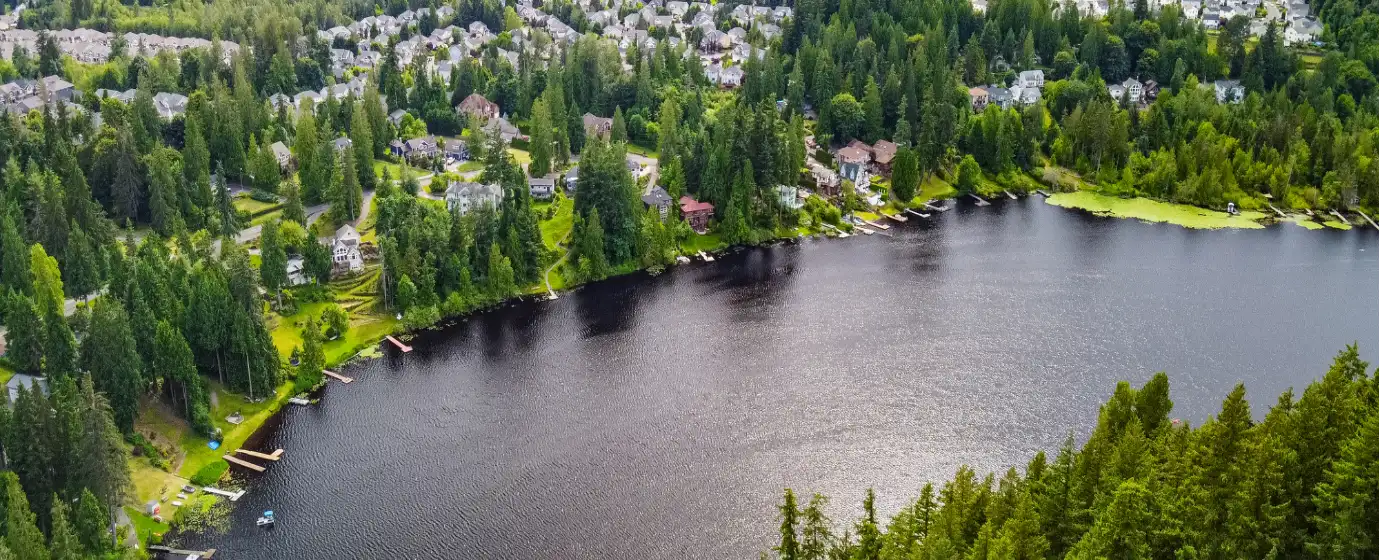
Puget Sound · Washington
Is Renton Safe? Crime Rates, Safest Neighborhoods & Local Reality (2026)
Renton has a reputation problem that doesn't match the reality most residents experience day to day. Pull up a crime comparison website and you'll see grades that make the city sound dangerous. Walk through Kennydale on a Tuesday morning, or spend a Saturday afternoon along the Cedar River Trail, and you'll wonder what the fuss is about. The truth sits somewhere between the headline statistics and the lived experience — and understanding that gap is what makes the difference between a smart housing decision and one based on incomplete information.
The numbers that shape Renton's overall profile are real but require context. Property crime — particularly motor vehicle theft — runs significantly above national norms and pulls the citywide statistics in a direction that distorts how safe most residential neighborhoods actually feel. Meanwhile, violent crime sits modestly below the national average per FBI estimates, and most of the city's residential pockets score A or A+ on neighborhood-level safety indices. What happens on a commercial corridor near Rainier Avenue South does not define what happens on a cul-de-sac in Maplewood Heights.
This guide breaks down what the crime data actually means for someone considering a move to Renton — where to focus your neighborhood search if safety is a priority, which areas carry more risk and why, and what practical habits locals develop without thinking twice. By the end, you'll have a clear-eyed picture, not an alarmist one and not an overly rosy one either.
FBI estimates for 2024 place Renton's overall crime rate at roughly 3,653 incidents per 100,000 residents — about 73% above the national rate and 31% above Washington state's average. That sounds alarming until you understand what's driving it. The city's commercial corridors, particularly along the western edge near Rainier Avenue South and around The Landing retail district, generate the kind of larceny and vehicle theft activity that inflates citywide totals without meaningfully affecting most residential neighborhoods. High retail density and visitor traffic create property crime conditions that look bad in aggregate statistics but don't translate to neighborhood-level risk for most homeowners.
The more meaningful trend is directional: Renton's total crime rate dropped roughly 24.5% from 2023 to 2024, one of the more significant single-year improvements among King County cities of comparable size. Renton Police Department's own mid-2025 projections suggest the trend is continuing, with property crimes projected to fall by roughly 1,400 incidents by year-end compared to 2024. That kind of movement doesn't get captured in annual comparison charts, but it matters considerably for anyone evaluating where the city is headed rather than just where it has been.
Structurally, Renton's crime patterns reflect a city in transition — a growing population, significant commercial retail concentration in the west, and residential neighborhoods in the southeast that register crime indices well below the national average. The citywide number is the average of very different realities depending on where you are. That geographical split is the most important thing a prospective buyer or renter needs to understand about safety in Renton.
Local police data and FBI estimates suggest Renton's violent crime rate runs around 339 per 100,000 residents — roughly 5.5% below the national rate. For a city of 105,000 people, 352 violent crimes in 2024 translates to a 1-in-295 chance of victimization in any given year, a figure that puts Renton broadly in line with other working-class urban suburbs of similar density across the Pacific Northwest. Aggravated assault specifically tracks at about 0.6 times the national rate, which means the incidents that do occur skew toward robbery and domestic-adjacent situations rather than random street violence. Daily life in Renton's residential areas doesn't feel threatening — most long-term residents report never experiencing or witnessing a violent incident directly.
Property crime is where Renton's numbers diverge sharply from comparable cities, and motor vehicle theft is the specific driver. Commonly reported around 1,138 incidents per 100,000 residents — more than three times the national average — car theft is the single most significant practical risk for Renton residents and shouldn't be dismissed. Larceny-theft makes up roughly 48% of all reported offenses and clusters near retail zones, parking areas adjacent to The Landing, and commercial corridors on the west side. The gap between Renton's commercial-zone property crime and its residential southeast neighborhoods is substantial; areas like Fairwood and Maplewood Heights post crime indices 45–46% below the national average, suggesting that where you park and where you live matters enormously here.
Sitting along the northeastern edge of Renton with views toward Lake Washington, Kennydale is one of the more sought-after residential pockets in the city and carries a crime grade of A- based on available neighborhood-level data. The central portion of the neighborhood registers the lowest victim risk — roughly 1 in 24 — while the southern edge closer to commercial activity runs closer to 1 in 15. For buyers drawn to this area for its waterfront adjacency and larger lots, the practical safety reality aligns well with the premium pricing: this is a quiet, owner-occupied neighborhood where the primary concern is the same as in any suburban setting — don't leave valuables visible in your car.
Best for: Buyers who want established neighborhood character, proximity to Lake Washington, and a safety profile that matches the price point.
Maplewood Heights posts a crime index of roughly 55 — about 45% below the national average — which makes it one of the demonstrably safer residential areas in the city by measurable data. The neighborhood benefits from its southeast Renton position, which puts physical distance between residents and the commercial crime corridors on the west side. It's primarily single-family homes with long-term owner-occupants, which consistently correlates with lower property crime across comparable neighborhoods nationwide. Residents here rarely report incidents beyond the occasional catalytic converter theft that affects most of the Pacific Northwest indiscriminately.
Best for: Families with children prioritizing residential safety, buyers who want quantifiable evidence before committing.
Technically in unincorporated King County but commonly grouped with Renton for real estate purposes, Fairwood posts a crime grade of A and a crime index of 54 — nearly identical to Maplewood Heights. The neighborhood's suburban layout, with limited through-traffic and predominantly residential land use, naturally suppresses the property crime activity that inflates numbers in denser commercial areas. Long-time residents consider it among the most genuinely quiet parts of greater Renton, and the demographic data — median household incomes in the area tracking well above the citywide average — reflects a stable, established community.
Best for: Buyers who want maximum residential quiet and a strong safety track record without paying Bellevue prices.
Annexed into Renton in 2008, Benson Hill carries a crime grade of A- and a crime index of 55, reflecting a diverse, primarily residential neighborhood with a community-oriented character that tends to keep informal neighborhood watch dynamics active. The area sits in Renton's southeastern quadrant, insulated from the commercial crime pressure zones to the west. It's one of the more racially and ethnically diverse neighborhoods in the city — a quality that draws many buyers specifically — and that diversity has never translated into elevated crime here. Vehicle theft remains the primary property crime concern, consistent with broader Renton patterns.
Best for: Buyers who want diversity, residential safety, and family-oriented neighborhood dynamics in southeast Renton.
The Highlands is a sprawling area that requires more geographic specificity than most of the other neighborhoods on this list. The eastern portion — sometimes called East Renton Highlands — carries a crime grade of A- with victim risk in the safer southeast sections running around 1 in 42. The western edge, where the Highlands transitions toward Sunset and Central Renton, runs meaningfully hotter. The practical advice locals give is consistent: the further east and southeast you go within the Highlands, the more the neighborhood feels like the quiet residential Renton most people are surprised to discover. The northeast corner carries more risk and sees more incident reports.
Best for: Budget-conscious buyers willing to be specific about their block — east is better than west, southeast is best.
Downtown and the surrounding Central Renton area are candid outliers in an otherwise favorable residential picture. The commercial concentration along Rainier Avenue South, the proximity to the rail corridor, and higher density housing create the conditions where both property crime and the occasional violent incident occur more frequently than in outlying neighborhoods. This is where the citywide statistics are being made. That said, Downtown Renton is also where active investment and city-led revitalization efforts have been most concentrated — the commercial core has changed visibly over the past decade, and RPD's patrol presence is heavier here by design. Buyers looking at condos or mixed-use buildings near Downtown should walk the blocks at multiple times of day before committing.
Best for: Buyers who prioritize walkability and urban amenities over the safest possible crime statistics, and who go in with clear eyes.

| City | Violent Crime / 1K | Property Crime / 1K | Overall Safety Profile |
|---|---|---|---|
| Renton | ~3.4 | ~33.1 | Mixed — strong residential SE, weaker commercial west |
| Bellevue | ~1.2 | ~18.0 | Among safest large cities in WA |
| Newcastle | ~0.8 | ~9.0 | Very low crime, suburban, affluent |
| Kent | ~5.1 | ~44.0 | Higher crime, similar urban-suburban dynamics |
| Tukwila | ~8.2 | ~68.0 | Significantly elevated, especially near commercial corridors |
| Issaquah | ~1.0 | ~11.0 | Low crime, suburban, higher price point |

When buyers ask me about Renton, the neighborhood conversation comes up almost immediately — and it genuinely matters for long-term value. Areas like Kennydale and Renton Highlands consistently draw strong buyer interest, and well-priced homes there move fast, often within days of listing. Cascade has also seen growing attention from buyers who want more space without stretching their budget too far. If you're targeting something under $750,000 in these neighborhoods, expect competition and have your financing squared away before you fall in love with a property.
That's exactly why I encourage buyers to connect with a lender before they ever schedule a tour. Your approval amount and your comfortable budget are two very different numbers, and understanding the full monthly payment — including property taxes, homeowner's insurance, any HOA dues, and how your loan is structured — can shift your thinking significantly. Renton's appeal means inventory in the safer, more desirable pockets moves quickly. Buyers who've already had that honest budget conversation with a lender are the ones who can move confidently when the right home appears.
The single most important practical habit Renton residents develop is never leaving anything visible in a parked car. This isn't Renton-specific paranoia — it's Pacific Northwest protocol — but it matters more here than in Bellevue or Issaquah because motor vehicle theft runs at a rate that makes complacency costly. Locals who've lived here longer than a year don't leave grocery bags, charging cables, or even empty backpacks on seats. It's a five-second habit that eliminates a meaningful slice of the risk. Residents near commercial corridors on the west side — particularly around Rainier Avenue South between South 3rd and South 7th — apply this most vigilantly, and many in those areas have shifted to covered parking where it's available.
The gap between what crime apps show and what neighborhoods feel like is particularly pronounced in Renton because of how the commercial corridor data pulls the overall grade down. Apps like SpotCrime and CrimeGrade aggregate citywide, which means a resident of Maplewood Heights gets assigned a grade reflecting incidents that happened three miles away near a strip mall. Locals in the southeast quadrant who've used Nextdoor or Ring Neighbors describe their actual incident rate as genuinely low — mostly package theft and the occasional car prowl. The apps aren't wrong about where incidents are occurring; they're just not well-calibrated for how geographically concentrated those incidents are.
Renton's crime picture has also been improving in ways that won't fully show up in annual comparisons for another year or two. The 2024 drop was significant, and RPD's 2025 projections — presented at a public safety committee meeting — point to continued reductions in property crime. For buyers doing due diligence now, it's worth understanding that the data you're reading reflects a city that was measurably worse 18 months ago. The trajectory matters as much as the snapshot.

Local Expert Takeaway: Prioritize streets east of SR-515 and south of NE Sunset Boulevard if safety is your primary filter — Maplewood Heights, Benson Hill, and the eastern Fairwood corridor consistently outperform the citywide numbers by a wide margin. If you're drawn to Kennydale for the lake views, focus on the central portion of the neighborhood and budget for a garage. Avoid drawing conclusions from citywide crime grades — Renton's residential and commercial realities are genuinely different datasets wearing the same city label.
✅ Renton's southeast residential neighborhoods — Maplewood Heights, Fairwood, and Benson Hill — post crime indices well below the national average and represent a fundamentally different safety environment than the citywide statistics suggest.
⚠️ Motor vehicle theft is the standout risk city-wide, running more than three times the national average. Park in a garage where possible, and never leave valuables visible in a parked car regardless of neighborhood.
📍 The trend is positive: total crime dropped roughly 24.5% from 2023 to 2024, and RPD's internal 2025 projections point to continued improvement — context that doesn't show up in static comparison charts.
Is Renton a safe place to live?
The answer depends almost entirely on where in Renton you're talking about. Based on available neighborhood-level data, roughly 93% of Renton's residential neighborhoods grade A or A+ for safety — it's the commercial corridors concentrated in the west and downtown core that pull the citywide statistics down. Families with children who focus their search on the southeast quadrant typically find a safety environment comparable to many quieter King County suburbs.
What is the biggest crime concern in Renton?
Motor vehicle theft is the most statistically elevated risk, commonly reported at more than three times the national average per FBI estimates. Larceny-theft near commercial areas is the second most prevalent category. Violent crime, by contrast, runs slightly below the national average — the city's profile is property-crime-heavy rather than violent-crime-heavy, which shapes the practical precautions residents take.
How does Renton compare to nearby cities for safety?
Renton sits in a middle tier among its immediate neighbors. It has meaningfully lower crime than Tukwila and Kent, and its residential southeast neighborhoods approach the safety profile of more expensive cities like Issaquah — but the citywide numbers don't match Bellevue or Newcastle, which benefit from lower commercial density and higher median incomes. For buyers accepting a modest safety trade-off in exchange for a significantly lower purchase price than those premium neighbors, the southeast Renton corridor consistently offers the best balance.
Explore the full Renton series: Living in Renton · Is Renton Safe? · Cost of Living · Best Neighborhoods · Schools & Family Life · Youth Sports · Parks & Rec · Retiring in Renton