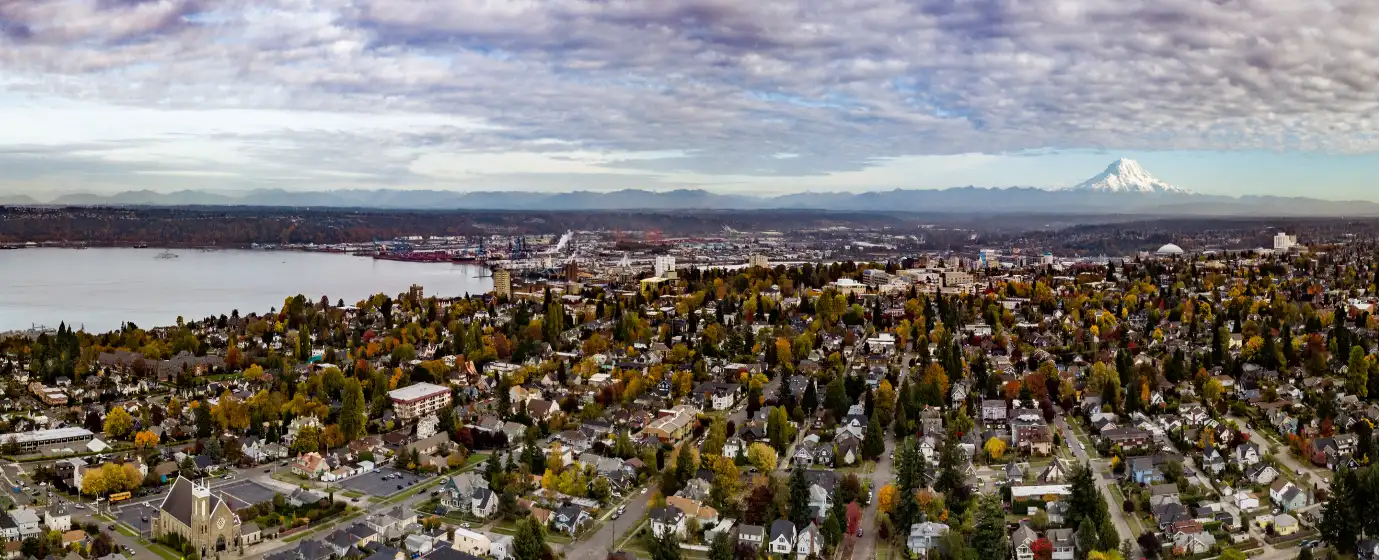
Puget Sound · Washington
Best Neighborhoods in Tacoma: Where to Buy or Rent (2026)
Choosing the wrong neighborhood in Tacoma isn't like choosing the wrong neighborhood in a smaller city — it's the difference between buying into one of the Pacific Northwest's most architecturally compelling historic districts and landing on a block where property crime runs high and resale will frustrate you for years. Tacoma covers 62 square miles of dramatically varied terrain, and the character gap between its best and most challenged neighborhoods is wider than almost anywhere else in the South Sound. The citywide median sold price of $485,000 tells you almost nothing about what you'll actually face at the offer table in Stadium District versus South End.
Geographically, Tacoma divides itself along a ridge. The North End, Proctor, Stadium District, and Old Town occupy the higher ground with views of Commencement Bay and the kind of Craftsman and Victorian housing stock that collectors pay a serious premium for. As you move south and east, elevations drop, housing stock ages differently, and the socioeconomic gradient becomes harder to ignore. That divide shapes everything: school quality, walkability, commute patterns, and long-term appreciation.
This guide breaks down where buyers and renters are actually looking in 2026, what each neighborhood genuinely costs, who each one suits best, and — just as importantly — which common assumptions about Tacoma real estate will cost you time and money if you don't catch them early.

| Neighborhood | Best For | Price Range | Vibe |
|---|---|---|---|
| Stadium District | Luxury buyers, history lovers | $900K–$1.5M+ | Grand historic mansions, walkable, iconic |
| North End | Families, established buyers | $630K–$720K | Craftsman character, bay views, leafy streets |
| Proctor District | Walkability seekers, young professionals | $680K–$760K | Boutique retail, neighborhood feel, bikeable |
| Old Town | Waterfront buyers, downsizers | $800K–$950K+ | Restored Victorians, steps from Ruston Way |
| North Slope | Architecture enthusiasts, preservationists | $680K–$780K | 940-home historic district, dense history |
| Northeast Tacoma | Families, commuters to Federal Way | $620K–$720K | Newer construction, quieter, strong schools |
| Central Tacoma | Midrange buyers, renters | $430K–$510K | Mixed-use corridors, in-between feel |
| Hilltop | First-time buyers, value seekers | $380K–$480K | Rapidly changing, proximity to downtown |
| New Tacoma | Budget-conscious buyers | $390K–$470K | Dense, urban-adjacent, improving |
| South End / South Tacoma | Entry-level, investors | $300K–$420K | Most affordable, practical, sparse amenity |
| Buyer Type | Best Neighborhood | Why |
|---|---|---|
| First-time buyer | Hilltop or New Tacoma | Below-median entry points with upside as Tacoma grows |
| Luxury buyer | Stadium District | Highest median in Tacoma at $1.25M; irreplaceable architecture |
| Walkability seeker | Proctor District | Boutique shopping, coffee, restaurants all within blocks |
| Families with kids | North End or Northeast Tacoma | Strong neighborhood schools, safer streets, established community |
| Commuters to Seattle | Stadium District or North End | Close to I-5 and SR-16; Link light rail access in Stadium |
| Large lot buyers | Northeast Tacoma or Browns Point | More land, newer construction, quieter residential character |
| Renters | Central Tacoma or New Tacoma | Most rental inventory, lower per-unit costs, transit access |
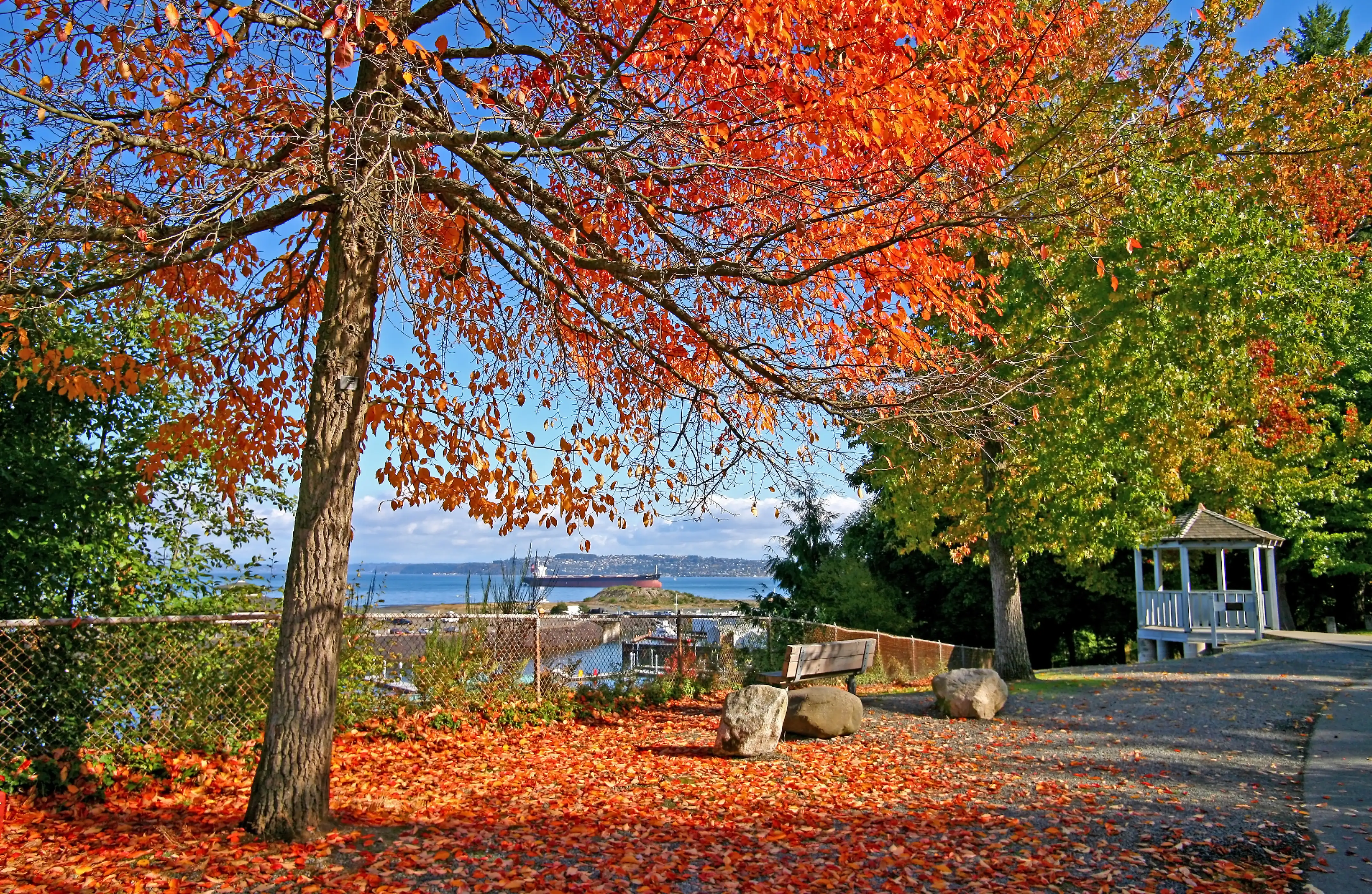
North End is Tacoma's most consistently desirable neighborhood — a dense collection of Craftsman bungalows, Victorian foursquares, and early 20th-century architecture perched above Commencement Bay with views that stop people mid-sentence. The median sold price runs between $630,000 and $720,000, homes typically receive four offers, and the average days-on-market hovers around two weeks. The downside is real, though: the neighborhood's popularity combined with limited inventory means that buyers on a strict budget get outcompeted repeatedly, and parking near Point Defiance and Ruston Way can border on chaotic on summer weekends.
Best for: Established buyers and families with kids who want architectural character, strong long-term appreciation, and proximity to Point Defiance Park.
No neighborhood in Tacoma commands attention the way Stadium District does. Stadium High School alone — a French château-style building with a 16,000-seat stadium carved into the hillside — is enough to make buyers who've never heard of Tacoma do a double-take. Single-family homes here are the most expensive in the city, with a median around $1.25 million, but the neighborhood also contains converted condos and smaller units that let buyers enter the zip code for considerably less. The trade-off is noise and urban friction: Stadium District sits close to downtown and the I-705 interchange, so buyers who need quiet should know what they're getting into before they fall for the architecture.
Best for: Luxury buyers, architecture enthusiasts, and buyers who want Link light rail access and walkability baked into their investment.
Proctor is Tacoma's most walkable neighborhood outside of downtown — a compact commercial strip along North 26th Street anchored by local restaurants, independent coffee shops, a beloved farmers market, and boutique retail that residents genuinely use rather than drive past. Home values cluster between $680,000 and $760,000, placing Proctor squarely in the upper-middle tier for Tacoma. The honest downside: the neighborhood's popularity has compressed inventory to the point where buyers need to move quickly, and the charming streetscape comes with limited parking on market days.
Best for: Walkability seekers, buyers who want a neighborhood-scale commercial district steps from home, and professionals who value community feel over square footage.
Old Town sits at the base of the ridge above Ruston Way, which makes it one of the few Tacoma neighborhoods where you can walk to the waterfront in under five minutes. The housing stock is a mix of restored Victorians and early-century bungalows, and the neighborhood has a tighter, more intimate feel than the North End despite similar architectural DNA. Prices here range from approximately $800,000 to $950,000-plus for single-family homes, and the primary downside for buyers isn't price — it's that the neighborhood's proximity to the waterfront trail means summer foot traffic on your block whether you want it or not.
Best for: Waterfront-oriented buyers, downsizers seeking character over square footage, and buyers who want Ruston Way access without paying Stadium District prices.
North Slope is Tacoma's largest historic district, encompassing 940 homes that represent an extraordinary concentration of late 19th- and early 20th-century residential architecture. Prices generally fall between $680,000 and $780,000, consistent with the broader North End premium. The neighborhood demands an honest look at maintenance: these homes are beautiful, but many haven't been fully updated, and buyers who underestimate renovation budgets often find the costs materially exceed what they planned for. Historic district designation also means exterior modifications require additional review.
Best for: Architecture enthusiasts, buyers who want preservation-grade character and are prepared for the ownership responsibilities that come with historic homes.
Northeast Tacoma is the city's most practical family neighborhood — newer housing stock, comparatively quieter streets, and proximity to East 72nd Street and SR-509 that makes commutes to Federal Way and the northern Kent employment corridor manageable. Median prices around $620,000 to $720,000 represent strong value given the neighborhood's trajectory, which has seen roughly 5% year-over-year appreciation even as other parts of the city softened. The honest downside is distance: Northeast Tacoma sits physically removed from the urban amenities that draw buyers to Proctor or Stadium District, and residents rely heavily on personal vehicles for most daily needs.
Best for: Families with school-age children, buyers who prioritize newer construction, and commuters with regular trips north toward Federal Way or Kent.
Central Tacoma is the city's most genuinely mixed-use middle ground — not as polished as Proctor, not as challenged as parts of Hilltop, but threading a corridor between the two with a median home price around $472,000 that sits just below the citywide figure. It's a neighborhood in transition: pockets of well-maintained mid-century homes sit alongside blocks that are still working through blight from prior decades. Buyers who do their due diligence block by block can find real value here, but the neighborhood lacks a coherent identity that makes blanket recommendations unreliable.
Best for: Midrange buyers willing to do neighborhood-level research, renters seeking transit access, and investors watching Tacoma's southward revitalization trend.
Hilltop is Tacoma's most talked-about neighborhood for buyers watching long-term appreciation plays. Entry-level homes start around $380,000, and the median runs approximately $448,000 — making it one of the city's most accessible owner-occupancy options. Hilltop sits directly adjacent to downtown, which makes it a natural candidate for continued investment as Tacoma's urban core matures. The trade-off buyers must weigh honestly is crime: Hilltop has historically posted higher property and violent crime rates than North End or Proctor, and that reality hasn't fully resolved despite visible reinvestment along MLK Jr. Way and the neighborhood's proximity to major transit.
Best for: First-time buyers and value-focused investors with a longer timeline and a realistic understanding of current neighborhood conditions.

Tacoma's neighborhood dynamics can significantly shape how your investment performs over time. Areas like the North End and Proctor District have shown consistent buyer demand, and well-priced homes there often receive multiple offers within days of listing — sometimes faster. The Stadium District attracts buyers drawn to its walkability and architectural character, with many move-in-ready homes finding buyers before they ever feel like they've been on the market long. Depending on condition and location, you're often looking at homes under $750,000 in these corridors, though that range shifts based on what the market is doing at any given moment.
Before you fall in love with a home on a tour, please talk to a lender first. Your full monthly obligation includes not just principal and interest, but property taxes, homeowner's insurance, and any HOA dues — and that combined number can look quite different from what a quick online calculator shows. I always encourage buyers to build a budget around what feels comfortable month to month, not simply the maximum a lender will approve. Being pre-approved means you can move with confidence when the right home in the right neighborhood appears.
Treating "North End" as a single uniform market. North End is a loose geographic label that covers several distinct micro-areas with meaningfully different character and price behavior. Homes on the bluff with direct Commencement Bay views command a premium that blocks four streets back simply don't. Buyers who make offers based on neighborhood-level comps without understanding the bluff premium versus interior street pricing often overbid in the wrong spots or lose on the properties that actually justified the price.
Underestimating the I-705 / SR-16 interchange effect. The downtown exits off I-705 and the SR-16 interchange near Proctor look manageable on Google Maps at 10 a.m. on a Tuesday. At 7:30 a.m. on a weekday, the Stadium Exit and the Sprague Avenue on-ramp can add 15–20 minutes to a Seattle commute that Google quotes at 45 minutes. Buyers relocating from outside the region consistently underestimate this chokepoint, particularly if they're planning to commute north more than two days a week.
Buying in Hilltop based on price per square foot without walking the specific block. Hilltop's overall trajectory is positive, but the neighborhood is not uniformly improving. The blocks closest to MLK Jr. Way and Tacoma's growing South Downtown arts corridor are genuinely different from the blocks further east or north near the I-705 ramps. A $420,000 Hilltop home can be a smart early-mover position or a frustrating ownership experience depending on a two-block radius, and buyers who evaluate only the ZIP code aggregate miss that distinction entirely.
Confusing Ruston and Browns Point with city-of-Tacoma neighborhoods. Ruston is technically a separate municipality entirely — a small city of roughly 900 people encircled by Tacoma — and Browns Point sits in unincorporated Pierce County. Both carry different tax structures, utility providers, and governance. Buyers who assume these are simply Tacoma neighborhoods and don't investigate the distinctions often face surprises after closing that are difficult to reverse.
| Area | Ideal For | Typical Rent Range | Trade-off |
|---|---|---|---|
| Downtown / Stadium District | Young professionals, walkability | $1,600–$2,400/mo | Street noise, urban density, limited parking |
| North End / Proctor | Families, longer-term renters | $2,000–$2,800/mo | Competitive market, limited rental inventory |
| Central Tacoma | Budget renters, transit riders | $1,300–$1,900/mo | Inconsistent block quality, limited walkable amenities |
| New Tacoma | First-time renters, value seekers | $1,200–$1,800/mo | Sparse nightlife and dining, car-dependent |
| Hilltop | Budget-first renters, creatives | $1,100–$1,700/mo | Higher crime rates require due diligence by block |
Local Expert Takeaway: If you're drawn to Tacoma's historic neighborhoods but find Stadium District single-family prices out of reach, spend a day walking Proctor and the North Slope before assuming you're priced out — the condo and townhome tiers in both areas still offer entry points in the $450,000–$550,000 range that retain the architectural character buyers come to Tacoma for. Northeast Tacoma is the neighborhood most worth watching for 2026 and 2027: newer stock, less buyer competition than North End, and an appreciation trend that's running opposite to the citywide softening. Whatever you do, tour your target block on a weekday morning before you make an offer — Tacoma's terrain and arterial noise vary dramatically within single neighborhood boundaries.
Looking to buy in Tacoma? Estimate your payment.
Enter your numbers to see an estimated monthly mortgage payment.
Estimate only. Excludes HOA fees and mortgage insurance.
Is Tacoma a good place for families?
Tacoma can be an excellent fit for families, but neighborhood selection matters more here than in most comparable cities. North End and Northeast Tacoma consistently rank as the top family areas — both offer safer streets, established neighborhood schools, and proximity to Point Defiance Park. Families who buy in those areas without factoring in school boundary lines, however, sometimes discover that the neighborhood vibe and the assigned school don't perfectly align.
What are the safest neighborhoods in Tacoma?
North End, Proctor District, and Northeast Tacoma consistently report lower crime rates than the citywide figures. Tacoma's overall violent crime rate runs at 7.4 per 1,000 residents, which is elevated relative to suburban Pierce County neighbors like University Place or Fircrest — but within Tacoma, the northern neighborhoods post considerably safer numbers than Hilltop, South End, or parts of Central Tacoma.
How does Tacoma compare to nearby cities for home prices?
Tacoma's $485,000 median sold price sits well below Seattle's current median of over $830,000 and meaningfully below Bellevue and the Eastside. Compared to immediate neighbors, Tacoma is generally priced similarly to or slightly below University Place and Lakewood, though Tacoma's premium northern neighborhoods easily exceed anything those cities offer. For buyers being priced out of Seattle and looking south, Tacoma's combination of price point and architectural character has no direct parallel in the South Sound.
Explore the full Tacoma series: Living in Tacoma · Is Tacoma Safe? · Cost of Living · Best Neighborhoods · Schools & Family Life · Youth Sports · Parks & Rec · Retiring in Tacoma