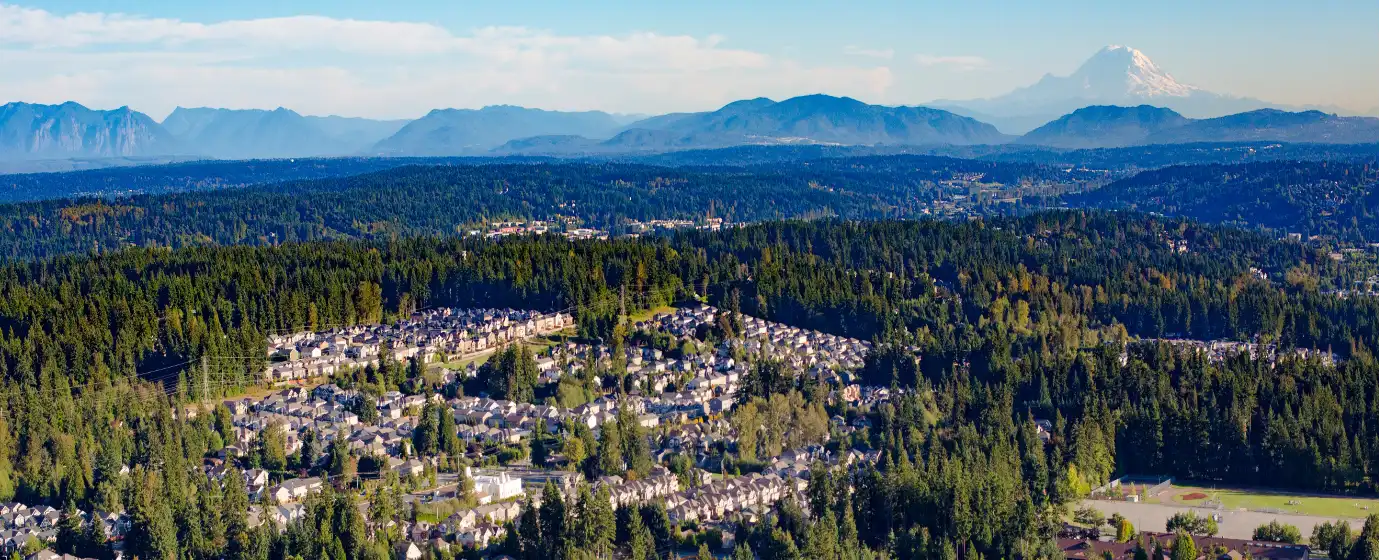
Puget Sound · Washington
Cost of Living in Bothell: Housing, Taxes, Utilities & Lifestyle (2026)
If you've been scanning Seattle-area real estate and landed on Bothell as a possible alternative, the first thing you need to recalibrate is your sense of "affordable." Bothell is one of the most desirable suburbs on the Eastside, and the prices reflect that. The median sold price sits at $970,000 as of spring 2026 — and while that's below what you'd pay for comparable square footage in Kirkland or Redmond, it is firmly in seven-figure territory. Buyers who come in expecting a discount on Seattle quickly discover they're shopping one of the most competitive suburban markets in the Pacific Northwest.
What shapes that price is straightforward: Bothell punches above its weight on every metric that matters to relocating families. The Northshore School District carries an A+ rating. Major employers like Seagen, AGC Biologics, and Lockheed Martin create strong local wage floors. The median household income here runs $140,427, and the city straddles both King and Snohomish counties — a geography that creates real variation in tax rates, school assignments, and even daily commute patterns depending on exactly where your home sits.
This guide breaks down what it actually costs to live in Bothell — housing by neighborhood, property taxes, utilities, commuting expenses, and how your total monthly outlay compares to what you'd spend in neighboring cities. Whether you're budgeting for a first purchase or trying to understand how a $970,000 price tag translates into a real monthly number, this is your starting point.

The median sold price of $970,000 in Bothell buys you something real: typically a 3- to 4-bedroom single-family home with a two-car garage, somewhere between 1,800 and 2,400 square feet, and a yard that's actually usable. At $493 per square foot, you're paying a premium over most of the region — but not the stratospheric premium of Bellevue or Mercer Island. Homes under $800,000 in Bothell are largely limited to older construction, fixer-uppers, or smaller footprints in more transitional pockets of town.
The market tempo is genuinely fast. Homes are selling in an average of nine days, and turnkey properties in Canyon Park or North Creek routinely draw three or more offers. Inventory has loosened slightly compared to 2024, which means buyers have a little more room to negotiate on inspection items — but don't mistake "more inventory" for "soft market." Homes priced right in desirable school zones still close above list. Buyers should factor in closing costs of $20,000–$30,000 on top of their down payment when building their budget.
Luxury pricing skews the city-wide averages significantly. The Bothell East enclave logged a median sold price of $1.5 million in early 2026, while Bothell West has been trending around $932,000. North Creek, with its newer construction and proximity to major tech employers, hit a 12-month median near $1.35 million — up dramatically year-over-year. The table below maps what different budgets realistically get you across the city.
| Budget Range | What You're Likely to Find |
|---|---|
| Under $700,000 | Condos, older townhomes, or fixer-upper ranchers in Maywood or Morningside |
| $700,000–$900,000 | Entry-level SFH, 2-3 BR, 1970s–1990s construction; may need updates |
| $900,000–$1.2M | 3-4 BR SFH, good condition, most neighborhoods; competitive multiple offers |
| $1.2M–$1.5M+ | Newer construction in North Creek, larger lots in Norway Hill, luxury finishes |
Bothell's property tax rate runs approximately 0.82%, which lands in the middle range for the Seattle metro — lower than what most King County cities carry, and a meaningful reason some buyers specifically target the Snohomish County portion of Bothell when they're crunching annual costs. On a home at the $970,000 median, that rate produces roughly $7,954 per year, or about $663 per month added to your housing payment. Washington's levy limit system caps annual increases at 1% for regular levies, giving homeowners a degree of predictability that many California and Texas transplants find surprising. Residents 61 and older may qualify for the state's senior property tax exemption program, which can significantly reduce or defer the annual bill depending on income thresholds.
Bothell's rental market sits firmly in the upper tier of the Seattle suburbs. The downtown core has seen the most new inventory in recent years — Emerald Crest and similar mixed-use developments along Main Street added apartment units with rooftop amenities that pushed rents well above what you'd pay in Mill Creek or Lynnwood for equivalent space. Canyon Park offers a broader range of rental options, including older garden-style complexes that provide the most accessible price points in the city.
| Unit Type | Average Monthly Rent |
|---|---|
| Studio | $1,600–$1,900 |
| 1-Bedroom | $1,900–$2,400 |
| 2-Bedroom | $2,400–$3,000 |
| 3-Bedroom | $3,000–$3,800 |
| Downtown 1-BR (newer builds) | $2,300–$2,600 |
Utilities in Bothell run close to Seattle-area averages. Puget Sound Energy provides electricity and natural gas service to most of the city, with monthly utility costs for a typical 2,000 square foot home running $150–$220 in non-peak months and $200–$300 during cold snaps in December and January when gas heat runs constantly. Internet service is widely available through Comcast/Xfinity and Ziply Fiber, with gigabit fiber plans running $60–$80 per month in most neighborhoods.
Bothell is a car-dependent city — full stop. Community Transit and King County Metro provide bus connections, and the Stride BRT service along SR-522 has improved north-south transit options meaningfully, but the reality is that most Bothell residents drive to work, to groceries, and to most daily errands. Commuting to Seattle takes roughly 50 minutes under normal conditions, though the SR-522/I-405 interchange near Bothell is one of the most reliably congested chokepoints in the region, particularly weekday mornings between 7:30 and 9:00 AM. Many residents heading to downtown Seattle time their departures before 7:00 AM to shave 15–20 minutes off that trip. Redmond and Kirkland are significantly more accessible — that commute runs 20–25 minutes in normal traffic — which is why Bothell has become a natural home base for employees at Amazon, Microsoft, and the biotech corridor along 148th Avenue.
Grocery access is solid throughout most of the city. Fred Meyer on Bothell-Everett Highway serves the Canyon Park corridor, and a QFC and Safeway cover the southern and central zones well. Whole Foods shoppers typically drive to Redmond or Woodinville, a gap that some buyers from denser metros find frustrating. Dining costs align with Seattle-suburb norms — a casual weeknight dinner for two runs $55–$85 at Bothell's downtown restaurants, with McMenamins Anderson School functioning as both a hotel, event venue, and dining destination that draws residents well beyond the immediate neighborhood.

One of the most useful things you can do before making an offer in Bothell is compare what the same budget gets you one city over. The table below shows where Bothell sits in the regional cost landscape.
| City | Median Home Price | Property Tax Rate | Avg Commute to Seattle | Notes |
|---|---|---|---|---|
| Bothell | $970,000 | 0.82% | 50 min | A+ schools, biotech hub |
| Kenmore | $870,000 | 0.98% | 45 min | Lower prices, less employer density |
| Woodinville | $1,050,000 | 0.95% | 55 min | Wine country feel, more rural |
| Kirkland | $1,200,000+ | 1.01% | 35 min | Closer to Seattle, significantly higher prices |
| Mill Creek | $850,000 | 0.95% | 55 min | Quiet, family-focused, newer construction |
| Lynnwood | $680,000 | 1.05% | 45 min | Most affordable nearby option; less prestige |
| Redmond | $1,150,000 | 0.95% | 40 min | Tech corridor, stronger appreciation |

From a lending standpoint, where you buy within Bothell matters more than most buyers realize when thinking about long-term value. Neighborhoods like Canyon Park and North Creek have seen consistent demand driven by proximity to major employers and strong school options, while Downtown Bothell continues attracting buyers who want walkability and a sense of community. Homes priced under $750,000 in these areas tend to generate multiple offers quickly — sometimes within days of listing — so being financially prepared isn't optional, it's essential.
That preparation starts with a real conversation with a lender before you ever schedule a tour. Your full monthly payment includes principal, interest, property taxes, homeowner's insurance, and potentially HOA dues depending on the community — and that total number can look quite different from what a basic online calculator shows. I always encourage buyers to focus on a payment that feels comfortable month to month, not simply the maximum a lender will approve. When the right home appears in a competitive market like Bothell, you want to move with confidence, not scramble to figure out the numbers.
This table models a typical monthly cost picture for a household purchasing at the $970,000 median with 10% down, in mid-2026 conditions.
| Expense Category | Monthly Estimate |
|---|---|
| Mortgage P&I (6.63%, 30-yr, $873,000 loan) | $5,620 |
| Property Tax (0.82% annually) | $663 |
| Homeowner's Insurance | $175 |
| HOA (where applicable — not universal) | $0–$300 |
| Utilities (gas, electric, water) | $180–$280 |
| Internet & Phone | $120–$160 |
| Groceries (family of 3–4) | $900–$1,200 |
| Transportation (2 cars, gas + insurance) | $700–$1,000 |
| Dining Out & Entertainment | $400–$700 |
| Childcare / After-School Activities | $800–$2,000 |
| Total Estimated Monthly | $9,558–$12,118 |
Washington has no state income tax, and for households earning $140,000+ annually, this is one of the most significant financial benefits of relocating here from California, Oregon, or the East Coast. A family in the $180,000–$200,000 income range moving from California to Bothell is effectively receiving a 9%–13% income boost simply by crossing the state line. The catch is that Washington funds state services through a higher sales tax — the combined state and local rate in Bothell runs approximately 10.5%, one of the higher combined rates in the region.
Washington's B&O (Business and Occupation) tax affects self-employed residents and small business owners differently than a traditional income tax, and professionals running side businesses or LLCs should understand that structure before assuming the "no income tax" story is entirely complete for their situation. For W-2 employees, however, the savings are direct and real. The state also offers a property tax deferral program for seniors and disabled homeowners who qualify by income — a meaningful benefit in a market where even modest homes generate $6,000–$8,000 in annual property taxes.
For buyers coming from high-tax states, Washington's combination of no income tax and a below-average property tax rate in the Bothell/Snohomish County zone creates a genuinely compelling financial picture. The absence of an estate tax exemption at lower thresholds than federal law is one area where estate planning attorneys often flag Washington, but for most working-age buyers, the tax environment here is one of the state's best features.
Local Expert Takeaway: Buyers fixating on Bothell's sticker price often overlook the total-cost math. When you account for Washington's no-income-tax environment, Bothell's 0.82% property tax rate — lower than Kirkland, Redmond, and most nearby cities — and the shorter commute to Eastside tech employers compared to further-out suburbs like Woodinville, the monthly cost picture is more competitive than the $970,000 headline suggests. If you're torn between Bothell and Kenmore, the deciding factor is usually the Northshore School District advantage and the biotech employer proximity — two things that hold value even when the broader market softens. Look hard at Morningside and the western Maywood corridor if you want to buy in Northshore SD at the low end of city pricing.
Looking to buy in Bothell? Estimate your payment.
Enter your numbers to see an estimated monthly mortgage payment.
Estimate only. Excludes HOA fees and mortgage insurance.
Is Bothell an expensive place to live?
Bothell is unquestionably a premium market — the $970,000 median home price places it well above national and statewide averages. That said, the combination of Washington's no state income tax, a below-regional-average property tax rate, and strong local wage levels means that total cost of living for a household earning near the city median compares favorably to similarly-priced cities in California, Colorado, or the Northeast.
How much do property taxes cost on a typical Bothell home?
At the city's 0.82% rate applied to the $970,000 median home price, annual property taxes run approximately $7,954 — or about $663 per month. Homeowners in the Snohomish County portion of Bothell may see slightly different levy breakdowns than those in the King County section, so your specific parcel location matters when building your budget.
How does Bothell's cost of living compare to Kirkland or Redmond?
Bothell is meaningfully less expensive than Kirkland, where median home prices run above $1.2 million, and less expensive than Redmond at around $1.15 million. The lower entry price in Bothell comes with a longer Seattle commute — roughly 50 minutes versus 35–40 from Kirkland — but Eastside commuters heading to Microsoft, Amazon's Bellevue campus, or the SR-522 biotech corridor often find Bothell the most cost-efficient option in the region.
Explore the full Bothell series: Living in Bothell · Is Bothell Safe? · Cost of Living · Best Neighborhoods · Schools & Family Life · Youth Sports · Parks & Rec · Retiring in Bothell