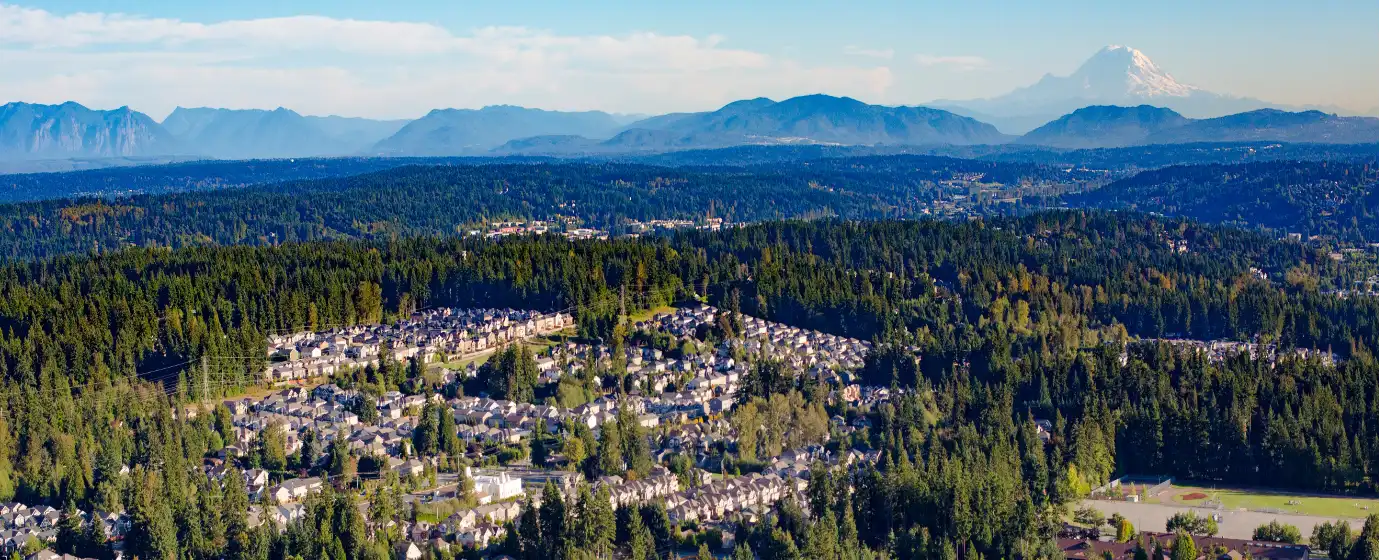
Puget Sound · Washington
Is Bothell Safe? Crime Rates, Safest Neighborhoods & Local Reality (2026)
Bothell doesn't fit the crime narrative that most people carry in from outside the Pacific Northwest. It's not a sleepy suburb where nothing ever happens, and it's not a cautionary tale. It sits somewhere more useful: a mid-sized, economically strong city where violent crime is genuinely rare and property crime clusters predictably around commercial corridors — which means where you live in Bothell matters more than whether you move to Bothell.
The numbers bear this out. Violent crime runs at roughly 2.6 incidents per 1,000 residents — a rate that local police data suggests is nearly 70% below the national average. Property crime, at around 13 per 1,000, is the more relevant concern for most households. But that figure is pulled upward by retail-dense zones like Canyon Park and Thrasher's Corner, where shoplifting and car prowls in parking lots generate the bulk of reported incidents. Strip those commercial areas out, and the residential picture looks considerably calmer.
This guide breaks down what those statistics mean at street level — which neighborhoods earn the highest safety grades, where the retail effect inflates the numbers, and what locals actually do to protect their property. If you're deciding between Bothell and a neighboring city, or choosing between two neighborhoods within Bothell, the picture here is more nuanced and more reassuring than a quick Google search might suggest.

The first thing to understand about Bothell's crime data is that different tools produce dramatically different conclusions — not because the underlying facts are disputed, but because of how crime rates are calculated. FBI-sourced data consistently suggests Bothell's overall crime rate runs about 30% below the national average. At the same time, some aggregate rating sites give the city middling marks because they weight property crime heavily and don't account for commercial-area distortions. Neither framing is wrong, exactly — but only one of them reflects what daily life feels like for residents.
What structurally shapes Bothell's numbers is the city's geography: a significant portion of reported crime originates in the western commercial corridors, where big-box retail clusters draw foot traffic and opportunistic theft. Residential neighborhoods east of SR-527 — the spine of the city — consistently report fewer incidents per capita, partly because of higher homeownership rates, lower transient foot traffic, and a demographic profile with low poverty rates hovering around 5%. Year-over-year trends are also moving in the right direction: property crime dropped roughly 37% in the most recent reporting period, while violent crime remained statistically rare.
For buyers and renters doing their homework, the practical takeaway is that Bothell's crime profile is heavily skewed toward property-related incidents rather than personal safety concerns. Theft, vehicle prowling, and occasional residential burglary make up the vast majority of reported crimes. The chance of being a victim of violent crime in any given year — based on commonly cited estimates from FBI-sourced data — runs approximately 1 in 910. That's not a guarantee, but it's a number that puts the city in genuinely favorable territory compared to most comparable Washington communities.
Violent crime in Bothell is low by any reasonable measure. Local police data suggests the rate sits around 2.6 per 1,000 residents, placing the city well below both Washington state and national benchmarks — roughly 59th percentile for violent crime safety among all U.S. cities according to available analyses. Bothell recorded zero homicides in the most recently reported year, and aggravated assault and robbery numbers remain small enough that most long-term residents never encounter a violent incident in their neighborhood. For a city of over 53,000 people with active commercial corridors and a university campus, that profile is worth noting.
Property crime is where Bothell earns more scrutiny — and where location within the city matters most. The citywide rate of roughly 13 per 1,000 is above average compared to all U.S. communities, but that figure reflects what happens in and around retail parking lots far more than what happens on residential cul-de-sacs. Vehicle prowls and retail theft in Canyon Park's commercial strip and the big-box zone near Thrasher's Corner are the dominant contributors. The residential neighborhoods tucked behind those business parks — the actual streets where families park in driveways and kids ride bikes — experience a significantly quieter reality.
Downtown has undergone a substantial transformation over the past decade, and the safety profile has tracked that investment. The Park at Bothell Landing, McMenamins Anderson School, and the Sammamish River Trail make this one of the more active pedestrian corridors in the city — which brings foot traffic but also the kind of natural surveillance that keeps neighborhoods accountable. Incidents here tend to be minor and opportunistic rather than predatory, and the presence of the UW Bothell campus nearby adds a layer of institutional activity that keeps the area lit and populated at most hours. Families walking to dinner and students heading to campus events are far more common than anything that should concern a buyer evaluating this area.
Best for: Buyers who want walkable access to restaurants, the river trail, and McMenamins without sacrificing a reasonable safety profile.
Canyon Park presents the clearest example of the retail-effect dynamic. The broader district earns a lower property crime grade than any other part of Bothell — driven almost entirely by the commercial strip along Canyon Park Road, where big-box stores and tech campuses generate consistent foot traffic and parking lot incidents. The residential pockets tucked behind the business parks, however, tell a different story: quiet streets, high homeownership rates, and a neighborhood feel that belies the commercial activity a few blocks away. The northwest section of Canyon Park is generally considered the calmest residential pocket. If you're evaluating a specific address here, distance from the main commercial arterial is the variable that matters most.
Best for: Tech workers who want a short commute and can identify a home on the right side of the commercial boundary.
This pocket earns the city's highest safety designation — an A+ grade across available neighborhood analyses — and the reasons are structural rather than coincidental. Queensborough and the adjacent Brentwood area are characterized by low cut-through traffic, a predominantly residential land use pattern, and limited commercial intrusion. Victimization risk here runs among the lowest in the city. These are streets where people know their neighbors, HOA activity is common, and the kind of opportunistic crime that plagues commercial zones simply has fewer entry points.
Best for: Families with school-age children and households prioritizing neighborhood quiet and residential consistency.
Norway Hill's elevated position — both literally and in terms of safety grades — gives it a natural buffer from the commercial corridors below. The area around Waynita and the Norway Hill parcels earned an A− grade in neighborhood-level analyses, placing it firmly in safe territory even if not at the absolute top of the city's rankings. The hills and winding roads that give this area its character also naturally limit cut-through traffic, which is one of the quieter drivers of residential security. Residents here tend to be long-tenured homeowners, and that stability shows in the neighborhood dynamic.
Best for: Buyers who want larger lots, wooded surroundings, and a lower day-to-day activity level than the flatter commercial zones.
Thrasher's Corner operates like Canyon Park does, only further north where SR-522 and I-405 traffic converges. The retail density along this corridor — grocery anchors, home improvement stores, and service businesses — generates the property crime numbers that elevate this section's aggregate grade to A−. That's still a safe designation by any national comparison, but the practical reality is that car prowls in parking lots happen here more than in purely residential areas. Residents living in the neighborhoods behind the main commercial strip experience a meaningfully quieter environment than the raw commercial-zone data suggests.
Best for: Households that prioritize convenience and access to SR-522 and don't mind proximity to commercial activity.
North Creek benefits from its position adjacent to North Creek Forest and the broader greenway corridor that runs through the eastern side of the city. The neighborhood is largely residential, with the kind of tree-lined streets and trail access that attracts long-term residents rather than transient populations. Safety grades for this corridor track with the eastern Bothell pattern: consistently above average, with property crime rates well below what the city's aggregate numbers might suggest. Violent crime in this part of the city runs at the lower end of already-low citywide figures — for violent crime specifically, the north section of Bothell sees the fewest incidents of any directional quadrant.
Best for: Outdoor-oriented households who want trail access from the front door and a neighborhood with low turnover.

| City | Violent Crime/1K | Property Crime/1K | Overall Safety Profile |
|---|---|---|---|
| Bothell | ~2.6 | ~13 | Strong residential safety; property crime elevated by retail zones |
| Kenmore | ~1.8 | ~11 | Quieter, smaller commercial footprint; consistently low across categories |
| Woodinville | ~1.5 | ~9 | Among the lower crime profiles in the Eastside corridor |
| Kirkland | ~2.9 | ~17 | Larger city with more commercial density; higher absolute numbers |
| Mill Creek | ~1.2 | ~8 | One of the safer suburban profiles in Snohomish County |
| Redmond | ~2.4 | ~14 | Tech corridor brings commercial activity; comparable to Bothell overall |
| Lynnwood | ~4.8 | ~28 | Higher crime across categories; reflects denser commercial and transit activity |

When buyers are researching safety in Bothell, they're often unknowingly doing their homework on long-term value at the same time. Neighborhoods like Canyon Park and North Creek consistently draw attention for their lower crime profiles, and that reputation shows up in buyer demand — well-maintained homes in these areas routinely go under contract within days, not weeks. Norway Hill has a similar story, with its quieter residential feel attracting families who plan to stay put. If you're targeting something under $750,000 in these pockets, you need to be financially ready before you start touring, because hesitation is costly in a market this competitive.
That's exactly why I encourage buyers to connect with a lender well before they fall in love with a home. Your approval amount and your comfortable budget are two different numbers, and the gap between them becomes real when you factor in property taxes, homeowner's insurance, any HOA dues, and how your loan is structured. Understanding your full monthly picture ahead of time means you can move confidently when the right home in the right neighborhood appears — and in Bothell, that window closes fast.
The most important thing a Bothell safety conversation tends to skip is the distinction between the SR-522 corridor west of I-405 and the neighborhoods east of it. The western commercial strip — Thrasher's Corner, the big-box zone along Canyon Park Road, and the retail clusters near the Bothell-Everett Highway — accounts for a disproportionate share of the incidents that land in aggregate crime data. Locals who've lived here more than a year know this without thinking about it. People moving in from out of state often don't, and it leads to overcorrection in either direction: either dismissing the data entirely or applying commercial-zone risk to streets that don't warrant it.
What locals actually do is straightforward. They don't leave valuables visible in vehicles — not because Bothell is dangerous, but because vehicle prowls in parking lots and on street-adjacent residential blocks are the most common property crime category in any moderately active suburban city. Residents near the Canyon Park commercial strip are more consistent about this habit than those in Queensborough or Norway Hill, where the issue is less frequent. The Bothell Police Department's Community Crime Reduction Team is genuinely active — they maintain a public ArcGIS dashboard where anyone can pull current crime patterns by location — and locals who use it tend to be better calibrated about actual risk than those relying on aggregate city grades alone.
One thing that surprises many people six months in: how quiet the residential streets feel relative to what the city's commercial activity level might suggest. The presence of AGC Biologics, Seagen, and the UW Bothell campus brings a working, educated population that is broadly invested in neighborhood stability. That demographic reality is one of the better predictors of residential safety that doesn't show up on any crime map.
Local Expert Takeaway: If you're choosing a neighborhood in Bothell with safety as a priority, the eastern residential areas — Queensborough, North Creek, and the streets behind Canyon Park's business parks — offer the strongest combination of low crime grades and residential character. Avoid using citywide aggregate scores to evaluate specific addresses; the difference between a home on a quiet cul-de-sac in Brentwood and one adjacent to a commercial arterial in the Canyon Park corridor is significant and won't show up in zip-code-level comparisons. Pull the Bothell PD's public crime dashboard and look at the six-block radius around any address you're seriously considering.
✅ Bothell's violent crime rate runs roughly 70% below the national average — based on FBI-sourced data, making personal safety concerns a low-priority factor for most households considering a move here.
⚠️ Property crime is the real story, and it clusters heavily around the western commercial corridors near Canyon Park Road and SR-522. Residential neighborhoods east of the freeway run significantly lower numbers.
📍 All 16 of Bothell's analyzed neighborhoods earned an A-range safety grade in the most recent neighborhood-level analysis — a fact that rarely makes it into the summary statistics that aggregate sites publish.
Is Bothell a safe place to live?
Yes, Bothell is broadly considered a safe community by Washington state standards. Violent crime is well below both state and national averages, and the residential neighborhoods that make up the bulk of the city's housing stock consistently earn top safety grades. Property crime is more common, particularly in commercial zones, but residents who take basic precautions with vehicles and valuables report few issues.
What is the most common crime in Bothell?
Property crime — specifically vehicle prowls, retail theft, and occasional residential burglary — dominates Bothell's incident reports. These crimes are concentrated in and around the city's commercial corridors rather than distributed evenly across residential streets. Violent crime makes up a small fraction of total incidents and has remained low across recent reporting years.
How does Bothell compare to other Eastside cities for safety?
Bothell is broadly comparable to Kirkland and Redmond in overall safety profile, with somewhat higher property crime numbers than quieter neighbors like Mill Creek and Woodinville. The gap between Bothell and those cities largely reflects commercial density rather than residential risk. Against Lynnwood to the north, Bothell comes out considerably safer across every major crime category.
Explore the full Bothell series: Living in Bothell · Is Bothell Safe? · Cost of Living · Best Neighborhoods · Schools & Family Life · Youth Sports · Parks & Rec · Retiring in Bothell