Eastern Washington · Washington
Cost of Living in East Wenatchee: Housing, Taxes, Utilities & Lifestyle (2026)
The first thing that surprises people who've been researching Eastern Washington is how East Wenatchee lands on the cost-of-living index. It's not a cheap small town — the overall index sits around 17% above the national average, with housing running roughly 38% higher than national benchmarks. But compared to where most relocating buyers are coming from — Seattle, the Bay Area, Southern California — that number still feels like a discount. The key is understanding what you're actually getting for those dollars, and where the real value is hiding.
What shapes the cost picture here is a combination of geography, industry, and Washington's tax structure. The Wenatchee Valley's agricultural economy and mid-size city infrastructure keep costs grounded in ways that Puget Sound metros simply can't replicate. No state income tax, a relatively modest property tax rate, and a housing market where the median sold price sits at $490,447 — these are the pillars of the financial case for East Wenatchee.
This guide breaks down every major cost category: what you'll pay to buy or rent, what utilities and transportation actually run, how property taxes compare across the region, and what a realistic monthly budget looks like for a household at the median income. Whether you're comparing East Wenatchee against Wenatchee proper or trying to understand whether your budget can stretch this far from the coast, the numbers are all here.
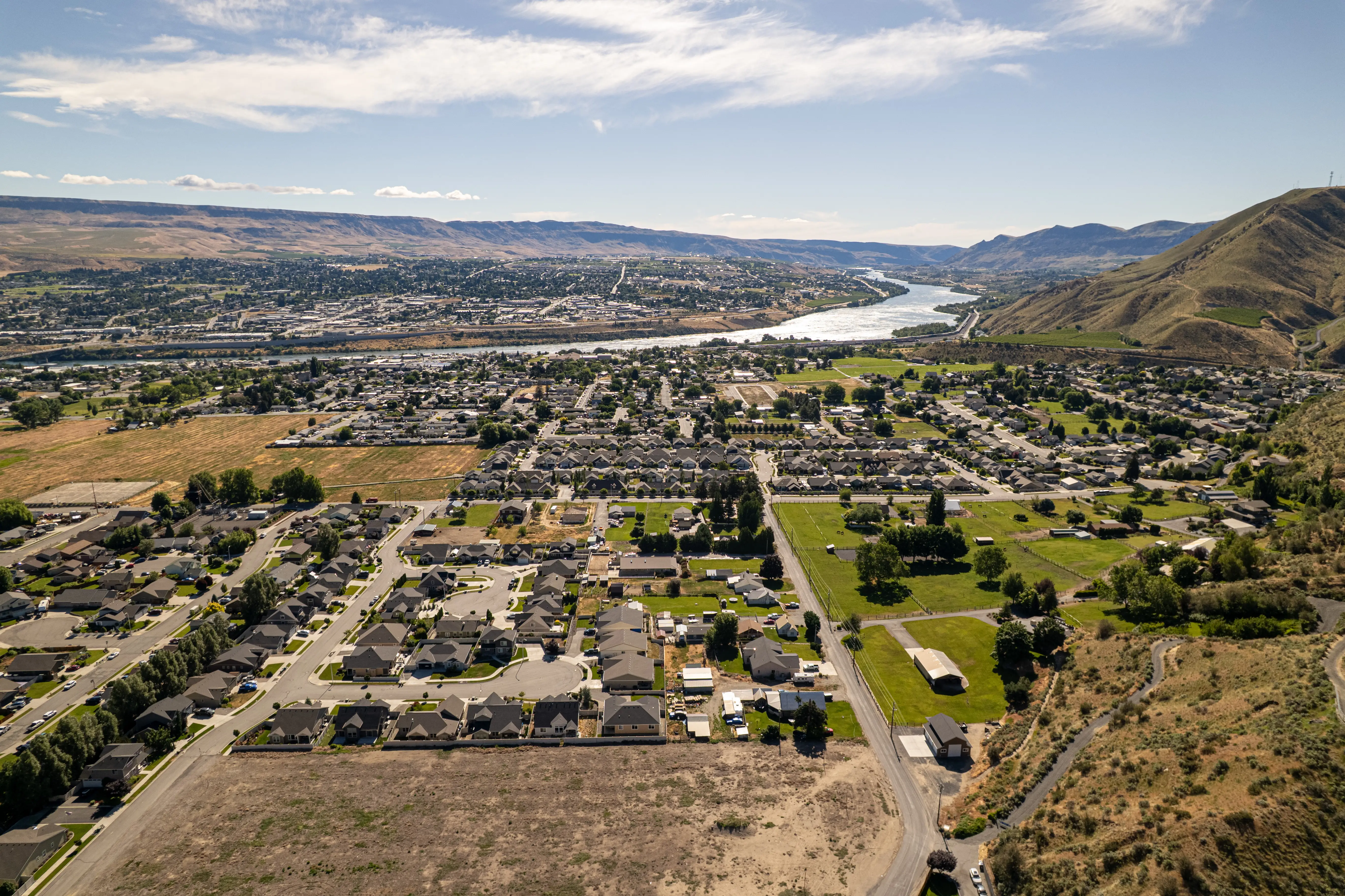
The median sold price in East Wenatchee — $490,447 as of mid-2026 — puts a three-bedroom, two-bath home squarely within reach for households earning in the $80,000–$100,000 range, especially with Washington's lack of state income tax padding the monthly cash flow. At that price point, buyers are typically looking at homes built in the late 1970s through early 2000s: ranch-style layouts, modest lots, and established landscaping. Newer construction, concentrated in developments like Maryhill Estates, starts in the low-to-mid $400,000s for base configurations and climbs toward $590,000 and above for larger or premium-spec builds.
The market moves fast. The average days on market has compressed dramatically — well-priced homes routinely go pending within a week, and competitive listings see multiple offers within days. Buyers who arrive expecting a leisurely search often find themselves making decisions quickly. That tempo rewards buyers who are pre-approved, flexible on closing timeline, and prepared to move on a home without extensive contingencies.
The per-square-foot cost on sold homes runs approximately $266, which gives a realistic baseline for what you're buying. At that rate, a 1,800-square-foot home lands right around the median; step up to 2,200 square feet and you're looking at $585,000 or higher, depending on finishes and neighborhood.
| Budget Range | What You Can Expect |
|---|---|
| Under $350,000 | Very limited inventory; older manufactured homes, fixer-uppers, or smaller condos |
| $350,000–$450,000 | Entry-level single-family homes, older construction, some updating needed |
| $450,000–$550,000 | Solid mid-range inventory; 3-bed/2-bath, established neighborhoods |
| $550,000+ | Newer construction, larger lots, premium finishes, Maryhill-area subdivisions |
Douglas County's effective property tax rate sits at 0.87%, which translates to approximately $4,267 annually on the $490,447 median — or roughly $356 per month added to your housing cost. Washington's levy limit system caps annual increases at 1% unless voters approve higher levies, which gives homeowners a meaningful degree of predictability in a market where other costs can shift unpredictably. For buyers aged 61 and older, Washington's senior property tax exemption program can significantly reduce that annual bill based on income thresholds — worth researching before closing if you're near retirement age or already there.
Rental inventory in East Wenatchee skews toward single-family homes and smaller apartment complexes rather than large institutional buildings. About 41% of the city's occupied housing units are renter-occupied, which means a meaningful supply of rentals exists — but availability tightens considerably in the spring and summer when agricultural employment peaks and relocation activity picks up.
| Unit Type | Estimated Monthly Rent |
|---|---|
| Studio | $1,200–$1,400 |
| 1-Bedroom Apartment | $1,450–$1,600 |
| 2-Bedroom Apartment | $1,650–$1,900 |
| 3-Bedroom Apartment | $2,100–$2,400 |
| 3-Bedroom House | $2,100–$2,600 |
| 4+ Bedroom House | $3,200–$3,800 |
Utilities in East Wenatchee benefit from the Columbia River's hydroelectric infrastructure, which keeps electrical rates below the national average. Chelan County PUD and Douglas County PUD are among the lower-cost public utilities in the state. A typical month of electricity, gas, water, and trash for a 1,500–2,000 square foot home runs in the $150–$220 range depending on season — summers are warm and dry enough that air conditioning is a real cost driver from June through September.
Transportation is car-dependent, full stop. East Wenatchee's walkability score is low; most errands require a vehicle. The commute to Wenatchee proper — where most major employers, medical facilities, and retail are concentrated — runs about five minutes under normal conditions, but the Wenatchee River bridges and the 9th Street corridor can back up during peak hours. Residents average two cars per household, and that's a realistic minimum for most families. Link Transit provides bus service connecting East Wenatchee to Wenatchee, but most residents rely on personal vehicles for daily movement.
Grocery and dining access is solid by Eastern Washington standards. The Wenatchee Valley supports a full Costco, multiple full-service grocery stores, and a growing restaurant scene centered primarily in Wenatchee. East Wenatchee's own commercial corridors along 9th Street NE and Valley Mall Parkway offer day-to-day retail without requiring a bridge crossing. Dining out for two at a mid-range restaurant typically runs $50–$75; coffee shops, fast casual, and regional chains are all represented within a short drive.
The broader cost picture on daily expenses: groceries run approximately 7% above national averages, transportation costs about 31% higher than the national benchmark (driven by fuel and car ownership costs), and healthcare comes in roughly 17% above average. These aren't outliers for the Pacific Northwest, but they're worth factoring into a full monthly budget beyond just housing.
| City | Median Home Price | Property Tax Rate | Commute to Wenatchee | State Income Tax | Notable Feature |
|---|---|---|---|---|---|
| East Wenatchee | $490,447 | 0.87% | 5 min | None | Columbia River access, newer growth |
| Wenatchee | ~$525,000 | ~0.90% | 0 min | None | City center, more walkable, hospital campus |
| Cashmere | ~$430,000 | ~0.85% | 20 min | None | Small-town feel, Chelan County |
| Rock Island | ~$340,000 | ~0.80% | 15 min | None | Very small, rural, limited services |
| Quincy | ~$310,000 | ~0.78% | 45 min | None | Agricultural base, data center corridor |
| Malaga | ~$470,000 | ~0.85% | 12 min | None | Orchard country, rural residential |
| Sunnyslope | ~$460,000 | ~0.86% | 10 min | None | Residential hillside, Wenatchee adjacency |

Location within East Wenatchee genuinely shapes long-term value in ways that go beyond the purchase price. Neighborhoods like Maryhill Estates and Highlander tend to attract steady buyer interest thanks to their views, lot sizes, and proximity to amenities — and well-priced homes there rarely sit long before receiving multiple offers. Sage Brooke offers a slightly different feel but draws similar attention from buyers looking for value in a growing market. Most desirable single-family homes across East Wenatchee are moving well under $750,000, though that window shifts quickly when inventory tightens. Understanding where you want to be geographically before you start seriously shopping helps you move with confidence when the right property appears.
Before you tour a single home, sit down with a lender and talk through the full monthly payment picture — not just principal and interest, but property taxes, homeowner's insurance, and any HOA dues that apply to a specific neighborhood. Your comfortable monthly budget and your maximum approval number are rarely the same figure, and building your search around the former protects you financially long after closing day. East Wenatchee moves fast enough that buyers who've already had that conversation
This budget models a household purchasing at the $490,447 median price with 10% down — a $441,402 loan at current rates.
| Expense Category | Estimated Monthly Cost |
|---|---|
| Mortgage (principal + interest) | $2,680–$2,850 |
| Property Taxes | $356 |
| Homeowner's Insurance | $110–$140 |
| HOA (where applicable) | $0–$75 |
| Electricity, Gas, Water, Trash | $160–$220 |
| Internet + Phone | $130–$160 |
| Groceries (family of 3–4) | $650–$850 |
| Transportation (2 vehicles) | $600–$800 |
| Dining Out & Entertainment | $300–$500 |
| Healthcare (premiums + out-of-pocket) | $400–$600 |
| Childcare or School Expenses | $0–$800 |
| Total Estimated Monthly | $5,386–$7,251 |
Washington's most significant financial advantage for residents is the absence of a state income tax — and it's not a small advantage. A household earning $90,000 in California pays upward of $5,000–$6,000 in state income tax annually. In Washington, that figure is zero. That structural difference affects everything from take-home pay to retirement income, and it's one of the primary reasons retirees and remote workers have been drawn to the state at accelerating rates.
Washington funds its services through sales tax, which runs at approximately 8.7% in Douglas County. Property taxes, as noted, carry a 1% annual levy increase cap under state law. The combination creates a tax environment that's notably favorable for earners but somewhat less friendly for high-consumption households — if you're buying a lot of goods or services, the sales tax adds up. For retirees living on investment income or Social Security, Washington's tax profile is particularly attractive since there's no tax on those income streams at the state level.
Washington also maintains a property tax deferral program for qualifying seniors and disabled residents — separate from the senior exemption mentioned in the property tax section — that allows homeowners to defer annual property tax payments as a lien against the property, repaid when the home is sold or ownership changes. For cash-flow-constrained retirees, it's a meaningful safety valve worth understanding before assuming property taxes are an unavoidable fixed monthly cost.
Local Expert Takeaway: The buyers who find the best value in East Wenatchee are the ones who move quickly and focus on the $450,000–$530,000 range where inventory is most concentrated. Don't waste time waiting for prices to drop significantly — the combination of fast days-on-market and no state income tax means your effective purchasing power here is stronger than raw price comparisons suggest. If you're comparing against Wenatchee proper, the $30,000–$40,000 savings on median price across the river often outweighs any perceived amenity difference, especially for households prioritizing newer construction or larger lots.
Looking to buy in East Wenatchee? Estimate your payment.
Enter your numbers to see an estimated monthly mortgage payment.
Estimate only. Excludes HOA fees and mortgage insurance.
Is East Wenatchee affordable compared to the rest of Washington?
Yes, relative to the state's western cities, East Wenatchee is meaningfully more affordable. The $490,447 median price is roughly 40–50% below Seattle-area equivalents, and the absence of state income tax adds effective spending power that doesn't show up in raw cost-of-living comparisons. The city runs about 17% above the national average overall, but households coming from high-cost metros consistently find their dollars go further here.
What are property taxes like in East Wenatchee?
Douglas County's effective rate of 0.87% translates to approximately $4,267 per year on the median-priced home — around $356 monthly. That's competitive for Washington state, and the 1% annual levy increase cap built into state law limits how quickly that number can climb. Seniors aged 61 and older may qualify for a meaningful exemption that can reduce the annual bill substantially based on household income.
How does East Wenatchee compare to Wenatchee for cost of living?
The two cities are tightly linked — a five-minute commute separates them — but East Wenatchee tends to offer slightly lower home prices (roughly $30,000–$40,000 below Wenatchee's median), newer housing stock concentrated in its northern and eastern developments, and comparable access to the same employers, schools, and amenities. Wenatchee offers more walkable urban access and the medical campus; East Wenatchee offers more room, newer builds, and modest price relief on the other side of the river.
Explore the full East Wenatchee series: The Ultimate East Wenatchee Relocation Guide · Is East Wenatchee Safe? · Cost of Living in East Wenatchee · Best Neighborhoods in East Wenatchee · East Wenatchee Schools & Family Life · East Wenatchee Youth Sports · East Wenatchee Parks & Recreation · Retiring in East Wenatchee · 1031 Tax-Deferred Exchange in East Wenatchee · East Wenatchee First-Time Homebuyers Guide · East Wenatchee Down Payment Assistance Guide · Moving to East Wenatchee from California