Puget Sound · Washington
Moving to Mukilteo from California: The Honest Comparison (2026)
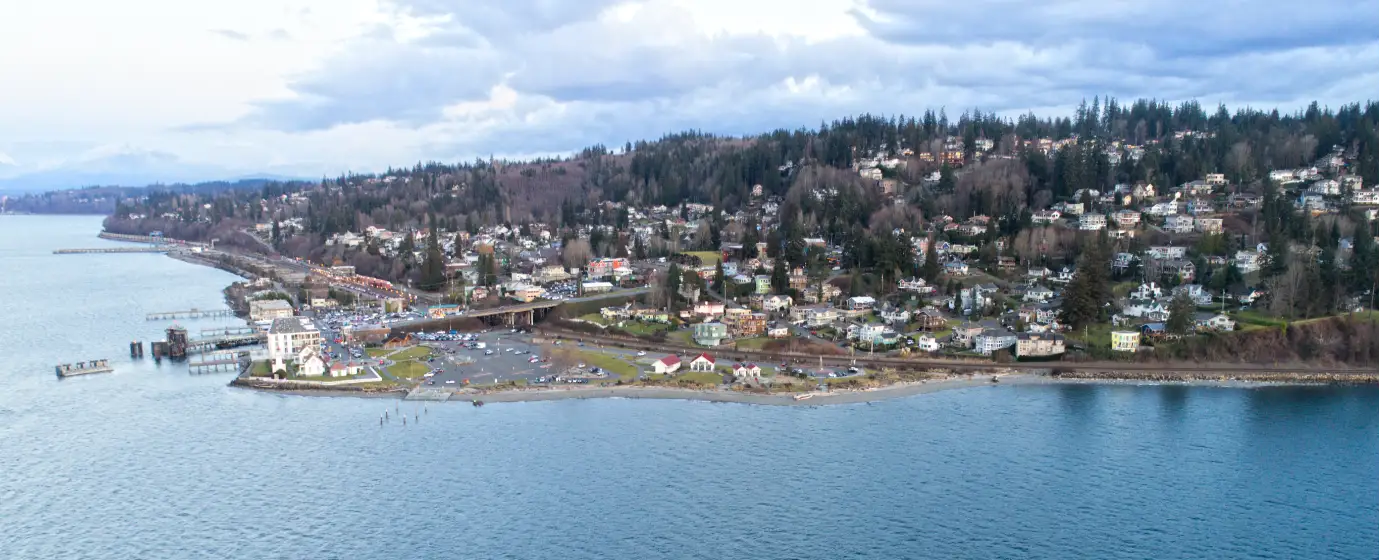
The Bay Area software engineer who finally got a yard — and kept their San Francisco salary — is one of the most common California-to-Mukilteo stories of the past five years. The San Diego family who stopped dreading their summer utility bill and started noticing they hadn't seen wildfire smoke in months. The Sacramento buyer who closed on a four-bedroom home with a Puget Sound view for less than their Elk Grove townhome cost. What pulls these buyers to Mukilteo specifically isn't just the price arithmetic — it's that Mukilteo sits on a bluff above Possession Sound, 35 minutes from Seattle, with a waterfront lighthouse, a real downtown, and some of the best public schools in Snohomish County. It punches above its 21,000-person weight class in ways that matter to California buyers who are done settling.
The hard part deserves equal billing. Mukilteo is not California, and the gaps are real. Rain falls for roughly 173 days a year here. December delivers fewer than two hours of daily sunshine. The food scene doesn't have the depth of San Jose or Los Angeles, and the cultural diversity most Bay Area residents take for granted feels thinner the farther north you get from Seattle. California transplants who arrive without knowing this often spend their first winter questioning every choice they made.
This guide exists to close that information gap. It walks through cost comparisons by California region, what your home equity actually buys here, the complete tax picture, the lifestyle reality, and common mistakes California buyers make in this specific market. There's also an interactive comparison tool at the end so you can plug in your exact California city and see the numbers side by side.

| Mukilteo, WA | Bay Area | Southern CA | Sacramento Metro | Central Valley | |
|---|---|---|---|---|---|
| Median Home Price (approx. 2026) | $863,937 | $1.45M–$1.7M+ | $630K–$942K | $520K–$620K | $340K–$450K |
| Property Tax Rate (effective) | ~0.93% | ~1.1%–1.2% | ~1.1%–1.25% | ~1.0%–1.15% | ~1.0%–1.1% |
| State Income Tax | None | Up to 13.3% | Up to 13.3% | Up to 13.3% | Up to 13.3% |
| State Sales Tax | 6.5% + local (~10.1%) | 7.25% + local (~8.5–10.25%) | 7.25% + local (~8.5–10.5%) | 7.25% + local (~8.75%) | 7.25% + local (~7.25–9%) |
| Avg Utilities (monthly est.) | ~$180–$220 | ~$200–$260 | ~$220–$300 | ~$200–$280 | ~$220–$320 |
| Avg 1BR Rent | ~$1,800–$2,200 | ~$2,800–$3,800 | ~$2,200–$3,000 | ~$1,600–$2,100 | ~$1,100–$1,500 |
The sales tax difference partially offsets that advantage — the Mukilteo area runs around 10.1% combined, which is real money on large purchases. But on any income above $80,000, the net math still tilts sharply in Washington's favor. Most California transplants who've been here a year describe the income tax savings as the financial change that surprised them most — because it shows up every single paycheck, not just at tax time.
Washington has no state income tax — one of only nine states — and for California transplants, this is not a footnote. It's the primary financial headline.
| Tax Item | California | Washington | Net Impact for Transplant |
|---|---|---|---|
| State Income Tax ($120K income) | ~$9,800–$10,500/yr | $0 | +$9,800–$10,500 annually |
| State Income Tax ($150K income) | ~$13,000–$14,500/yr | $0 | +$13,000–$14,500 annually |
| State Income Tax ($200K income) | ~$19,000–$22,000/yr | $0 | +$19,000–$22,000 annually |
| Capital Gains Tax (above $262K/yr) | Up to 13.3% | 7% (WA state) | Favorable for most |
| Property Tax (on $863,937) | Varies — newly purchased ~1.1%+ | ~0.93% | ~$1,500–$1,800 savings/yr |
| Senior Property Tax Exemption | Limited | Yes, age 61+, income-based | Meaningful for retirees |
California's property taxes are famously complex: a longtime homeowner benefits from Proposition 13 rate compression, but a buyer purchasing at today's California prices pays a rate that often runs 1.1% to 1.25% of the new purchase price. At $863,937, Mukilteo's 0.93% effective rate saves that buyer roughly $1,500–$1,800 annually compared to the same purchase price in California. Stack that against the income tax advantage, and the total annual financial improvement for a $150,000 household is commonly in the $13,000–$16,000 range — which, in monthly cash flow terms, is transformative.
A buyer leaving Palo Alto, Saratoga, or the Piedmont hills with $1.5 million in equity is shopping Mukilteo with one of the most powerful positions in the Pacific Northwest market. At the city's median price, that equity eliminates the mortgage entirely — and in neighborhoods like Boulevard Bluffs, where the median sold price runs approximately $1.17 million, they're paying cash for one of the best-located properties in the city with money left over. Harbour Pointe, Mukilteo's most established master-planned community, offers golf course frontage, Puget Sound views, and turnkey construction that Bay Area buyers often find compares favorably to comparable Marin County stock at a fraction of the price.
The buyers leaving San Jose with $1.8 million or more are increasingly competing for waterfront and bluff-top properties that genuinely don't exist in quantity anywhere in the region. Old Town Mukilteo's lighthouse-adjacent homes and the Chennault Beach corridor occasionally surface properties in the $1.1M–$1.4M range with views across Possession Sound to Whidbey Island — the kind of setting that would trade at $4 million or more in a comparable California coastal location. For this equity tier, the question isn't affordability — it's figuring out which Mukilteo neighborhood matches their lifestyle.
A buyer selling in Pasadena, Irvine, or the South Bay with $900,000 in equity is entering Mukilteo at the top of the market. That equity level — paired with a strong down payment — puts them comfortably into Harbour Pointe, Harbour Heights, or the Olympic View corridor, where well-maintained single-family homes in the $850,000–$1.1 million range trade regularly. They are unlikely to need jumbo financing, which simplifies the purchase considerably.
The Southern California buyer who sold a Torrance or Anaheim Hills home at $850,000 and walks away with $650,000–$750,000 after costs has still cleared enough to make a 30–40% down payment in Mukilteo — well above conventional thresholds and sufficient to access competitive rate tiers. What surprises these buyers is that $700,000–$900,000 in Mukilteo buys genuine square footage: 2,200–2,800 square feet is realistic at that price in several neighborhoods, compared to the sub-1,600-square-foot homes at comparable prices in Irvine or Redondo Beach.
This equity tier is where the math gets interesting but requires more planning. A buyer leaving Folsom or Roseville with $500,000 in equity can put 40–50% down on a Mukilteo home at the city-wide median price, which sharply reduces their monthly payment — and the elimination of California's income tax starts covering what would have been mortgage interest. The Paine Field–Lake Stickney corridor and the Holly neighborhood offer entry-level options in the $700,000–$800,000 range, which is where this buyer tier most commonly lands.
The Inland Empire buyer leaving Rancho Cucamonga or Murrieta with $400,000 in equity is working with a tighter but still workable margin. At a 30–35% down payment in Mukilteo, their monthly payment increases from their California home — but the income tax savings frequently compress that gap to near-neutral. The WSHFC Home Advantage program may also be relevant for households whose purchase falls within program price limits, providing additional down payment support.
A buyer leaving Fresno, Bakersfield, or Stockton with $350,000 in equity is making the most significant financial stretch of any California tier — but they're also making the most significant lifestyle upgrade. In Mukilteo's lower price bands, $700,000–$780,000 buys solid construction in established neighborhoods that would be essentially unobtainable in any comparable waterfront Pacific city. The Norma Beach area and portions of the Paine Field–Lake Stickney corridor represent the most accessible entry points, and at $350,000 down, a buyer in this range is still putting down more than 40%.
What makes the move financially defensible at this equity level isn't just the housing delta — it's the compounding annual income tax advantage. A Central Valley household earning $90,000 between two incomes is saving $6,000–$8,000 annually in state income tax. Over five years, that's $30,000–$40,000 in cumulative tax savings — roughly the equivalent of a second down payment working in their favor.

The single honest thing a friend three years into Mukilteo life will tell you: the winters are genuinely hard if you're not prepared. Rain falls on roughly 173 days per year. December gives you fewer than two hours of sunshine daily on average, compared to six or more in Sacramento and nine in San Diego. Los Angeles gets approximately 3,250 hours of sunshine annually; Mukilteo gets around 2,180. That gap lives in November through February, when the Pacific sky turns a uniform gray that takes most Californians a full year to make peace with.
The summer counter-narrative is real and compelling. July in Mukilteo averages around 73°F with nearly no humidity, about 312 hours of sunlight for the month, and almost no wildfire smoke in most years. For the Southern California family who spent August 2021 keeping their kids inside with air purifiers running, the contrast is visceral and meaningful. The outdoor culture shifts with the seasons in a way California transplants don't fully anticipate — Mukilteo residents hike in the rain, kayak in overcast conditions, and generally keep moving in ways that don't map to California's sun-dependent outdoor culture. The adjustment takes most people one full winter to complete.
What transplants genuinely love after a year: the summers without air conditioning, the Mukilteo Beach access in August, the lack of traffic relative to any Bay Area or LA commute, and the quiet that comes from a 21,000-person waterfront city rather than an anonymous suburban sprawl. What they genuinely miss: year-round beach access that requires actual swimming, the restaurant and cultural depth of San Jose or San Francisco, the social energy and ethnic diversity of large California metros, and — this one surprises people — the California winter sun that kept their spirits up even when it was cold.
If you want to see how Mukilteo stacks up against the specific city you're leaving, the tool below covers 120 California cities with current housing, tax, and cost-of-living data side by side.
Home prices: Redfin median sale data, Q1–Q2 2026. Select your city to compare.
Ready to talk through what your specific California equity could do in Mukilteo? Todd can model your exact scenario in a single call.

Mukilteo's neighborhoods don't all appreciate at the same pace, and that matters when you're relocating from California thinking long-term. Harbour Pointe tends to hold strong resale value given its amenities and community feel, while Old Town Mukilteo carries a certain character that draws buyers who want walkability to the waterfront — those homes rarely sit long. Boulevard Bluffs also gets consistent attention from buyers coming from the Bay Area or Southern California who want views and a quieter setting. Well-priced, move-in-ready homes across these areas — particularly anything under $750,000 — can move within days, not weeks, so being financially prepared isn't optional, it's the whole strategy.
That's exactly why I encourage California transplants to talk with a lender before they start touring homes. You need to see your full monthly payment picture — loan structure, property taxes, homeowner's insurance, and any HOA dues together — not just the purchase price. California buyers sometimes underestimate how those pieces stack up differently here. Getting pre-underwritten also means when the right home in Harbour Pointe or Old Town appears, you're positioned to move
Mistake 1: Treating Mukilteo as a uniform market. There's a significant character divide between Old Town Mukilteo — walkable, historic, tight lots, water proximity — and the master-planned sprawl of Harbour Pointe on the plateau above. Buyers who tour Harbour Pointe first and assume they've seen Mukilteo often miss the waterfront neighborhoods entirely, which trade in a different register and attract a different buyer. Understanding the geographic and price divide between the bluffs and the plateau neighborhoods matters before making any offer.
Mistake 2: Underestimating winter commuting. California drivers are not trained for what Highway 525 and the Mukilteo Speedway do in November through February — wet roads, limited visibility, and a commuter ferry schedule that doesn't wait for late arrivals. The Mukilteo ferry to Whidbey Island and connections north are genuine assets, but they require schedule discipline that LA or Bay Area driving habits don't build. Budget an extra 10–15 minutes into any Eastside commute between November and March.
Mistake 3: Assuming the no-income-tax savings is an annual event. Most California transplants mentally file this as a "tax season" benefit. It's not — it shows up in every single paycheck, immediately, the month after you establish Washington residency. A household earning $130,000 often sees an increase of $800–$1,000 per month in net take-home pay. Buyers who don't internalize this going in consistently underestimate how quickly their financial position changes after the move.
Mistake 4: Overbuilding their California contingency timeline. California buyers selling in a competitive market and trying to time a Mukilteo purchase often build in too much cushion — assuming they'll have 60–90 days to shop after their California close. Mukilteo's well-priced inventory, particularly in Harbour Pointe and the bluff corridors, moves in 6–12 days. Buyers who arrive without pre-approval and a clear budget tier regularly lose their first two or three choices and end up settling for neighborhoods they ranked third on their initial tour.
Bay Area sellers with substantial equity — the Palo Alto couple netting $1.6 million, the Cupertino family with $1.8 million — are often best served by exploring all-cash or very low LTV scenarios that prioritize offer competitiveness over rate optimization. In a market where Mukilteo's faster-moving properties can go under contract in under a week, a cash offer or proof-of-funds letter does more work than a pre-approval letter from a bank that requires 10 business days to underwrite. If the California property was an investment or rental, a 1031 exchange into Mukilteo investment property is worth a pre-close conversation — the Mukilteo 1031 Exchange guide covers the mechanics in detail.
Southern California sellers with $700,000–$1,000,000 in equity are most commonly entering conventional financing territory in Mukilteo — and often don't need jumbo products at all if they're targeting properties at or below the city-wide median. A 30–40% down payment is realistic for this tier, which keeps them in the best conventional rate bands. The former Irvine homeowner putting $500,000 down on a $900,000 Mukilteo home is borrowing $400,000 — a mortgage that feels dramatically smaller than what they left behind.
Sacramento and Inland Empire buyers with more modest equity should explore the WSHFC Home Advantage program, which offers below-market rate financing and down payment assistance for qualifying buyers. Income and purchase price limits apply, so a conversation with a Washington-licensed lender before closing the California sale is worthwhile — it determines whether this buyer qualifies for assistance or structures a conventional purchase instead. Buyers in this tier who are moving for employer-tied relocation should also ask about ONE+ and employer-assisted programs that occasionally apply to Boeing-adjacent buyers relocating to the Paine Field corridor.

Local Expert Takeaway: California buyers consistently underestimate how quickly the income tax advantage changes their monthly reality in Mukilteo — not at the end of the tax year, but starting with their first Washington paycheck. A household earning $132,000 moving from California to Mukilteo typically sees $900–$1,100 per month in additional take-home pay immediately. Factor that into your mortgage math before you finalize your down payment size, because many buyers in this situation can afford a stronger offer than their California-trained budget intuition suggests. And if you're choosing between Harbour Pointe and the Old Town bluff neighborhoods, tour both before committing — the price points overlap but the daily lifestyle experience doesn't.
✅ Washington's zero income tax advantage is worth $9,000–$22,000+ annually for most California transplants — the single largest financial change you'll experience after moving.
⚠️ Mukilteo's gray winters are real. November through February brings fewer than two hours of daily sunshine, 20+ rainy days per month, and a lifestyle adjustment that most California transplants underestimate their first year.
📍 Your California equity tier determines which Mukilteo neighborhoods are realistic — Bay Area sellers can shop all-cash in Boulevard Bluffs; Sacramento buyers should target Paine Field–Lake Stickney and Holly with strong but not unlimited down payments.
Is moving from California to Mukilteo worth it?
For most California households earning above $100,000, the combination of no state income tax, lower property tax rates, and competitive housing prices relative to Bay Area and Southern California markets makes the financial case strong. The harder question is lifestyle — Mukilteo's winters require genuine adjustment for anyone arriving from San Diego or the Central Valley, but the summers and community character draw a high rate of long-term retention among transplants who come in with honest expectations.
How much cheaper is housing in Mukilteo vs. California?
Compared to the Bay Area, Mukilteo's median home price at $863,937 represents savings of $600,000–$800,000 against San Jose and San Francisco medians. Against Los Angeles and Orange County, the gap narrows to $70,000–$200,000 depending on submarket. Sacramento and Inland Empire buyers will find Mukilteo prices are actually higher than what they're leaving — the financial case for those buyers rests more heavily on the income tax savings than on housing cost reduction.
What do I need to know about moving from California to Washington?
Establish Washington residency promptly after your move — register your vehicle, update your driver's license, and register to vote within 30 days of arriving to lock in your income tax exemption status. Washington has no state income tax on wages, but does levy a 7% capital gains tax on long-term gains above approximately $262,000 annually. You'll also want to understand that Washington uses an escrow-based closing system similar to California, so the purchase process will feel familiar even if the market pace is faster.
Explore the full Mukilteo series: The Ultimate Mukilteo Relocation Guide · Is Mukilteo Safe? · Cost of Living in Mukilteo · Best Neighborhoods in Mukilteo · Mukilteo Schools & Family Life · Mukilteo Youth Sports · Mukilteo Parks & Recreation · Retiring in Mukilteo · 1031 Tax-Deferred Exchange in Mukilteo · Mukilteo First-Time Homebuyers Guide · Mukilteo Down Payment Assistance Guide · Moving to Mukilteo from California