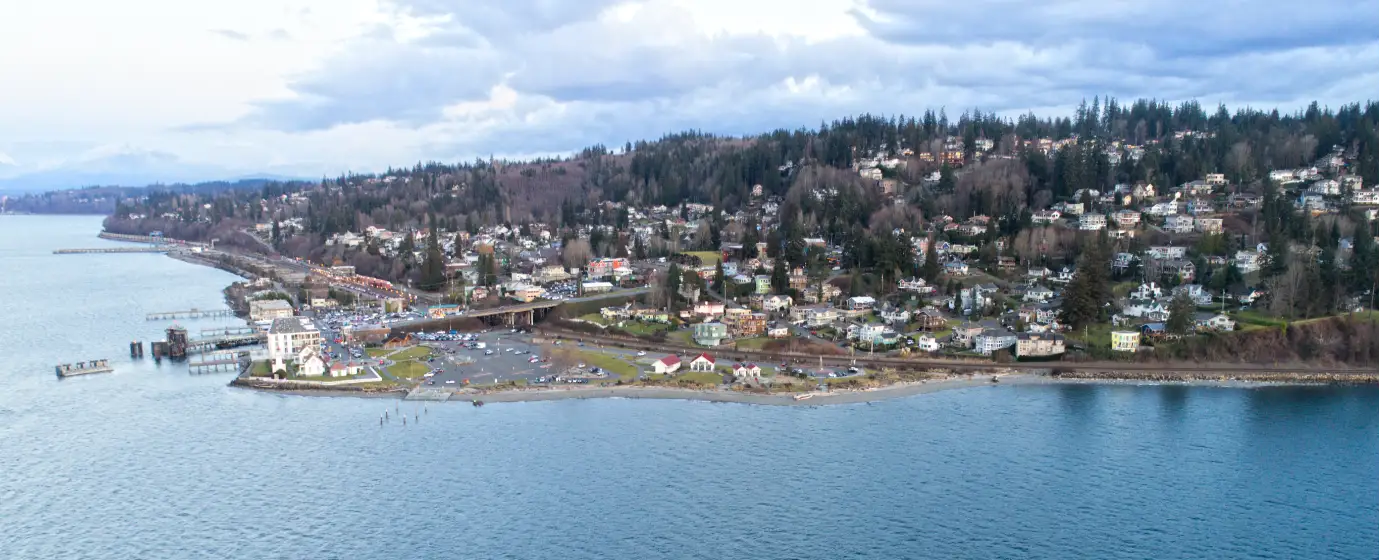
Puget Sound · Washington
1031 Exchange & Investment Real Estate in Mukilteo (2026)
Not every investor reading this runs a portfolio of twelve doors. Many are California homeowners who finally sold a property they'd owned for twenty years — a San Jose duplex, a Pasadena bungalow, a Sacramento rental — and are now sitting on a significant gain they don't want to hand to the IRS. A 1031 exchange buys time and preserves capital, but only if the replacement property is worth owning. Mukilteo keeps appearing on the shortlist for California capital heading to the Pacific Northwest because it checks the boxes that matter: durable employment anchored by Boeing and Amazon, a school district that commands premium rents from families, and a coastal Puget Sound setting that supports long-term property values in ways that suburban Phoenix or Boise simply cannot replicate.
Rental demand in Mukilteo runs on a specific engine. The tenant base skews professional — aerospace engineers, tech workers, and healthcare staff from Providence Regional Medical Center who either can't yet afford to buy at the $863,937 median or are waiting out a competitive market before committing. That demographic profile keeps vacancy low, currently sitting around 6%, which is tighter than the national average. The property types that trade most frequently as investment vehicles are single-family homes converted to rentals and small multifamily duplexes, with a limited but growing condo inventory at the entry tier around $425,000.
This guide covers everything a 1031 investor needs to evaluate Mukilteo as a replacement property market: the exchange mechanics, local cap rate realities, Washington's tax advantages relative to California, the new rent stabilization law that every out-of-state landlord must understand, and a due diligence checklist calibrated specifically to this market. If you're deploying proceeds from a California sale, the comparison at every turn is intentional.

The core mechanic is straightforward: sell a relinquished property, transfer the proceeds to a qualified intermediary — never touch the money yourself — and identify replacement property within 45 calendar days of closing. That 45-day window is the pressure point. It starts the moment the sale closes, not when you decide you're ready, and the IRS grants no extensions for a slow market or a cold seller. Most experienced 1031 buyers begin identifying candidate properties before their relinquished property closes escrow, because 45 days in a market like Mukilteo — where well-priced homes go pending in roughly 12 days — evaporates quickly.
Once you've identified property (you may name up to three alternatives without restriction, or more under the 200% rule), you have 180 days total from the sale of your relinquished property to close on the replacement. The like-kind requirement is broader than most people assume: all U.S. real property qualifies as like-kind to all other U.S. real property. A California commercial building can exchange into a Mukilteo single-family rental. A raw land parcel can exchange into a duplex. The category is "real estate" — not the property type within it.
The boot trap catches investors who don't match their equity precisely. Any cash you receive — or debt you reduce — that isn't reinvested into the replacement property is called "boot" and is taxable in the year of the exchange. If you sold for $1.2 million and carried $300,000 in mortgage, you need to replace at least $1.2 million in value and carry at least $300,000 in debt on the new property to defer the entire gain. Buying down in price or pulling equity out triggers a tax event on the difference.
Mukilteo is a premium market, and investors who underestimate that reality get caught on the 45-day clock holding wishful cap rate projections. The median sold price as of mid-2026 runs in the $900,000–$967,000 range for the 90-day trailing period, which compresses returns significantly compared to adjacent Everett or Lynnwood where small multifamily trades closer to $100,000 per unit. That said, Mukilteo's tenant profile and long-term appreciation trajectory — running ahead of roughly 70% of Washington cities — make it a defensible hold for investors with a 7–10 year horizon.
| Property Type | Typical Price Range | Est. Cap Rate | Avg Days to Close |
|---|---|---|---|
| Single-Family Rental (SFR) | $800,000 – $1,100,000 | 3.0% – 4.5% | 30 – 45 days |
| Duplex / Small Multifamily | $900,000 – $1,300,000 | 4.0% – 5.5% | 35 – 50 days |
| Condo / Attached Unit | $375,000 – $550,000 | 4.5% – 5.5% | 25 – 40 days |
| ADU-Equipped SFR | $950,000 – $1,250,000 | 4.5% – 6.0% | 35 – 50 days |

The arithmetic is compelling once you run it. A California investor who sold an appreciated Bay Area or Southern California property at a significant gain finds that Mukilteo's price-to-rent ratios, while not aggressive, are supported by a tenant base that pays reliably and stays long. The Pacific Northwest's landlord-friendly culture — before the 2025 rent stabilization shift — and Washington's income tax advantage do real work for after-tax cash flow.
A Bay Area investor selling a property at $1.4 million — common for a 1970s San Jose or Oakland rental — can purchase a waterfront-adjacent Mukilteo SFR and a duplex outright, or leverage into a larger multifamily position with 30–40% down. Gross rents in Harbour Pointe run $2,600 per month for a two-bedroom, meaning a $950,000 all-cash acquisition returns roughly $31,200 annually before expenses — lean, but backed by a property that has historically appreciated.
An LA or San Diego investor selling a 2-bedroom condo at $700,000–$800,000 can land a solid Mukilteo condo or entry-level SFR rental near the $425,000–$550,000 range and park the remaining equity into a second Snohomish County property for stronger cap rates in Everett. The strategy many Southern California sellers use is a primary Mukilteo holding for stability and a secondary Everett or Lynnwood property for yield.
Sacramento and Inland Empire investors — often coming out of properties in the $600,000–$850,000 range — can make a near-even swap into a Mukilteo mid-tier SFR without additional leverage. The key difference they notice immediately: Mukilteo rents hold steady even during market softening because the Boeing and Amazon employee base doesn't evaporate when the broader market wobbles.
The headline advantage is the one that surprises California sellers most viscerally: Washington has no state income tax. Every dollar of net rental income stays with the investor rather than being split with Sacramento at rates that top out at 13.3% in California. On a property netting $30,000 annually, that differential is real money — roughly $4,000 per year at California's mid-bracket rates — compounding over a multi-decade hold.
| Tax Item | California | Washington |
|---|---|---|
| State income tax on rental income | Up to 13.3% | 0% |
| Property tax rate (new purchase) | ~1.1–1.2% (Prop 13 resets on sale) | ~0.93% (Snohomish County) |
| Sales tax on renovation materials | 7.25% + local | 6.5% + local (~10.4% combined) |
| Long-term capital gains (state) | Up to 13.3% | 7% on gains over $262,000/year |
| Rent control / stabilization | Statewide AB 1482 (5% + CPI, max 10%) | HB 1217 (7% + inflation, max 10%) |
Two additional items worth knowing: Washington's sales tax on materials and fixtures is real and applies to rental property rehabilitation — budget approximately 10.4% in combined state and local sales tax on supplies and finishes when estimating a renovation. And depreciation basis in a 1031 carries over from the relinquished property rather than resetting, which means your depreciation schedule reflects the original basis plus improvements, not the full replacement property value. For investors who want zero management overhead, a Delaware Statutory Trust (DST) allows 1031 proceeds to be placed into a professionally managed real estate structure that still qualifies as like-kind replacement property.

When investors start exploring 1031 exchange opportunities in Mukilteo, location within the city genuinely shapes long-term value. Properties near Harbour Pointe tend to attract consistent rental demand given the neighborhood's established infrastructure and proximity to employment corridors. Old Town Mukilteo carries its own appeal — walkability, waterfront access, and a character that holds value through market cycles. Possession Bay properties also draw serious investor attention, and well-priced investment homes across these areas often move within days once listed, particularly those priced under $900,000 with strong rental income potential.
Before you start touring replacement properties for a 1031 exchange, please talk to a lender first — and I mean before you're under any exchange timeline pressure. Your full monthly payment includes principal, interest, property taxes, insurance, and potentially HOA dues, and that complete picture looks very different from a purchase price alone. I'd also encourage you to think about a comfortable payment, not just your maximum approval. In a 1031 exchange, timing is strict, and having your financing clearly mapped out means you can move confidently when the right Mukilteo investment property appears.
Washington passed HB 1217 in May 2025, establishing statewide rent stabilization for the first time. Annual increases are now capped at 7% plus inflation or 10%, whichever is lower — a significant shift from the previously uncapped environment. Out-of-state investors who modeled aggressive annual rent growth into their pro formas need to recalibrate. The practical effect for most Mukilteo landlords is modest, since market rents haven't historically jumped more than 10% in a single year, but the constraint is now statutory.
Washington landlord-tenant law requires specific notice periods for entry, lease termination, and eviction proceedings — and the rules have tightened in recent years. Non-payment evictions require a 14-day pay-or-vacate notice; lease terminations for no-cause require 20 days for month-to-month tenancies under a year and longer for tenancies exceeding a year. The code is balanced, not punitive, but out-of-state landlords operating informally get caught by the notice requirements. A local property manager is not optional for someone running a portfolio from California.
Local property management companies serving the Snohomish County market — including the Mukilteo corridor — typically charge 8–10% of gross monthly rent for full-service management, with leasing fees running an additional half to full month's rent for tenant placement. On a $2,600/month Harbour Pointe unit, that's roughly $208–$260 per month in management fees before maintenance reserves. Budget 30–35% of gross rent for all operating expenses including management, maintenance, insurance, and vacancy to get to a realistic net operating income figure.
| Item | What to Verify | Local Resource |
|---|---|---|
| Title search | Clear title, no liens, HOA delinquencies | Snohomish County Auditor / local title company |
| Sewer vs. septic | Connection to municipal sewer or private septic (affects cost + liability) | City of Mukilteo Public Works |
| Flood zone status | FEMA flood map designation — coastal and gulch-adjacent parcels vary | FEMA Flood Map Service Center |
| Rental permit requirement | City of Mukilteo business license / rental registration requirements | City of Mukilteo Finance Dept. |
| HOA rental restrictions | CC&Rs — some Harbour Pointe and condo associations cap rental percentage | HOA documents / title review |
| ADU zoning eligibility | Washington's 2023 ADU law expanded rights — verify lot size and setbacks | Snohomish County Planning |
| Short-term rental ordinances | Mukilteo does not currently have explicit STR restrictions — verify current city code | City of Mukilteo Planning Dept. |
| Current lease status | Lease terms, rent amount, tenant notice requirements for acquisition | Review all lease documents in escrow |
| School district confirmation | Mukilteo School District boundary (affects tenant pool premium) | Mukilteo School District boundary map |
| Full inspection — deferred maintenance | Roof age, HVAC, plumbing, seismic straps — older stock has deferred items | Licensed WA home inspector |
| Property management referral | Line up management before close — 45-day clock doesn't allow time to search after | Interview 2–3 local PM companies pre-offer |
| Title company recommendation | Use a company with 1031 exchange coordination experience | Ensure QI coordination is confirmed in escrow |
| Zoning verification | Confirm current zoning matches intended use (SFR vs. multifamily) | Snohomish County Parcel Viewer |
| Environmental check | Japanese Gulch and Big Gulch adjacency — verify no environmental encumbrances | WA Dept. of Ecology ECOLI database |

Local Expert Takeaway: The single most common mistake California investors make in Mukilteo is buying on cap rate projections built from Sacramento or Inland Empire market norms, then realizing Mukilteo's $900,000–$967,000 price floor compresses yields to the 3.5%–4.5% range on straight SFR plays. The investors who make this market work are buying ADU-equipped properties — which Washington's expanded ADU statutes now make increasingly accessible — or pairing a Mukilteo hold with a higher-yield Everett property to balance the portfolio. Don't treat Mukilteo as a cash flow play in isolation; treat it as a capital preservation and appreciation anchor.
✅ Washington's zero state income tax means every dollar of net rental income stays in your pocket — a compounding advantage over California's 13.3% top bracket that grows more valuable the longer you hold.
⚠️ HB 1217 changes the game for rent growth projections. Washington now caps annual rent increases at 7% plus inflation or 10% maximum. Any pro forma built on 12–15% annual rent bumps is no longer viable.
📍 ADU-eligible properties are the highest-value 1031 play in Mukilteo right now. Washington's expanded ADU legislation makes it possible to add a second unit to many existing SFRs, effectively improving cap rate from 3.5% to 5%+ on a single acquisition.
Does a 1031 exchange work for out-of-state property?
Yes — the like-kind rule applies to all U.S. real property regardless of state. A California investor selling a Los Angeles rental can 1031 directly into a Mukilteo single-family rental, duplex, or commercial property. The qualified intermediary holds the funds between close of the relinquished property and close of the replacement, keeping the exchange IRS-compliant regardless of geography.
What is the cap rate on rental property in Mukilteo?
Cap rates in Mukilteo run approximately 3%–4.5% on single-family rentals given median prices in the $900,000–$967,000 range against gross rents of $2,200–$3,800 per month. ADU-equipped properties and small multifamily duplexes push closer to 4.5%–6% when both units are occupied. Investors chasing 6%+ yields in Snohomish County typically look toward Everett or Lynnwood rather than Mukilteo proper.
Do I need a local property manager for a 1031 investment in Washington?
For an out-of-state owner, a local property manager is effectively mandatory — not because Washington law requires it, but because HB 1217's notice requirements, lease renewal rules, and eviction procedures are specific enough that remote self-management creates real legal and financial exposure. Management fees run 8–10% of gross rent, and placing that cost into your underwriting before closing is standard practice for experienced investors entering this market.
Explore the full Mukilteo series: The Ultimate Mukilteo Relocation Guide · Is Mukilteo Safe? · Cost of Living in Mukilteo · Best Neighborhoods in Mukilteo · Mukilteo Schools & Family Life · Mukilteo Youth Sports · Mukilteo Parks & Recreation · Retiring in Mukilteo · 1031 Tax-Deferred Exchange in Mukilteo · Mukilteo First-Time Homebuyers Guide · Mukilteo Down Payment Assistance Guide · Moving to Mukilteo from California