
Puget Sound · Washington
Moving to Olympia from California: The Honest Comparison (2026)
The Bay Area software engineer who bought in Olympia three years ago still works remotely for the same San Jose company at the same salary. What changed: she has a backyard, a garage, and a mortgage payment that's less than half what her Oakland rent was. The San Diego family who relocated in 2024 stopped dreading August utility bills, stopped tracking air quality alerts during fire season, and bought a four-bedroom house with a fenced yard for what their Chula Vista townhome sold for. The Sacramento buyer who was priced out of every neighborhood they wanted ended up in South Capitol with a Craftsman bungalow and enough equity left over to renovate the kitchen. Olympia keeps showing up in these stories because it offers something increasingly rare on the West Coast — the combination of Pacific Northwest quality of life, a functioning downtown, and home prices that don't require two tech salaries to access.
The honest part comes next. Olympia is not California, and the transplants who arrive expecting a slightly greener version of what they left tend to have a harder adjustment. The gray is real — Olympia logs roughly 136 sunny days per year against a precipitation calendar that covers nearly half the year, and it is actually rainier than Seattle because the Olympic Mountains provide no shelter this far south. The food scene, the diversity, the sprawling network of friends-of-friends — the social infrastructure that California cities build over decades takes time to replicate. Pace is slower here in ways that can feel either liberating or isolating depending on the person.
This guide is for the California buyer who is past the daydream stage and wants real numbers. We'll compare cost of living by California region, show what different equity levels actually buy in Olympia's neighborhoods, break down the tax math in plain terms, and give you an interactive tool to compare your specific California city. The surprises are worth knowing about before you make an offer.

| Olympia, Washington | Bay Area | Southern CA | Sacramento Metro | Central Valley | |
|---|---|---|---|---|---|
| Median Home Price (approx. 2026) | $513,000 | $1,300,000+ | $780,000 | $480,000 | $370,000 |
| Property Tax Rate (effective) | ~0.96% | ~1.1–1.25% | ~1.1–1.25% | ~1.0–1.2% | ~0.9–1.1% |
| State Income Tax | None | Up to 13.3% | Up to 13.3% | Up to 13.3% | Up to 13.3% |
| State Sales Tax | 8.0–9.5% (local) | 7.25–10.25% | 7.25–10.75% | 7.75–8.75% | 7.25–8.75% |
| Avg. Utilities (monthly est.) | $180–$230 | $300–$400 | $280–$380 | $250–$350 | $230–$320 |
| Avg. 1BR Rent | $1,400–$1,700 | $2,800–$3,600 | $2,200–$2,900 | $1,600–$2,000 | $1,100–$1,500 |
A buyer leaving Walnut Creek with a $1.4 million home and buying in Olympia at the $513,000 median isn't just trading down in price — they're likely eliminating their mortgage entirely or cutting it to a number that feels almost unreasonable. The equity difference funds the move, the renovation, the emergency fund, and still leaves a portfolio intact. For the Irvine or Pasadena buyer carrying a $900,000 home, the same math positions them to buy one of Olympia's nicer properties in South Capitol or Northwest Olympia with a down payment that makes a 15-year mortgage feel achievable.
The Washington no-income-tax advantage deserves its own line in the household budget. A California resident earning $150,000 pays somewhere in the range of $10,000 to $12,000 in state income tax annually. A Washington resident earning the same amount pays nothing. Over five years, that's a down payment on a second property. Remote workers who held onto their California salary while moving north are often the ones who talk about it most — because the effect on monthly cash flow shows up in the very first paycheck.
Washington has no state income tax — one of only nine states in the country. For California transplants, this is frequently the financial headline that tips the decision, and the numbers bear it out at every income level.
| Tax Item | California | Washington | Net Impact for Transplant |
|---|---|---|---|
| State Income Tax ($120K income) | ~$8,200/year | $0 | +$8,200/year in take-home pay |
| State Income Tax ($150K income) | ~$11,000/year | $0 | +$11,000/year in take-home pay |
| State Income Tax ($200K income) | ~$15,500/year | $0 | +$15,500/year in take-home pay |
| Sales Tax | 7.25–10.75% | 8.0–9.5% (Thurston Co.) | Roughly comparable; slight CA advantage in some counties |
| Capital Gains Tax | Up to 13.3% (as ordinary income) | 7% on gains over $262,000/year | WA applies only to long-term gains over threshold |
| Property Tax Rate | Resets to ~1.1–1.25% on purchase | ~0.96% (Thurston County) | WA advantage on purchase |
| Senior Property Tax Exemption | Limited circuit breaker program | Yes — income-based, age 61+ | WA advantage for retirees |
Thurston County's effective property tax rate of approximately 0.96% is meaningfully lower than what California buyers encounter when purchasing at current California prices. A $513,000 home in Olympia generates roughly $4,925 per year in property taxes. That same purchase price in a Sacramento suburb at a 1.1% effective rate runs closer to $5,643 annually — a modest difference — but a Bay Area buyer who just sold a $1.4 million home was paying far more at their prior California rate on that higher assessed value.
A buyer leaving Palo Alto or San Jose with $1.5 million in equity can purchase one of Olympia's finest properties outright and have six figures remaining. The waterfront homes along West Bay Drive — where Puget Sound views come with price tags ranging from $700,000 to over $2 million — are within reach for cash buyers who wouldn't have considered them in their California market. At the top of the market, Cooper Point Road NW includes estate-level properties that have sold or appraised above $4 million, representing genuine Pacific Northwest luxury at a fraction of comparable Bay Area pricing.
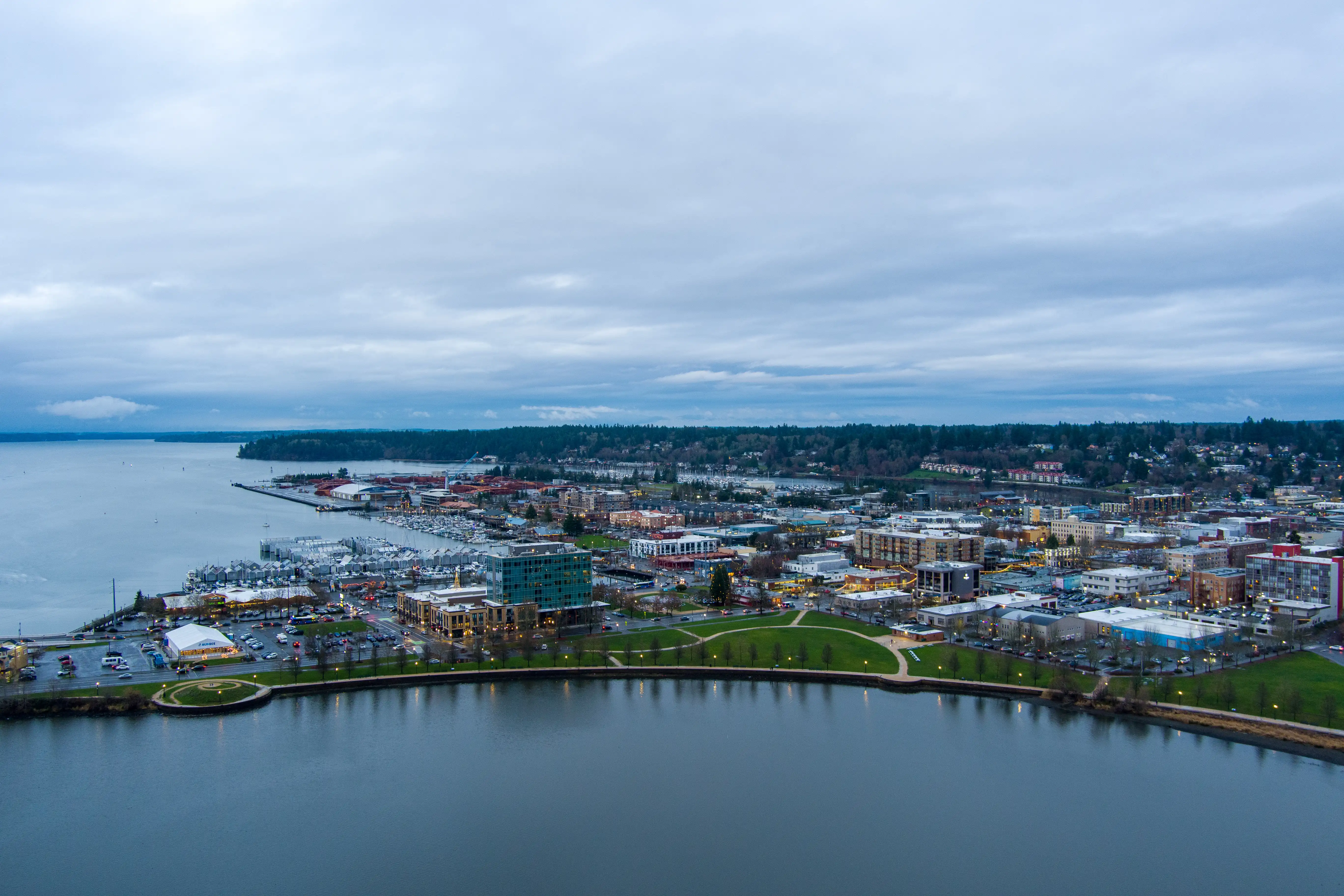
For the buyer leaving San Francisco with $1.2 million in equity who wants something livable and immediately beautiful, South Capitol offers Victorian and Craftsman homes within walking distance of the Capitol grounds, the Farmers Market, and Percival Landing Park for $500,000 to $900,000. These buyers typically end up either mortgage-free or holding a loan under $200,000 — a position that fundamentally changes monthly cash flow, retirement planning, and risk tolerance.
The buyer leaving Pasadena or San Diego with $900,000 in equity lands in Northwest Olympia or South Capitol without financial strain. Northwest Olympia's median sold price runs around $565,000, with well-maintained suburban homes on larger lots than anything comparable in Orange County at that price. Homes in this corridor move quickly — some selling in under two weeks — so Southern California buyers accustomed to long escrow timelines should expect a different pace.
A $1 million equity seller from the Los Angeles area can afford to purchase at the upper end of Olympia's market and still carry a conservative loan — or purchase a primary residence in South Capitol and retain investment capital. The no-income-tax benefit compounds this advantage meaningfully if they're continuing to earn a California-level salary remotely.
Sacramento and Inland Empire buyers have a closer relative gain, but the financial case remains strong. A Roseville buyer with $500,000 in equity can purchase near the city-wide median with a modest mortgage, and the income tax elimination alone — worth $8,000 to $11,000 annually for most professional incomes — accelerates their financial position faster than the equity difference might suggest.
The Eastside and Northeast Olympia neighborhoods offer entry points in the $400,000 to $575,000 range — giving Sacramento-area buyers access to established residential areas without overextending. Northeast Olympia's median sold price has tracked around $475,000, making it the most accessible established neighborhood for buyers whose equity covers a solid down payment rather than a full purchase.
Central Valley buyers carry the most modest relative advantage, but the comparison still works. A Fresno or Stockton buyer with $380,000 in equity puts a strong down payment on a home in Bigelow Highlands or the Eastside corridor — neighborhoods where homes in the $430,000 to $550,000 range are realistic and where lot sizes and home conditions generally exceed what that same money produces in their origin market.
The income tax benefit is disproportionately valuable for this group because it's a guaranteed gain regardless of market conditions. A Modesto transplant earning $100,000 annually keeps roughly $6,000 to $8,000 more per year in Washington that they were sending to Sacramento — and that figure compounds forward every year they stay.

Here is what the friend who moved three years ago will tell you if they're being straight: the summers here are genuinely extraordinary. July in Olympia is warm, dry, and long — 10-plus hours of daily sunshine, temperatures in the mid-70s, and access to the water, the trails at Priest Point Park, and the farmers market that runs every Thursday and Saturday through the season. The social energy in summer is high, the landscape is beautiful in a way that photographs can't fully capture, and most California transplants will tell you they had no idea the Pacific Northwest could feel this good between June and September.
Then November arrives. Olympia logs roughly 168 rain days per year and only 136 sunny days — and the darkest month, November, averages just two hours of sunshine per day. This is not Seattle-lite. Olympia is actually wetter than Seattle because it sits south of the protection the Olympic Mountains provide. California transplants who moved from San Diego, where January averages 260 hours of sunshine, or from the Sacramento Valley, where clear winter days are routine, consistently report that the first November was harder than expected. The people who adapt fastest tend to be those who buy rain gear immediately, join a gym or a community activity with an indoor component, and build social structure that doesn't depend on the weather.
What California transplants genuinely appreciate after the first year — beyond the space and the mortgage payment — tends to cluster around two things. First, the commute and traffic reality: getting anywhere in Olympia takes minutes, not hours, and the absence of freeway gridlock as a background stressor changes daily life in ways that are hard to quantify until you've lived it. Second, the community feel: Olympia is a small enough city that repeat faces at the Capitol Lake path, the Olympia Farmers Market, and the coffee shops near downtown create a social fabric faster than many California transplants expect from a city they arrived knowing nobody in.
What they miss is real too — year-round beach access is not available here, and the Pacific is cold even in summer. California's food scene, particularly in the Bay Area and Los Angeles, is deeper and more diverse than what Olympia currently offers. And the sheer social density of a city like San Diego or San Jose — where it's easy to find dozens of people who grew up where you grew up, work in your industry, and share your specific references — takes years to replicate in a city of 56,000.
If you want to see how Olympia compares directly to the city you're leaving, use the tool below — it covers the 120 largest California cities with current housing and tax data.
Home prices: Redfin median sale data, Q1–Q2 2026. Select your city to compare.
Ready to talk through what your specific California equity could do in Olympia? Todd can model your exact scenario in a single call.

Olympia's neighborhoods each tell a different story when it comes to long-term value, and that matters especially for buyers coming from California markets. South Capitol and Downtown tend to attract strong buyer demand — homes there move quickly, sometimes within days of listing, so being financially prepared isn't optional. Northwest Olympia appeals to buyers wanting newer construction with more space, and well-priced homes under $750,000 in that corridor rarely sit long either. Understanding where you want to land before you start touring helps you move with intention rather than scrambling once you find the right place.
This is exactly why I encourage California transplants to connect with a lender before they ever walk through a front door. Your comfortable monthly budget looks very different from your maximum approval once you factor in Washington property taxes, homeowner's insurance, any HOA dues, and the loan structure itself — all of which vary more than people expect. Knowing your real number upfront means you're shopping honestly, not optimistically, and when something good hits the market in Olympia, you're genuinely ready to act.
Assuming the whole city has the same character. The divide between Downtown Olympia, South Capitol, and the suburban corridors of Northwest and Northeast Olympia is significant enough to matter in daily life. A buyer who wants walkability, independent coffee shops, and proximity to arts events belongs in South Capitol or Downtown. A buyer who wants quiet cul-de-sacs, newer construction, and quick freeway access belongs in Northwest Olympia or Cain Road. Buying in the wrong part of town because "it was cheaper" or "it was available" is one of the most common regrets among transplants who didn't do neighborhood-level research.
Not accounting for the winter commute adjustment. California drivers learn to deal with congestion. Pacific Northwest drivers learn to deal with low-visibility rain, wet leaves on arterials, and — occasionally — ice on elevated roads and bridges. The drive from Northeast Olympia down Boulevard Road to I-5 in November fog is a fundamentally different experience from a dry Southern California freeway. Buyers who choose a home based on summer weekend drives sometimes discover that the winter morning commute from certain hillside neighborhoods adds time and stress they didn't anticipate.
Underestimating the income tax gain on monthly cash flow. This sounds like a talking point until you see the first full Washington paycheck. A California remote worker earning $160,000 who hasn't done the monthly math sometimes assumes the benefit is modest. It isn't — the swing can exceed $1,000 per month in net take-home pay, which directly affects what mortgage payment is comfortable and how quickly the buyer can rebuild savings after a major relocation spend.
Expecting California-style year-round outdoor access. California outdoor culture operates 12 months a year. Trail running in January, beach days in February, hiking in March — the calendar is continuous. Olympia's outdoor culture is genuinely excellent but strongly seasonal. Watershed Park and the Capitol State Forest are beautiful in summer and accessible in light rain, but the buyer who pictures themselves maintaining a California outdoor routine through a Pacific Northwest winter may find themselves recalibrating. The transition is easier when buyers research indoor fitness infrastructure, water trails, and the specific winter activities — kayaking in Capitol Lake, covered markets, indoor climbing — that keep Olympia's outdoors-oriented residents engaged through the gray months.
Bay Area sellers arriving with $1.2 million or more in equity face a welcome problem: most Olympia price points make a large mortgage unnecessary. Cash buyers or buyers bringing 60%-plus down payment have a meaningful competitive advantage in Olympia's market, where inventory has been running below a 2.5-month supply. Speed matters — sellers here frequently choose cleaner offers over slightly higher prices, and a buyer with substantial California equity who can close quickly or waive financing contingencies is in a strong position. If the California property was held as an investment or rental, a 1031 exchange may allow the buyer to defer capital gains — worth exploring before closing. The Olympia 1031 Exchange guide covers this in full.
Southern California sellers carrying $700,000 to $1.2 million in equity typically have no need for a jumbo loan at Olympia's price points — the city-wide median of $513,000 sits comfortably within conventional conforming limits. A buyer from San Diego putting down $400,000 on a $550,000 home in South Capitol is looking at a loan under $200,000, which means rate becomes almost secondary to terms and closing speed. The primary focus shifts to structuring the California sale and Washington purchase in a timeline that avoids a gap — bridge financing or contingency offers are worth discussing with a lender early.
Sacramento and Inland Empire buyers with equity in the $400,000 to $650,000 range may find that Washington State Housing Finance Commission programs add value even with strong equity. The WSHFC Home Advantage program provides below-market rate first mortgages and down payment assistance for qualifying buyers, and at Olympia's median price point, many Sacramento-area buyers will fall within income and purchase price limits. This group benefits most from modeling the no-income-tax gain alongside the mortgage structure — the combination often reveals a monthly payment situation significantly better than they left behind in California.
Local Expert Takeaway: The single thing most California buyers underestimate about Olympia is how quickly the no-income-tax advantage reshapes the monthly budget — not as a theoretical annual figure, but as a real difference in what shows up on every paycheck. A buyer earning $150,000 who moves from Sacramento to Olympia and buys at the city median with strong California equity may find their total monthly housing and living cost is $2,000 to $3,000 lower than what they were paying as a renter in California. That gap funds retirement contributions, college savings, or the renovation they always talked about. Run the monthly math specifically — not just the purchase price comparison — before you make your decision.
✅ The financial case is strongest for Bay Area and Southern California sellers. Olympia's $513,000 median against $1 million-plus California home prices creates an equity gap that can eliminate or dramatically reduce a mortgage — combined with the no-income-tax benefit, the monthly cash flow transformation is real and immediate.
⚠️ The weather transition is harder than most California buyers expect. Olympia averages only 136 sunny days per year and roughly 168 rain days — significantly less sun than any major California metro. The first November is the real test. Buyers who research this honestly and plan for it tend to stay; buyers who arrive assuming it's "like a rainy Bay Area winter" sometimes don't.
📍 Neighborhood research matters as much as city-level research. Olympia's character varies substantially between South Capitol's walkable historic streets, Northwest Olympia's suburban family corridors, and the Downtown arts-and-government core. Buying in the wrong neighborhood for your lifestyle is one of the most common relocation mistakes — and one of the most avoidable.
Is moving from California to Olympia worth it?
For most California transplants who've done the math, the answer has been yes — but the "worth it" calculation depends heavily on income level, lifestyle priorities, and which part of California you're leaving. The financial case is clearest for Bay Area and Southern California sellers, where equity differences and the annual income tax savings combine to create a material change in monthly financial position. The lifestyle case requires honest engagement with the weather, which is the dominant adjustment most transplants report.
How much cheaper is housing in Olympia vs. California?
Olympia's median sold price sits at $513,000, compared to $1.3 million-plus in the Bay Area, roughly $780,000 in Southern California, and around $480,000 in the Sacramento metro. The Sacramento comparison is the closest, but Washington's zero state income tax adds meaningful annual value that pure home price comparisons don't capture. For Bay Area and Southern California sellers, the equity differential is large enough to fundamentally change what kind of mortgage — if any — the buyer needs to carry.
What do I need to know about moving from California to Washington?
The three things that matter most: first, Washington has no state income tax, which adds thousands to annual take-home pay and changes the monthly budget significantly. Second, Olympia's winters are gray, rainy, and long — plan for it rather than hoping you'll be the exception who doesn't notice. Third, the Olympia housing market moves quickly — the city has been running below a 2.5-month supply of homes, which means California buyers who take several months to "see how we feel" sometimes miss the inventory window they were tracking. Getting pre-approved and understanding your equity position before you start shopping seriously is essential.
Explore the full Olympia series: The Ultimate Olympia Relocation Guide · Is Olympia Safe? · Cost of Living in Olympia · Best Neighborhoods in Olympia · Olympia Schools & Family Life · Olympia Youth Sports · Olympia Parks & Recreation · Retiring in Olympia · 1031 Tax-Deferred Exchange in Olympia · Olympia First-Time Homebuyers Guide · Olympia Down Payment Assistance Guide · Moving to Olympia from California