
Puget Sound · Washington
Is Poulsbo Safe? Crime Rates, Safest Neighborhoods & Local Reality (2026)
Poulsbo has a reputation that outruns its reality — and that's mostly a good thing. People who've never been here tend to picture a sleepy Scandinavian tourist town with ferry access and not much else. What they don't expect is a small city of nearly 13,000 that consistently ranks among the safest communities in Kitsap County, with a long-term downward crime trend and a police department that publishes annual transparency reports most cities three times its size don't bother with.
The numbers deserve some context before you trust them. Depending on which index you read, Poulsbo looks either well below national averages or slightly above them — and both can be technically true. The difference comes down to methodology: sources that compare Poulsbo only to large urban centers paint a rosier picture, while those that stack it against every small town in America skew the grade downward. What matters for your daily life is this: with a violent crime rate commonly reported around 2.4 per 1,000 residents and a property crime rate near 18.7 per 1,000, Poulsbo sits meaningfully below Washington state averages on both counts.
This guide breaks down what those figures mean at street level — which parts of town see the most activity, what locals actually do to protect their property, and how Poulsbo compares to Silverdale, Bainbridge Island, and Bremerton. If you're deciding whether this is the right place to plant roots, this is the information the aggregate scores don't give you.

Local police data and FBI-reported estimates for 2024 place Poulsbo's overall crime index around 143 on City-Data's scale — roughly 1.6 times lower than the U.S. average of 235. That single figure tells most of the story, but the trend line is even more reassuring: the 2024 rate dropped approximately 14% from the year prior, and over the last 15 years Poulsbo has shown a consistent long-term decline in both violent and property crime. The city is commonly cited as the second-safest community in Kitsap County, behind only some of the peninsula's more rural unincorporated areas.
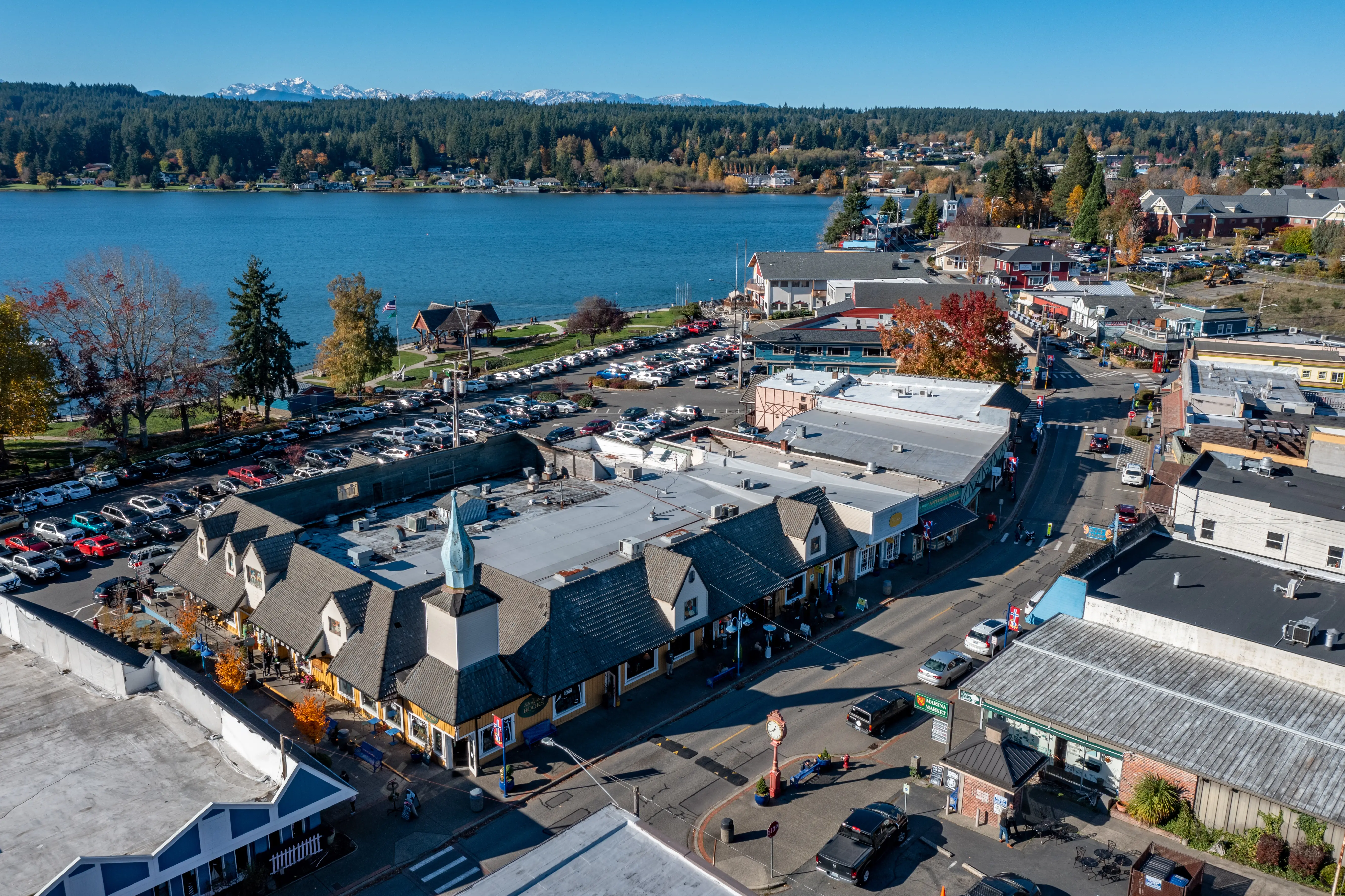
Where the picture gets nuanced is in how crime clusters geographically. Central Poulsbo — the commercial corridor near downtown, Viking Avenue, and the waterfront retail district — accounts for a disproportionate share of reported incidents, roughly 340 per year by some estimates. This is almost entirely a function of foot traffic and retail density, not residential danger. High-visitor areas produce more reported incidents simply because more transactions, more strangers, and more opportunity for petty theft converge in one place. Neighborhoods away from that commercial core see dramatically lower numbers.
The structural factors that keep Poulsbo's overall rates relatively low are worth understanding. High homeownership rates, a stable median household income around $116,250, and a mostly owner-occupied residential fabric create the kind of community where neighbors know each other and notice when something is off. The city's relatively compact footprint — hemmed in by Liberty Bay to the east and rural county land to the west — also limits the anonymity that tends to enable serial property crime in sprawling suburban grids.
Violent crime in Poulsbo runs roughly 2.4 per 1,000 residents by commonly reported estimates — a figure that AreaVibes data suggests is more than twice as low as the Washington state average. In practical terms, the northwest portion of the city sees the fewest violent incidents, with the odds of being a victim in that zone estimated around 1 in 447. The central and downtown area sees the highest count, near 19 incidents annually, though that number includes the full range from aggravated assault down to incidents that don't always register as dangerous to most residents. For day-to-day life, Poulsbo doesn't generate the kind of violent crime headlines that shape perception in larger Kitsap cities.
Property crime at around 18.7 per 1,000 is where Poulsbo requires more attention. Auto-related theft and vehicle break-ins are the dominant category — car theft odds run roughly 1 in 304 citywide, which is manageable but not negligible. The highest concentration of property crime sits in central Poulsbo near the shopping corridors, where the risk approaches 1 in 20 in the most active commercial blocks. The southeast portion of the city — covering areas like Lemolo and Lemolo Shore Drive — offers the lowest property crime exposure, with victimization odds closer to 1 in 74. Leaving valuables visible in parked cars remains the single most avoidable risk factor locals cite.
Vinland sits in the northwest quadrant of Poulsbo — the zone that local crime mapping consistently identifies as the city's safest overall. Violent crime odds in this part of the city run near 1 in 447, the lowest in the city by a significant margin. The neighborhood's single-family residential character, limited through-traffic, and distance from the commercial core all contribute to that profile. Residents here tend to be long-established homeowners, which creates the kind of informal neighborhood watch dynamic that no formal program fully replicates.
Best for: Buyers prioritizing residential quiet and the lowest available crime exposure in Poulsbo.
Lofall occupies the far northern edge of the Poulsbo area, closer to Hood Canal than to downtown's retail corridor. Its physical separation from the city's commercial activity zones means it simply doesn't generate the property crime patterns seen in more central neighborhoods. The catch is that it's among the more rural-feeling pockets in the city's orbit, with fewer walkable amenities and longer drives for daily errands.
Best for: Buyers willing to sacrifice convenience for a genuinely low-density, low-incident environment.
Viking Heights sits closer to the central city than the northwest neighborhoods, and its safety profile reflects that proximity. It's not a high-crime area by any standard, but it's more exposed to the commercial corridor spillover that affects properties near Viking Avenue. Residents here report occasional vehicle break-ins consistent with the broader pattern city-wide, and the practical precaution — not leaving anything visible in parked cars — applies here more than it does in the outer northwest zones.
Best for: Buyers who want a central location and accept a modestly higher property crime exposure in exchange for walkability to downtown Poulsbo.
Lemolo and the Lemolo Shore Drive corridor fall in the southeast portion of the city, which crime data identifies as Poulsbo's lowest zone for property crime — with victimization odds near 1 in 74. This is the quieter, more established residential waterfront side of the city, where the visitor and retail traffic that drives central Poulsbo's numbers simply doesn't reach. Violent crime in the southeast zone runs at moderate levels compared to the northwest, but the overall daily-life experience here is calm and predominantly residential.
Best for: Buyers focused on minimizing property crime risk who also want proximity to the water.
Scandia aligns with the broader northwest safety corridor, sharing the same geographic and demographic factors that keep that zone's numbers low. It's a quieter residential pocket with limited commercial traffic, and the community fabric here — established families, owner-occupied homes — mirrors the pattern that keeps Vinland's numbers down. The Poulsbo Police Department's automated traffic safety program, which targets high-traffic school and park zones, also applies to some of the corridors connecting Scandia to central Poulsbo.
Best for: Families with children who want the northwest safety profile with a slightly more established neighborhood feel.
Caldart Heights sits within the city's more developed interior, where proximity to retail corridors and higher traffic volume creates a somewhat different picture than the outer residential neighborhoods. Property crime exposure here is closer to the citywide average than the low readings in Lemolo or Vinland. It's not an area locals would flag as concerning — but it's also not where you'd point a buyer whose top priority is the city's safest possible address.
Best for: Buyers prioritizing access to amenities and schools who are comfortable with average citywide crime exposure.

| City | Violent Crime/1K | Property Crime/1K | Overall Safety Profile |
|---|---|---|---|
| Poulsbo | ~2.4 | ~18.7 | 2nd safest in Kitsap County; below WA state averages |
| Bainbridge Island | ~1.2 | ~12.0 | Among the lowest in the region; low density, high income |
| Kingston | ~1.8 | ~14.5 | Small, rural character; limited commercial crime drivers |
| Silverdale | ~3.5 | ~28.0 | Higher property crime; major retail hub creates more exposure |
| Suquamish | ~2.0 | ~16.0 | Comparable to Poulsbo; tribal governance layer adds context |
| Bremerton | ~5.8 | ~38.0 | Highest in the region; urban core crime patterns |
| Indianola | ~1.5 | ~11.0 | Unincorporated, low-density; limited incident volume |

From a lending standpoint, where you buy within Poulsbo genuinely matters for long-term value. Areas like Viking Heights and Indian Hills Estates tend to draw consistent buyer interest, partly because of their established feel and the sense of community stability that buyers researching safety are already looking for. Miller Bay Estates is another area worth watching — homes there tend to move quickly when priced well, sometimes within days of hitting the market. If you find something you love under $750,000 in these pockets, hesitation is usually costly.
That said, knowing your comfortable budget before you start touring is the most practical thing I can tell you. Your full monthly obligation includes more than principal and interest — property taxes, homeowner's insurance, any HOA dues, and your loan structure all factor into what you'll actually write a check for each month. Max approval and comfortable approval are rarely the same number, and understanding that difference before you fall in love with a home saves a lot of frustration. When the right place comes up in a neighborhood like Vinland or Lofall, being prepared means you can move with confidence.
The crime map on Poulsbo's city website tells you something important that the aggregate scores don't: the incidents cluster tightly around Viking Avenue between NE Lincoln Road and the downtown waterfront. If you're living in a residential neighborhood north of NE Lincoln Road, west toward the Vinland corridor, or southeast in Lemolo, you're largely insulated from the property crime activity that shows up in central Poulsbo's numbers. The map is publicly available through poulsbo.gov, and it's worth pulling up before you make any neighborhood decision.
What most Nextdoor conversations in Poulsbo eventually land on isn't violent crime — it's vehicle break-ins and occasional loose dogs in parks. The practical local response is simple and unglamorous: don't leave anything in your car that you'd mind losing, even in your own driveway, and be aware that Muriel Iverson Williams Waterfront Park and the Liberty Bay Marina area see more overnight activity than the residential streets two blocks away. Neither of those things should alarm a buyer — but pretending they don't exist would give you an incomplete picture.
The Poulsbo Police Department's 28-person force is small for a city this size, which means response times to non-emergency calls can stretch. The department publishes annual use-of-force and bias-based policing reports through the city website, which is more transparency than most Kitsap cities offer. The Co-Response mental health navigator program addresses the kind of low-level public disturbances — the ones that generate Nextdoor posts without generating crime statistics — that tend to be the actual daily friction point for residents rather than anything on the violent crime ledger.
Local Expert Takeaway: If safety is your primary filter, the northwest Poulsbo corridor — Vinland, Scandia, and the neighborhoods pulling away from Viking Avenue — gives you the city's lowest crime exposure with no real sacrifice in school access or community character. Avoid leaving anything visible in your vehicle regardless of neighborhood, and check the city's public crime map before committing to a specific block. The aggregate scores on NeighborhoodScout tend to overstate Poulsbo's risk by comparing it to rural towns rather than comparable small cities — your actual daily experience will feel consistent with a well-managed, safe Pacific Northwest community.
✅ Poulsbo ranks second-safest in Kitsap County and consistently performs below Washington state averages for both violent and property crime, with a 15-year downward trend in overall incidents.
⚠️ Central Poulsbo near the Viking Avenue retail corridor sees the highest concentration of property crime in the city — this is a commercial traffic pattern, not a residential danger signal, but it's worth understanding before choosing a neighborhood.
📍 The northwest and southeast zones offer Poulsbo's lowest crime exposure — northwest neighborhoods like Vinland have the city's lowest violent crime odds, while southeast areas like Lemolo carry the lowest property crime risk.
Is Poulsbo a safe place to live?
By most available measures, yes. Poulsbo ranks second on Niche's safest communities list in Kitsap County and records violent crime well below Washington state averages. The city's 15-year crime trend runs consistently downward, and residents surveyed on platforms like Nextdoor generally describe it as a safe, community-oriented place — with occasional property crime near commercial areas as the most commonly cited concern.
What is the biggest crime risk in Poulsbo?
Property crime — specifically vehicle break-ins and opportunistic theft near the downtown retail corridor — is the most commonly reported issue. The central part of the city near Viking Avenue and the waterfront shopping district accounts for a disproportionate share of incidents. Residential neighborhoods away from that corridor, particularly in the northwest and southeast zones, see significantly lower property crime exposure.
How does Poulsbo compare to Silverdale or Bremerton for safety?
Poulsbo is meaningfully safer than both on available data. Silverdale's retail concentration drives property crime rates noticeably higher than Poulsbo's, and Bremerton carries the region's highest violent and property crime rates by a substantial margin. Bainbridge Island and the more rural Indianola area post lower numbers than Poulsbo, but they also carry significantly higher home prices for comparable square footage.
Explore the full Poulsbo series: The Ultimate Poulsbo Relocation Guide · Is Poulsbo Safe? · Cost of Living in Poulsbo · Best Neighborhoods in Poulsbo · Poulsbo Schools & Family Life · Poulsbo Youth Sports · Poulsbo Parks & Recreation · Retiring in Poulsbo · 1031 Tax-Deferred Exchange in Poulsbo · Poulsbo First-Time Homebuyers Guide · Poulsbo Down Payment Assistance Guide · Moving to Poulsbo from California