
Puget Sound · Washington
Moving to Poulsbo from California: The Honest Comparison (2026)
The California-to-Washington move rarely happens because of a single spreadsheet line. It happens when a software engineer in Foster City realizes she's been paying California income tax on a salary she earned entirely from her home office — and that the same work, done from a house three times the size, would cost her nothing in state income tax if she relocated to Washington. It happens when a San Diego family calculates what they'd save on cooling bills and wildfire evacuation insurance and decides the Pacific Northwest's gray winters are a fair trade. And it happens when a Sacramento buyer discovers that what their townhome sells for could buy a waterfront view home in a small Norwegian-themed city on Puget Sound, with money left over. That city is Poulsbo — and for California transplants specifically, it checks boxes that most Pacific Northwest destinations don't.
The honest part comes next. Poulsbo is not California, and no amount of enthusiasm about tax savings changes that. The winters are long, gray, and legitimately dark in December. The ferry commute to Seattle is beautiful but slow. The food scene is small. The social pace is genuinely different from what most California cities offer. None of these are dealbreakers for the right buyer — but they surprise people who arrived expecting a cleaner, cheaper version of home.
This guide is written for the California buyer who has already done basic research and wants the real picture: what your equity actually buys here by California origin market, what the tax shift means in actual dollars, where the lifestyle comparison honestly lands, and what California transplants consistently get wrong before their first winter.
| Poulsbo, WA | Bay Area | Southern CA | Sacramento Metro | Central Valley | |
|---|---|---|---|---|---|
| Median Home Price (approx. 2026) | $667,000 | $1.7M (SF) / $1.1M (East Bay) | $954,000 (San Diego) / ~$900K (LA) | ~$550,000 | ~$380,000–$450,000 |
| Property Tax Rate (effective) | ~0.91% | ~1.1%–1.3% (post-Prop 13 varies widely) | ~1.1%–1.25% | ~1.0%–1.15% | ~0.9%–1.1% |
| State Income Tax | None | Up to 13.3% | Up to 13.3% | Up to 13.3% | Up to 13.3% |
| State Sales Tax | 8.9% (Kitsap County) | 8.625%–10.75% | 7.25%–10.5% | 7.25%–8.75% | 7.25%–8.25% |
| Avg Utilities (monthly est.) | ~$130–$160 | ~$200–$260 | ~$210–$280 | ~$180–$240 | ~$190–$260 |
| Avg 1BR Rent | ~$1,700–$2,000 | ~$3,000–$3,800 | ~$2,200–$2,900 | ~$1,600–$1,950 | ~$1,200–$1,500 |
The no-income-tax advantage is where the math gets genuinely compelling. California's top marginal rate hits 13.3%, but even a household earning $150,000 is paying roughly $12,000–$15,000 per year to Sacramento in state income tax. Washington collects none of it. For remote workers who kept their California salaries, that difference shows up in monthly cash flow immediately — and it compounds every year they stay.
Washington's status as one of nine states with no personal income tax is the single biggest financial story for California transplants. It is not a small or theoretical advantage — it is tens of thousands of dollars over the first few years of residency.
A California household earning $120,000 annually pays roughly $8,000–$10,000 in state income tax. At $150,000, that climbs to $12,000–$15,000. At $200,000 — increasingly common for remote tech workers who retained Bay Area salaries after relocating — the California state income tax burden can reach $18,000–$22,000 per year. Washington collects zero on all of it. That is what the move means on a per-paycheck basis, not just as an abstract tax rate.
Washington does levy a 7% capital gains tax, but it applies only to long-term capital gains exceeding $262,000 per year and exempts real estate transactions entirely. For most families selling a California primary residence and buying in Poulsbo, this tax is not relevant — the federal capital gains exclusion ($250,000 single / $500,000 married) already shields most home sale gains, and Washington's capital gains tax does not apply to the real estate sale itself. The sales tax in Kitsap County runs approximately 8.9%, which is higher than some California counties but lower than San Francisco, Los Angeles, and most of the Bay Area. On balance, the net tax position for nearly every California income bracket improves substantially in Washington.
| Tax Item | California | Washington | Net Impact for Transplant |
|---|---|---|---|
| State Income Tax | Up to 13.3% | None | +$8,000–$22,000/yr depending on income |
| Capital Gains Tax (real estate) | Up to 13.3% (primary residence exemptions apply) | Exempt (real estate) | Positive — no WA tax on home sale gains |
| Capital Gains Tax (investment) | Up to 13.3% | 7% on gains over $262K/yr | Mostly neutral for typical income levels |
| Property Tax Rate | ~1.1%–1.3% (newer purchases) | ~0.91% (Kitsap County) | Positive — lower rate on lower purchase price |
| Sales Tax | 7.25%–10.75% | ~8.9% (Kitsap) | Slight offset — roughly comparable |
| Senior Property Tax Exemption | Limited (Prop 19 limited relief) | Yes — age 61+, income-based | Significant benefit for retirees |
A buyer selling in Palo Alto, San Jose, or the Oakland Hills and netting $1.5 million in equity arrives in Poulsbo with the ability to purchase essentially anything on the market — all cash. The top of Poulsbo's market sits around $1.2 million to $1.7 million for premium waterfront properties on Liberty Bay, with a small number of Hood Canal-adjacent parcels pushing higher. For a Bay Area buyer, this tier is simply where they lived, not a luxury upgrade. What changes is the debt. Arriving mortgage-free to a four-bedroom home with mountain views and a 10-minute walk to the marina is not a compromise from a San Mateo lifestyle — it is a financial reset.
At this equity level, neighborhoods like the Vinland waterfront, Lemolo Shore Drive, and Liberty Bay Estates represent the highest-value options in the market. Even buyers who choose to keep $300,000–$500,000 liquid after the purchase are buying at the top of Poulsbo's inventory with cash remaining for investments, a rental property, or a complete home renovation. The Vinland corridor specifically offers standard single-family homes from roughly $539,000 to $760,000 on the non-waterfront side, with premium waterfront lots stretching to $1.2 million and beyond — all well within range for most Bay Area sellers.
A buyer leaving Irvine, La Jolla, or the San Fernando Valley with $800,000–$1.1 million in equity lands in Poulsbo's upper tier without breaking stride. The city-wide median sits at $667,000, and a buyer with this equity level can either purchase near that price point all-cash or buy a significantly upgraded property — waterfront-adjacent or view-property on Liberty Bay — with a very modest mortgage. San Diego's median sold price ran approximately $954,000 in early 2026, meaning a seller clearing $800,000 from that market can buy the best of Poulsbo's inventory and still net substantial equity.
Southern California buyers specifically tend to appreciate Poulsbo's Viking Heights and Indian Hills Estates neighborhoods, where newer construction and larger lots offer the suburban square footage that comparable Southern California prices no longer deliver. A $667,000 purchase in Viking Heights buys a four-to-five bedroom home with a two-car garage and wooded lot — a property type that hasn't been accessible at that price point in San Diego County or the LA basin for over a decade.
This group has the closest relative financial starting point to Poulsbo's median, but the math still strongly favors the move. A Sacramento buyer selling at $550,000 with $450,000 in equity can purchase at the Poulsbo median with a modest down payment and a small mortgage — or stretch slightly above median with 20% down and a conventional loan. What they gain immediately is the income tax elimination: a household earning $120,000 keeps roughly $8,000–$10,000 more per year in Washington, which more than offsets a modestly higher cost of living index. Neighborhoods like Alasund Meadows, Applewood Estates, and Deer Run sit in the $550,000–$700,000 range and offer newer construction, good school proximity, and reasonable commute access to the Silverdale corridor.
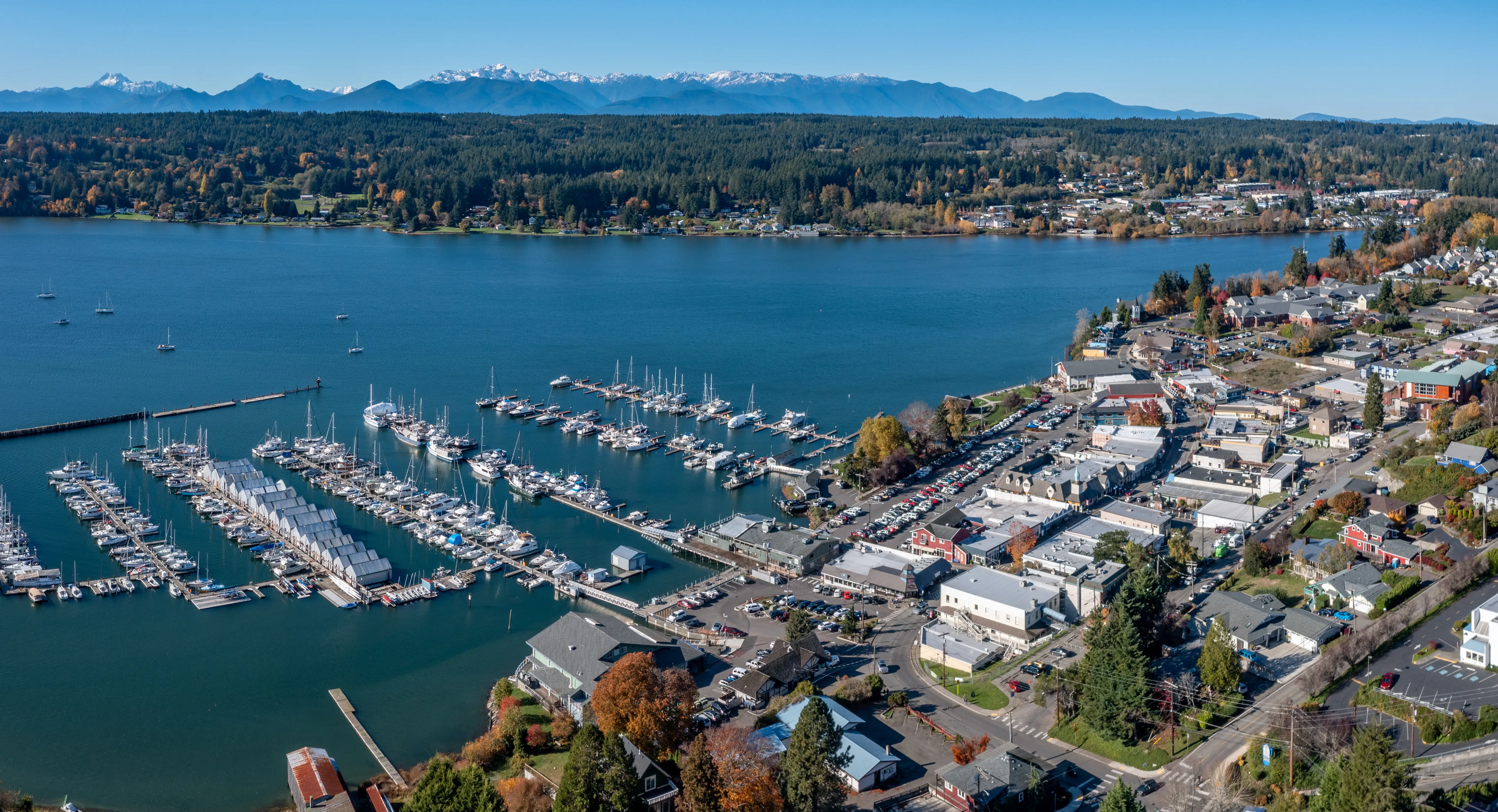
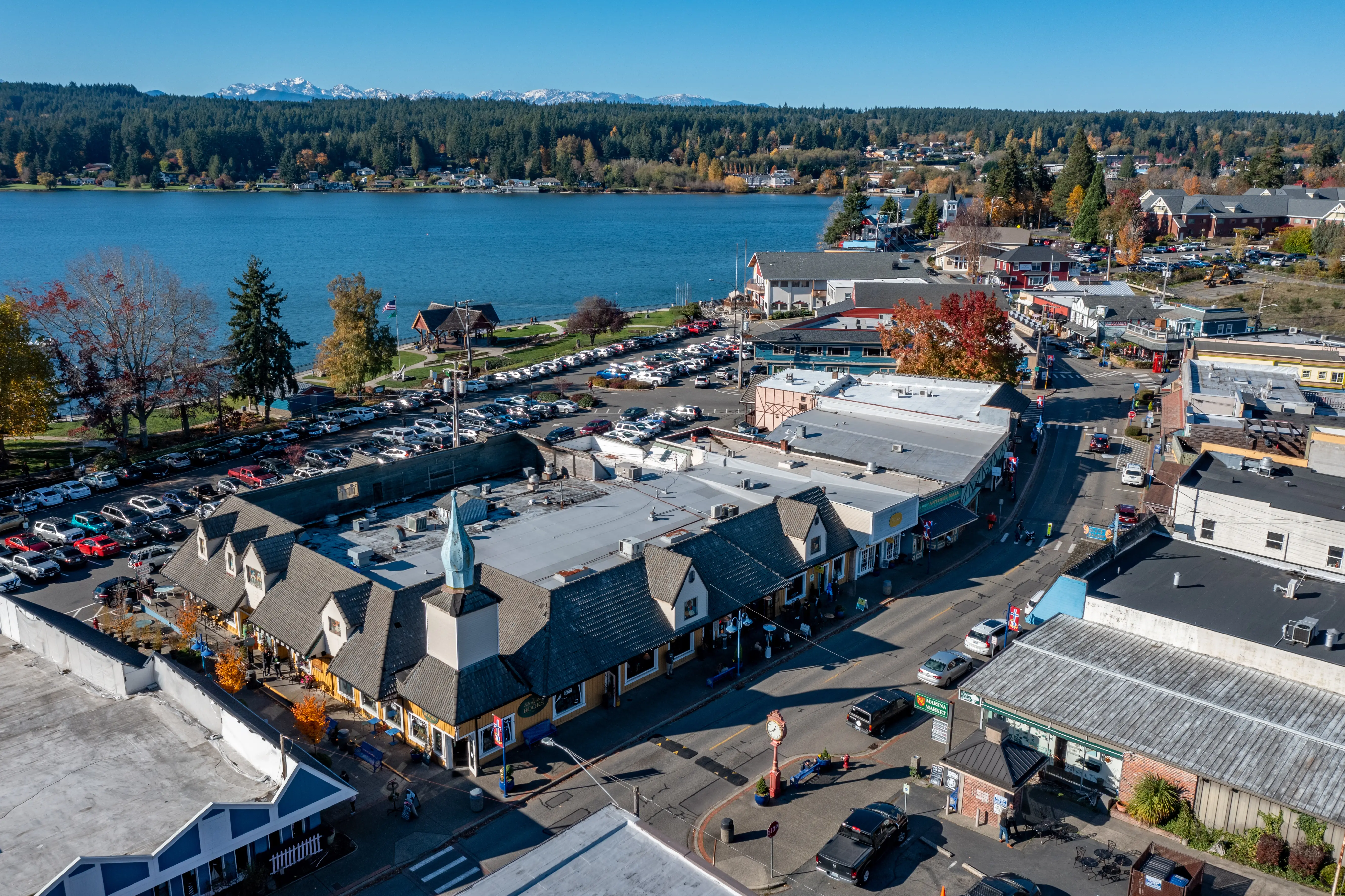
Inland Empire buyers — Riverside, Ontario, Rancho Cucamonga — often find Poulsbo's pace and density more comfortable than Seattle or Bellevue would be. Poulsbo is a small city of about 12,800 people with genuine community infrastructure: a waterfront park, a marina, a Main Street with local restaurants, and a school district rated B+ by Niche. The lifestyle adjustment is real but the financial case is straightforward.
This is where the relative gain is most modest, but still meaningful. A buyer from Fresno, Bakersfield, or Modesto selling at $380,000–$440,000 with $300,000–$400,000 in equity will likely need a mortgage to reach Poulsbo's median. Neighborhoods like Poulsbo Gardens, Caldart Heights, and Forest Rock Hills offer entry-level opportunities in the $530,000–$620,000 range — more house than the Central Valley delivers at that price, but not a dramatic equity windfall. What makes the move financially compelling for this group is almost entirely the income tax story. A two-income household earning a combined $140,000 from remote work keeps $11,000–$14,000 more per year in Washington than in California, which over five years represents $55,000–$70,000 in cumulative after-tax income that can service a mortgage, build retirement savings, or pay down the purchase faster.

Poulsbo averages 155 sunny days per year. Los Angeles averages 284. San Diego is close to 266. San Francisco, which California residents sometimes accept as cloudy, still sees about 259 sunny days. That gap is not trivial — Poulsbo's November through February is genuinely gray, with December offering barely 1.8 hours of sunlight per day on average and rain falling on roughly 21 days of the month. If you are a Southern California resident whose mental health is tied to daily sunshine, this is something to take seriously before buying.
What California transplants who've been in Poulsbo for a year or more consistently say is that the summers are the revelation. July and August are legitimately spectacular — dry, mild, with daylight stretching past 9 pm and temperatures in the mid-70s. The Puget Sound ferry routes, the kayaking on Liberty Bay, the hiking on the Olympic Peninsula an hour west, and the Seattle waterfront 80 minutes east all become part of a summer life that California residents often find richer than what they left. The crowds are smaller. The traffic is lighter. The outdoor access — on foot, on water, on trails — is genuinely exceptional during those months.
What people miss is honest and predictable: the year-round beach culture doesn't translate. Poulsbo has a beautiful waterfront at Muriel Iverson Williams Waterfront Park, but swimming in Liberty Bay in October is not happening. The restaurant depth of San Diego, the food scene density of San Francisco, the energy of Los Angeles on a Friday night — none of those exist at Poulsbo's scale. The city has good local spots and a Main Street with genuine character, but it is a city of 12,800 people, and the social options reflect that. Buyers who thrive here are generally people who wanted a slower pace and built their social life accordingly — not people who hoped to replicate California's energy at a lower price.
If you want to see how Poulsbo compares directly to the city you're leaving, use the tool below — it covers the 120 largest California cities with current housing and tax data.
Home prices: Redfin median sale data, Q1–Q2 2026. Select your city to compare.
Ready to talk through what your specific California equity could do in Poulsbo? Todd can model your exact scenario in a single call.

Poulsbo's neighborhoods each tell a different story when it comes to long-term value. Areas like Viking Heights and Miller Bay Estates tend to attract strong buyer interest because of their combination of views, lot sizes, and proximity to town — and well-priced homes there rarely sit long before receiving multiple offers. Indian Hills Estates offers a slightly quieter pace while still holding its value well over time. For California buyers accustomed to significantly higher price points, finding quality homes under $750,000 here can feel almost surprising, but don't let that lull you into moving slowly once you've found something you love.
Before you start touring homes, have a real conversation with a lender — not just about what you're approved for, but about what your full monthly payment actually looks like once taxes, insurance, and any HOA dues are folded in. Washington's property tax structure and insurance landscape are different from California's, and that affects your comfortable budget in ways that max approval numbers don't reflect. Knowing your real number before you fall in love with a home means you can move decisively when the right one appears.
Assuming the commute to Seattle is like a Bay Area BART ride. The 80-minute commute to Seattle from Poulsbo is not public transit — it's ferry-dependent, weather-sensitive, and not run on a frequency that accommodates flexible work schedules the way BART or Caltrain does. Most Poulsbo residents working in Seattle do so on a hybrid schedule and plan their in-office days around the Kingston or Bainbridge ferry timetables. Buyers who show up expecting a metro-style commute and discover the reality at 7:00 AM on a November Tuesday — standing on the Kingston dock in the rain — are the ones who regret the location choice. If Seattle office time is regular and non-negotiable, South Kitsap or Bainbridge Island deserves a serious look before Poulsbo.
Underestimating how different the pace is from a California suburb. Poulsbo is not a slow city in a bad way, but it is genuinely unhurried in ways that can disoriented buyers arriving from San Jose, Roseville, or Pasadena. The Main Street shuts down earlier than California equivalents. The weekend social infrastructure is different. Neighbors wave and mean it. This is a feature for people who wanted it, and an adjustment for people who didn't realize they were signing up for it. Buyers who haven't spent time here in November or February before purchasing are taking a real risk on lifestyle fit.
Not modeling the no-income-tax gain into their monthly cash flow before negotiating. The most common financial mistake California buyers make in Poulsbo is negotiating home price without having calculated what their Washington take-home pay looks like. A family moving from California on a $180,000 household income has roughly $1,200–$1,500 per month more in take-home pay the moment they establish Washington residency. That figure changes what mortgage payment is comfortable. It changes how aggressive they can be in a multiple-offer situation. Buyers who arrive having already run that number make better decisions faster.
Buying in an area without understanding the Silverdale vs. Poulsbo dynamic. Poulsbo has the charm, the waterfront, and the school district — but Silverdale, five miles southeast, has the big-box retail, the medical center, the movie theater, and most of the employment concentration in the region. Buyers who want walkable access to daily errands and choose a property on the north or northwest edge of Poulsbo sometimes find themselves driving to Silverdale for everything practical while also not having quick waterfront access. The neighborhoods closest to Highway 305 and Viking Avenue — areas like Viking Heights and Caldart Heights — tend to offer the best of both without the isolation that some outer Poulsbo addresses carry.
Bay Area sellers with substantial equity are often best served by all-cash or very low-LTV purchases in Poulsbo, particularly given that the city's price point sits well below even a modest Bay Area property. When rate matters less than certainty of close — and in a market where Poulsbo homes are going pending in roughly 8 days in competitive windows — cash offers carry real advantages over financed buyers. If the California property being sold is an investment or rental rather than a primary residence, a 1031 exchange into a Poulsbo investment property is worth a conversation before the California close; the Poulsbo 1031 Exchange guide covers the mechanics and timelines specific to this market.
Southern California sellers arriving with $700,000–$1 million in equity can purchase at or above Poulsbo's median price with a conventional down payment and a manageable loan balance. Poulsbo's median falls well below the 2026 conforming jumbo threshold, meaning most purchases here clear conventional financing without requiring jumbo loan terms — a meaningful difference from what these buyers were navigating in their CA market. The rate and terms conversation is straightforward with a strong down payment from CA sale proceeds.
Sacramento and Inland Empire buyers landing in the $400,000–$650,000 equity range may find that Washington State Housing Finance Commission programs — particularly the WSHFC Home Advantage program — can supplement their down payment and make a $667,000 purchase more accessible, particularly if a portion of equity is earmarked for reserves or moving costs. The Poulsbo Down Payment Assistance guide covers income thresholds and property price caps for the most current program terms.
Local Expert Takeaway: The number most California buyers fail to calculate before making an offer is their new Washington take-home pay. A Poulsbo household earning $160,000 from remote work keeps approximately $13,000–$16,000 more per year than the same household would in California — that's over $1,100 per month of additional cash flow that directly changes what mortgage payment is sustainable. Run that number before you negotiate your offer price. It almost always means you can buy more confidently than you thought, and it makes the waterfront neighborhoods that initially seem out of reach far more accessible than a quick mortgage payment calculator suggests.
✅ Washington's no-income-tax advantage is worth $8,000–$22,000 per year depending on household income — this is the single most powerful financial reason California buyers choose Washington over Oregon or other relocation markets.
⚠️ The commute to Seattle is ferry-dependent and 80 minutes — buyers planning regular in-office schedules should map the ferry timetable before choosing Poulsbo over Bainbridge Island or South Kitsap.
📍 Poulsbo's median home price of $667,000 represents a dramatically better value-per-dollar than every major California metro, with the gap largest for Bay Area and San Diego sellers who arrive with $1M+ in equity and can purchase near or at the top of Poulsbo's market outright.
Is moving from California to Poulsbo worth it?
For most California buyers — particularly those earning above $100,000 in household income, working remotely, or arriving with significant home equity — the financial case is genuinely strong. The income tax elimination, lower property tax burden on a lower purchase price, and substantially more home per dollar all favor the move. The lifestyle adjustment is real and worth taking seriously, but buyers who visit in summer and again in January before deciding tend to arrive with accurate expectations and stay satisfied.
How much cheaper is housing in Poulsbo vs. California?
Compared to San Francisco's $1.7 million median sold price, Poulsbo's $667,000 median represents roughly a 60% reduction. Against San Diego's $954,000, it's about 30% less. Against the Sacramento metro median of approximately $550,000, Poulsbo is modestly more expensive on sticker price — but the income tax elimination and lower property tax rate often make the monthly all-in cost lower for Washington residents within the first year.
What do I need to know about moving from California to Washington?
Establish Washington residency promptly after your move — voter registration, driver's license, and vehicle registration all contribute to your residency record, which matters for income tax purposes. Washington has no state income tax, but California has been known to audit former residents who maintained business ties or property in-state while claiming Washington residency. Sell or transfer California property cleanly and keep documentation of your move date. On the Washington side, budget for higher sales tax on major purchases — Kitsap County runs approximately 8.9% — and account for the fact that Washington's property tax is assessed annually on the full market value without the Prop 13 caps California homeowners may have been enjoying for years.
Explore the full Poulsbo series: The Ultimate Poulsbo Relocation Guide · Is Poulsbo Safe? · Cost of Living in Poulsbo · Best Neighborhoods in Poulsbo · Poulsbo Schools & Family Life · Poulsbo Youth Sports · Poulsbo Parks & Recreation · Retiring in Poulsbo · 1031 Tax-Deferred Exchange in Poulsbo · Poulsbo First-Time Homebuyers Guide · Poulsbo Down Payment Assistance Guide · Moving to Poulsbo from California