Puget Sound · Washington
Retiring in Redmond: Is It the Right Fit for Your Next Chapter? (2026)
Redmond is not the retirement destination most people picture when they imagine slowing down. It's a tech-industry powerhouse where Microsoft and Nintendo engineers bike to work, where median home prices sit at $1,240,000, and where the average household earns more than $160,000 a year. That profile makes some retirees immediately self-select out — and that's a mistake worth examining before you do.
The retirees who genuinely thrive in Redmond tend to share a few traits: they want access to world-class healthcare without moving to a dense urban core, they have the financial flexibility to own or rent at premium price points, and they place high value on natural beauty, low crime, and proximity to family who work in the tech corridor. If your adult children are in Bellevue or on the Eastside, if you want to walk the Sammamish River Trail on a Tuesday morning and have a serious cardiac event handled competently nearby, Redmond starts making real sense.
This guide covers what retirement in Redmond actually looks like day to day — the tax picture, healthcare infrastructure, senior living options, walkability realities, and how Redmond stacks up against the alternatives most retirees are weighing. If you're deciding between staying in Redmond after a career here, or choosing it as a new base after leaving California or the Midwest, the answers you need are below.
Washington State's tax treatment of retirement income is one of the most compelling financial arguments for choosing Redmond over comparable cities in Oregon, California, or Colorado.
| Income Type | Washington State Tax Treatment |
|---|---|
| Social Security Benefits | Not taxed |
| Traditional IRA/401(k) Distributions | Not taxed |
| Roth IRA Distributions | Not taxed |
| Pension Income | Not taxed |
| Investment/Capital Gains (under $270K) | Not taxed |
| Investment/Capital Gains (over $270K) | 7% capital gains excise tax |
| Dividends & Interest | Not taxed |
| Property Tax (Redmond rate) | Approximately 0.74% of assessed value |
| Sales Tax (King County) | Approximately 10.25% |
| Estate Tax | WA imposes estate tax on estates over $2.58M |
Washington also offers a Senior Citizens and People with Disabilities Property Tax Exemption for qualifying residents aged 61 or older. To be eligible, your combined disposable income must fall within state-established thresholds — roughly $67,411 or below for full exemption, with sliding scale reductions for incomes above that figure. For retirees on fixed income who own in Redmond, this exemption can provide real relief against the city's property tax burden. Oregon does offer its own senior property tax deferral program, but Washington's exemption applies to assessed value rather than deferring the bill, making it more immediately useful for cash-flow-conscious retirees.
The healthcare question is the one that matters most for retirees, and Redmond's answer is legitimately strong for routine and urgent care — with one honest caveat.
EvergreenHealth operates a primary and critical care facility directly in Redmond — the Evergreen Medical Center at Bella Bottega, a three-story, roughly 49,000-square-foot facility with 16 fully-equipped emergency care rooms, a Level III trauma center, diagnostic imaging, and laboratory and surgical services. It's located within the Redmond Town Center corridor off 164th Avenue NE, which means it's reachable from most Redmond neighborhoods in under 15 minutes without hitting the main commuter chokepoints. For the majority of senior health events — fractures, infections, cardiac monitoring, acute illness — this facility handles the load well. It accepts Medicare, WA Apple Health, and most private insurance.
The honest caveat is that a Level III trauma center is not a Level I. For complex neurosurgical events, major trauma, or specialized oncology care, you will be transferred or transported to either Overlake Medical Center in Bellevue (a 349-bed non-profit community hospital roughly 10–15 minutes south) or UW Medical Center in Seattle, one of the leading academic medical systems in the Pacific Northwest, approximately 20–25 miles west. The Bellevue-to-Redmond healthcare corridor is well-developed, and EvergreenHealth's primary care clinics in Redmond accept same-day appointments with online scheduling — a practical convenience that matters more than most retirees anticipate before they actually need it.
EvergreenHealth as a system employs roughly 4,500 people, including more than 1,100 physicians, and operates emergency rooms in Kirkland, Monroe, and Redmond. For retirees managing chronic conditions like heart disease or diabetes, the combination of Redmond's EvergreenHealth outpost and the proximity to Overlake Medical is genuinely sufficient for most care trajectories.
Redmond has a denser senior living ecosystem than most people expect for a city its size. There are reportedly nine continuing care retirement communities (CCRCs) within or immediately adjacent to Redmond — a concentration that reflects both the city's aging Eastside population and the demand from tech-corridor professionals approaching retirement age.
| Community | Type | Location | Est. Monthly Cost |
|---|---|---|---|
| Emerald Heights | Life Care CCRC (nonprofit) | Central Redmond | Entrance fee + monthly fee (varies by plan) |
| Overlake Terrace | Independent, Assisted Living, Memory Care | Overlake (152nd Ave NE) | From ~$4,640/month |
| Aegis Living Redmond | Assisted Living & Memory Care | 7480 W Lake Sammamish Pkwy NE | Typically $5,500–$8,000/month |
| Fairwinds – Redmond | Independent & Assisted Living | Bear Creek (Avondale Rd NE) | $3,000–$6,000/month (income-qualified options available) |
| Redmond Heights Senior Living | Independent, Assisted, Memory Care, Skilled Nursing | Willows Rd NE | $4,500–$13,000/month (varies by care level) |
| Reunion at Redmond Ridge | Senior Apartment Community | Redmond Ridge | $2,800–$5,000/month (est.) |
| Peters Creek Retirement & Assisted Living | Independent, Assisted, Memory Care | Central Redmond | $4,000–$7,500/month |
| Skilled Nursing Facilities (various) | Skilled Nursing & Rehabilitation | Multiple locations | $13,000–$20,000/month |
Fairwinds – Redmond on Avondale Road NE in the Bear Creek area stands out for a different reason: it operates an income-qualified program for residents aged 62 and older whose household income falls below approximately $55,000 individually, making it one of the few pathways into Eastside senior living for retirees who are asset-rich (equity from a home sale) but relatively income-constrained. The community is pet-friendly, has an indoor pool and bistro, and maintains a full activity calendar.
The daily rhythm of retirement in Redmond has a particular texture, and it's worth being honest about both what works and what doesn't.
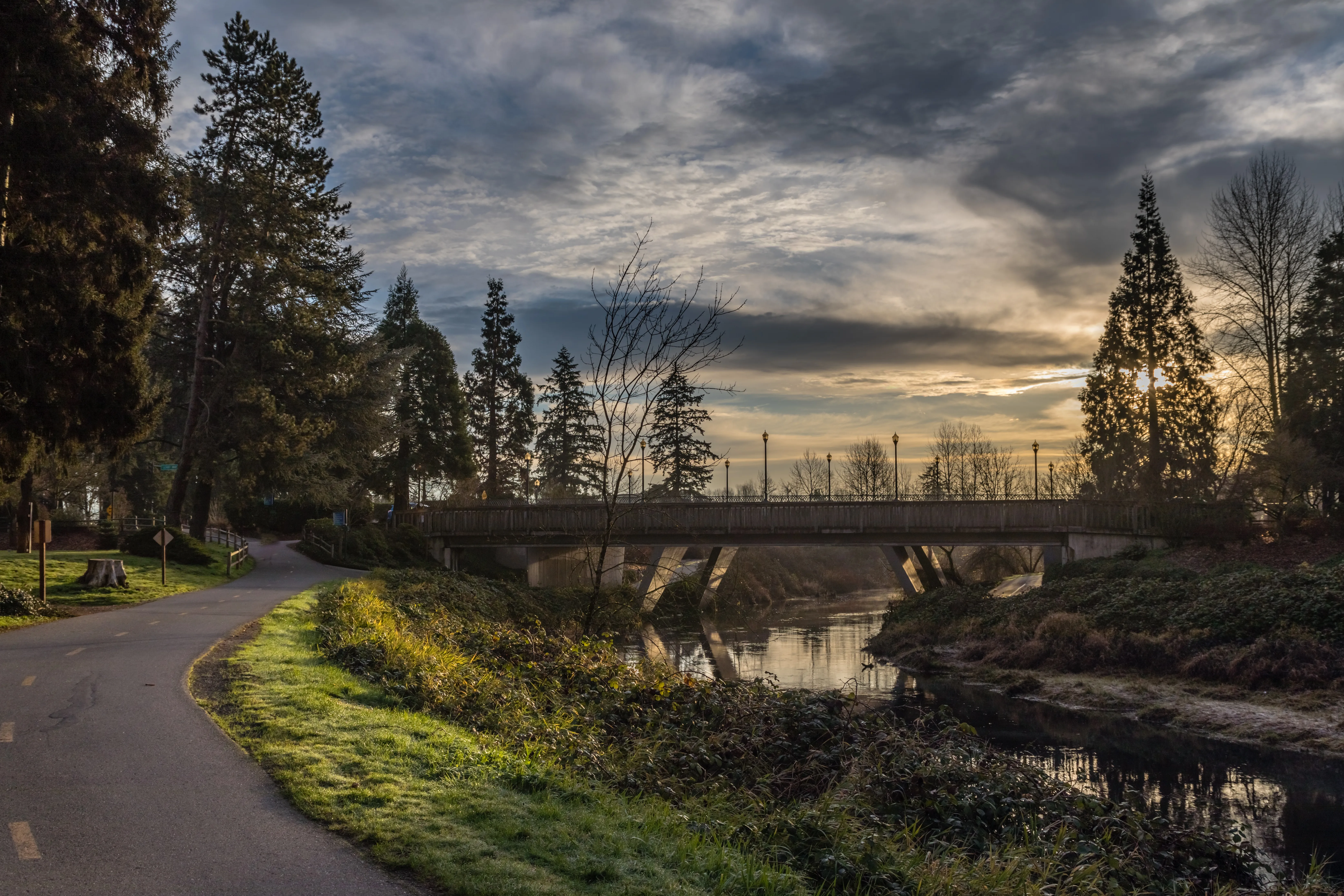
The Sammamish River Trail is genuinely one of the best amenities a retirement in Redmond offers. The paved multi-use trail runs roughly 11 miles from Marymoor Park north toward Bothell, flat and accessible, shaded by cottonwoods and bordered by open farmland and wetlands. Retirees who walk, bike, or use mobility aids report this trail as a near-daily habit. Marymoor Park itself — more than 600 acres at the southern end of the trail — hosts the Redmond Saturday Market (seasonal), the Marymoor Velodrome for cycling enthusiasts, off-leash dog areas, and free summer concerts in the park that regularly draw large crowds.
Walkability in central Redmond is improving but uneven. Downtown Redmond around Redmond Town Center and the immediate blocks near the Sammamish River has genuine on-foot access — coffee shops, restaurants, the library, and small retail within reasonable walking distance. Outside of that core, particularly in Education Hill, North Redmond, and Redmond Ridge, a car is functionally necessary for most errands. The city's investment in the downtown core, including Redmond's connection to the new East Link light rail extension, is gradually shifting that calculus for central neighborhoods.
Getting around without a car is possible but not seamless. King County Metro serves Redmond with multiple routes, and the Redmond Technology Station (formerly the Overlake Transit Center area) and Downtown Redmond Station on Sound Transit's East Link light rail provide direct rail service into Bellevue and Seattle. For retirees who no longer want to drive regularly, living within ten minutes of Downtown Redmond makes the transit-dependent lifestyle workable. Retirees in Redmond Ridge or Union Hill-Novelty Hill will find the car essentially mandatory.
Cultural programming in Redmond is modest but consistent. The Redmond Performing Arts Festival brings summer outdoor performances to the downtown core. Gallery at Redmond Town Center offers rotating exhibits, and the Redmond Library hosts regular programming including author talks and senior-focused workshops. It's not the density of arts programming you'd find in Seattle, but for retirees who want occasional cultural engagement without managing the city, it's sufficient.
What surprises most people after six months of living in Redmond as a retiree is how strongly the weekly rhythm organizes around outdoor life rather than urban amenities. The Saturday morning market, a Tuesday walk on the river trail, a concert at Marymoor in July — that's genuinely what retirement looks like here for a large portion of the senior population. If that sounds appealing, Redmond delivers. If you picture yourself walking to galleries and independent restaurants five nights a week, Bellevue's Bel-Red corridor or Kirkland's waterfront will serve you better.

Redmond's retirement appeal varies quite a bit depending on where you land within the city. Downtown Redmond and Grass Lawn tend to attract retirees who want walkability and a strong sense of community, and homes there — particularly those priced under $900,000 — can move within days when they're well-maintained and move-in ready. Education Hill offers a quieter, more residential feel that resonates with buyers looking to downsize without giving up space, and properties there hold their value well given the neighborhood's established character. If you're open to newer construction, North Redmond and Bear Creek have seen steady interest from retirees who want modern layouts and lower maintenance demands from the start.
Before you fall in love with a specific home, it really helps to sit down with a lender and understand your full monthly picture — not just the loan payment, but property taxes, homeowner's insurance, and any HOA dues that come with the property. What you're approved for and what feels comfortable to pay each month are often two different numbers, and that distinction matters more in retirement when income is fixed. Getting clarity on that before you start touring means you can move confidently when the
| City | Median Home Price | Primary Hospital | Walkability | Senior Living Depth | Overall Retirement Fit |
|---|---|---|---|---|---|
| Redmond | $1,240,000 | EvergreenHealth (Level III, on-site) | Moderate (downtown only) | Strong (9 CCRCs) | ★★★★☆ |
| Kirkland | ~$1,050,000 | EvergreenHealth Kirkland (full campus) | Good (waterfront core) | Moderate | ★★★★☆ |
| Bellevue | ~$1,350,000 | Overlake Medical (349-bed, Level II) | Good (downtown/Bel-Red) | Strong | ★★★★☆ |
| Sammamish | ~$1,200,000 | No hospital on-site | Low | Moderate | ★★★☆☆ |
| Woodinville | ~$900,000 | No hospital on-site | Low | Low | ★★★☆☆ |
| Bothell | ~$780,000 | EvergreenHealth Monroe (nearby) | Low-moderate | Moderate | ★★★☆☆ |
Bellevue offers the strongest urban amenities and the closest Level II hospital, but the price premium is real and downtown Bellevue's density is a significant lifestyle shift for retirees coming from quieter neighborhoods. Sammamish and Woodinville are noticeably more affordable but lack both on-site hospital access and the senior living infrastructure that matters for later retirement years.
Local Expert Takeaway: Retirees who do best in Redmond typically fall into two groups: those with strong equity who want to age in place near adult children in the tech corridor, and those who proactively choose a Life Care community like Emerald Heights and want that decision settled permanently. For the first group, single-level homes on Education Hill and in Grass Lawn are the most practical targets — quiet streets, manageable yards, and close enough to the downtown core to remain connected without feeling embedded in it. Retirees who depend entirely on walkability or urban transit access should seriously consider Kirkland or downtown Bellevue instead; Redmond's car-dependent outer neighborhoods will feel isolating as driving becomes less appealing.
Is Redmond a good place to retire?
Redmond is a strong retirement fit for financially secure retirees who value natural beauty, low crime, excellent healthcare access, and proximity to family in the Eastside tech corridor. The $1,240,000 median home price creates a real entry barrier, but retirees arriving with substantial equity — particularly from California, out-of-state metros, or a long-held Eastside home — often find the lifestyle and tax advantages well worth the price point.
What senior living options are available in Redmond?
Redmond has one of the most developed senior living ecosystems on the Eastside, with roughly nine continuing care retirement communities and a range of assisted living, memory care, and independent living options. Emerald Heights is the flagship nonprofit Life Care community. Fairwinds – Redmond offers an income-qualified track for age-62-plus residents meeting income thresholds. Monthly costs range from around $3,000 for independent senior apartments up to $20,000 for skilled nursing facilities.
How does Redmond compare to Kirkland for retirement?
Both cities offer access to the EvergreenHealth system, similar Pacific Northwest character, and premium home prices. Kirkland edges ahead on walkability, with its Lake Washington waterfront and denser dining and retail core offering a more pedestrian-friendly retirement lifestyle. Redmond has a deeper senior living inventory and more extensive trail access through Marymoor Park and the Sammamish River Trail. The choice typically comes down to whether you'd rather walk to the waterfront or walk to the forest.
Explore the full Redmond series: Living in Redmond · Is Redmond Safe? · Cost of Living · Best Neighborhoods · Schools & Family Life · Youth Sports · Parks & Rec · Retiring in Redmond