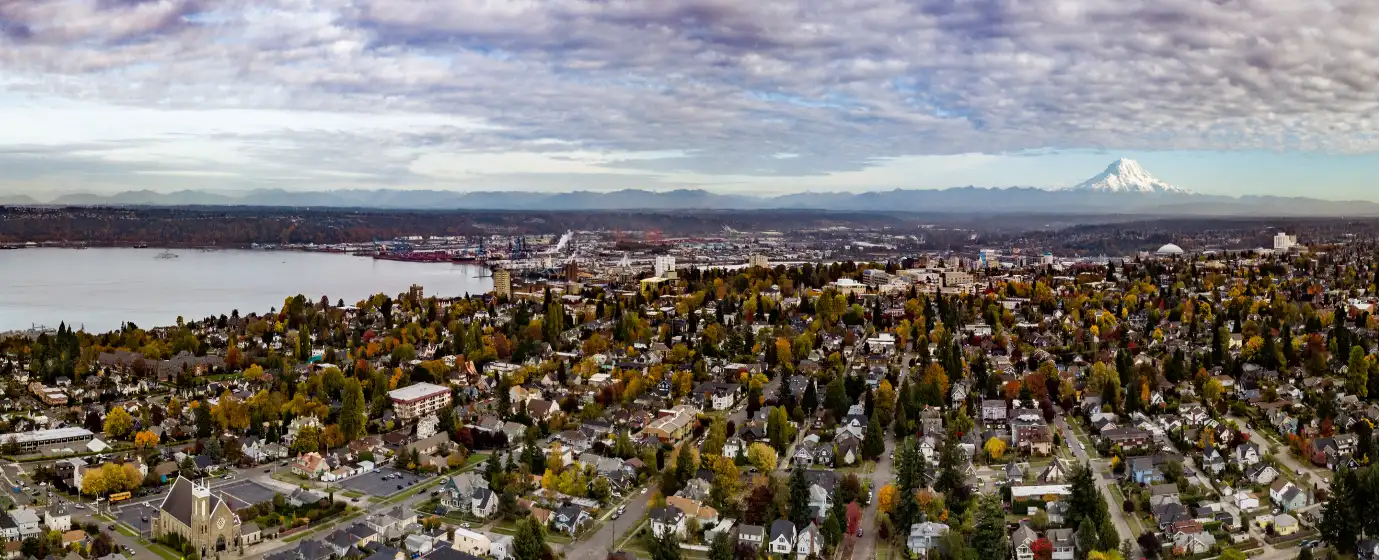
Puget Sound · Washington
Cost of Living in Tacoma: Housing, Taxes, Utilities & Lifestyle (2026)
Tacoma gets compared to Seattle constantly, and that comparison does buyers a disservice. The real story isn't "Tacoma is cheap Seattle" — it's that Tacoma is a genuinely established city with its own employment base, neighborhoods, and cultural identity, where the median sold price in early 2026 sits at $485,000. That's 11% above the national median, which means Tacoma isn't a bargain by most of America's standards. It just looks like one when Seattle is the reference point.
What shapes the cost picture here is a combination of geography, employment, and neighborhood stratification that most relocation guides flatten into a single number. The difference between buying in the Stadium District and buying in South Tacoma is nearly $850,000. Understanding where that number lives — and where the $400,000s remain accessible — is what separates buyers who make smart decisions from those who anchor to the citywide median and get surprised at open houses.
This guide walks through what housing actually costs across Tacoma's price spectrum, what renters are paying, how utilities and daily expenses stack up, and how Tacoma compares to its Pierce County and South Sound neighbors. By the end, you'll have a realistic monthly budget and a clear picture of where the value genuinely is in 2026.

The $485,000 median sold price reflects a market that has cooled slightly from its 2022 peak but remains competitive. Homes in Tacoma are going under contract in roughly 11 days on average, receiving about two offers, and closing at 99.8% of list price — numbers that describe a seller's market with some breathing room, not a free-for-all. Supply remains constrained at approximately a 2.3-month inventory level, which keeps downward pressure modest even as year-over-year prices dipped about 1%.
At $485,000, you're typically looking at a 3-bedroom craftsman or mid-century bungalow in an established neighborhood like North End or Proctor, often with original hardwood floors and a detached garage. The same budget in Central Tacoma or South Tacoma buys more square footage — sometimes considerably more — but in neighborhoods with more industrial character or active revitalization. At the top end, Stadium District historic mansions regularly transact above $1.25 million. The spread across the city is one of the widest in the South Sound.
The price-per-square-foot citywide sits at approximately $338, up about 5.6% year-over-year — meaning the land and structure are appreciating even as headline prices drift slightly. Buyers who focus only on the sold price and miss the per-square-foot trend sometimes underestimate how quickly their equity position can shift in a neighborhood that's improving.
| Budget Range | What You're Likely Getting |
|---|---|
| Under $400,000 | Older construction in South Tacoma, Eastside, or Salishan; fixer potential; smaller lots |
| $400,000–$500,000 | 3-bed/1-2 bath craftsman or ranch in Central Tacoma, New Tacoma, or South End; move-in ready options exist |
| $500,000–$700,000 | Updated homes in North End, Hilltop's revitalizing corridors, or Northeast Tacoma; newer construction in outer neighborhoods |
| $700,000–$1,000,000 | North Slope historic homes, Proctor District, waterfront-adjacent properties near Ruston |
| $1,000,000+ | Stadium District mansions, waterfront Point Defiance area, premium Proctor build-outs |
Pierce County's effective property tax rate for Tacoma properties runs approximately 1.09%, which translates to roughly $5,285 annually on a $485,000 home — or about $440 per month added to your carrying cost. Washington operates under a 1% annual increase cap on levy amounts under Initiative 747 principles, which limits how aggressively your assessed value can translate into a tax bill year over year. Homeowners 61 and older with household income below the state threshold may qualify for Pierce County's senior exemption program, which freezes the taxable value and can reduce the annual bill meaningfully — it's one of the most underutilized benefits for retiring buyers in this market.
Tacoma's rental market has tightened noticeably heading into 2026, with the average apartment rent landing around $1,679–$1,782 per month depending on the data source — a range that reflects both the broader city and its newer inventory. That figure sits roughly 14% below the national average, which helps explain why Tacoma continues to attract renters priced out of Seattle's market without sacrificing urban amenities.
| Unit Type | Average Monthly Rent |
|---|---|
| Studio | $1,358–$1,476 |
| 1-Bedroom | $1,602–$1,648 |
| 2-Bedroom | $2,048 |
| 3-Bedroom | $2,671 |
| 4+ Bedroom | $3,182 |
Utilities in Tacoma benefit from one significant structural advantage: Tacoma Public Utilities operates the city's electricity system, and its rates run meaningfully below the national average. A typical household budget for electricity, water, sewer, and garbage combined runs roughly $175–$230 per month for a mid-sized home, though homes with electric baseboard heating can push that higher in winter months. Natural gas service is provided by Puget Sound Energy, with average monthly bills in the $70–$130 range depending on the season.
Tacoma is a car-dependent city for most errands. The Walk Score for much of the residential grid sits in the 50–65 range, with the Downtown core and Proctor District being the most walkable exceptions. Pierce Transit operates the bus network across the city, and the Tacoma Link light rail provides a useful downtown circulator connecting Union Station to the Stadium District and Hilltop — though its network is limited compared to Seattle's Link system. Commuters heading to Seattle's downtown core face roughly a 45-minute drive under normal conditions, or can use the Sounder commuter rail from Tacoma Dome Station, which runs weekday peak-hour service and takes about an hour to King Street Station.
Gas prices in the South Puget Sound region typically run $0.20–$0.40 above the national average, a consistent feature of Washington's fuel tax structure. For a household running two cars with average mileage, transportation costs commonly reach $900–$1,200 per month once insurance, registration, and fuel are factored in. Washington's annual vehicle registration fees are notoriously high by national standards — a significant and often-forgotten line item for buyers relocating from states with flat registration costs.
Groceries and dining in Tacoma are slightly more expensive than the national average but considerably more affordable than Seattle. A full-service grocery run for a family of four typically falls in the $800–$1,100 monthly range. The South Sound is well-served by Fred Meyer, Safeway, QFC, and multiple Grocery Outlet locations; the Proctor and 6th Avenue corridors have strong walkable access to specialty grocers and independent markets. Restaurant dining in Tacoma is genuinely underpriced relative to Seattle, with solid dinner-for-two options in the $60–$90 range at respected local spots — a difference that adds up over a year for households that eat out regularly.

| City | Est. Median Home Price | Property Tax Rate | Key Cost Note |
|---|---|---|---|
| Tacoma | $485,000 | ~1.09% | City-wide median; widest neighborhood spread in the region |
| University Place | ~$530,000 | ~1.05% | Suburban, quieter; slightly pricier than Tacoma's mid-range |
| Fircrest | ~$510,000 | ~1.06% | Small, tight inventory; premium for quiet residential feel |
| Lakewood | ~$430,000 | ~1.08% | More affordable; heavy JBLM commuter base |
| Puyallup | ~$475,000 | ~1.07% | Valley location; strong schools; growing bedroom community |
| Federal Way | ~$510,000 | ~1.02% | King County rates; perceived safety concerns in some corridors |
| Seattle | $832,000+ | ~0.85% | Dramatically higher entry price; lower effective tax rate |

From a lending standpoint, where you buy within Tacoma matters as much as what you pay. Neighborhoods like the North End and Proctor District consistently hold their value and attract strong buyer demand, meaning well-priced homes often go under contract within days. The Stadium District has seen similar momentum, with buyers drawn to the walkability and character of the area. If you're targeting something under $750,000 in these pockets, you need to move quickly and come prepared.
That's exactly why I encourage buyers to connect with a lender before they ever step foot in a home. Your purchase price is just one piece of the picture — property taxes, homeowner's insurance, any HOA dues, and your specific loan structure all fold into your true monthly obligation, and that number can look very different from what a basic online calculator shows. Understanding your comfortable budget, not just your maximum approval, puts you in a position to make a confident decision when the right home comes along rather than scrambling to figure out the numbers after you've already fallen in love with a place.
This budget is built on a $485,000 purchase with 10% down ($48,500), a loan amount of $436,500, and current 30-year fixed mortgage rates in the mid-to-upper 6% range.
| Category | Estimated Monthly Cost |
|---|---|
| Principal & Interest (6.75% rate) | ~$2,830 |
| Property Tax (1.09%) | ~$440 |
| HOA (if applicable — varies widely) | $0–$300 |
| Electric (Tacoma Public Utilities) | ~$90–$120 |
| Natural Gas (Puget Sound Energy) | ~$70–$130 |
| Water/Sewer/Garbage | ~$80–$110 |
| Internet (Comcast/Xfinity or Wave G) | ~$65–$95 |
| Groceries (household of 3–4) | ~$900–$1,100 |
| Transportation (2 vehicles, fuel, insurance) | ~$1,000–$1,200 |
| Dining out / entertainment | ~$400–$600 |
| Total Estimated Monthly | ~$5,875–$6,925 |
Washington state has no personal income tax — a real financial advantage over Oregon, California, and most other West Coast states. For a household earning $85,000 annually, the absence of state income tax represents roughly $4,500–$6,000 in savings compared to California's rate structure, and approximately $4,000–$5,000 against Oregon's income tax brackets. That figure meaningfully shifts the affordability calculus for buyers relocating from income-tax states.
The state funds public services through sales tax, and Washington's combined state and local rate in Pierce County sits at 10.2% — one of the higher combined rates in the country. Groceries (unprepared food) are exempt from Washington sales tax, which takes the sting out for daily household spending, but discretionary purchases and large durable goods feel the full rate. Buyers who move from income-tax states should run the full picture: the income tax savings are real, but higher sales tax, vehicle registration fees, and gas taxes partially offset them for high-spending households.
For older buyers, Washington's senior property tax deferral program allows qualifying homeowners 60 and older to defer property taxes until the home is sold, essentially creating a state-backed loan on the tax bill. Combined with the Pierce County senior exemption for 61+ residents, Tacoma can be a genuinely tax-advantaged landing spot for retirees — a dimension that rarely shows up in the generic cost-of-living comparisons.

Local Expert Takeaway: The buyers who get the best value in Tacoma are the ones who stop using the $485,000 citywide median as their anchor and start buying for a specific corridor's trajectory. New Tacoma at $435,000 with 6% year-over-year appreciation is a fundamentally different bet than Central Tacoma at $472,000 with stable-to-flat growth. If you're coming from Seattle and budget is the primary driver, the North Slope at $740,000 still pencils against Capitol Hill's prices — but don't try to buy the Stadium District on a North End budget expecting similar character. Know which version of Tacoma you're buying.
Looking to buy in Tacoma? Estimate your payment.
Enter your numbers to see an estimated monthly mortgage payment.
Estimate only. Excludes HOA fees and mortgage insurance.
Is Tacoma affordable compared to other Washington cities?
Tacoma is significantly more affordable than Seattle, where medians have crossed $830,000, and sits within $30,000–$50,000 of Puyallup and University Place. The city offers genuine entry-level options in the $380,000–$450,000 range in South Tacoma and Eastside, which are hard to find anywhere closer to Seattle. That said, a single median income of roughly $85,000 still requires a meaningful down payment to hit a comfortable payment-to-income ratio.
What are monthly housing costs for a typical Tacoma buyer?
On a $485,000 purchase with 10% down at current rates, the combined principal, interest, and property tax runs approximately $3,270 per month before utilities and maintenance. Adding typical household expenses brings the full monthly cost of ownership into the $5,875–$6,925 range — a figure that comfortably requires dual incomes for most buyers at the citywide median.
How do Tacoma's property taxes compare to Seattle's?
Tacoma's effective property tax rate of approximately 1.09% is higher than Seattle's, which typically runs closer to 0.85%. On a $485,000 home, Tacoma buyers pay roughly $440 per month in taxes, compared to what would be a lower effective bill in King County — though the much higher Seattle entry prices make the raw dollar comparison favor Tacoma significantly.
Explore the full Tacoma series: Living in Tacoma · Is Tacoma Safe? · Cost of Living · Best Neighborhoods · Schools & Family Life · Youth Sports · Parks & Rec · Retiring in Tacoma