Puget Sound · Washington
Retiring in Tacoma: Is It the Right Fit for Your Next Chapter? (2026)
Tacoma doesn't make the retirement shortlists that Scottsdale or Asheville do, and that's exactly why the retirees who land here tend to stay. This is a city with genuine cultural infrastructure — world-class museums, a working waterfront, serious hospital systems — at home prices that still allow equity-rich buyers from California or the eastside of Seattle to downsize into something comfortable without exhausting their savings. The honest answer to whether Tacoma fits retirement is: it depends on what you actually want from this chapter, and this guide is designed to help you figure that out before you make an offer.
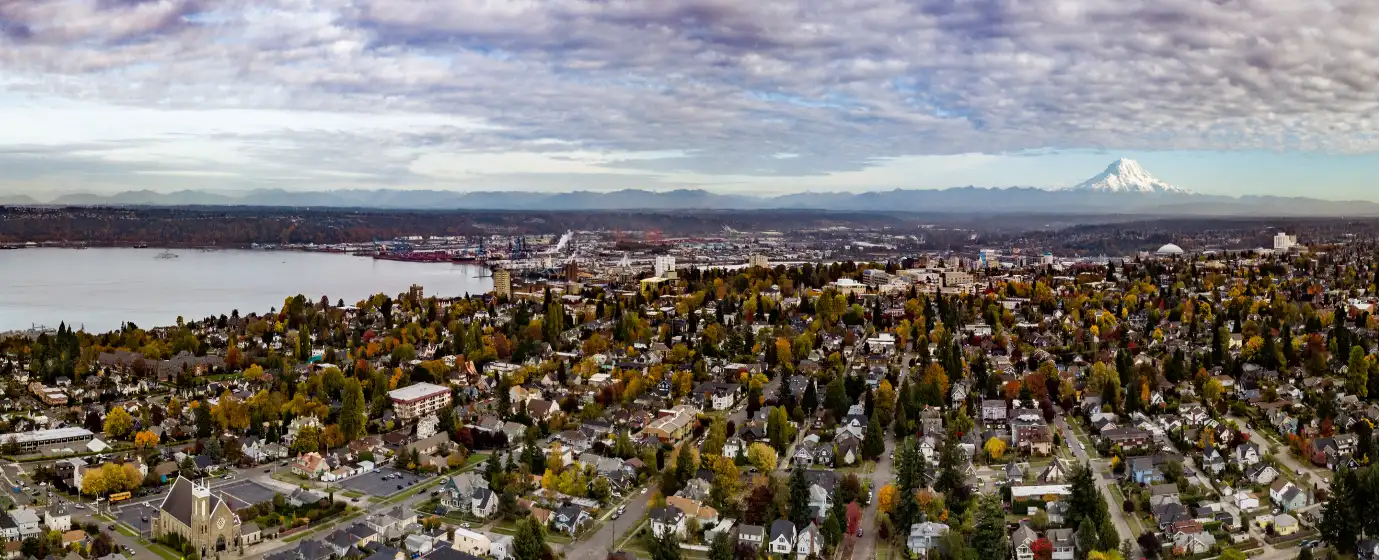
The city sits along Commencement Bay at the southern end of Puget Sound, with the Cascade Range visible on clear days and Point Defiance Park — one of the largest urban parks in the country — anchoring the northwest corner of the city. Daily life here is shaped by hills, water, and a street grid that rewards people who know it but can frustrate newcomers. The neighborhoods closest to the water and the North End tend to attract retirees who want walkable streets and cultural access; the south and east sides offer more space and lower price points for those whose priority is acreage over amenity proximity.
This guide covers Washington's retirement tax advantages, Tacoma's hospital infrastructure, the senior living landscape, what daily life actually looks like for retirees in 2026, and an honest comparison with the nearby cities that often come up as alternatives.

Washington is one of nine states with no state income tax — and for retirees, that single fact reshapes every budget conversation. Social Security, pension income, 401(k) withdrawals, and IRA distributions are all untaxed at the state level.
| Income Type | Washington State Tax Treatment |
|---|---|
| Social Security Benefits | No state tax |
| Pension / Defined Benefit | No state tax |
| 401(k) / IRA Withdrawals | No state tax |
| Investment / Capital Gains | Capital gains tax on gains above $270K threshold |
| Dividend / Interest Income | No state income tax on ordinary dividends or interest |
| Military Retirement Pay | No state tax |
| Part-Time Employment Income | No state income tax |
| Property Tax (median rate) | Approximately 1.05% effective rate |
| Sales Tax (Tacoma) | Approximately 10.2% combined rate |
Washington also offers a meaningful senior property tax exemption for homeowners 61 and older who meet income thresholds. Qualifying seniors can have a portion of their home's assessed value frozen, reducing annual property tax liability on a $485,000 home from roughly $5,093 down to a figure that varies by income tier — in some cases by several hundred dollars annually. Pierce County administers the program, and the application process is straightforward for most homeowners. The sales tax rate does sting compared to Oregon's zero sales tax on consumer goods, so retirees who do significant retail shopping will feel that trade-off — but for most people living on fixed income with limited discretionary spending, the income tax elimination is the dominant factor.
Tacoma has a more developed senior living ecosystem than its reputation might suggest, with options ranging from independent apartment communities to full continuing care retirement communities (CCRCs) with memory care and skilled nursing on the same campus.
| Community | Type | Location | Est. Monthly Cost |
|---|---|---|---|
| Franke Tobey Jones | CCRC / Life Plan | North End (20-acre campus) | Entry fee + monthly varies |
| Merrill Gardens at Wright Park | Independent / AL / Memory Care | Stadium District | $3,500–$6,500+ |
| Merrill Gardens at Tacoma | Independent / AL | West Tacoma | $3,000–$5,500+ |
| GenCare Lifestyle at Point Ruston | AL / Memory Care (waterfront) | Ruston / North Tacoma | $4,640–$8,420+ |
| Cogir at The Narrows | CCRC | West Tacoma | Varies by care level |
GenCare Lifestyle at Point Ruston is the most distinctive option for buyers who want retirement living with a genuine waterfront lifestyle. The community sits on Puget Sound's Point Ruston esplanade, with 159 studio through two-bedroom assisted living apartments and 24 memory care suites. Studios start around $4,640 per month; two-bedrooms run up to $8,420. The community has an active partnership with MultiCare Health System and Dispatch Health, which delivers mobile urgent care directly to residents — a meaningful advantage for those who want healthcare proximity without daily visits to a clinic.
Merrill Gardens at Wright Park earned the 2026 Reputation 800 Award and the 2025 Best of Pierce County designation, and its location in the Stadium District offers something few assisted living communities can match: unobstructed views of Commencement Bay, Mount Rainier, the Cascades, and the Olympics, with Wright Park's green canopy directly outside. For retirees whose life in a senior community still centers on beauty and environment, this location is hard to beat.
The honest version: Tacoma is not a walking city for retirees in the way that Portland's Pearl District or downtown Bellevue are. The topography is real — the city runs on steep hills — and several of the most desirable residential neighborhoods require a car to reach grocery stores, pharmacies, and medical appointments comfortably. That said, certain pockets of the city deliver genuine walkability.
The North End and Stadium District are where retirees who prioritize a walkable daily routine tend to gravitate. Within a few blocks of North 26th Street and Proctor, you'll find a farmers market, coffee shops, independent restaurants, and the Proctor District's retail corridor. Wright Park — a 27-acre Victorian-era park with a 500-species conservatory — is walkable from most North End addresses. The Museum of Glass, Tacoma Art Museum, and Washington State History Museum form a cultural campus along the waterfront that takes a short drive or rideshare from most residential neighborhoods but is genuinely world-class for a city this size.
The cultural calendar has depth. The Tacoma Farmers Market runs weekly through the growing season at the Proctor District and in downtown. The Tacoma Little Theatre has operated continuously since 1918 and offers a full seasonal schedule. The Tacoma Symphony, Tacoma Opera, and Broadway Center for the Performing Arts bring programming that keeps retirees engaged year-round without requiring a drive to Seattle. Point Defiance Park's rose gardens, Japanese Garden, and Zoo & Aquarium provide the kind of low-intensity outdoor experience that retirees return to weekly rather than saving for occasional visits.
Getting around without a car is possible but imperfect. Pierce Transit operates throughout the city, and the Tacoma Link light rail connects downtown to the Hilltop neighborhood with free fare — but frequency and reach remain limited compared to Seattle's system. Retirees who plan to be fully car-free will find the experience manageable in the North End and Stadium District but increasingly difficult in the South End, West End, or any of the hillier residential neighborhoods. Rideshare availability in Tacoma is consistent in the central city and dramatically thinner late at night or in outer neighborhoods — something to factor in for retirees considering giving up a vehicle entirely.
What surprises most people after six months in Tacoma: the density of the cultural infrastructure relative to the price point. Retirees who moved from larger metros expecting to compromise on arts, dining, and civic life often find that the gap is smaller than advertised — and that the cost difference versus Seattle frees up real money for experiences rather than mortgage payments.

Tacoma's retirement appeal varies quite a bit depending on where you land within the city. The North End and Proctor District consistently draw retirees who want walkability, established trees, and a genuine neighborhood feel — and homes there tend to move fast, often within days of listing. The Stadium District offers that same character with stunning views, and well-maintained properties under $750,000 don't sit long. If you're drawn to waterfront calm, Old Town has its own loyal following. Understanding which pockets match your lifestyle before you start touring helps you move with confidence rather than scrambling to get finances in order after you've already fallen in love with a place.
That's exactly why I encourage retirees to connect with a lender before the first showing. Retirement income structures — Social Security, distributions, pensions — can all qualify, but they shape your loan options differently than a traditional paycheck. More importantly, knowing your full monthly payment picture, including taxes, insurance, and any HOA dues, helps you find a genuinely comfortable budget, not just a maximum approval number. The right home shows up when you least expect it, and being ready matters.
| City | Median Home Price | Hospital Access | Walkability | Senior Community Depth | Overall Fit |
|---|---|---|---|---|---|
| Tacoma | $485,000 | Excellent (2 Level II Trauma Centers) | Moderate – excellent in North End | Strong | ★★★★ |
| Lakewood | ~$380,000 | Good (St. Clare Hospital nearby) | Limited | Moderate | ★★★ |
| University Place | ~$520,000 | Good (Tacoma hospitals nearby) | Low | Limited | ★★★ |
| Puyallup | ~$480,000 | Good (Good Samaritan Hospital) | Moderate | Moderate | ★★★ |
| Federal Way | ~$500,000 | Moderate (St. Francis Hospital) | Low | Moderate | ★★½ |
| Gig Harbor | ~$680,000 | Moderate (St. Anthony nearby) | Moderate | Growing | ★★★½ |
Tacoma sits at the center of this regional picture with the strongest combination of hospital depth, cultural infrastructure, and senior living variety. The catch — and it's worth naming honestly — is that the urban environment brings higher property crime rates than the quieter suburban alternatives. Retirees who are uncomfortable with that context or who prioritize suburban quiet above cultural access will likely be happier in University Place, Gig Harbor, or Fircrest.

Local Expert Takeaway: Retirees who thrive in Tacoma are typically those who want a real city — with arts, waterfront access, and genuine hospital depth — at prices that don't require liquidating their equity to make it work. The North End and Stadium District deliver the best day-to-day retirement lifestyle within the city; if you want independent living in a senior community with a view, GenCare at Point Ruston and Merrill Gardens at Wright Park are the two addresses I'd look at first. Retirees who are primarily motivated by suburban quiet, very low crime, and simplicity should take an honest look at University Place or Gig Harbor before committing to Tacoma — the fit depends entirely on which version of retirement you're actually planning to live.
Is Tacoma a good place to retire?
For the right type of retiree, yes. Tacoma offers a genuine combination of world-class cultural infrastructure, strong hospital systems, a developing senior living ecosystem, and home prices below the broader Seattle metro average. Washington's lack of a state income tax makes retirement income stretch further here than in Oregon or California.
What is the crime situation for retirees in Tacoma?
Tacoma's property crime rate of 55 per 1,000 residents is elevated compared to smaller suburban neighbors like University Place or Gig Harbor, and it's a legitimate factor for retirees to weigh. The North End, Stadium District, and Proctor District tend to report lower crime activity than the citywide average; the south and central neighborhoods have more variability. Retirees who research neighborhood-level patterns before choosing a home tend to find the situation manageable.
How does Tacoma compare to Gig Harbor for retirement?
Gig Harbor offers a quieter, more suburban-village atmosphere with lower crime and a more homogeneous residential character — but home prices run roughly $180,000–$200,000 higher, hospital access for serious conditions requires a drive to Tacoma, and the senior living infrastructure is still developing. Tacoma gives retirees more cultural activity, more healthcare options on-site, and more senior community choices; Gig Harbor gives them more peace and a prettier waterfront setting. The decision typically comes down to how much daily activity and urban access you want versus how much you're willing to pay for calm.
Explore the full Tacoma series: Living in Tacoma · Is Tacoma Safe? · Cost of Living · Best Neighborhoods · Schools & Family Life · Youth Sports · Parks & Rec · Retiring in Tacoma