Puget Sound · Washington
Living in Tacoma: The Ultimate Relocation Guide (2026)
Maybe you've been priced out of Seattle and someone at your office mentioned Tacoma as the place people are actually buying right now. Maybe you caught a headline about Tacoma's arts scene or saw a photo of Stadium High School perched above Commencement Bay and thought — wait, that's a real place? Or maybe you've been transferred to Joint Base Lewis-McChord and you're trying to figure out whether to live on base, in Lakewood, or take a chance on a city that seems to be in the middle of something. Whatever brought you here, Tacoma is not a simple city to evaluate from a distance. It has some of Washington's most stunning historic architecture and some of its most stubborn urban challenges sitting within a few miles of each other — and the difference between a great move and a frustrating one often comes down to which five square miles you choose.
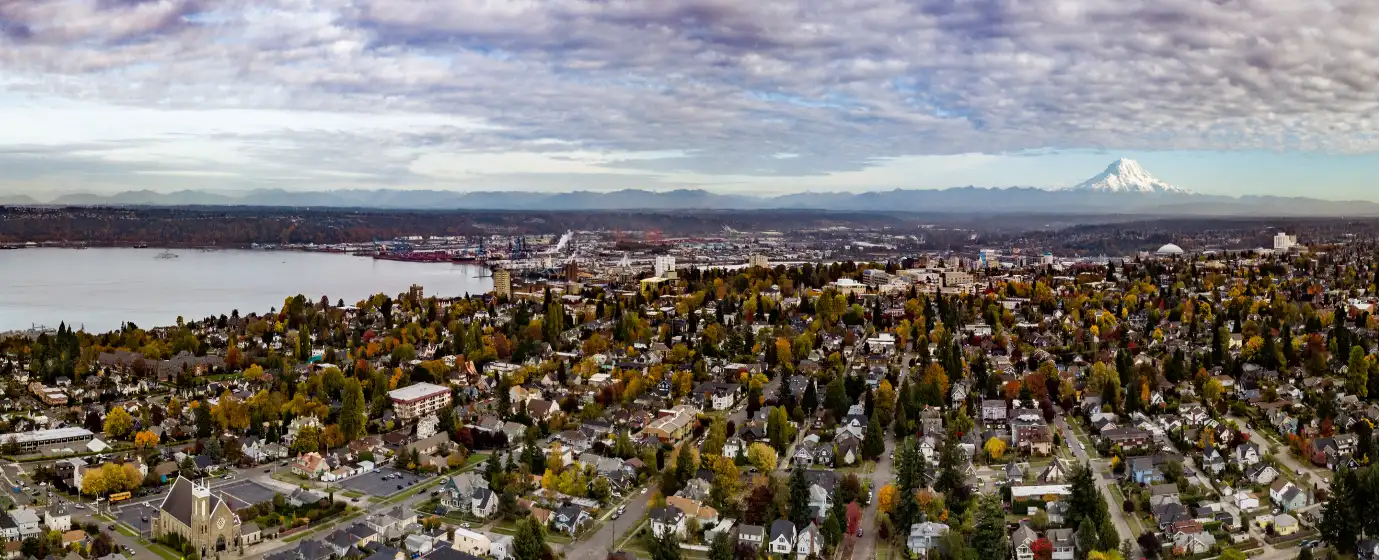
Tacoma is Washington's third-largest city, home to roughly 222,000 to 232,000 residents across a geography shaped by Commencement Bay to the north, the Puyallup River to the south, and the Cascade foothills visible on clear days from just about everywhere. It sits 35 miles south of Seattle along I-5, which makes it a legitimate commuter city for people working in the capital of Pacific Northwest tech — though anyone who tells you the commute is easy hasn't driven it at 4:30 on a Thursday afternoon. Daily life here is shaped by that relationship to Seattle, but also by the military presence at JBLM, the industrial heritage of the Port of Tacoma, and a cultural renaissance that has quietly been building for two decades around institutions like the Museum of Glass, the Tacoma Art Museum, and a downtown that has absorbed more serious investment than most people outside the region realize.
This guide is designed to help you figure out whether Tacoma actually fits your life — not just your budget. You'll get an honest read on the neighborhoods, the commute reality, the housing market, the trade-offs most newcomers don't anticipate, and the specific parts of the city that locals know are categorically different from each other. By the end, you'll have enough to make a genuinely informed decision rather than an internet-research guess.
Not every city is right for every buyer, and Tacoma is more defined by its contrasts than most. Here's a direct read on who tends to thrive here — and why.
| Best For | Why |
|---|---|
| Seattle commuters | Median home price of $485,000 vs. Seattle's $837,000+ — same Puget Sound, dramatically different cost |
| First-time buyers | Entry-level inventory exists in Central Tacoma, Lincoln, and South Tacoma under $400K |
| Military families (JBLM) | 10–20 minutes to base; strong rental market; established military community networks |
| Arts and culture seekers | Museum of Glass, Tacoma Art Museum, Washington State History Museum, Theater District all walkable from Downtown |
| Families with school-age children | West End and North End offer strong schools, Point Defiance Park access, and stable neighborhoods |
| Remote workers | Lower housing costs free up income; walkable North End neighborhoods deliver lifestyle quality without Seattle pricing |
Tacoma is a city that rewards people who take the time to learn it. The first drive-through impression — industrial waterfront on one side, some tired commercial corridors — doesn't capture the neighborhoods that sit just a few blocks north or west. The North End genuinely feels like a different city from the commercial stretches of South Tacoma Way, and that geographic reality is something every buyer should internalize before falling in love with a Zillow listing without checking the cross streets.
The commute to Seattle deserves honest treatment. The 45-minute figure reflects light traffic and favorable conditions — a Tuesday morning departure at 7 a.m. can hit that mark. But I-5 northbound through Federal Way during peak hours regularly stretches to 60–90 minutes, and buyers who are making this drive five days a week discover quickly that the math changes their lifestyle calculus. Sounder commuter rail is the serious commuter's tool of choice: the Tacoma Dome Station connects to King Street Station in Seattle in about an hour with predictable timing and no highway frustration, and it remains underused relative to how good it actually is.
The community vibe in Tacoma is genuinely difficult to summarize because it's so neighborhood-dependent. In the Proctor District on a Saturday morning — with the farmers market running, the Metropolitan Market doing its usual weekend business, and the cobblestone streets filling up — it feels as activated and pleasant as any urban neighborhood in the Pacific Northwest. Six blocks in the wrong direction and the energy changes completely. That contrast is Tacoma's defining characteristic, and it's not a flaw so much as a feature of a city that hasn't finished becoming what it's becoming.
One thing that surprises most people after six months of living here: the social life organizes itself around neighborhoods more than in most cities. Proctor people tend to stay in Proctor. North Slope residents walk to 6th Avenue. The Hilltop arts crowd has its own gravitational pull. If you buy in the right neighborhood for your lifestyle, Tacoma's density and walkability can feel genuinely urban. If you land somewhere without a natural social anchor, the city can feel more isolated than it looks on a map.
The price-to-quality ratio on housing is extraordinary compared to the broader Puget Sound. A $485,000 median price in a city with Tacoma's waterfront access, historic housing stock, and cultural infrastructure is something that doesn't exist elsewhere in the region. Seattle buyers who make the move routinely report a sense of space — physical and financial — that they hadn't anticipated. That median buys you a craftsman bungalow in Central Tacoma, a solid family home in the West End, or gets you within reach of the historic North End with some strategic shopping.
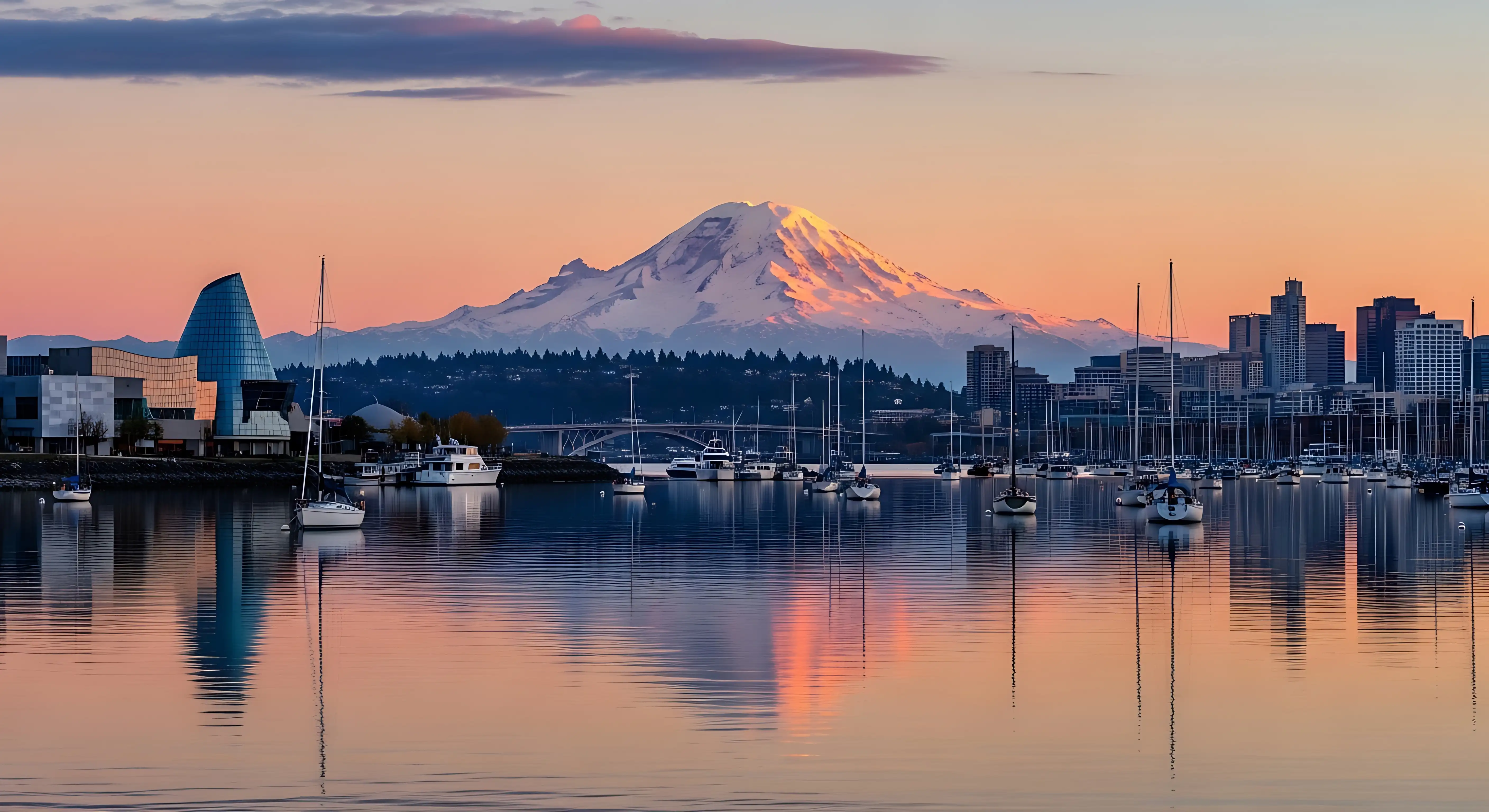
Point Defiance Park is one of the genuinely great urban parks in the country and it belongs to Tacoma. At 760 acres, it includes old-growth forest, the Five Mile Drive loop, Owen Beach on Puget Sound, a zoo and aquarium, boat launch facilities, and trail systems that feel nothing like a city park. Families who discover it in the first month of living here often describe it as the single feature that sealed their decision. The Ruston Way Waterfront adds another dimension — a 2.2-mile pedestrian and cycling path along Commencement Bay with views of Mount Rainier on clear days that genuinely stops people mid-stride.
The cultural infrastructure is deeper than Tacoma's reputation suggests. The Museum of Glass, designed by Arthur Erickson with its signature cone-shaped hot shop, hosts live glassblowing demonstrations and world-class exhibitions year-round. The Tacoma Art Museum, Washington State History Museum, and the Broadway Center for the Performing Arts are all within walking distance of each other in a downtown that has been steadily activating for years. The University of Puget Sound and Pacific Lutheran University give the city a year-round academic energy that feeds the arts scene and the independent restaurant culture on 6th Avenue and in the Proctor District.
Tacoma's job market has also diversified well beyond its industrial origins. MultiCare Health System, Virginia Mason Franciscan Health, and Kaiser Permanente collectively represent one of the strongest healthcare employment clusters in Pierce County. Joint Base Lewis-McChord is one of the largest military installations in the country and anchors a significant portion of the regional economy. The Port of Tacoma — one of the largest container ports on the West Coast — provides industrial and logistics employment that has remained stable even during broader economic uncertainty. For buyers who work locally rather than commuting to Seattle, the employment diversity is a genuine asset.
Tacoma's property crime rate — approximately 55 incidents per 1,000 residents — is something buyers need to understand before they make an offer. This is well above the national average and it's not uniformly distributed across the city. Car break-ins and property theft are the most common categories, and certain commercial corridors and neighborhoods experience this more acutely than others. The West End, North End, and Northeast Tacoma consistently post crime statistics below the citywide average. Hilltop and parts of Central Tacoma see more activity. This is navigable information, not a reason to avoid the city, but it's the kind of thing that should inform your neighborhood shortlist rather than surface as a surprise after you've signed.
The weather is a legitimate consideration that often gets glossed over in Pacific Northwest real estate conversations. Tacoma averages roughly 150 gray days a year — less rainfall than Seattle in terms of total precipitation, but similarly overcast from October through April. People who move from California or the Southwest often find the winter light genuinely difficult. This isn't unique to Tacoma, but it's worth naming because the cloudy season is long and it affects daily mood and energy in ways that are hard to fully appreciate from a relocation visit in June.
Why some people leave Tacoma tends to come down to a few consistent themes: the commute to Seattle becomes unsustainable for people who underestimated its variability; the neighborhood quality gap — the stark difference between blocks that feel safe and activated versus blocks that don't — wears on people who aren't in one of the premium enclaves; and for families with children in the Tacoma School District, the school quality varies enough by school and program that navigating the system requires active engagement rather than passive enrollment. The buyers who struggle most are those who purchased based on citywide averages without understanding that in Tacoma, your specific neighborhood and school assignment matter more than the city's overall statistics.
The housing market itself, while softer than its 2022 peak, remains competitive in the neighborhoods buyers most want. With roughly 2.3 months of inventory citywide and average days on market around 11, well-priced homes in the North End, West End, and Northeast Tacoma move quickly. Buyers who arrive expecting a leisurely pace will be surprised.
The North End is the umbrella geography that contains most of Tacoma's premium residential character — bounded roughly by 6th Avenue to the south and Commencement Bay to the north, with sub-areas including the Stadium District, Proctor District, North Slope Historic District, and Old Town. Tree-lined streets, pedestrian-friendly sidewalks, and proximity to Ruston Way give it a quality of life that consistently surprises buyers relocating from other markets. Median prices across the North End range from approximately $633,000 to $716,000 depending on the specific block, with the Stadium District commanding significantly more.
Best for: Established professionals and families with children who want Tacoma's best walkability, historic character, and long-term value retention.
Stadium District is Tacoma's most expensive neighborhood, with a 2026 median sold price of $1.25 million — and the homes here justify the premium in ways that are immediately apparent. The neighborhood anchors around Stadium High School, the iconic 1891 castle-like structure overlooking Commencement Bay, and the surrounding blocks are lined with historic mansions featuring bay views that would cost three times the price in Seattle. A Link light rail stop adds transit access, and the walkable commercial street at the base of the hill provides daily errands without a car.
Best for: Luxury buyers who want Tacoma's most architecturally significant housing and are comfortable with the responsibilities of historic home ownership.
The Proctor District is the neighborhood that makes North End residents never want to leave — a compact, walkable village with cobblestone accents, a year-round farmers market, the Metropolitan Market as the anchor grocer, and a dense collection of independent restaurants and coffee shops. Average home values run approximately $741,000, putting it in the same premium tier as North Slope. The annual Proctor Arts Fest in August draws the neighborhood together around local artists and live performances, and it's become one of Tacoma's most anticipated community events.
Best for: Buyers who prioritize walkable daily errands, a genuine neighborhood social scene, and proximity to some of Tacoma's best independent dining.
North Slope holds the designation of Tacoma's largest historic district, encompassing roughly 940 homes built between 1880 and 1953. The 2026 median sits at approximately $740,000. Owning here means engaging with the city's historic preservation guidelines for exterior modifications — a trade-off that filters for buyers who genuinely value the neighborhood's architectural integrity. The walkable grid of family-owned shops and the proximity to Downtown and 6th Avenue make this one of the most livable patches of real estate in Pierce County.
Best for: History-minded buyers who want the North End's character at a slight discount to Stadium District pricing and don't mind the historic district remodeling guidelines.
Old Town sits along the waterfront near Point Ruston, a mixed-use development that brought new dining, retail, and marina access to the Commencement Bay edge of the North End. It consistently ranks among Tacoma's most expensive neighborhoods alongside Stadium District and Proctor, and the waterfront premium is real — homes here capture views and walkable water access that few other Tacoma neighborhoods can match. Inventory is limited and turnover is low.
Best for: Buyers who want Tacoma's most direct waterfront access and can budget for a North End premium price point.
The West End is Tacoma's most consistently family-friendly neighborhood and one of its safest, posting crime statistics approximately 46% below the citywide average. Point Defiance Park, Owen Beach, and Tacoma Community College are all within the neighborhood's orbit, and the school options — both public and private — are among the stronger offerings in the district. The Redfin median runs approximately $580,000, making it more accessible than the deepest North End pockets while still delivering the quality-of-life characteristics families with children typically prioritize.
Best for: Families with school-age children who want Tacoma's best safety profile and immediate access to Point Defiance Park.
Central Tacoma, anchored by the 6th Avenue corridor, is where Tacoma's urban energy is most concentrated and most affordable relative to the North End. Median prices range from approximately $450,000 to $580,000 depending on the specific block, and the neighborhood delivers walkability to independent restaurants, bars, music venues, and coffee shops that give it a genuinely activated feel on weekday evenings and weekends. The honest trade-off here is more variability in block quality — the best streets in Central Tacoma are excellent; others require a higher tolerance for urban rough edges.
Best for: Younger buyers and remote workers who want urban lifestyle, walkable nightlife, and a lower entry price than the North End.
Hilltop is in active transition — one of Tacoma's most historically significant neighborhoods and also one of its most honestly complex. Median home prices run approximately $380,000 to $520,000, making it the most accessible entry point in the near-Downtown geography, and the arts community has been establishing roots here for years. The Link light rail line connects Hilltop directly to Downtown and Stadium District, which is a genuine quality-of-life asset. Buyers drawn to Hilltop for its value and urban character should research specific blocks carefully — the neighborhood's revitalization is real but uneven.
Best for: Buyers comfortable with a neighborhood in transition who want the lowest entry price in Tacoma's core urban geography and proximity to the Link corridor.

If you're relocating to Tacoma, where you land within the city can meaningfully shape your long-term equity story. Neighborhoods like the North End and Proctor District have shown steady buyer demand, and well-priced homes there — often under $750,000 — can receive multiple offers within days of hitting the market. The Stadium District draws buyers who want walkability and historic character, and that combination tends to hold value well over time. Understanding these micro-market dynamics before you start touring helps you set realistic expectations and move with confidence when something clicks.
That's exactly why I encourage relocating buyers to connect with a lender before scheduling a single showing. Your purchase price is just one piece of the picture — property taxes, homeowner's insurance, potential HOA dues, and your loan structure all factor into what you'll actually pay each month. Max approval and comfortable budget are rarely the same number, and knowing the difference upfront protects you from falling in love with a home that quietly stretches you thin. When the right place appears in a fast market like Tacoma, being fully prepared is what lets you act decisively.
| City | Best For | Approx. Home Price | Commute to Seattle | Vibe |
|---|---|---|---|---|
| Tacoma | Urban lifestyle + value; JBLM proximity | $485,000 | 45–90 min (I-5) | Gritty, artsy, culturally rich; neighborhood-dependent |
| University Place | Families wanting Tacoma access without urban friction | $550,000–$620,000 | 55–75 min | Quiet, residential, suburban |
| Fircrest | Small-town feel, safe streets, West End adjacency | $500,000–$560,000 | 55–75 min | Calm, walkable in its core, very suburban |
| Lakewood | JBLM commuters; most affordable Pierce County option | $400,000–$460,000 | 55–80 min | Auto-oriented; improving; less walkable |
| Puyallup | Families, suburban amenities, strong school options | $520,000–$580,000 | 50–70 min | Family-suburban; downtown has character |
| Federal Way | Seattle commuters on a tighter budget | $480,000–$530,000 | 35–60 min | Commercial-suburban; less neighborhood identity |
| Metric | Figure |
|---|---|
| Population | ~222,000–232,000 (3rd largest city in Washington) |
| Median Sold Home Price (2026) | $485,000 |
| Median Household Income | $85,884 |
| Property Tax Rate | Approximately 1.05% |
| Average Days on Market | ~11 days |
| Commute to Seattle (I-5) | 45–90 minutes depending on traffic |
| Violent Crime per 1,000 Residents | 7.4 |
| Property Crime per 1,000 Residents | 55 |
| School District | Tacoma School District (B rating) |
| Major Employers | MultiCare, JBLM, Tacoma Public Schools, Virginia Mason Franciscan Health, Port of Tacoma |
Tacoma has a running rivalry with Seattle that locals treat with more affection than bitterness — the "Grit City" identity is something residents have embraced deliberately as an antidote to Seattle's tech-polished self-image. You'll see it on bumper stickers, coffee shop signage, and the way locals describe the city to newcomers. It's less a chip on the shoulder than a genuine point of pride about a city that built real things — ships, timber, rail — and never forgot it.
The Proctor Farmers Market runs year-round, not just in summer, which sets it apart from nearly every other farmers market in the Pacific Northwest. On a rainy February Saturday, it's one of the few outdoor public gathering spaces in the region that still draws a real crowd — vendors, locals with dogs, people who've been shopping the same stalls for fifteen years. It's at 2525 N Proctor and it functions as the North End's informal town square in a way that no other single venue in Tacoma replicates.
The Tacoma Aroma — a sulfurous smell that occasionally drifts in from the pulp mills in the industrial waterfront — is a thing locals mention with resigned familiarity. It's less common than it was twenty years ago as industrial operations have changed, but on certain wind conditions it's noticeable, particularly in the lower elevations near the waterfront. It won't affect your quality of life meaningfully, but it's the kind of specific local reality that newcomers discover on their own and wish someone had mentioned.
What I would not do if moving to Tacoma: I would not buy in the stretches of South Tacoma Way or the immediate surroundings of the commercial corridor along Pacific Avenue without spending several evenings there at different times of day. These corridors have block-by-block variation that daytime visits and Google Street View won't accurately capture. The homes on the surrounding residential streets can be genuinely good value, but the adjacency to high-traffic commercial zones with inconsistent activity deserves more than one drive-through visit before you make an offer.
Local Expert Takeaway: If your budget is $485,000, don't anchor exclusively on the citywide median — that figure includes neighborhoods ranging from the West End at $580,000 to South Tacoma entry points under $400,000. The most productive approach is to identify your non-negotiables (school access, walkability, commute corridor) and let those parameters define your neighborhood shortlist before you look at a single listing. For buyers who can stretch toward $580,000–$650,000, the West End and the lower end of the North End represent the strongest combination of lifestyle quality and long-term value stability in Pierce County.
✅ Tacoma's price advantage over Seattle is real and substantial — the $485,000 median delivers Puget Sound waterfront access, historic housing stock, and a genuine arts scene at roughly 40% less than Seattle's comparable market.
⚠️ Neighborhood selection is the single most important decision you'll make — the quality gap between Tacoma's best and most challenging neighborhoods is wider than in most comparable Pacific Northwest cities. Get hyper-specific about your target area before you shop.
📍 The Sounder commuter rail to Seattle is dramatically underutilized — buyers who rely on I-5 and struggle with the commute often discover the Tacoma Dome Station too late. If Seattle access matters to your lifestyle, factor the Sounder into your neighborhood decision from day one.
Is Tacoma a good place to raise a family?
Tacoma can be an excellent place for families, but neighborhood selection matters more here than in most cities. The West End consistently delivers strong safety statistics, Point Defiance Park access, and solid school options, while the North End offers historic character and walkability that families with older children particularly appreciate. Parents willing to engage actively with the Tacoma School District's magnet and specialty program options tend to have better outcomes than those who enroll by default assignment.
What is the crime rate in Tacoma?
Tacoma's violent crime rate runs approximately 7.4 incidents per 1,000 residents, with property crime at roughly 55 per 1,000 — figures that are above national averages and worth taking seriously. These statistics are not uniformly distributed: the West End, North End, and Northeast Tacoma post crime rates significantly below the citywide average, while parts of Central Tacoma and the Hilltop corridor see more activity. Most buyers who research at the neighborhood level rather than the citywide level find the picture considerably more manageable.
How does Tacoma compare to nearby cities like Lakewood or University Place?
Tacoma offers more cultural infrastructure, greater housing variety, and a stronger urban lifestyle than either Lakewood or University Place, but those cities deliver quieter, more suburban living with lower crime profiles. Lakewood runs approximately $400,000–$460,000 for median home prices and is the strongest option for JBLM-focused buyers who prioritize commute time to base over urban amenity. University Place delivers good schools and a calmer residential feel at prices typically ranging from $550,000 to $620,000 — a meaningful premium over Tacoma's median for buyers who value the trade-off of less urban friction.
Explore the full Tacoma series: Living in Tacoma · Is Tacoma Safe? · Cost of Living · Best Neighborhoods · Schools & Family Life · Youth Sports · Parks & Rec · Retiring in Tacoma