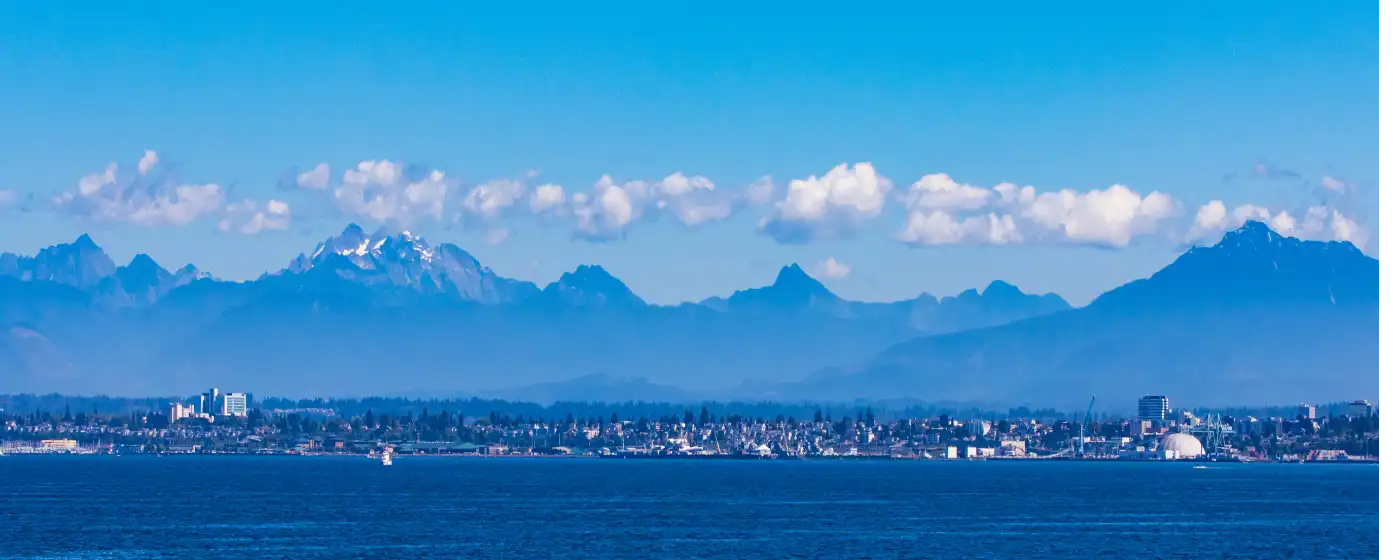
Puget Sound · Washington
Living in Everett: The Ultimate Relocation Guide (2026)
Maybe your employer is relocating you somewhere in the Seattle metro and Everett kept coming up in conversations. Maybe you've watched Eastside prices climb past $900,000 and someone told you Everett is where the value still lives. Maybe you drove through on I-5, saw the Boeing facility stretching across the horizon, and wondered whether a city built around aerospace manufacturing could actually feel like home. All three reactions make sense — and all three tell an incomplete story.
Everett occupies a fascinating and slightly uncomfortable position in the Puget Sound housing market. It is the county seat of Snohomish County, home to 114,070 people, and one of Washington's largest cities. It sits 25 miles north of Seattle on the water, with a working port, a naval station, a genuinely redeveloping downtown, and neighborhoods that range from bluff-top estates with Puget Sound views to walkable urban corridors to quiet suburban streets near major hospital campuses. The city contains multitudes — and that's exactly what makes buying here without research a gamble.
This guide is designed to cut through the abstractions. You'll find an honest breakdown of who Everett genuinely suits, which neighborhoods match which buyers, what the housing market actually looks like in mid-2026, and the tradeoffs that rarely appear in the glossy listings. Whether you're a Boeing contractor, a remote worker chasing square footage, or a family trying to land in a good school zone without overpaying, the answers are in here.
Not every city works for every buyer. Everett has a clear profile — and being honest about that upfront saves everyone time.
| Best For | Why |
|---|---|
| Boeing/aerospace workers | 35,000+ Boeing employees work locally; living close eliminates the brutal I-5 commute from further south |
| First-time buyers | $570,000 median sold price is meaningfully below Bellevue or Kirkland; more inventory, less bidding war pressure |
| Families with school-age children | Everett School District holds an A- rating; neighborhoods like Delta and Harborview offer strong elementary options |
| Healthcare professionals | Providence Regional Medical Center and The Everett Clinic are both major local employers with on-site-proximity neighborhoods |
| Commuters to Seattle | 38-minute drive or Sounder North commuter rail access; closer than many assume, better than Marysville |
| Retirees seeking waterfront lifestyle | Port of Everett marina access, Howarth Park beach, and lower price points than south Sound alternatives |
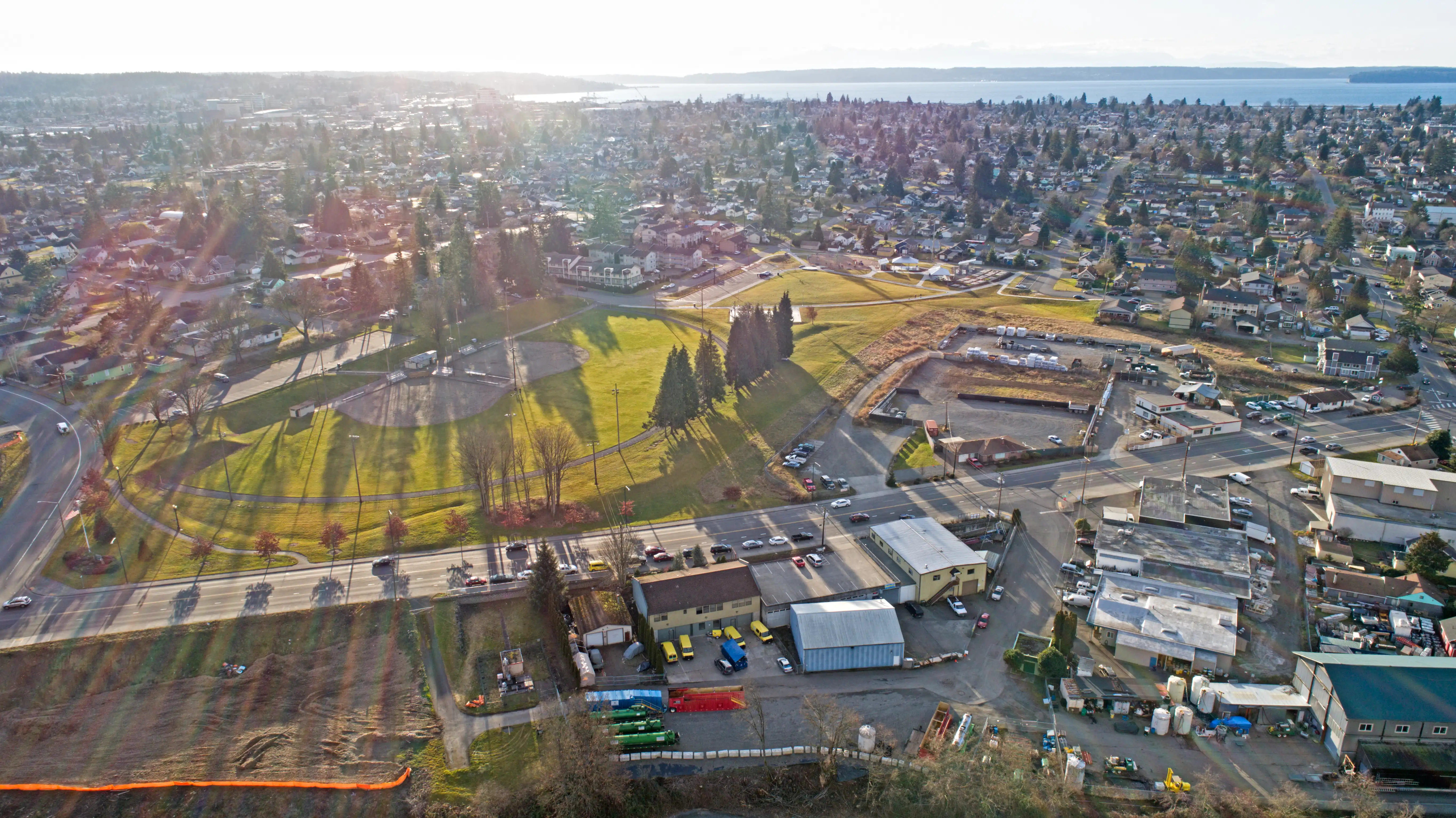
Geography shapes everything about daily life in Everett in ways that don't show up on a map. The city runs north-south along a bluff system that drops toward Puget Sound to the west and flattens into suburban grid patterns to the east. That topography creates real divides — the western neighborhoods perched above the water feel categorically different from the eastern commercial corridors near the mall or the quieter inland subdivisions around Silver Lake. Understanding which side of that ridge you're buying on matters more than the zipcode.
Downtown Everett is in the middle of a genuine transformation. The waterfront redevelopment has brought new apartment buildings, a handful of credible restaurants, and activated public spaces along the Port of Everett marina — the largest public marina on the West Coast. What's notable is that the downtown revitalization isn't just hype: sales data confirms that median prices in the downtown corridor climbed even as the broader market softened in 2025 and early 2026. The city is investing, and the trajectory is visible on the streets, not just in press releases.
The commute reality is better than most people expect from a city this far north. The 38-minute drive to Seattle works in off-peak hours and is genuinely manageable for many schedules. Sounder North commuter rail runs between Everett and Seattle's King Street Station, giving riders a stress-free option during peak hours. The honest friction point is I-5 itself — southbound in the morning between Everett and Lynnwood is among the worst choke points in the region, and buyers who plan to commute daily should test that drive on a Tuesday at 7:45 a.m. before they make an offer.
Community feel in Everett is harder to characterize than in smaller cities because the city contains so many distinct zones. The neighborhoods near the water and bluffs draw residents with a strong sense of place and long tenure; turnover is low and neighbors know each other. The suburban eastern neighborhoods have more of the transient feel common to growing Pacific Northwest metros — newer construction, younger households, less neighborhood identity. The sweet spot many buyers land on is neighborhoods like Harborview or Silver Lake, where the city's scale starts to feel like an asset rather than a drawback.
Boeing's presence is a stabilizer, not just a talking point. Roughly 35,000 people work at Boeing's Everett facility, which makes it one of the single largest aerospace manufacturing sites on the planet. The practical effect on the housing market is a persistent baseline of demand that cushions Everett from the volatility that hits pure bedroom communities. When tech layoffs ripple through Bellevue, Everett doesn't feel it the same way. That stability is worth something to buyers who plan to own for a decade.
The waterfront access is legitimately exceptional. Jetty Island — a two-mile sandy spit accessible by a short free ferry from the Port — draws residents all summer for swimming, kayaking, and birdwatching in a setting that feels nothing like a typical suburban park. Howarth Park drops down through old-growth forest to a beach on Puget Sound with mountain views that will stop you mid-sentence. American Legion Memorial Park and Forest Park round out a parks system that punches well above what Everett's size would suggest.
Everett's cost of living relative to the broader Seattle metro is its most durable selling point. A $570,000 median sold price — still 34% above the national average, which gives you a sense of how far Puget Sound prices have traveled — is meaningfully more accessible than comparable inventory in Bellevue, Kirkland, or even Bothell. The property tax rate of approximately 0.83% is on the lower end for Snohomish County, and Washington's lack of a state income tax compounds that advantage for households moving from California, Oregon, or the East Coast.
The Everett School District's A- rating reflects genuine quality across a large, diverse urban district. The presence of Everett Community College adds a community layer that smaller suburban cities don't have — continuing education, performing arts programming, athletics events, and a steady influx of young residents who keep neighborhoods from feeling stagnant. Providence Regional Medical Center is one of the region's major hospital systems, which matters both as an employer and as a practical quality-of-life consideration for families with young children or aging parents.

Everett has a property crime rate of 32 per 1,000 residents — significantly higher than many Snohomish County neighbors. This figure covers a wide range of incidents, from vehicle prowls in commuter parking lots to retail theft near the mall corridor, and it's distributed unevenly across the city. Neighborhoods near the bluffs and established residential areas like Harborview and Silver Lake tend to feel very different from the corridors around Everett Avenue or the mall area after dark. Buyers should look at neighborhood-specific data rather than treating the citywide number as their reality.
The Boeing dependency that stabilizes Everett also concentrates its risk. The company's February 2026 announcement that 787 Dreamliner production work would shift to South Carolina directly affected approximately 300 local workers — a small fraction of the workforce, but a signal that the single-employer risk is real. Long-term buyers should think about what Everett's economy looks like if Boeing's local footprint contracts further over the next decade. The city has been diversifying — Funko, Fluke Corporation, Premera Blue Cross — but aerospace manufacturing is still the center of gravity.
Traffic on I-5 through Everett is a genuine quality-of-life issue, not just a minor inconvenience. The merging pattern near the US-2 trestle creates a consistent slowdown that adds 15 to 25 minutes to southbound commutes during peak hours. Buyers who live in eastern Everett and work in Lynnwood or Bothell may find the surface streets more manageable than I-5, but that route requires some learning. Several residents describe discovering that SR-526 westbound toward Mukilteo connects to I-5 south more efficiently during certain windows — a commute hack worth testing before you assume the highway is your only option.
Why some people leave Everett tends to come down to two things: they outgrow the city's entertainment options and want the fuller cultural scene that Seattle proper offers, or they get a job opportunity south of Lynnwood and find the daily commute no longer worth the savings. The city's restaurant and nightlife scene has improved meaningfully with the waterfront redevelopment, but it's still a place where you'll drive to Seattle for a special occasion dinner rather than finding it locally. For buyers whose social life is largely neighborhood- and family-based, that rarely matters. For others, the distance starts to feel real by year two.
Boulevard Bluffs is Everett's premium address, full stop. Homes here sit on a ridge with unobstructed views of Puget Sound, the Olympic Mountains, Whidbey Island, and on clear days the San Juan Islands — the kind of scenery that makes first-time visitors question whether they have the city right. The Zillow listing median runs around $1,026,000, with active luxury properties clustered near that figure and hot listings clearing above list price in under a week. The downside is essentially zero walkability — a Walk Score of 12 means you are car-dependent for everything, and the neighborhood's quietude comes at the cost of any neighborhood-center feel.
Best for: Move-up buyers who prioritize views and prestige address over walkability or urban access.
This is one of the neighborhoods local agents mention most often to buyers who want Everett's scenic advantages without the Boulevard Bluffs price tag. Panoramic Puget Sound and Olympic Mountain views are common from established mid-century and contemporary homes, with listing medians around $681,000. Howarth Park and Harborview Park provide direct beach and trail access, and View Ridge Elementary is among the district's well-regarded schools. The neighborhood has consistently low turnover and strong resale trajectories.
Best for: Families with school-age children who want views, parks, and a stable, established community feel.
Silver Lake functions as one of Everett's most accessible mid-range neighborhoods, with Zillow Home Value Index data from late 2025 putting values around $687,000. The neighborhood wraps around Silver Lake itself, offering residents water views, a park system, and a suburban feel that's closer to Mill Creek or Lake Stevens energy than downtown Everett. It attracts buyers who want more square footage and a quieter street than the western bluff neighborhoods, with the understanding that commute distances to the water or downtown run a bit longer.
Best for: Families and remote workers who want suburban quiet, outdoor access, and a mid-range price point.
Port Gardner sits close to the waterfront and the ongoing downtown redevelopment, making it one of the more interesting value plays in Everett right now. Listing medians around $547,000 represent some of the most accessible owner-occupied housing in the western portion of the city, and proximity to the marina and Port of Everett public spaces gives residents a lifestyle that feels genuinely urban by Everett standards. The neighborhood is evolving — expect more new construction and rising prices if the waterfront trajectory continues.
Best for: First-time buyers or investors who want proximity to the waterfront redevelopment at a price point well below the bluff neighborhoods.
Delta earns consistent attention from families partly because of its school options and partly because of its location near Providence Regional Medical Center — a significant employer whose staff naturally gravitates toward nearby neighborhoods. Garfield Elementary is highly regarded within the district. Residents have walkable access to Senator Henry M. Jackson Park and a relatively short trip to Jetty Island ferry access. The neighborhood feels solidly middle Everett: not the drama of the bluffs, not the urban energy of Port Gardner, but a functional, family-oriented community.
Best for: Healthcare workers and families with younger children who want proximity to Providence and a quiet residential feel.
Glacier View hits the middle of Everett's market — listing medians around $554,000 — and offers that suburban-meets-urban balance that's hard to find closer to either Seattle or the waterfront. The neighborhood draws buyers who want a conventional single-family home environment without the premium attached to view properties or the price compression that comes with older housing stock near downtown. It's not a neighborhood with a singular identity, which is both its limitation and its appeal: buyers who've already decided they want Everett often find Glacier View's inventory broad enough to find what they need.
Best for: Buyers seeking mid-market value in a stable, conventional suburban setting.
Lowell sits in the southeastern portion of Everett along the Snohomish River corridor, giving it a character distinct from the city's western neighborhoods. Listing medians around $680,000 are somewhat surprising for a neighborhood without the bluff views, but Lowell's combination of larger lots, river proximity, and established mature trees creates a setting that commands its price. The area draws buyers who want space and relative privacy, with the understanding that some parts of the neighborhood are further from Everett's commercial core than the price might suggest.
Best for: Buyers who prioritize lot size, mature landscaping, and a quieter, more rural edge to their Everett address.
Evergreen is worth flagging specifically for one reason that transcends its current $559,000 listing median: the planned Sound Transit Everett Link light rail extension includes an SR-526/Evergreen Way station as part of the network. When light rail arrives — and construction timelines remain a running conversation in regional planning circles — Evergreen's transit access will shift materially. Buyers willing to hold for 5-10 years are looking at a neighborhood with current mid-market pricing and potential infrastructure upside that doesn't yet show up in the price.
Best for: Long-horizon buyers and commuters betting on transit-oriented development upside.

Everett's neighborhoods each tell a different financial story, and where you land matters more than people realize. Buyers drawn to Boulevard Bluffs and Cascade View are competing for homes that often go under contract within days, and well-priced properties in Evergreen have shown consistent long-term appeal as the area continues to attract new residents. If your budget is flexible up to around $700,000, you'll find meaningful options across these neighborhoods, but you need to move with intention — hesitation typically means starting over.
Before you fall in love with a house on a tour, sit down with a lender first. Your approval amount and your comfortable monthly payment are two very different numbers, and the gap between them widens fast once you fold in property taxes, homeowner's insurance, any HOA dues, and the loan structure itself. Relocating families sometimes underestimate how those layers stack up. Knowing your real number before you walk through a single door means you're not just browsing — you're ready to act when the right home appears.
| City | Best For | Median Home Price | Commute to Seattle | Vibe |
|---|---|---|---|---|
| Everett | Boeing workers, first-time buyers, waterfront lifestyle | $570,000 | 38 min | Working-class backbone meets waterfront revival |
| Mukilteo | Aerospace workers, ferry access, premium suburban | $800,000–$900,000+ | 40–45 min | Quiet, upscale, ferry-connected |
| Marysville | Budget-conscious buyers, space seekers | $480,000–$520,000 | 50–60 min | Suburban sprawl, longer commute |
| Lake Stevens | Families, lake access, newer construction | $590,000–$650,000 | 55–65 min | Growing suburb, outdoor-oriented |
| Mill Creek | Top school ratings, planned community feel | $720,000–$800,000 | 45–50 min | Polished, walkable, premium schools |
| Lynnwood | Light rail access, mid-range pricing | $600,000–$650,000 | 35 min | Transit-connected, diverse, transitioning rapidly |
| Category | Data |
|---|---|
| Population | 114,070 (2026 estimate) |
| Median Sold Home Price | $570,000 (3-month rolling, April 2026) |
| Property Tax Rate | Approximately 0.83% |
| Median Household Income | $83,512 |
| Commute to Seattle | 38 minutes (off-peak drive); Sounder North rail available |
| School District | Everett School District (A- rating) |
| Violent Crime per 1,000 | 3.7 |
| Property Crime per 1,000 | 32 |
| Median Age | 37.2 years |
| Homeownership Rate | Approximately 48% |
| Major Employers | Boeing, Providence Regional Medical Center, U.S. Navy, Funko, Fluke Corporation |
| County | Snohomish County |
Everett has a handful of traditions and characteristics that don't appear in any housing market report but shape daily life in ways residents feel immediately.
Jetty Island season is taken seriously here. Every summer, the City of Everett operates a free ferry from the Port of Everett marina to Jetty Island — a two-mile-long sandy beach that feels incongruous with a working industrial port city. Locals treat it as their private coastal escape, arriving early on weekend mornings to stake out beach access before the crowds. Newcomers who don't discover it until their second summer frequently describe it as one of the best things about living here.
The Boeing factory tour is one of the largest public building tours in the country. The Future of Flight Aviation Center adjacent to the Paine Field facility offers public access to the 747/787 assembly line — a genuinely awe-inspiring sight at any age. Everett residents treat it as a permanent local asset that friends and visiting family are reliably impressed by, even if they take it for granted after the first visit.
The Port of Everett Farmers Market runs seasonally and anchors summer weekend routines for the western side of the city. The combination of waterfront setting, local vendors, and ferry views makes it one of the region's more scenic market experiences — a detail that residents mention repeatedly when asked what they love about living near downtown.
What I would not do if moving to Everett: I would not buy in the corridor along Everett Avenue between Broadway and I-5 without spending several evenings there first, at different times of day. That stretch concentrates a disproportionate share of the city's social services, motels, and foot traffic patterns that show up in the property crime data. The adjacent neighborhoods can be genuinely fine — but the corridor itself requires eyes-open awareness that a Saturday afternoon visit won't reveal.
Local Expert Takeaway: If I'm advising a buyer in mid-2026, the clearest opportunity in Everett is the gap between Boulevard Bluffs pricing and everything directly below it. Harborview-Seahurst-Glenhaven delivers much of the same view-corridor lifestyle at listings starting around $681,000 — and with Boeing's workforce creating consistent resale demand in that tier, the fundamentals are solid. For buyers with a longer time horizon and a tighter budget, Evergreen's planned light rail station makes the current $559,000 median look different than it will in five years. Don't buy downtown without walking the waterfront development area on a weekday — the pace of change there is real, and understanding it before you make an offer is genuinely worth an afternoon.
✅ Everett's $570,000 median sold price represents genuine value relative to south Sound and Eastside alternatives, with Boeing employment stability and an actively redeveloping downtown waterfront supporting long-term demand.
⚠️ Property crime rates are meaningfully higher than neighboring cities — research neighborhood-specific patterns before assuming the citywide figure applies to your target area.
📍 The city is not one market. Boulevard Bluffs runs past $1 million; Port Gardner and Glacier View offer entry-level to mid-range options closer to $550,000. Where you buy inside Everett matters more than the city average.
Is Everett a good place for families?
Everett works well for families, particularly in neighborhoods like Delta, Harborview-Seahurst-Glenhaven, and Silver Lake. The Everett School District holds an A- rating, with standout elementary options in established residential areas. Parks infrastructure — including Jetty Island, Forest Park, and Howarth Park — gives families genuine outdoor access without leaving the city.
What is the crime rate in Everett?
The violent crime rate is 3.7 per 1,000 residents, which is relatively moderate. The property crime rate of 32 per 1,000 is higher and worth paying attention to — though it's distributed unevenly across the city. Neighborhoods like Harborview-Seahurst-Glenhaven are consistently cited among the city's safer areas, while corridors near the transit and commercial zones carry most of the risk.
How does Everett compare to nearby Mukilteo or Mill Creek?
Mukilteo offers comparable Boeing-proximity and premium views at noticeably higher prices, generally in the $800,000-plus range. Mill Creek runs $720,000–$800,000 with stronger school ratings and a more polished suburban feel. Everett's $570,000 median gives it the value advantage, with the tradeoff being more urban complexity and higher property crime than either of those neighbors.
Explore the full Everett series: Living in Everett · Is Everett Safe? · Cost of Living · Best Neighborhoods · Schools & Family Life · Youth Sports · Parks & Rec · Retiring in Everett