
Puget Sound · Washington
First-Time Home Buyer Guide for Federal Way (2026)
There's a specific moment most first-time buyers describe — somewhere between getting pre-approved and making their third offer — when the emotional weight of it all becomes real. It's not just about square footage or school ratings. It's the realization that you're trying to plant roots in a city that has real momentum, real competition, and real stakes. Federal Way is one of those cities where that moment hits hard but also resolves quickly for buyers who do their homework. The 30-minute commute to Seattle, the price gap versus Burien or Des Moines to the north, and a housing stock that still includes genuine entry-level opportunities make this one of the more compelling first-purchase markets in King County right now.
The median home price in Federal Way sits at $610,000 — and at that number, you're typically looking at a 3-bedroom, 2-bath single-family home in reasonable condition in a neighborhood like Steel Lake, Adelaide, or Twin Lakes. That figure is anchored in a market where detached homes genuinely start around $450,000 for older or smaller properties, while the $550,000–$650,000 range delivers the most inventory for serious buyers. Rent for a comparable home runs $2,100–$2,600 per month, and once you run the math on a 30-year fixed with a reasonable down payment, ownership starts looking like the obvious move — if you can clear the upfront costs.
This guide walks you through the full picture: what your budget actually gets you in Federal Way's current market, how the offer process works and where first-timers typically stumble, what credit and income you actually need to qualify, which neighborhoods make sense at different price points, and what down payment help exists right now. The goal is to leave you with enough clarity that your next conversation with a lender and agent feels like confirmation, not confusion.
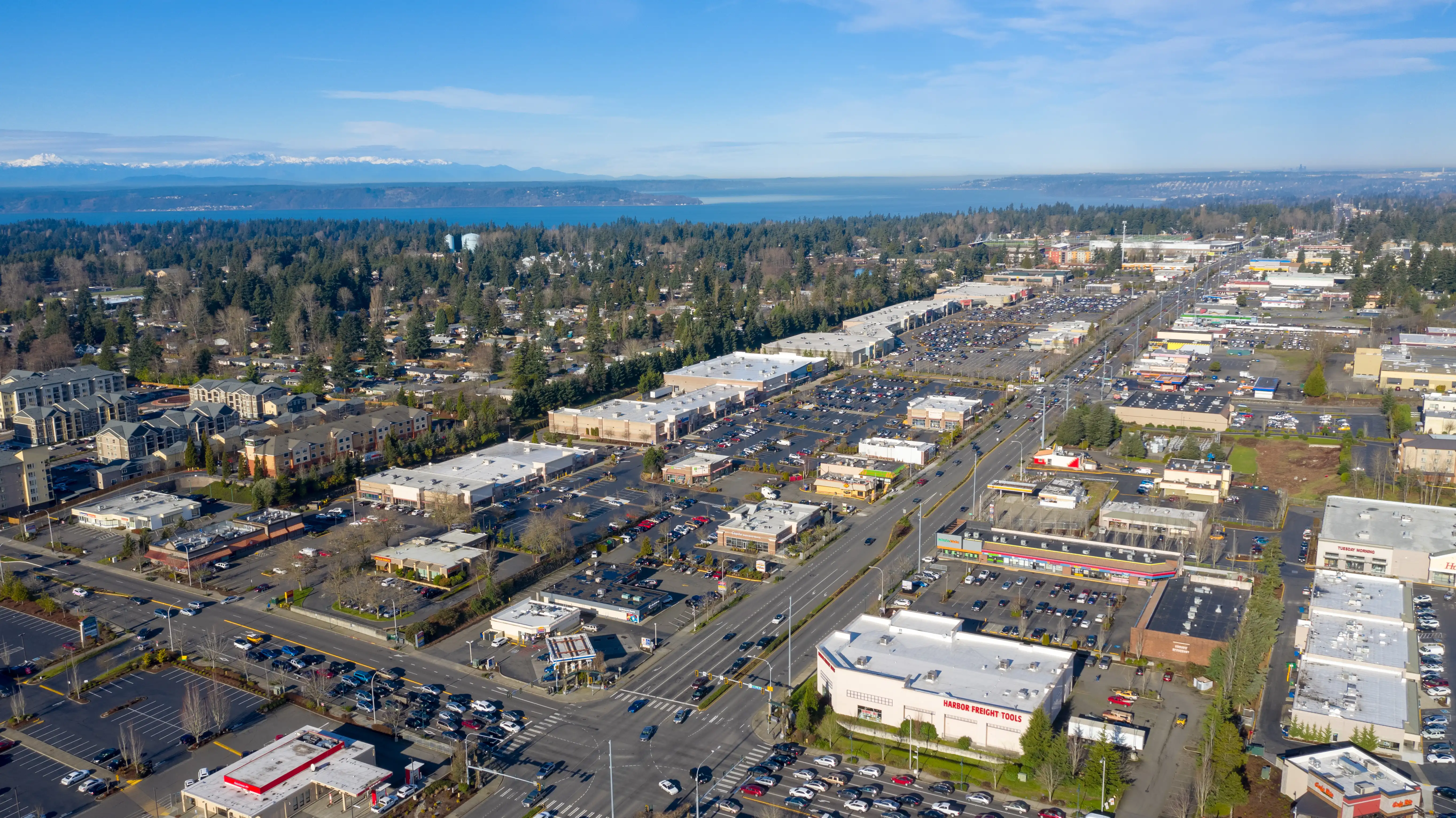
Federal Way's case for first-time buyers is straightforward: it's one of the last King County cities where someone earning a median household income — around $86,900 — can realistically stretch into homeownership without a co-signer or a six-figure family gift. Seattle, Bellevue, and even Renton have moved well past what a solo buyer or a dual-income household earning under $120,000 can comfortably afford. Federal Way hasn't. That's the central reason buyers who've been renting in Burien or Des Moines start looking south, and it's why the city's inventory — around 150–175 active listings on any given week — tends to move steadily rather than sitting.
The honest downsides are worth naming too. Federal Way's housing stock skews older, with a significant percentage of homes built in the 1970s through the 1990s that may need updates to roofing, electrical, or plumbing. The school district, Federal Way Public Schools, draws a B- rating — adequate, but not a draw in the way that higher-rated districts in Issaquah or Northshore are for families prioritizing that factor above all else. And while the commute to Seattle is a manageable 30 minutes under normal conditions, Interstate 5 through this corridor earns its reputation during peak hours. These aren't dealbreakers, but they're real considerations to weigh against the affordability advantage.
For realistic entry points, neighborhoods like Adelaide (north Federal Way, close to Des Moines), Kitts Corner, and parts of Lakota consistently surface under $550,000 for dated but livable single-family homes. The City Center submarket, which includes condos and attached housing, opens the door even lower — some units have sold closer to $300,000 in recent months, making it genuinely accessible for a buyer with FHA financing and limited savings.
| Price Range | What You Typically Find | Neighborhood Examples | Competition Level |
|---|---|---|---|
| Under $350K | Condos, townhomes, older attached units; limited SFR availability | City Center, older condo complexes near Pacific Hwy S | Moderate — niche pool of buyers |
| $350K–$450K | Small SFR fixer-uppers (1960s–1980s), 2BR/1BA; some townhomes | Kitts Corner, older City Center adjacents | Moderate, but condition-dependent |
| $450K–$550K | Dated 3BR/1-2BA SFR in move-in condition; 1,200–1,600 sq ft | Adelaide, Lakota, parts of Alderbrook | Competitive — 2–3 offers common |
| $550K–$650K | Updated 3BR/2BA; larger lots; 1,600–2,000 sq ft | Steel Lake, Twin Lakes, Mirror Lake | Highly competitive, fastest-moving tier |
| $650K+ | Larger or newer construction; 4BR homes; waterfront-adjacent lots | West Campus, Marine Hills, Redondo | Selective competition; fewer first-timers |
The $550,000–$650,000 range represents the sweet spot where inventory quality, neighborhood stability, and resale potential converge. Homes in Steel Lake and Twin Lakes at this price point tend to sell within 30–40 days and occasionally faster. If your budget lands here and you've been pre-approved, you're competitive — but you'll need to move decisively when the right property appears.
| Step | What Happens | Typical Timeline | What First-Timers Get Wrong |
|---|---|---|---|
| Get finances in order | Pull credit, review debts, build savings for down payment + closing costs | 1–6 months before searching | Underestimating closing costs (2–3% of purchase price on top of down payment) |
| Pre-approval | Lender reviews income, credit, assets; issues pre-approval letter | 1–3 days with full docs ready | Waiting until they "find a house" — sellers won't accept an offer without it |
| Find an agent | Interview buyer's agents familiar with Federal Way specifically | 1–2 weeks | Choosing someone who works primarily in Seattle and treats this market as an afterthought |
| Active search | Tour homes, track DOM, understand neighborhood pricing | 2–8 weeks typical | Shopping based on Zestimate rather than recent closed comps |
| Making offers | Submit offer with earnest money, terms, contingencies | Same-day in competitive markets | Writing below-list offers on well-priced homes that have been sitting for a reason |
| Under contract | Seller accepts; earnest money deposited (typically 1–3% in King County) | Within 48 hours of acceptance | Not understanding earnest money is at risk if they back out outside contingency windows |
| Inspection | Hire inspector; negotiate repairs or credits | 5–10 days after acceptance | Skipping it on older Federal Way housing stock to compete — this is almost always a mistake |
| Appraisal | Lender orders appraisal to confirm value | 1–2 weeks after inspection clearance | Assuming appraisal = inspection; they measure different things |
| Final walkthrough | Verify property condition hasn't changed | Day before or day of closing | Skipping it — a 5-minute walk can surface a last-minute issue |
| Closing | Sign documents, funds transfer, keys exchanged | 30–45 days from contract typically | Being surprised by the final cash-to-close number; request HUD-1 review 48 hours early |
Inspection waivers have appeared in Federal Way's most competitive offers, but waiving on a 1970s or 1980s home with original systems is a risk most buyers come to regret. The city has a meaningful stock of homes from that era, and surprises in roofing, crawlspace moisture, or aging electrical panels are common enough that a $500 inspection can prevent a $15,000 surprise after closing. Most offers in this market are written with inspection contingencies intact — you don't need to waive to be competitive if your price and terms are clean.
Closing typically takes 30–45 days from contract, and King County's recording process is well-organized. The biggest timing mistake buyers make is not having their funds fully sourced and documented before the appraisal comes back — lenders cannot close until assets are verified, and large unexamined deposits in your checking account will pause the process at the worst moment.
The minimum credit score for a conventional loan is 620, but the honest answer is that 680 and above is where the rates get meaningfully better. On a $450,000 loan, the difference between a 650 and a 740 credit score can translate to a rate gap of 0.5–0.75 percentage points, which over 30 years adds up to tens of thousands of dollars. If you're sitting at 650 right now, spending 6 months paying down revolving balances before applying is often the best financial move you can make before buying.
FHA loans accept scores as low as 580 for the 3.5% down option, and that's a real pathway for buyers who haven't had time to build their credit profile. The catch is mortgage insurance — FHA charges an upfront premium plus an annual premium built into your monthly payment, and unlike conventional PMI, FHA's mortgage insurance doesn't automatically drop off once you hit 20% equity if your loan-to-value was over 90% at origination. It's a meaningful cost to factor in over a 5–7 year holding period.
On income, the standard guideline is that your monthly housing payment shouldn't exceed 28% of your gross monthly income. To qualify for a $400,000 home comfortably, you're looking at roughly $5,500–$6,000 per month in gross income, or about $66,000–$72,000 annually. For a $500,000 purchase, that figure climbs to approximately $82,000–$88,000, and for a $600,000 home, expect to need household income closer to $100,000–$110,000 depending on your debt load. Washington has no state income tax, which is a real and underappreciated advantage for buyers relocating from California, Oregon, or other income-tax states — that extra 5–9% staying in your paycheck meaningfully increases both your qualifying power and your monthly cash flow after closing.

As someone who works with buyers throughout the South Sound, I can tell you that location within Federal Way matters more than most first-timers realize. Neighborhoods like Twin Lakes and Steel Lake tend to hold their value well thanks to proximity to water, established trees, and community character that buyers keep coming back for. Adelaide has also attracted steady interest from buyers wanting more space without pushing into higher price points. In areas like these, well-priced homes under $600,000 can move in days, not weeks — sometimes before a buyer who isn't prepared even has a chance to schedule a showing.
That's exactly why I encourage every first-time buyer to talk with a lender before they ever step inside a home. Your approval amount and your comfortable budget are two very different numbers, and the gap between them becomes real once you factor in property taxes, homeowner's insurance, any HOA dues, and how your loan is structured. Knowing your true monthly picture upfront keeps you from falling in love with something that quietly stretches you too thin — and it means when the right home appears in Federal Way, you're ready to move with confidence.
Mistake 1: Confusing list price with market value. Homes in Federal Way's active tiers are priced with strategy, not sentiment. A home listed at $529,000 on a Steel Lake street where everything closed at $545,000–$565,000 in the last 90 days is priced to create competition, not to signal a deal. Buyers who anchor their offers to list price instead of closed comps consistently get outbid on the good properties and overpay on the stale ones.
Mistake 2: Skipping inspection on older homes to compete. Federal Way's housing inventory includes a large percentage of homes built between 1965 and 1990, and many of those homes are on the market precisely because deferred maintenance has accumulated. Buyers who waive inspection to write a "clean" offer sometimes win the battle and lose the war — crawlspace moisture, original panel boxes, and aging HVAC systems don't negotiate after closing.
Mistake 3: Buying at the top of their qualification. A lender will tell you what you can qualify for. That number and what you can comfortably afford monthly are often different. In Federal Way specifically, property tax at 1.11% adds approximately $560 per month on a $610,000 home — a figure that many buyers overlook when they're focused on the mortgage payment alone. Build your budget from monthly cash flow, not from the pre-approval ceiling.
Mistake 4: Misunderstanding how school boundary lines affect resale. Federal Way Public Schools serves a large geographic area, but specific elementary school boundaries — and proximity to higher-performing schools — do affect how quickly homes sell and at what premium. Buyers who don't research the school zone for the specific address they're purchasing sometimes discover that resale to the next family with school-age children is harder than they expected, particularly if the assigned school is less desirable.
Mistake 5: Waiting for prices to drop. Federal Way's market has seen modest softening from the 2022 peak, but with only about 2.5 months of housing supply in the market, a meaningful buyer's-market correction is not what the data suggests is coming. Buyers who've been "waiting to see what happens" since late 2024 have largely watched their renting costs continue to climb while the available inventory in their preferred neighborhoods has stayed tight. The timing question in a supply-constrained market is less often "when will prices drop" and more often "when will I be ready."
Adelaide sits in the northwest corner of Federal Way near the Des Moines border, and it's one of the neighborhoods local agents mention most consistently for first-time buyers with budgets in the $470,000–$560,000 range. The homes here are largely 1970s–1980s ranch styles and split-levels on larger lots, and while they require updates, they offer more square footage per dollar than comparable listings in the northern suburbs. Proximity to SR-509 keeps the Seattle commute reasonable.
Lakota is a quieter pocket in the southwest part of the city, close to Dash Point State Park and the Puget Sound shoreline. Entry-level homes here tend to start in the high $400,000s for dated single-family properties, and the neighborhood has a settled, residential feel that buyers who prioritize peace over proximity tend to appreciate. Resale has historically been steady, supported in part by the park access and the waterfront adjacency.
Mirror Lake offers a slightly higher entry point — most single-family homes start closer to $530,000–$580,000 — but the neighborhood's proximity to Federal Way's central core, reasonable school access, and established character make it a strong resale bet. First-time buyers who can stretch into this range often find that the extra spend buys meaningfully better condition and lower near-term maintenance costs.
For buyers whose budget genuinely tops out below $450,000, City Center condos and attached housing remain the realistic pathway into King County homeownership. HOA fees vary and should be factored carefully, but the price entry is real and the building stock is improving as the downtown core continues to redevelop around the new light rail station planned for Federal Way.
If cash to close is what's standing between you and a purchase offer, Todd offers ONE+ by Rocket Mortgage — and it's worth understanding what makes it different from other programs. The buyer puts down 1% of the purchase price, and Rocket Mortgage contributes a 2% grant — up to $7,000 — that is never repaid. That brings the total down payment to 3% without requiring the buyer to save the full amount themselves. The maximum loan amount is $350,000, and household income must be at or below $114,800 for King County. The minimum credit score is 620, there is no second lien attached to your title, and the grant does not need to be paid back at sale or refinance. It functions as a true grant — not a deferred loan dressed up in program language.
To see if ONE+ might work for your income and purchase price, check out the full program details and eligibility guide →
Local Expert Takeaway: The single most common mistake first-time buyers make in Federal Way is treating the $610,000 median as a ceiling rather than a midpoint — and then getting caught off guard when entry-level single-family homes in Steel Lake or Twin Lakes require offers at or above $570,000 to be competitive. Set your search range $40,000–$50,000 below your maximum qualification, get pre-approved before you tour a single home, and prioritize neighborhoods like Adelaide or Mirror Lake where the price-to-condition ratio still rewards buyers who move decisively. Waiting for a better market in a city with 2.5 months of supply is the move that costs people the most.
✅ Federal Way is one of the few remaining King County cities where first-time buyers earning median household income can realistically purchase a single-family home without extraordinary savings or down payment gifts.
⚠️ The true entry point for detached single-family homes sits around $450,000 — buyers counting on finding a move-in-ready house under $400,000 will find mostly condos and attached units at that price.
📍 Neighborhoods like Adelaide, Lakota, and Mirror Lake offer the best combination of value, commute access, and resale stability for first-time buyers in Federal Way's current market.
Can I buy a home in Federal Way as a first-time buyer?
Yes — Federal Way is one of the more accessible King County markets for first-time buyers in 2026. With roughly 150–175 active listings at any given time and a median home price of $610,000, buyers with household incomes around $86,000–$110,000 and a 3–5% down payment can realistically compete for homes in neighborhoods like Adelaide, Lakota, or the City Center condo market. FHA and conventional options both work here, and ONE+ by Rocket Mortgage can reduce the required down payment to as little as 1% for qualifying buyers.
How much do I need to buy my first home in Federal Way?
For a $550,000 home with a 3.5% FHA down payment, you'd need approximately $19,250 for the down payment plus roughly $11,000–$16,500 for closing costs — totaling around $30,000–$36,000 in cash to close. With a conventional loan at 5% down, the down payment climbs to $27,500, though PMI costs may be lower over time if your credit score is strong. Programs like ONE+ can reduce the buyer's required down payment contribution significantly for eligible borrowers on loans up to $350,000.
What credit score do I need to buy a house in Washington state?
The minimum for most loan programs is 620 — that gets you access to FHA, conventional, and programs like ONE+. A score of 680 or above typically unlocks better interest rates on conventional loans, and 740+ gets you close to the best available pricing. If your score is below 680, six months of focused credit improvement — paying down revolving balances, avoiding new inquiries — can make a meaningful difference in your monthly payment.
Explore the full Federal Way series: The Ultimate Federal Way Relocation Guide · Is Federal Way Safe? · Cost of Living in Federal Way · Best Neighborhoods in Federal Way · Federal Way Schools & Family Life · Federal Way Youth Sports · Federal Way Parks & Recreation · Retiring in Federal Way · 1031 Tax-Deferred Exchange in Federal Way · Federal Way First-Time Homebuyers Guide · Federal Way Down Payment Assistance Guide · Moving to Federal Way from California