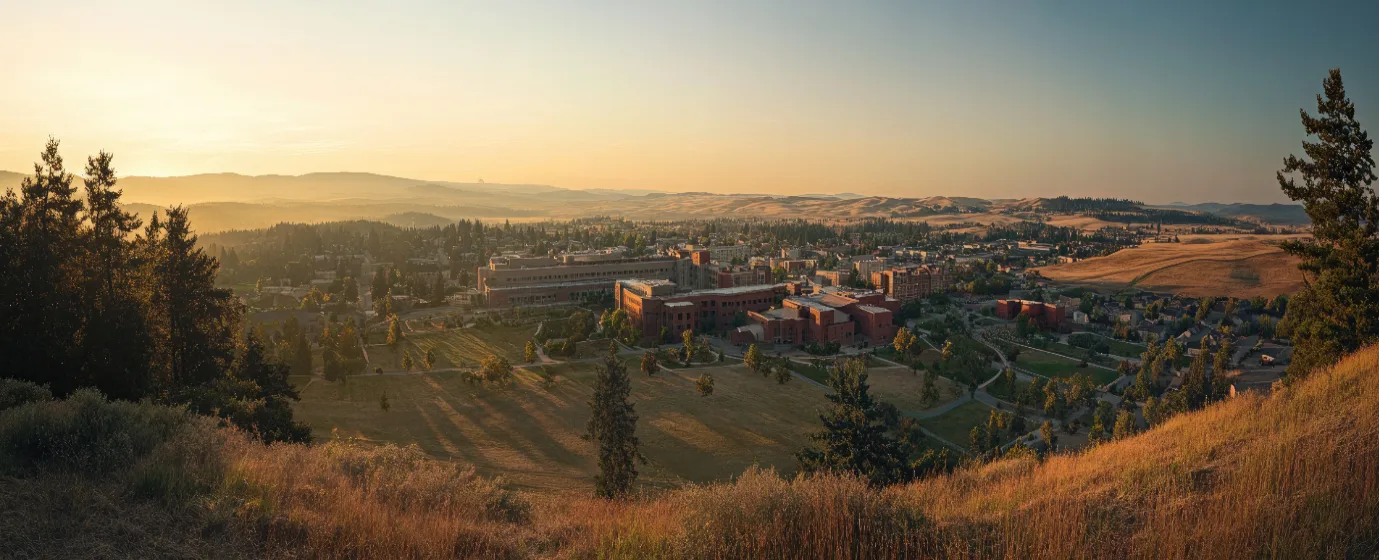
Eastern Washington · Washington
Best Neighborhoods in Pullman: Where to Buy or Rent (2026)
Where you land in Pullman shapes your daily life more than almost any other factor. The city is carved across four distinct hills — College Hill, Military Hill, Pioneer Hill, and Sunnyside Hill — and locals navigate entirely by these landmarks. Buying on the wrong hill for your lifestyle isn't a minor inconvenience; it's the difference between walking to campus in 10 minutes or sitting in stop-and-go traffic every morning along Grand Avenue.
The key geographic divide in Pullman runs along Main Street and Grand Avenue, splitting the city into its northeast, northwest, southeast, and southwest quadrants. Each hill has its own character, its own school zones, its own trade-offs between proximity to WSU and quiet residential living. Add in newer planned developments on the western edge and the density of the downtown core, and you have a surprisingly layered real estate market for a city of 33,886.
This guide breaks down every major neighborhood worth knowing — what it costs, who it suits, and what the listing photos won't tell you. Whether you're buying your first home near WSU, relocating for a position at Schweitzer Engineering Laboratories, or trying to figure out the best areas to rent in Pullman before committing to a purchase, this is the roadmap.

| Neighborhood | Best For | Price Range | Vibe |
|---|---|---|---|
| Pioneer Hill | Families, established buyers | $420,000–$580,000 | Tree-lined, walkable, historic |
| College Hill | Investors, young professionals | $280,000–$450,000 | Lively, student-adjacent, mixed-use |
| Military Hill | WSU employees, families | $350,000–$520,000 | Quiet, established, walkable |
| Sunnyside Hill | Families, outdoor lovers | $380,000–$540,000 | Residential, park-heavy, newer construction |
| Whispering Hills | Move-up buyers, large lots | $480,000–$680,000 | Planned community, spacious, modern |
| Downtown Pullman | Renters, urban seekers | $250,000–$420,000 | Mixed-use, walkable, energetic |
| Airport Hill | Budget buyers, commuters | $310,000–$430,000 | Single-family, quieter, north-side access |
| Terre View | Professionals, families | $390,000–$520,000 | Newer builds, suburban feel |
| Cougar Country | First-time buyers, students | $260,000–$380,000 | Dense, affordable, rental-heavy |
| South Pullman | Budget buyers, larger lots | $300,000–$440,000 | Spread out, quieter, less walkable |
| Buyer Type | Best Neighborhood | Why |
|---|---|---|
| First-time buyer | College Hill / Cougar Country | Lower entry prices, strong rental demand if you move on |
| Luxury buyer | Whispering Hills | Largest floor plans, modern construction, planned community feel |
| Walkability seeker | Pioneer Hill | Walk to downtown and WSU, established sidewalks, park access |
| Families with kids | Sunnyside Hill | Sunnyside Park, newer construction, family-oriented streets |
| WSU employees | Military Hill | Closest hill to campus employment, Pullman High walkable |
| Large lot buyers | Whispering Hills / South Pullman | Most square footage per dollar outside the urban core |
| Renters | College Hill / Downtown | Highest rental inventory, most flexible lease options |
Pioneer Hill is Pullman's oldest and arguably most coveted residential quadrant, settled first among the city's four hills and still carrying that foundational character in its architecture and street feel. Craftsman cottages and ranch-style homes share tree-lined blocks that slope down toward Lawson Gardens and Kruegel Park, and the pedestrian access to both downtown and the WSU campus is genuinely walkable in a way that most suburban neighborhoods only claim. The catch is that older homes here often come with deferred maintenance costs that don't show up in the listing price — buyers should budget for updates to electrical, plumbing, or roofing on anything built before 1980. As of mid-2026, expect to pay between $420,000 and $580,000 for a single-family home here, with Craftsman-era properties on the lower end and updated larger homes pushing the ceiling.
Best for: Established buyers and families who want walkability, character architecture, and proximity to Lawson Gardens without the student-density of College Hill.
Sunnyside Hill occupies Pullman's southwest quadrant and has evolved into the city's most family-oriented residential neighborhood, anchored by Sunnyside Park — a genuine community asset with walking trails, a pond, a gazebo, and community garden plots that residents actually use. The neighborhood hosts Pullman's 4th of July celebration, which tells you something about the community identity here: people are invested in where they live. The downside is that Sunnyside Hill is among the less convenient quadrants for non-WSU commuters — reaching the main commercial corridors requires navigating hilly terrain that can be challenging in Pullman's icy winters. Single-family homes typically run $380,000–$540,000, with newer construction subdivisions pushing toward the upper end of that range.
Best for: Families with school-age children who prioritize park access, newer construction, and a quieter residential atmosphere over campus proximity.
Military Hill sits in Pullman's northwest quadrant, named for the Pullman Military College that briefly occupied the hill in the early 1890s before burning down in 1893. Today it's one of the more practical neighborhoods for buyers employed at WSU or at Schweitzer Engineering Laboratories, whose operations anchor the northwest side of town — the commute from Military Hill to SEL barely qualifies as a commute. Pullman High School and Jefferson Elementary are both located here, making it a logical choice for families with school-age children who want both employment proximity and school convenience on the same hill. The catch is that Military Hill housing stock trends older and denser in places, with condos and townhouses mixed into residential blocks — the single-family inventory that offers the best value sits in the $350,000–$520,000 range, but buyers need to be selective about lot size and parking.
Best for: WSU and SEL employees, families prioritizing school proximity, buyers who want to walk to Pullman High School events.
College Hill fills the northeast quadrant of Pullman and runs closest to the WSU campus, which is both its greatest draw and its most significant limitation for non-student buyers. The neighborhood's roughly 6,000 residents make it the most populated of the named quadrants, and that density creates a lively streetscape with local shops, eateries, and the constant background hum of a university town. For investors, it's the most obvious purchase in Pullman — rental demand here is structural and tied to WSU enrollment rather than economic cycles. For owner-occupants who want quiet weekends, it's a harder sell; football game days on Stadium Way and late-night activity near the campus edge are part of the package. Entry-level duplexes from the 1940s and 1950s start around $280,000, with larger updated properties running up to $450,000.
Best for: Real estate investors, buyers who thrive in a university energy, and young professionals who want walkable access to campus amenities.
Downtown sits at the geographic center where Pullman's hills converge — originally called "Three Forks" because two streams and a river join at that point. The commercial core serves both residents and the WSU community, with restaurants, retail, and services dense enough to run most errands on foot. The National Lentil Festival has called Reaney Park home every August since 1989, drawing the broader Palouse community into downtown for a weekend of cooking competitions, a street fair, and a parade the day before WSU's fall semester kicks off. Purchasing here means accepting some noise and traffic from the commercial activity; it's genuinely urban by Pullman's standards. Price ranges reflect the mixed-use character, with condos and smaller homes running $250,000–$420,000 — the most accessible owner-occupied entry points in the city.
Best for: Buyers who prioritize walkability and urban energy over square footage, and renters testing the market before committing to a hill.
Whispering Hills is the most significant new development in Pullman's recent history — a planned community spread across more than 170 acres on the western edge of the city, adjacent to Sunnyside Park and its trail network. The homes here are built to modern construction standards with spacious floor plans, three-car garages, and cul-de-sac configurations that simply don't exist in Pullman's older hill neighborhoods. The premium is real: you're paying $480,000–$680,000 for the privilege of newer everything, and the western location adds minutes to any commute that runs east toward WSU or downtown. Buyers coming from larger metros consistently describe the value here as the most compelling in the city — the square footage-to-price ratio beats comparable new construction in Spokane's South Hill decisively.
Best for: Move-up buyers and relocating professionals who need modern construction, larger floor plans, and trail access without sacrificing Pullman's overall market value.

Treating all four hills as interchangeable. The hill framework isn't just a quaint local navigating habit — it reflects genuine differences in school zones, commute patterns, noise levels, and neighborhood character. Buyers who shop by price and square footage alone, ignoring which hill a property sits on, routinely end up frustrated. A home on College Hill at $380,000 and a home on Sunnyside Hill at $380,000 are fundamentally different purchases for a family with children.
Underestimating Grand Avenue during WSU events. Grand Avenue is Pullman's main north-south spine, and on football Saturdays — or during move-in weekend in August — it becomes a bottleneck that affects every quadrant. Buyers who commute through or across Grand Avenue daily should drive their intended route during a home game before making an offer. The backup from Stadium Way can extend well past Main Street and add 20-plus minutes to what should be a five-minute drive.
Assuming the older homes on Pioneer Hill are turnkey. The Craftsman-era homes that give Pioneer Hill its visual appeal were built in an era when electrical panels, plumbing, and insulation standards were dramatically different. A home priced at $440,000 in that neighborhood can carry $40,000–$60,000 in deferred infrastructure work that a surface inspection won't catch. Budget for a thorough inspection with a local inspector who specifically knows older construction on Pullman's hills.
Buying near campus without understanding the rental market exit. College Hill and Cougar Country have strong investor demand precisely because rental yields are reliable. But if you're buying as an owner-occupant and later plan to sell, your buyer pool will be dominated by investors looking at cap rates — not emotional buyers willing to pay a premium. Price expectations on exit need to reflect that reality from day one.

Pullman's neighborhoods each tell a different story from a lending perspective. College Hill and Sunnyside Hill tend to hold their value well given the proximity to Washington State University — buyer demand stays relatively consistent there, and well-priced homes can move within days rather than weeks. Pioneer Hill has also attracted attention from buyers looking for something a bit more established and residential in feel. Most single-family homes across these neighborhoods fall comfortably under $500,000, though that range shifts depending on size, condition, and exactly where you are on the hill.
Before you fall in love with a specific street, it's worth sitting down with a lender first. Your pre-approval number and your comfortable monthly payment are two very different things once you factor in property taxes, homeowner's insurance, any HOA dues, and the loan structure itself — all of that shapes what you'll actually write a check for each month. Pullman moves fast enough that knowing your real budget before you tour means you're in a position to act confidently when the right home comes up, not scrambling to catch up.
| Area | Ideal For | Typical Rent Range | Trade-off |
|---|---|---|---|
| College Hill | Students, WSU employees | $900–$1,600/mo (1–2 BR) | Noise, parking competition, street activity |
| Downtown Pullman | Young professionals, new arrivals | $850–$1,500/mo (studio–2 BR) | Limited parking, commercial noise |
| Military Hill | Families, WSU/SEL employees | $1,100–$1,800/mo (2–3 BR) | Older rental stock, limited availability |
| Sunnyside Hill | Families, long-term renters | $1,200–$2,000/mo (2–4 BR) | Fewer units available, car-dependent |
| Airport Hill / North Pullman | Budget renters, commuters | $900–$1,400/mo (2–3 BR) | Furthest from campus, limited walkability |

Local Expert Takeaway: The single most actionable piece of advice for buyers in Pullman is to establish which hill serves your daily life before you start touring homes. If you're employed at SEL or Pullman High School, Military Hill eliminates your commute entirely. If your household has school-age children and you value outdoor space, Sunnyside Hill's park access and newer construction is hard to beat at current prices. Whispering Hills is the market's most compelling value proposition for buyers coming from Spokane or larger metros — modern floor plans at prices that genuinely surprise people who've been shopping elsewhere in the region.
Looking to buy in Pullman? Estimate your payment.
Enter your numbers to see an estimated monthly mortgage payment.
Estimate only. Excludes HOA fees and mortgage insurance.
Is Pullman a good place to buy a home?
Pullman offers genuine long-term stability anchored by WSU employment, Schweitzer Engineering, and Pullman Regional Hospital — three institutional employers that don't relocate. The median home price of $429,000 remains accessible relative to other Pacific Northwest markets, and the four-hill neighborhood structure gives buyers real options across character, price point, and lifestyle. For buyers whose timeline aligns with academic cycles and who do their neighborhood research upfront, it's a strong purchase market.
What is the most affordable neighborhood in Pullman?
Downtown Pullman and the Cougar Country area offer the city's lowest owner-occupied entry points, with condos and smaller homes available in the $250,000–$380,000 range. College Hill also carries affordable inventory on the lower end, particularly in older duplex stock — though buyers there should factor in the investor-dominated resale market when planning their exit strategy.
How does Pullman compare to nearby Moscow, Idaho for housing?
Moscow sits roughly 8 miles south of Pullman across the Idaho state line and functions as a genuine alternative market for buyers who work on the Palouse. Moscow's housing stock is generally comparable in price, but Pullman's concentration of institutional employers — particularly for those working directly at WSU's Washington campus — keeps most professional buyers focused on Pullman's four hills. The key differentiator is usually employment location and school district preference rather than price.
Explore the full Pullman series: Living in Pullman · Is Pullman Safe? · Cost of Living · Best Neighborhoods · Schools & Family Life · Youth Sports · Parks & Rec · Retiring in Pullman