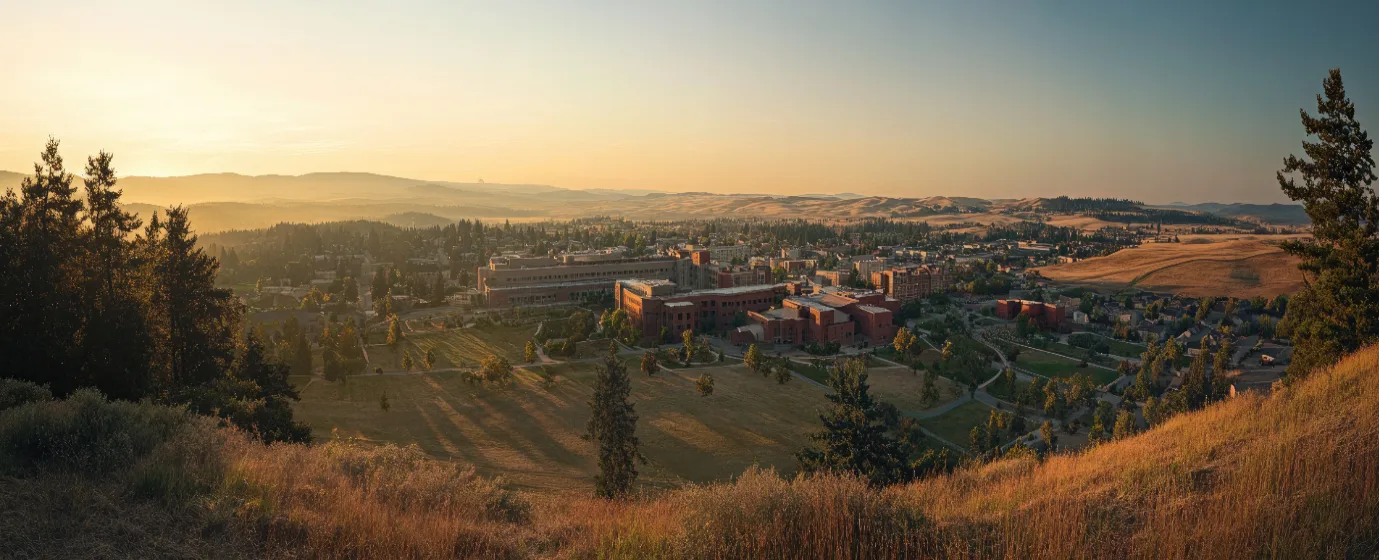
Eastern Washington · Washington
Is Pullman Safe? Crime Rates, Safest Neighborhoods & Local Reality (2026)
Pullman's safety story is genuinely counterintuitive. This is a college town of roughly 34,000 people — nearly half of whom are students cycling in and out every year — and yet FBI data consistently places it among the safer cities in Washington state. That's not spin. It's a structural reality that crime statistics, when read correctly, bear out. The nuance worth understanding before you sign a lease or make an offer is where the risk concentrates, because it does not spread evenly across every street in town.
Property crime is the number you need to pay attention to. Theft and vehicle break-ins cluster around the commercial core and high-traffic student areas — not in the residential neighborhoods where most families and long-term residents actually live. The city's violent crime rate, by contrast, runs well below both the Washington state average and the national average. That distinction matters enormously for anyone trying to decide whether Pullman is a reasonable place to raise a family or settle into retirement.
This guide breaks down what the raw numbers mean in practical terms, walks through the city's six most distinct neighborhoods by safety profile, and gives you the local context that crime-comparison websites consistently miss. By the end, you'll know exactly which parts of Pullman to prioritize, which to approach with clear eyes, and what the daily reality looks like for people who actually live here.

The first thing most people encounter when they search Pullman's crime data is a jarring mismatch between two types of scores. FBI-sourced platforms like AreaVibes show Pullman's total crime rate running roughly 55% below the national average. CrimeGrade.org, by contrast, gives the city a D- and ranks it in the 15th percentile nationally. Both are technically using real data. The difference is entirely methodological: CrimeGrade measures crimes per resident in a city where nearly half the population turns over annually and thousands of visitors flood the commercial zones around WSU on game days and long weekends. When you divide incidents by permanent resident count and ignore visitor volume, cities with dense retail corridors and a large transient population always look worse than they are.
Local police data and FBI UCR figures for 2024 suggest a more reassuring picture. Pullman recorded 30 violent crimes and 309 property crimes that year — figures that translate to a total crime rate of roughly 951 per 100,000 residents, well over 50% below the national rate of 2,119. The 2024 numbers also reflect a 16% drop from 2023, continuing what city-data records as a broadly downward trend across 18 years of reporting. It's accurate to note that violent crime has crept up modestly over a five-year window — but starting from an already low baseline, that trend is worth monitoring rather than alarming.
Washington state as a whole runs a higher-than-average property crime rate — roughly 35 incidents per 1,000 residents in recent state reporting, placing it among the top three states nationally for property crime. Pullman outperforms that state average significantly. SafeWise has ranked Pullman among the four safest cities in Washington, and AreaVibes data suggests the city is safer than about 91% of Washington communities. For a college town with a major research university at its center, that's an unusual achievement.
FBI estimates put Pullman's violent crime at approximately 2 per 1,000 residents — a figure commonly cited as about average nationally, but one that looks considerably better when adjusted for the city's inflated daytime population. Practically speaking, the 1-in-770 lifetime odds of violent crime victimization translate to a city where most residents go years, even decades, without a serious incident anywhere near their block. Aggravated assault drives the majority of what gets counted; street-level robbery and murder are rare enough that individual incidents make local news.
Property crime sits at around 10 per 1,000 residents — the category that deserves more of your attention. Larceny and vehicle break-ins are the dominant types, concentrated heavily in the commercial blocks around campus, the Grand Avenue corridor, and areas with high foot traffic near apartment complexes built for student turnover. The 1-in-122 victimization odds look intimidating until you understand the geography: those odds flatten dramatically once you move into the established residential neighborhoods northwest of campus. Unlocked cars and bikes left unsecured account for a disproportionate share of what gets reported, which means the most effective local precaution is also the simplest one.
Pioneer Hill sits in the northwest quadrant of Pullman, which local police data consistently identifies as the city's lowest-crime zone — roughly 22 crimes annually in that part of the city compared to 271 in the more active northeast. The neighborhood is characterized by established owner-occupied homes, tree-lined streets, and the kind of multigenerational stability that naturally suppresses property crime. Residents here describe a strong sense of community awareness: neighbors know each other, lights stay on, and unfamiliar activity gets noticed.
Best for: Long-term residents, families with school-age children, and buyers who want the lowest-risk residential environment in Pullman.
Sunnyside Hill occupies some of the higher terrain south of downtown, offering a mix of single-family homes and modest multifamily properties. The neighborhood's elevation and residential character keep it insulated from the commercial-corridor activity that drives most of Pullman's property crime counts. Sunnyside Park anchors the area, and the park's family-oriented programming keeps foot traffic predictable and community-facing rather than transient.
Best for: Families and professionals who want proximity to downtown amenities without the foot traffic and turnover of student-dense zones.
Military Hill carries a reputation among locals as one of the quieter, more settled residential pockets in the city. Its housing stock skews toward owner-occupancy, which structurally correlates with lower property crime rates — homeowners invest in their surroundings and tend to maintain the informal social surveillance that deters opportunistic theft. The neighborhood doesn't border any major commercial strip, which keeps larceny incidents low relative to the city average.
Best for: Buyers prioritizing residential stability and low through-traffic, particularly those employed at WSU or Schweitzer Engineering who want a short, quiet commute.
College Hill is the neighborhood where Pullman's safety picture becomes more layered. Sitting close to the WSU campus, it carries higher student density than the hillside neighborhoods to the north and south — and with that comes more of the property crime that concentrates around campus edges. Bike theft and car break-ins are the most commonly reported incidents here, particularly in the blocks closest to Greek Row. That said, College Hill is far from dangerous in any meaningful sense; it simply requires the standard precautions that any high-foot-traffic urban-adjacent neighborhood demands.
Best for: WSU faculty, graduate students, and buyers comfortable with a more active street environment who want to walk to campus.
Downtown functions as Pullman's commercial and social core, which means it carries the highest activity — and the highest concentration of reported property crimes — of any area in the city. The 1-in-13 victimization odds cited for central Pullman neighborhoods almost entirely reflect this commercial density. Retail businesses, restaurants on Grand Avenue, and the foot traffic from campus events create exactly the conditions that inflate per-resident crime rates: lots of people, lots of opportunity, measured against a small number of permanent residents. Violent crime remains low even here; what you're managing downtown is mostly opportunistic theft in high-traffic situations.
Best for: Buyers who understand the trade-offs of urban density and prioritize walkability and proximity to Pullman's dining and cultural scene.
Whispering Hills sits in a quieter suburban pocket of Pullman, buffered from the campus corridor by distance and topography. The neighborhood's newer housing stock and lower density mean residents rarely encounter the foot traffic issues that drive property crime elsewhere in the city. Locals here tend to describe it as a low-key, low-drama place to live — not because anything dramatic has been solved, but because the structural conditions for crime (transient population, commercial density, unlocked communal spaces) simply aren't present.
Best for: Buyers seeking newer construction in a calm, lower-density setting — particularly those relocating from outside Washington who want a conventional suburban feel.

| City | Violent Crime/1K | Property Crime/1K | Overall Safety Profile |
|---|---|---|---|
| Pullman, WA | ~2.0 | ~10 | Among safest WA cities; college-town nuance applies |
| Moscow, ID | ~2.5 | ~22 | Sister college town; higher property crime per capita |
| Spokane, WA | ~8.5 | ~52 | Significantly higher across both categories |
| Clarkston, WA | ~4.5 | ~35 | Elevated relative to Pullman; smaller community |
| Colfax, WA | ~1.8 | ~14 | Small county seat; low volume, rural context |
| Lewiston, ID | ~5.0 | ~40 | Regional hub; noticeably higher crime rates |
| Albion, WA | ~0.5 | ~5 | Very small population; low incident volume |

When buyers ask me about Pullman, the conversation almost always circles back to location within the city. Neighborhoods like Pioneer Hill and Sunnyside Hill consistently draw strong buyer interest, partly because of their reputations for stability and their distance from higher-traffic areas near campus. College Hill attracts a different buyer — often investors or parents of WSU students — but that demand keeps values competitive. Desirable homes in these pockets move quickly, sometimes within days of listing, and in this market most well-priced properties under $750,000 don't sit long enough for hesitant buyers to circle back.
That's exactly why I encourage people to connect with a lender before they ever schedule a tour. Your approval amount and your comfortable monthly payment are two very different numbers, and once you factor in property taxes, homeowner's insurance, any HOA dues, and how your loan is structured, the full picture looks different than the listing price alone suggests. Knowing your real budget ahead of time means that when the right home in the right neighborhood appears, you're ready to move — not scrambling.
The apps that aggregate crime scores — and the online forums where people argue about them — rarely account for the most important variable in Pullman: the student cycle. Every August, tens of thousands of people move into and around Pullman. Every May, they leave. Property crime ticks up in the fall when new students arrive with unlocked bikes and cars full of electronics. It drops again in summer when the campus empties and the city reverts to its quieter, smaller-town self. If you're checking crime statistics in June, you're reading a very different city than you'd encounter in October. Locals account for this rhythm without thinking about it.
The specific corridors that generate most of Pullman's property crime reports are Stadium Way between the WSU campus and downtown, the blocks around Greek Row on the campus edge, and the Grand Avenue commercial strip through the heart of downtown. None of these are areas where locals feel threatened in their daily lives — but they're the zones where leaving a laptop visible in your car or a bike unlocked for an hour is genuinely inadvisable. Residents who've been here more than a year develop habits automatically: bikes go inside or get heavy U-locks, cars get cleared before parking downtown, and packages don't sit on porches in the student-dense blocks.
One thing Pullman's safety picture gets consistently right: drug crime. CrimeGrade gives the city an A+ for drug-related incidents, placing it in the 93rd percentile nationally. For a college town, that's remarkable, and it reflects both university enforcement culture and the community's relatively stable professional class. The sex offender registry ratio — roughly 5,500 residents per registrant — runs well below the Washington state average. These are the data points that rarely make it into the alarming headlines but matter enormously to families evaluating the actual day-to-day environment.

Local Expert Takeaway: If you're buying a home in Pullman and safety is a priority, put your search north and west of campus — Pioneer Hill, Military Hill, and the quieter stretches of Sunnyside Hill give you the lowest property crime exposure in the city. Avoid leaving anything visible in your car if you're parking along Stadium Way or near the Grand Avenue commercial corridor. And if a crime score website is giving Pullman a D or F, check which methodology they're using — per-resident rates in a city of 34,000 with 20,000+ students cycling through annually are a fundamentally different number than what you'll experience as a homeowner.
✅ Pullman's violent crime rate sits well below both the Washington state and national averages — FBI 2024 data puts it among the safer cities in the state, with SafeWise ranking it fourth safest in Washington.
⚠️ Property crime is the real story — larceny and vehicle break-ins cluster around campus edges, Stadium Way, and the downtown commercial corridor. Residential neighborhoods, especially those northwest of campus, experience a fraction of these incidents.
📍 The safest residential pockets are Pioneer Hill and Military Hill in the northwest quadrant of the city, where local police data suggests annual crime counts in the low double digits — dramatically lower than the campus-adjacent northeast.
Is Pullman a safe place to live?
Yes, by most objective measures. FBI data for 2024 shows Pullman's total crime rate running over 50% below the national average, and the city ranks among the top four safest in Washington according to SafeWise. The nuance is that property crime is higher than the national average on a per-resident basis — a pattern common in cities with large student populations — and it concentrates in specific commercial and campus-adjacent corridors rather than spreading evenly across residential neighborhoods.
What type of crime is most common in Pullman?
Property crime dominates — specifically larceny and vehicle break-ins rather than violent offenses. The areas with the highest incident counts are the downtown commercial strip, the blocks near Greek Row, and the Stadium Way corridor. Violent crime remains rare, running meaningfully below state and national averages, and drug-related crime is exceptionally low for a city of Pullman's size and college-town character.
How does Pullman compare to nearby cities for safety?
Pullman compares favorably to most regional alternatives. Spokane and Lewiston both carry significantly higher violent and property crime rates. Moscow, Idaho — Pullman's closest neighbor and similarly a college town — runs higher property crime per capita. Colfax sits close to Pullman in violent crime rate but operates in a much smaller, rural context. For a city with a major research university at its center, Pullman's crime numbers are genuinely better than most peer communities.
Explore the full Pullman series: Living in Pullman · Is Pullman Safe? · Cost of Living · Best Neighborhoods · Schools & Family Life · Youth Sports · Parks & Rec · Retiring in Pullman