Eastern Washington · Washington
Living in Pullman: The Ultimate Relocation Guide (2026)
Maybe your company just posted a position at Schweitzer Engineering Laboratories and you pulled up Pullman on a map for the first time. Maybe you're a WSU hire weighing the trade-off between a university town salary and the cost of staying in Seattle. Or maybe you've been watching Eastern Washington home prices from afar, noticed that $429,000 buys a real house here — not a condo, not a teardown — and you're trying to figure out what the catch is. The catch, if you want to call it that, is this: Pullman is a college town in the truest sense, and that shapes everything from the neighborhood energy on football Saturdays to the median age on your block to the rental market your landlord is navigating. Understanding that reality before you arrive is the difference between loving this place and feeling blindsided by it.
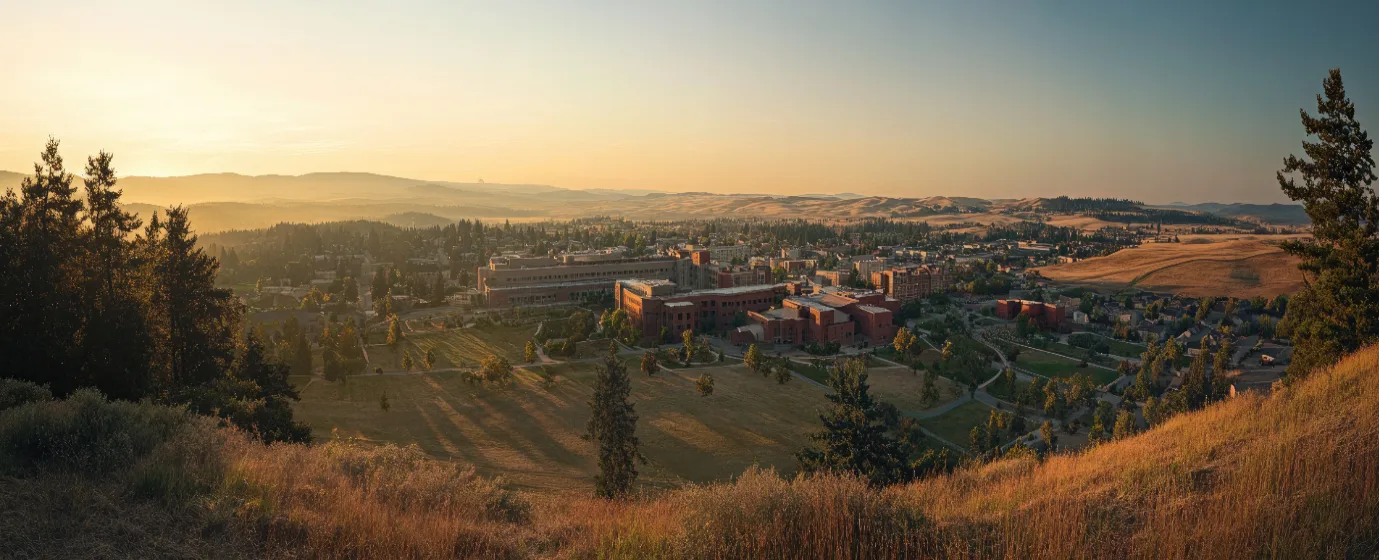
Pullman sits in the heart of the Palouse — that rolling, improbably beautiful wheat-farming landscape in southeastern Washington, just eight miles from the Idaho border. Washington State University anchors the city both economically and culturally, and the university's presence is not a background detail. It is the foreground, the backdrop, and the frame. Roughly 23,000 students call Pullman home for at least part of the year, which is why approximately 69% of housing units are renter-occupied and why the median age of residents runs around 23. Spokane is the nearest major city, 84 minutes northwest on U.S. 195 — close enough for a Costco run or a medical specialist, far enough that you'll learn to appreciate what Pullman has locally.
This guide will help you decide whether Pullman is the right fit for your household. It covers who genuinely thrives here, which neighborhoods suit different lifestyles and budgets, the honest tradeoffs that don't show up in the Zillow listing, and the local quirks that take transplants about six months to fully appreciate. By the end, you'll have a clear picture — not just of the spreadsheet version of Pullman, but of what it actually feels like to live here.

Not every city works for every buyer. Pullman's particular mix of university energy, Palouse scenery, and small-town infrastructure suits some households exceptionally well — and others less so. The table below cuts to the verdict.
| Best For | Why |
|---|---|
| WSU faculty and staff | Short commute, strong community ties, housing value far above Seattle or Spokane comparisons |
| Families with school-age children | Pullman School District ranks among the top 10% of Washington districts with a graduation rate commonly reported around 96% |
| Remote workers (with caveats) | Lower cost of living and genuine quality of life — but internet infrastructure varies by neighborhood |
| First-time buyers | $429,000 median with 98.44% sale-to-list ratios; entry points exist well below that figure for condos |
| Real estate investors | 69% renter-occupied market driven by WSU enrollment; consistent demand for student housing |
| Retirees (selective fit) | Pullman Regional Hospital is on-site, cultural programming is rich, but medical specialty access requires Spokane travel |
Pullman is built on four hills — Pioneer, Sunnyside, Military, and College — separated by draws and connected by roads that locals navigate on autopilot but that will humble you during your first winter. The city is compact enough that almost nothing is more than a 10-minute drive, but the topography means you'll develop strong opinions about which routes to avoid when it snows. And it does snow — not Seattle's occasional dusting, but genuine Eastern Washington winters with weeks of subfreezing temperatures and ice that respects no one's commute timeline.
The daily rhythm here revolves around the university calendar in ways that are impossible to separate. When school is in session, downtown Main Street and the streets around College Hill have the energy of a city twice Pullman's size. When WSU lets out for summer, the city exhales. Restaurants that were packed on a Tuesday in March feel quiet in July. This seasonal pulse is one of the most commented-upon adjustments for people who move here without a university connection — not bad, just different from what they expected.
What surprises most people after six months of living here is how genuinely social the city is for adults. The Bill Chipman Palouse Trail — a paved multi-use path connecting Pullman to Moscow, Idaho — is where you'll run into your neighbors, your kids' teachers, and the colleague you've been meaning to grab coffee with. Reaney Park along the South Fork of the Pullman River serves as the city's unofficial gathering place, hosting community events and serving as the weekend destination for families with young children. The farmers market on Main Street runs seasonally and draws a loyal crowd that treats it as a social appointment, not just a grocery run.
The commute reality deserves a direct conversation. Pullman is not a suburb of anything — it is its own destination. The 84-minute drive to Spokane is genuine, and it's not a pleasant highway slog through flat terrain; U.S. 195 through the Palouse is scenic but winding, and winter conditions regularly add time or close the route entirely. Buyers who are accepting a Pullman-based job and treating Spokane as an occasional trip will be fine. Buyers who are hoping to split their week between Pullman and Spokane should pressure-test that assumption before committing to a mortgage here.
The Palouse landscape is not a minor amenity. It is a genuinely unusual place to live — rolling agricultural hills that turn gold in summer and green in spring, with working farms visible from residential streets and a horizon that doesn't exist in most Pacific Northwest cities. People who grow up on the Palouse or move here for a few years frequently report that they never quite shake the attachment to it. The Palouse Discovery Science Center near the WSU campus provides an educational and community hub that extends well beyond the university's formal programs.
The school district performance is a legitimate competitive advantage for families. Pullman School District commonly ranks in the top 10% of Washington's 306 school districts based on math and reading proficiency, and the graduation rate has held around 96% in recent years. For a city of approximately 33,000 to 35,000 residents, that level of school district quality is unusual — most comparable-sized cities in Washington can't claim it. Families who move here specifically for the schools tend to stay.
Housing affordability relative to western Washington is real and quantifiable. The $429,000 median buys a fundamentally different product here than it does in Bellevue or even Tacoma — more square footage, a yard, and a neighborhood where homeownership is a realistic outcome on a professional salary rather than a decade-long savings exercise. Property taxes run approximately 1.45%, which is in line with Washington state norms and meaningfully lower than the rates buyers encounter in Oregon cities that are otherwise comparable.
Schweitzer Engineering Laboratories is a meaningful part of why non-university professionals can build a career in Pullman without WSU affiliation. SEL is a globally significant company in the power systems and automation space, and it has created a professional ecosystem in Pullman that attracts engineers and technical staff who then stay, buy homes, and become the backbone of the non-student residential community. The presence of Pullman Regional Hospital as a full-service community hospital adds another anchor employer and ensures that basic healthcare access doesn't require a drive to Spokane.

Pullman's isolation is real and worth naming plainly. The nearest major retail corridor is in Moscow, Idaho — eight miles east — and significant shopping, specialty medical care, and airport access all require the Spokane drive. Moscow does extend Pullman's effective amenity radius, and the two cities share a genuine regional identity, but buyers used to suburban Seattle or Bellevue's retail density will go through an adjustment period. There is no Trader Joe's. There is no Apple Store. The regional Costco is in Spokane.
The rental market dominance creates a neighborhood character tension that owner-occupants should understand going in. With 69% of housing units renter-occupied, many of them occupied by students, certain blocks — particularly around College Hill — cycle through tenants annually in a way that affects the long-term community feel. This isn't a criticism of students; it's a geographic reality. The neighborhoods that insulate most effectively from this dynamic are Pioneer Hill, Military Hill, and Sunnyside, where the homeownership rate is higher and the population skews toward faculty, hospital staff, and established professionals.
Why some people leave comes down to one word: career. Pullman's job market has two primary engines — WSU and SEL — with Pullman Regional Hospital and city government rounding it out. For people whose careers don't fit those sectors, advancement eventually requires a move. This is the most common reason long-term Pullman residents relocate in their late 30s and 40s: not because they stopped liking the city, but because their next professional step doesn't exist here. Remote work has changed this calculation for some, but not all.
The winter driving reality is not something to dismiss as a minor inconvenience. Black ice on the hills connecting Pullman's neighborhoods is an annual event, and the city's terrain makes driving in winter genuinely more challenging than in a flat city. Many residents keep AWD or 4WD vehicles specifically for winter navigation. New residents who arrive in summer or spring and form their early impressions during temperate months frequently say their first winter recalibrated their experience of the city significantly.
Pioneer Hill is Pullman's most historically significant residential area — a south-of-Main-Street neighborhood defined by Craftsman cottages, early 1900s construction, tree-lined streets, and genuine walkability to both downtown and the western edge of WSU's campus. Lawson Gardens, a formal public garden within the neighborhood, and proximity to Kruegel Park give it green space that newer developments can't replicate. Prices here sit above the city-wide median for single-family homes, but buyers get the walkability, the neighborhood character, and the stability of an established ownership community in exchange.
Best for: Faculty, hospital staff, and buyers who want established neighborhood character with walkable access to both downtown and campus.
Sunnyside Hill occupies the southwest section of Pullman and has evolved into one of the city's more desirable areas for families seeking newer construction and views across the Palouse. Subdivisions here tend toward larger lots and more recent builds than Pioneer Hill's historic stock, and the area's parks and paved trails have drawn WSU faculty families who want to be away from the student-housing density of College Hill. The honest downside is that the area's growth also means some streets are still completing their buildout, so the neighborhood coherence is stronger in established sections than in the newest phases.
Best for: Families prioritizing newer construction, Palouse views, and quieter suburban character.
Named for the short-lived Pullman Military College that opened in 1891, Military Hill sits in the northwest quadrant of the city and has developed a reputation as one of Pullman's quieter, more established residential areas. Single-family homes with mature trees and backing trails characterize the neighborhood, and the demographic leans toward families and professionals rather than students. Its proximity to WSU is close enough to be convenient for faculty but far enough from the core student housing zones to feel distinctly residential in character.
Best for: Professionals and families who want established quiet, mature landscaping, and proximity to WSU without the College Hill energy.
College Hill is where WSU sits — literally perched on the hill east of North Grand Avenue — and the neighborhood character follows accordingly. Student apartments, townhomes, and single-family rentals dominate the housing stock, and the energy during the academic year is high. For buyers, College Hill functions best as an investment play: the rental demand is structural and consistent, tied directly to WSU enrollment, and the turnover is predictable. Owner-occupants looking for a permanent-residence feel will likely find the annual tenant churn disruptive.
Best for: Investors targeting the student rental market and buyers comfortable with a high-energy, high-turnover neighborhood environment.
Main Street Pullman functions as the city's commercial and social spine — walkable, genuinely active during the academic year, and home to the restaurants, coffee shops, and bars that give Pullman its day-to-day urban texture. Rico's on Main Street has become something of a local institution for its live jazz on weekends. The Pullman Farmers Market runs seasonally and draws a cross-section of the community that reflects Pullman at its most cohesive. Living downtown means accepting the trade-off of proximity to both the energy and the parking limitations that come with a college town's commercial core.
Best for: Young professionals and university affiliates who want walkability and don't need a quiet residential street.
Whispering Hills is a newer residential subdivision in Pullman's southwest corridor, adjacent to the broader Sunnyside area. The housing stock skews toward recently built single-family homes with family-oriented floor plans, and the neighborhood character is quieter than anything near downtown or College Hill. Specific price data for Whispering Hills as a distinct submarket is limited, but buyers should expect values that track with the broader newer-construction inventory in the city's southwest quadrant.
Best for: Families seeking new construction in a quieter setting without the premium of Pioneer Hill's historic character.

Pullman's neighborhoods each tell a different story when it comes to long-term value. Homes near College Hill tend to attract consistent demand given the proximity to Washington State University, and well-priced properties there often go under contract within days of listing. Pioneer Hill and Sunnyside Hill appeal to buyers looking for more established residential settings with good resale history. If your relocation budget is flexible, you'll find a reasonable range of options across Pullman generally under $500,000, though move-in-ready homes in the most desirable pockets move quickly enough that hesitation can cost you the house.
That's exactly why I encourage anyone relocating to Pullman to connect with a lender before they start touring homes. Your pre-approval number is a ceiling, not a target — and your actual monthly obligation includes property taxes, homeowner's insurance, and any HOA dues layered on top of your loan payment. Those figures together determine what genuinely feels comfortable month to month, not just what you technically qualify for. Getting that clarity early means when the right home appears, you're ready to move with confidence rather than scrambling to catch up.
| City | Best For | Approx. Home Price | Commute to Pullman | Vibe |
|---|---|---|---|---|
| Pullman, WA | University career, families, investors | $429,000 | — | College town, Palouse energy |
| Moscow, ID | University of Idaho lifestyle, slightly lower prices | ~$350,000–$380,000 | 15 min | Quieter university town, outdoor-focused |
| Spokane, WA | Career diversity, major retail, metro amenities | ~$380,000–$420,000 | 84 min | Mid-size city, growing tech and healthcare sector |
| Colfax, WA | Rural quiet, very low prices, Whitman County seat | ~$200,000–$260,000 | 35 min | Small town, agricultural, limited amenities |
| Lewiston, ID | Lower cost, river setting, no state income tax (ID) | ~$290,000–$320,000 | 70 min | Blue-collar industrial, outdoor recreation hub |
| Clarkston, WA | Lower prices, Snake River access, Lewiston adjacency | ~$260,000–$300,000 | 70 min | Small, quiet, outdoor recreation base |
| Metric | Data |
|---|---|
| Population | ~33,000–35,000 (commonly cited 2025–2026 estimates) |
| Median Home Price | $429,000 (city-wide median) |
| Median Household Income | $46,812 |
| Property Tax Rate | Approximately 1.45% |
| Average Rent | ~$1,447/month (April 2026) |
| School District | Pullman School District — A rating, top 10% in WA |
| Violent Crime per 1,000 | 2 |
| Property Crime per 1,000 | 10 |
| Commute to Spokane | 84 minutes via U.S. 195 |
| Owner/Renter Split | 31% owner-occupied / 69% renter-occupied |
Apple Cup Weekend transforms the city. When Washington State hosts the Apple Cup — the annual rivalry game against the University of Washington — Pullman's population effectively doubles for 48 hours. Hotels within 60 miles sell out months in advance, traffic on Stadium Way backs up in ways that locals know to avoid entirely, and Martin Stadium becomes the emotional center of the region. If you buy a home near the stadium corridor, you'll either learn to love this or you'll learn to leave town that weekend.
The Palouse Empire Fair runs annually in late summer at the Whitman County Fairgrounds in Colfax — a 35-minute drive — and draws Pullman families as reliably as any local event. It's not technically in Pullman, but it functions as a shared regional tradition that newcomers get invited to within their first year. Fair week is genuinely one of the better windows into the agricultural identity that underlies the university town surface layer.
The WSU Bear Center is one of Pullman's most genuinely unusual assets — a research facility that houses grizzly bears and is open to public tours. It's the kind of thing residents mention casually to visitors from elsewhere and watch them do a double-take. It's been operating for decades as a research and education resource, and local kids grow up treating a grizzly bear tour as a routine field trip destination.
What I would not do if moving to Pullman: Buy on the street grid immediately surrounding College Hill's student apartment core without renting there first for at least a semester. The noise, parking pressure, and annual tenant turnover on blocks like those immediately north of Stadium Way can be manageable or miserable depending on the specific block and building mix — and that variance is hard to judge from a weekend visit or a listing photo. The rest of Pullman is fine to buy into on a standard timeline, but the College Hill fringe rewards patience.

Local Expert Takeaway: If you're relocating to Pullman for a WSU or Schweitzer Engineering role, prioritize Pioneer Hill and Sunnyside Hill in your search — both offer genuine neighborhood stability, proximity to your workplace, and the school district access that makes Pullman worth buying into rather than renting through. Start your search 60 to 90 days before your move date; with homes averaging 19 days on market in early 2026, waiting until you arrive is a real risk. And account for a winter AWD vehicle in your relocation budget — the hills here aren't a four-season afterthought.
✅ Pullman's school district is a genuine asset — top-10% rankings statewide with a graduation rate around 96% make it one of the strongest in Eastern Washington at any price point.
⚠️ The university calendar runs your city — if you're not affiliated with WSU, the seasonal pulse of student arrivals and departures will take adjustment, especially in neighborhoods near College Hill.
📍 Pioneer Hill and Sunnyside Hill are the most stable long-term ownership neighborhoods — both offer walkability, school access, and housing character that holds value independent of the student rental cycle.
Is Pullman a good place for families?
Yes — Pullman offers a combination of school district quality, affordable housing, and genuine community infrastructure that is uncommon for a city its size. The Pullman School District consistently ranks among the top 10% in Washington, the outdoor recreation on the Palouse is accessible and year-round, and the cost of homeownership here is a fraction of what families with similar needs would pay in western Washington markets.
What is the crime rate in Pullman?
Pullman's violent crime rate runs approximately 2 incidents per 1,000 residents — meaningfully lower than state and national averages for cities of comparable size. Property crime runs around 10 per 1,000, which is elevated compared to the violent crime figure but tracks with what many college towns experience given the density of student housing and the transient nature of a portion of the population. The northwest side of the city — Military Hill and surrounding residential streets — is generally considered among the quieter areas.
How does Pullman compare to nearby Moscow, Idaho?
Moscow and Pullman are sister cities connected by U.S. 195 and the Bill Chipman Palouse Trail, and the two are genuinely complementary rather than directly competitive. Moscow tends to offer slightly lower home prices and a somewhat quieter university-town feel tied to the University of Idaho. Pullman has stronger school district metrics, the WSU employment anchor, and Schweitzer Engineering as a private-sector employer that Moscow can't match. Many Pullman residents shop, dine, or commute to Moscow regularly — the 15-minute drive makes the border functionally irrelevant for most daily decisions.
Explore the full Pullman series: Living in Pullman · Is Pullman Safe? · Cost of Living · Best Neighborhoods · Schools & Family Life · Youth Sports · Parks & Rec · Retiring in Pullman