Eastern Washington · Washington
Retiring in Pullman: Is It the Right Fit for Your Next Chapter? (2026)
Pullman surprises people. Most retirees who land here come for WSU-connected reasons — a son or daughter on faculty, a lifelong Coug who wants to stay close to the action, or a spouse whose career wrapped up at Schweitzer Engineering. What they find is a small city that functions better than it should for its size: a real hospital with a Joint Commission accreditation and da Vinci surgical capability, a tax environment that Washington makes genuinely favorable, and a walkable downtown that doesn't require a car to enjoy Tuesday afternoon. The honest answer to whether Pullman works for retirement is: yes, with conditions.
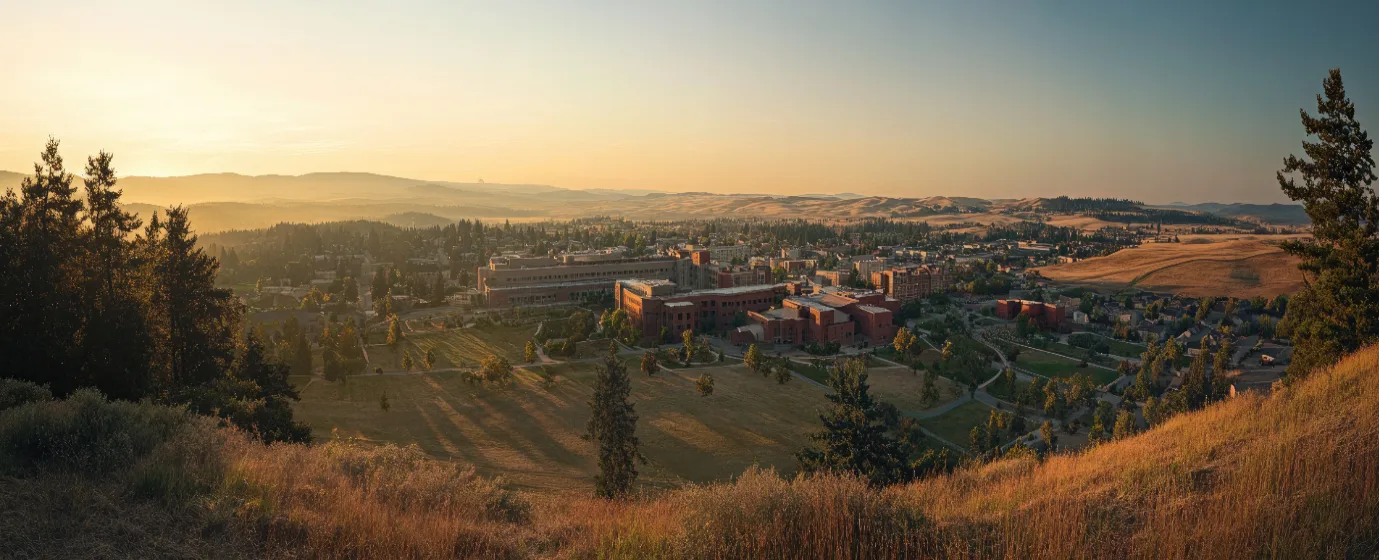
The retiree who thrives here tends to be someone who values intellectual energy over resort amenities. WSU brings guest lectures, theatrical performances, sporting events, and a calendar that stays active year-round. The Palouse landscape — rolling wheat and lentil fields in every direction — offers a particular kind of quiet beauty that either feels like home or feels like the middle of nowhere, depending on who you are. If your retirement vision involves ocean views, warm winters, or a walkable urban core with twenty restaurant options, Pullman isn't the answer.
This guide covers the tax picture, the healthcare reality, senior living inventory, what daily life actually looks like in your sixties and seventies here, and how Pullman stacks up against the retirement alternatives you're probably also considering.

Washington's biggest gift to retirees is structural: there is no state income tax. Social Security, pension income, 401(k) withdrawals, IRA distributions — none of it is taxed at the state level. For a retiree drawing $60,000 to $80,000 a year from retirement accounts, that single fact can represent a four-figure annual savings compared to living in Oregon or Idaho.
| Income Type | Washington State Tax Treatment |
|---|---|
| Social Security Benefits | Not taxed |
| Pension Income | Not taxed |
| 401(k) / IRA Withdrawals | Not taxed |
| Investment Income / Capital Gains | Generally not taxed at state level* |
| Earned Income / Part-Time Work | Not taxed |
| Estate / Inheritance Tax | WA estate tax applies above $2.193M threshold |
| Property Tax | 1.45% effective rate in Pullman / Whitman County |
What these rates mean practically is that a retired couple in Pullman keeps more of their fixed income than in most western states. The tradeoff is on the property side: Pullman's effective property tax rate of 1.45% runs higher than the Washington statewide average, largely because of local levies including the Pullman Regional Hospital bond. On a home at the $429,000 median, that's approximately $6,220 annually in property taxes — a real number that shouldn't catch buyers off guard.
Washington offers a meaningful senior property tax exemption for homeowners aged 61 and older with income below certain thresholds. Eligible seniors can freeze their assessed value for tax purposes, which limits exposure to rising property valuations over time. Oregon, by comparison, taxes pension income and charges income tax on IRA withdrawals — meaning a retiree drawing $70,000 per year in Oregon pays state income tax where a Pullman retiree pays nothing. That gap compounds significantly over a 10-to-15-year retirement horizon.
Pullman Regional Hospital sits at 835 SE Bishop Boulevard on Pioneer Hill, and it punches well above its weight for a critical access facility. The hospital is 95,000 square feet with 25 patient beds, four operating rooms, and around-the-clock emergency care staffed by board-certified emergency physicians. For a town of 34,000, the capabilities on offer are genuinely impressive — da Vinci robotic-assisted surgical options, a fully digital imaging center, nuclear medicine, oncology services, telestroke technology, and what the hospital describes as the only comprehensive audiological services on the Palouse.
The ICU provides continuous cardiac and respiratory monitoring including life support capability, and the on-site hospitalist program means patients admitted through the ER aren't falling through coordination gaps. Patient satisfaction scores consistently rank in the top 3% nationally, and 93% of patients report they would recommend the hospital — numbers that reflect something real about the nursing culture here. For routine senior health needs, orthopedic care, post-surgical rehab, and outpatient procedures, Pullman Regional handles the caseload well.
The honest limitation is specialty depth. Complex cardiac procedures, neurosurgery, transplant care, and high-acuity oncology treatment require a trip to a larger academic medical center. Spokane is 84 minutes up US-395, and Providence Sacred Heart Medical Center there provides the tertiary care capability that no small-town hospital can match. The telestroke program helps bridge that gap for stroke response time, but retirees managing serious chronic conditions should factor that drive into their calculus. In November 2022, Pullman voters passed a $27.5 million bond to expand surgical, outpatient, and emergency capacity — meaning the facility will be meaningfully larger and more capable within the next few years.
Pullman's senior living inventory is modest relative to larger retirement markets, which reflects both its size and its university-town demographic lean. Independent living and assisted living options do exist, though the depth of continuing care communities you'd find in Spokane or a dedicated retirement corridor isn't replicated here.
| Community | Type | Location | Est. Monthly Cost |
|---|---|---|---|
| Pullman Retirement Inn | Independent / Assisted Living | NE Pullman | $2,800–$4,200 |
| Hawthorn Court at Pullman | Assisted Living / Memory Care | Pullman | $4,500–$6,500 |
| Riverview Retirement Community (Moscow, ID) | Independent / Assisted Living | Moscow, ID (8 mi.) | $3,200–$5,000 |
| Regency at the Park (Spokane) | Independent / Assisted / Memory | Spokane (84 mi.) | $4,800–$7,500 |
| Home Care Agencies (multiple) | In-Home Services | Citywide | $25–$40/hr |

Walkability in Pullman is real but uneven. If you land on Pioneer Hill or Sunnyside Hill, you can walk to downtown's Main Street shops, restaurants, and services without a car. The terrain is hilly — this is a city of literal hills — so "walkable" comes with the asterisk that you'll be working your calves. The Bill Chipman Palouse Trail, which begins near downtown, gives walkers and cyclists a flat, paved path through the Palouse farmland toward Moscow, Idaho. It's one of the genuinely lovely daily rituals Pullman retirees cite after six months of living here.
The WSU calendar is the cultural engine. Cougar football at Martin Stadium draws tens of thousands from September through November and turns quiet Pullman into a regional event destination. Beyond athletics, the campus hosts performances through the Beasley Performing Arts Coliseum, academic lectures open to the public, and a constant rotation of visiting events that a city this size would never generate on its own. The Palouse Discovery Science Center adds a family-friendly venue that also hosts adult programming. Lawson Gardens near Pioneer Hill is a formal garden space that becomes a community gathering point through the warmer months.
Two local traditions anchor the calendar year. The National Lentil Festival each August is legitimately one of the more distinctive community events in Eastern Washington — the Palouse produces a significant share of the nation's lentil crop, and the festival reflects that with a warmth that feels earned rather than manufactured. The annual Fourth of July celebration at Sunnyside Park draws a cross-section of the whole community, with the park's trails, pond, and gazebo providing a natural gathering space.
Getting around without a car is possible within the core but impractical for everything else. Pullman Transit runs local bus routes, and the WSU campus is accessible without driving, but grocery runs and medical appointments to Spokane require a vehicle. The Pullman-Moscow Regional Airport offers limited commercial service, primarily as a connection point through Seattle — useful for retirees with family on the coasts, though the flight costs run higher than what you'd pay out of Spokane's airport.
What surprises most retirees after six months here is how much the university keeps social isolation at bay. There are continuing education opportunities through WSU, athletic events that give you a reason to be out on crisp October Saturdays, and a town that stays intellectually engaged year-round because it's built around an institution that never fully quiets down. The flip side is what some discover just as quickly: the restaurant options are thin for a city this size, winters on the Palouse are cold and occasionally icy, and the nearest Costco is in Moscow.

Pullman's neighborhoods each tell a different story when it comes to long-term value for retirees. Homes on College Hill and Pioneer Hill tend to attract steady interest because of their walkability and proximity to Washington State University's amenities — think arts events, medical resources, and lifelong learning programs. That combination keeps demand fairly consistent, and well-maintained homes in those areas under $400,000 don't sit long before receiving serious attention. Sunnyside Hill offers a quieter feel with solid appreciation history, which matters when you're thinking about a home as part of your retirement picture rather than just a place to live.
Before you start touring homes, please sit down with a lender first — not because it's a formality, but because your full monthly payment involves more than the loan itself. Property taxes, homeowner's insurance, any HOA dues, and how your loan is structured all shape what you're actually committing to each month. I always encourage retirees to think about a comfortable payment, not just the maximum they're approved for. Being financially prepared also means you can move quickly and confidently when the right home appears.
| City | Median Home Price | Hospital Access | Walkability | Senior Community Depth | Overall Retirement Fit |
|---|---|---|---|---|---|
| Pullman, WA | $429,000 | Level IV on-site | Moderate (hilly) | Limited but functional | ★★★★☆ |
| Moscow, ID | ~$350,000 | Critical Access (Gritman) | Moderate | Comparable to Pullman | ★★★★☆ |
| Spokane, WA | ~$390,000 | Major medical hub (Providence) | Good in core | Deep and varied | ★★★★★ |
| Colfax, WA | ~$220,000 | No hospital (Pullman/Spokane) | Low | Very limited | ★★☆☆☆ |
| Lewiston, ID | ~$290,000 | St. Joseph Regional on-site | Moderate | Better than Pullman | ★★★★☆ |
| Clarkston, WA | ~$280,000 | 8 mi. to Lewiston hospital | Low–moderate | Limited | ★★★☆☆ |

Local Expert Takeaway: Pioneer Hill is the strongest landing spot for retirees who want to walk to the hospital, walk to downtown, and live in an established neighborhood with mature trees and historic character — all at prices that leave equity room on a fixed budget. Sunnyside Hill is the better call if you want newer construction or proximity to Sunnyside Park's trail system. Retirees who need consistent specialist care beyond what Pullman Regional handles should weight their decision toward Spokane or Lewiston rather than trying to manage that 84-minute drive repeatedly. For the right buyer — intellectually curious, mobile, and genuinely drawn to Palouse life — Pullman offers a retirement cost structure that's hard to match anywhere else in Washington.
Is Pullman, WA a good place to retire?
Pullman works well for retirees who value intellectual and cultural engagement, want Washington's income-tax-free environment, and are comfortable in a small city with a university heartbeat. The combination of a capable local hospital, a walkable core on Pioneer Hill and Sunnyside Hill, and access to WSU's events and continuing education makes it a legitimately strong fit for the right personality. Retirees who need extensive specialist medical care or a broad senior living marketplace will find the depth of a larger city like Spokane more suitable.
What healthcare is available for retirees in Pullman?
Pullman Regional Hospital at 835 SE Bishop Boulevard provides 24-hour emergency care, an ICU, robotic-assisted surgery, oncology services, orthopedic and rehabilitation care, and telestroke technology. It consistently ranks in the top 3% nationally for patient satisfaction. For complex cardiac, neurosurgical, or transplant care, Providence Sacred Heart Medical Center in Spokane is the referral destination, approximately 84 minutes away.
How does Pullman's cost of living compare for retirees on a fixed income?
Pullman's median home price of $429,000 sits roughly $180,000 below the Washington statewide median, making entry into homeownership more manageable on fixed income. Washington's lack of a state income tax protects retirement account withdrawals, Social Security, and pension income entirely. The 1.45% property tax rate is higher than the statewide average but remains predictable, and the senior property tax exemption for homeowners 61 and older with qualifying income can meaningfully reduce that annual carrying cost.
Explore the full Pullman series: Living in Pullman · Is Pullman Safe? · Cost of Living · Best Neighborhoods · Schools & Family Life · Youth Sports · Parks & Rec · Retiring in Pullman