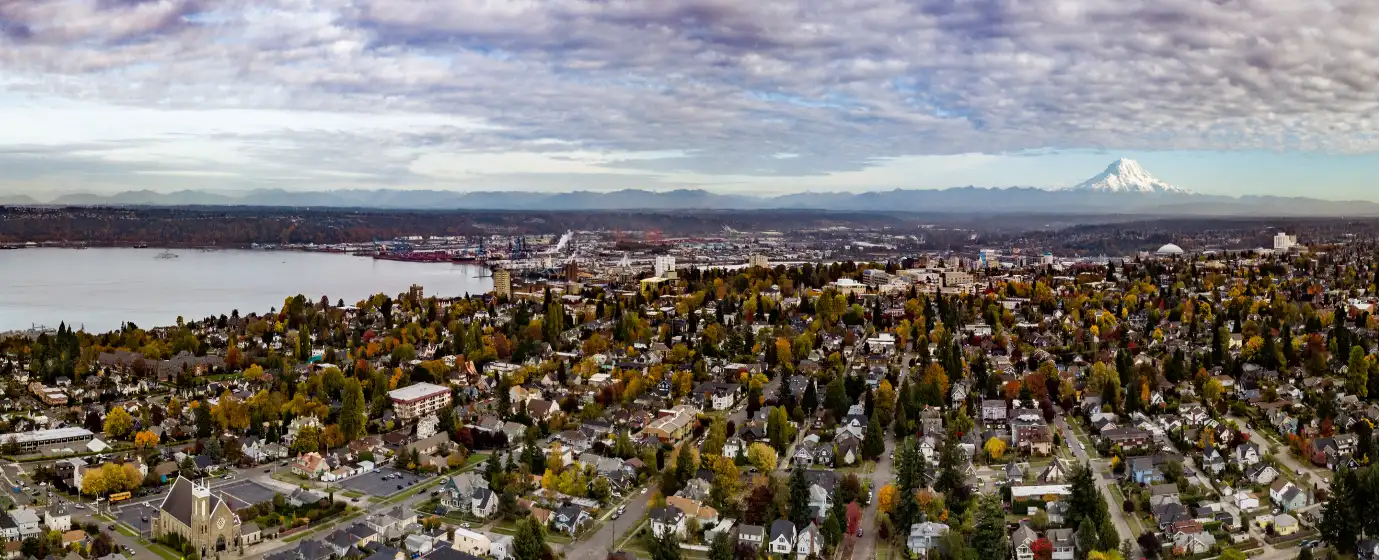
Puget Sound · Washington
Moving to Tacoma from California: The Honest Comparison (2026)
The Bay Area software engineer who finally got a yard and kept their salary. The San Diego family that stopped dreading July utility bills and August wildfire smoke notifications. The Sacramento couple who bought a four-bedroom craftsman in Tacoma's North End for less than their two-bedroom townhome sold for. These aren't edge cases — San Francisco consistently ranks as one of the top two cities sending homebuyers directly into Tacoma, and California broadly remains the single largest out-of-state source of migrants to the Seattle-Tacoma metro. What's pulling people here isn't just cheaper housing. It's the combination of cheaper housing, no state income tax, and a genuinely livable mid-sized city that most Californians haven't fully priced in yet.
The hard part is that Tacoma is not California, and the guides that skip over that fact are doing you a disservice. The gray season runs roughly October through March — six months of heavy cloud cover where November averages just two hours of daily sunshine. The food scene, while genuinely improving, doesn't replicate the depth of Los Angeles or San Francisco. The social pace is different, and not always in the ways you'd expect. You will miss things that were invisible to you in California because they were simply always there.
This guide covers what your California equity actually buys here at several price points, the tax picture in real dollar terms, an honest side-by-side on weather and lifestyle, the four mistakes California buyers make most often, and a comparison tool that lets you look up your specific city. If you're weighing whether the move pencils out, this is the post to read before the Zillow deep dive.

| Tacoma, Washington | Bay Area | Southern CA | Sacramento Metro | Central Valley | |
|---|---|---|---|---|---|
| Median Home Price (approx. 2026) | $485,000 | $1,300,000–$1,600,000+ | $750,000–$950,000 | $500,000–$620,000 | $330,000–$440,000 |
| Property Tax Rate (effective) | ~1.05% | ~1.1% (Prop 13 caps vary widely) | ~1.1–1.2% | ~1.1–1.2% | ~1.0–1.2% |
| State Income Tax | None | Up to 13.3% | Up to 13.3% | Up to 13.3% | Up to 13.3% |
| State Sales Tax | 8.8–10.4% (combined) | 8.625–10.25% | 7.75–10.5% | 7.75–8.75% | 7.25–8.75% |
| Avg. Utilities (monthly est.) | ~$150–$180 | $200–$280 | $220–$300 | $180–$240 | $180–$240 |
| Avg. 1BR Rent | ~$1,500–$1,800 | $2,800–$3,800 | $2,200–$3,200 | $1,500–$1,900 | $1,100–$1,500 |
The Washington no-income-tax advantage deserves its own sentence: for a California household earning $150,000 per year, the difference between California's marginal rate and zero is roughly $10,000 to $15,000 annually in additional take-home pay. That figure compounds. Over ten years, a couple earning $150K combined is looking at $100,000 to $150,000 in cumulative tax savings — money that in California was funding Sacramento and in Washington stays in your account.
Washington is one of only nine states with no state income tax, and for California transplants, this is the headline advantage that reshapes the entire financial picture. The numbers are straightforward: a California household earning $120,000 pays roughly $7,000–$8,500 in state income tax annually. At $150,000, that figure climbs to approximately $10,500–$13,000. At $200,000, California's progressive rate structure pushes the annual state tax bill above $17,000. In Washington, all three of those households pay zero.
| Tax Item | California | Washington | Net Impact for Transplant |
|---|---|---|---|
| State Income Tax | 1%–13.3% (progressive) | None | $7,000–$17,000+/year savings depending on income |
| Sales Tax | 7.25%–10.5% combined | 8.8%–10.4% combined | Roughly comparable; slight WA edge in some counties |
| Capital Gains Tax | Taxed as ordinary income | 7% on gains over $262,000/year | Minimal impact for most W-2 earners |
| Property Tax Rate | Prop 13 artificially caps longtime owners; new buyers pay full assessed value | ~1.05% in Pierce County | Similar on new purchases; CA new buyers often pay more |
| Senior Property Tax Exemption | Limited circuit breaker programs | Yes — age 61+, income-based | Meaningful for retirees |
| Estate / Inheritance Tax | None at state level | Washington estate tax applies above $2.193M | Relevant only for high-net-worth estates |
Two paragraphs of post-move tax math that surprises people: the take-home pay difference shows up immediately on the first paycheck, not at tax time. A California employee used to seeing state withholding on every stub will notice the difference within the first month. That monthly cash flow shift — often $600 to $1,400 per month depending on income — is what makes the Washington tax picture feel concrete rather than abstract.
A buyer leaving San Jose or Palo Alto with $1.4 million in equity can purchase essentially any home in Tacoma's market outright — in cash — and still retain a meaningful investment reserve. Tacoma's median sits at $485,000, and even its most premium addresses in the North End or Proctor District rarely exceed $900,000 to $1.1 million for a fully renovated historic home. That means the Bay Area buyer isn't just moving to a different market; they're fundamentally changing their financial position. For households that choose to carry a small mortgage rather than deploy all their equity into the purchase, the resulting monthly payment on a $200,000 loan is a number that feels almost abstract compared to what they left behind.
At this equity level, the neighborhoods that make the most sense are North End — particularly the blocks between N. 26th and N. 30th Streets where mature craftsman homes and Tudors regularly sell in the $700,000 to $950,000 range — and the Stadium District for buyers who want walkable urban access with architectural character. Both neighborhoods offer something rare in California: genuine historic fabric, established trees, and proximity to the water without the $2 million price tag that equivalent character commands in Marin County or the East Bay hills.
A buyer leaving Pasadena, Irvine, or coastal San Diego with $900,000 in equity is positioned at the top tier of Tacoma's market with significant flexibility. They can purchase in Proctor District — where bungalows and Tudors in the $550,000 to $800,000 range are consistently well-maintained and close to independent retail and restaurant corridors — and retain enough equity to furnish, renovate, or invest. The jump from a $1.1 million Irvine townhome to an $650,000 craftsman on a real lot in Proctor isn't just a savings story; it's a quality-of-life story about square footage, a yard, and a detached garage.
Southern California buyers at this equity level should also look seriously at the Old Town neighborhood and Ruston, where smaller waterfront-adjacent homes and renovated properties offer views and walkability that would command triple the price in Laguna Beach or La Jolla. The comparison isn't perfect — Puget Sound is not the Pacific — but the lifestyle logic holds.
This buyer group has a tighter relative advantage, but the tax math closes the gap considerably. A household leaving Roseville or Rancho Cucamonga with $500,000 in equity can put a substantial down payment on a well-located Tacoma home in Central Tacoma or the West End, keeping their monthly carrying cost well below what they paid in California — and then recapturing an additional $8,000 to $12,000 annually through the income tax elimination. Over five years, the cumulative financial benefit of that combination — lower mortgage, no state income tax — adds up to a number that makes the math compelling even when the equity differential alone doesn't look dramatic on paper.
Price points that work for this buyer: well-maintained homes in Central Tacoma commonly sell in the $380,000 to $520,000 range, and the South End and Fern Hill corridors offer good value in the $340,000 to $480,000 range for buyers willing to prioritize square footage and neighborhood stability over walkability scores.
The Central Valley buyer — leaving Fresno, Modesto, or Stockton — is working with the most modest relative advantage, but the comparison still holds for specific reasons. First, Washington's property tax rate at 1.05% is competitive with what Central Valley buyers pay on current market purchases in California. Second, the income tax elimination matters more at lower income levels than it might seem: a household earning $85,000 in Fresno pays roughly $4,500 to $5,500 annually in California state income tax. That disappears entirely. Third, Tacoma's entry-level market — homes in South Tacoma, Lincoln, and Eastside in the $320,000 to $420,000 range — is accessible on this equity level and delivers more square footage, more storage, and generally more functional layouts than equivalent California product at the same price.

Let's be direct: Tacoma gets less sunshine than any California metro you might be leaving. Los Angeles averages roughly 3,254 sunshine hours per year. San Diego is close behind. Sacramento clears 2,800. Tacoma comes in at approximately 2,172 hours annually — and those hours are heavily concentrated from May through September. From October through March, the cloud cover is persistent and real. November averages just two hours of daily sunlight. December brings approximately 17 rainy days. If you've never lived in a marine climate before, the gray season requires active management — people here talk about light therapy lamps and outdoor routines with a seriousness that Californians find puzzling until they've lived through their first November.
What California transplants consistently report loving after a year in Tacoma is the summer. July and August in Tacoma are genuinely exceptional — temperatures in the mid-70s, dry air, 10+ hours of daily sunshine, and a city that knows how to use it. Point Defiance Park becomes a weekend anchor. The Ruston Way waterfront fills with runners, kayakers, and families who've been waiting since October for exactly this. Summers in Tacoma have a collective release energy that doesn't quite exist in places where nice weather is assumed. The tradeoff is that you earn it.
What people miss most specifically: year-round beach access, the culinary depth of Los Angeles or San Francisco, and — more than anything — the ease of outdoor spontaneity that California weather makes possible. A Southern California transplant used to hiking Runyon Canyon in February will find that Tacoma's winter trails are hikeable but wet, and the motivation calculus is genuinely different. The community feel and the housing space are consistently what keep people here. The weather takes adjustment, and the honest answer is that it adjusts most people, not the other way around.
If you want to see how Tacoma compares directly to the city you're leaving, use the tool below — it covers the 120 largest California cities with current housing and tax data.
Home prices: Redfin median sale data, Q1–Q2 2026. Select your city to compare.
Ready to talk through what your specific California equity could do in Tacoma? Todd can model your exact scenario in a single call.

Tacoma's neighborhoods vary quite a bit in terms of long-term value, and where you land matters more than people realize. The North End and Stadium District have drawn consistent buyer interest from California transplants because of the walkability, character homes, and proximity to downtown — well-priced homes there under $750,000 tend to disappear within days, not weeks. The Proctor District has a similar pull, with a neighborhood feel that resonates with buyers coming from places like the Bay Area or San Diego who want something genuinely livable without the California price tag.
Before you start touring homes, please talk to a lender first — not because it's a formality, but because your full monthly payment includes property taxes, homeowner's insurance, and potentially HOA dues on top of principal and interest, and that number can feel very different from what you imagined. California buyers sometimes get pre-approved for more than they're truly comfortable spending, and those are two very different things. Knowing your real number before you fall in love with a home means you're ready to move confidently when the right one shows up.
Mistake 1: Assuming the city is uniform. Tacoma has more internal neighborhood variation than most mid-sized cities its size, and California buyers who tour one area and extrapolate are consistently surprised later. The character difference between North End and Hilltop — about two miles apart — is significant. Buyers who purchase in a neighborhood based on price alone without understanding what surrounds it commonly find that the specific block matters far more than the zip code. Do the neighborhood-level homework, not just the city-level homework.
Mistake 2: Not accounting for winter commuting. California drivers are unaccustomed to navigating the Tacoma Narrows approach, Highway 16, or I-5 through Fife in fog, low light, and wet conditions that persist for months. The commute from South Tacoma to Joint Base Lewis-McChord or from Northeast Tacoma to downtown Seattle (roughly 45 minutes in normal conditions) can stretch significantly in winter morning traffic. This isn't a dealbreaker — it's a calibration. Buy based on your winter commute, not your July test drive.
Mistake 3: Underestimating the income tax impact on monthly cash flow. Most California transplants understand the income tax advantage intellectually but don't feel it until the first paycheck. A household earning $160,000 combined will see roughly $900 to $1,100 per month more in take-home pay starting with their first Washington paycheck. That figure changes the home-buying calculation materially — it effectively lowers the real cost of a mortgage payment in ways that don't show up in the lender's initial numbers.
Mistake 4: Expecting California-style year-round outdoor spontaneity. Tacoma has genuinely excellent outdoor access — Wright Park, Point Defiance, the Ruston Way waterfront, and Mount Rainier under two hours away — but the outdoor culture operates differently in winter. People here still hike, run, and cycle in November, but they've built routines around it rather than treating it as effortless. California transplants who rely on weather as the default motivation often find their outdoor activity drops sharply in the first winter. The locals who thrive have a deliberate approach. Build that approach before you arrive, not after.
Bay Area sellers arriving with $1.2 million or more in equity are often operating in a space where the mortgage structure is less about rate optimization and more about liquidity management, speed, and terms. An all-cash offer in Tacoma's market is a genuine competitive advantage — sellers move faster, contingencies are simpler, and in multiple-offer situations cash typically wins. For buyers who prefer to keep equity deployed rather than sitting in a home, a low-LTV conventional loan at even a moderate rate leaves significant capital free. If the property being sold in California was an investment or rental property, a 1031 exchange can defer the capital gains tax on the sale — Tacoma has strong rental fundamentals and eligible replacement properties are available in multiple price tiers. The 1031 Exchange in Tacoma guide covers this in detail.
Southern California sellers typically arrive with enough equity to make a substantial down payment on any Tacoma home without approaching jumbo territory — the conforming loan limit means most Tacoma purchases are handled on conventional financing, which simplifies the process considerably compared to what these buyers navigated buying in coastal California. The practical question for this group is usually whether to maximize the down payment for payment reduction or retain equity for reserves or investment.
Sacramento and Inland Empire buyers land in a more nuanced position. Those with equity in the $400,000 to $550,000 range and household incomes near or below the median may find that Washington State Housing Finance Commission's Home Advantage program is worth examining — it provides down payment assistance for income-qualifying buyers and is available on properties in Tacoma's market. The income limits and purchase price caps can vary, so buyers in this segment should verify current program parameters with a local lender who knows the WSHFC programs before assuming they qualify.

Local Expert Takeaway: The California buyers who get the most out of Tacoma aren't the ones who find the cheapest house — they're the ones who run the real math on monthly cash flow after factoring in the income tax elimination. A $485,000 home with a 20% down payment in Washington, with no state income tax on a $150K household income, frequently produces a lower total monthly outlay than renting a one-bedroom in San Jose. Run that specific calculation with your actual income before you set your Tacoma price ceiling — most buyers find their ceiling is higher than they thought, which opens neighborhoods like North End and Proctor that feel out of reach until the math is done.
Is moving from California to Tacoma worth it?
For most California households — particularly those earning $100,000 or more and selling into a market where their equity exceeds $400,000 — the financial case is strong and multi-layered. The combination of lower home prices, no state income tax, and lower utility costs creates a monthly cash flow improvement that compounds over time. The lifestyle case is more personal: if you can adapt to a genuinely gray winter and you're drawn to a mid-sized city with real neighborhoods, strong outdoor access, and a lower cost basis, Tacoma is a legitimate and well-established destination.
How much cheaper is housing in Tacoma vs. California?
The gap varies dramatically by origin market. Compared to the Bay Area, Tacoma's $485,000 median is roughly 65–70% less than comparable Bay Area medians. Against Los Angeles or San Diego, the gap is typically 40–50%. Against Sacramento, the differential is closer to 15–25% — but the income tax elimination closes that gap substantially. Against the Central Valley, the price differential is modest, but product quality, neighborhood amenities, and tax structure consistently favor Tacoma for buyers who can execute the move.
What do I need to know about moving from California to Washington?
The practical checklist: establish Washington residency promptly (which affects your vehicle registration, driver's license, and voter registration), understand that Washington has no state income tax but does have a business and occupation tax if you're self-employed, and recognize that property taxes in Pierce County run approximately 1.05% of assessed value annually. The gray season requires genuine preparation — light therapy, outdoor routines, and social anchoring matter more here than in California. And the mortgage process benefits from getting fully underwritten before you begin touring, since the Tacoma market can move faster than California buyers expect.
Explore the full Tacoma series: The Ultimate Tacoma Relocation Guide · Is Tacoma Safe? · Cost of Living in Tacoma · Best Neighborhoods in Tacoma · Tacoma Schools & Family Life · Tacoma Youth Sports · Tacoma Parks & Recreation · Retiring in Tacoma · 1031 Tax-Deferred Exchange in Tacoma · Tacoma First-Time Homebuyers Guide · Tacoma Down Payment Assistance Guide · Moving to Tacoma from California