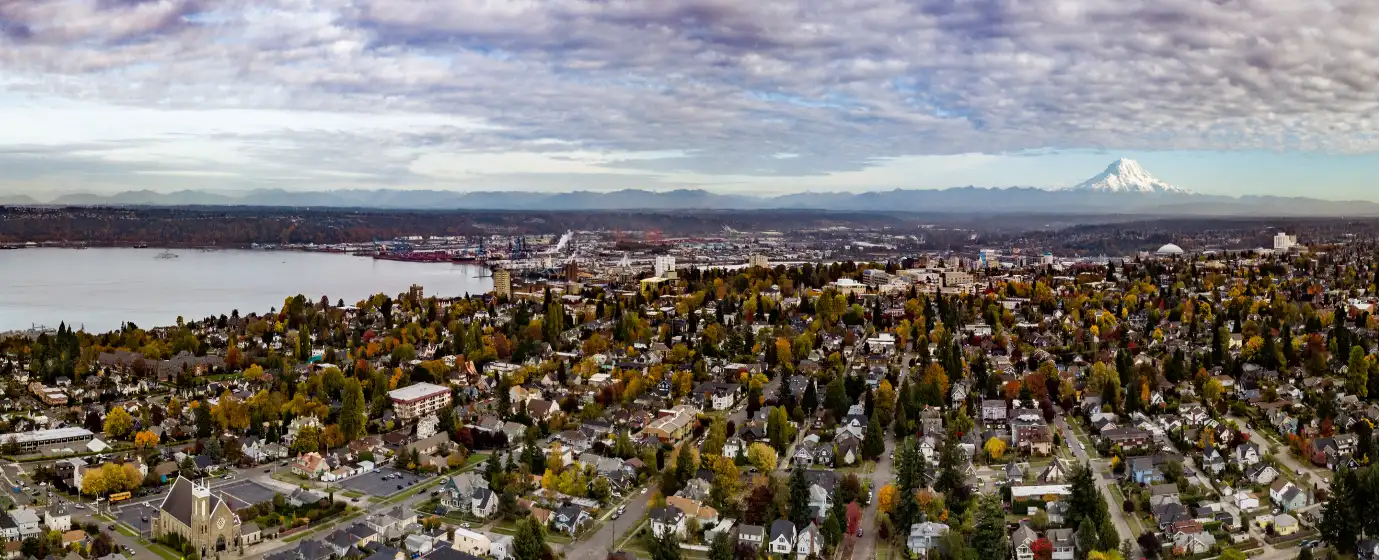
Puget Sound · Washington
1031 Exchange & Investment Real Estate in Tacoma (2026)
Not every 1031 exchange investor is a seasoned portfolio builder. A significant share of the capital flowing into Tacoma right now is coming from California homeowners who finally sold — a Bay Area bungalow, a San Diego condo, a Sacramento ranch house — and are staring at a gain they'd rather defer than hand to the IRS. Tacoma is earning serious attention from that crowd, and for good reason: a $485,000 median home price in a metro anchored by major employers, a military installation, and a port puts replacement property within reach of exchange proceeds that would barely cover a down payment back home.
The Tacoma rental market has real structural durability. Joint Base Lewis-McChord generates a constant rotation of housing-qualified service members who rent rather than buy. The Port of Tacoma, MultiCare Health System, and Virginia Mason Franciscan Health collectively employ tens of thousands of workers across income bands, sustaining demand for everything from studio apartments to three-bedroom single-family rentals. Inventory sits around 2.3 months of supply — well below balanced-market levels — which keeps vacancy tight and gives landlords pricing power they haven't always had in secondary Pacific Northwest markets.
This guide covers what you actually need to know before pulling a Tacoma property into a 1031 exchange: the mechanics that determine whether your exchange holds up, the property types trading here and at what cap rates, the tax advantages Washington State offers compared to California, and the property management realities that out-of-state investors consistently underestimate.

The exchange itself is straightforward but unforgiving on timing. From the date you close on your relinquished property, you have 45 days to identify potential replacement properties in writing to your qualified intermediary. Most investors use the three-property rule — identify up to three properties regardless of value — though the 200% rule allows more identifications if total value stays under twice the relinquished property's value. Miss the 45-day window by a single day and the exchange collapses; there are no extensions for market conditions, cold feet, or inventory shortages.
The 180-day closing deadline runs concurrently from the same relinquished-property close date — not from the end of the identification period. In practice, that gives you roughly 135 days after identification to get to the closing table. Your qualified intermediary holds the proceeds the entire time; you cannot touch the funds or the exchange is disqualified. The like-kind rule is broader than most people assume: all real property qualifies, from raw land to commercial to residential to industrial — the only requirement is that both properties are held for investment or business use, not personal residence.
The boot trap catches more investors than the deadlines do. Boot is any value received in the exchange that isn't replacement real estate — cash back, debt relief, personal property, or closing costs paid from exchange funds. Boot is taxable in the year of the exchange, which defeats the purpose of deferring gain. If your relinquished property sold for $800,000 and you buy a $650,000 replacement, that $150,000 difference is taxable boot. The fix is simple: trade up or equal in both value and debt.
Tacoma's investment property market trades across four main categories, and each has a meaningfully different risk-return profile. Single-family rentals dominate the transaction volume — they're easier to finance, easier to manage, and the buyer pool on exit includes both investors and owner-occupants. Small multifamily (duplexes through six-plexes) is where cap rates get interesting, particularly in the South Tacoma, Eastside, and Central Tacoma corridors where purchase prices stay well below the citywide median and rents track consistently with the broader market. Downtown condos and small commercial round out the mix, though 1031 buyers on a deadline tend to avoid condos with HOA rental restrictions.
Homes in Tacoma receive roughly two offers on average and sell in around 31 days — meaningful context for an investor who needs to close before the 180-day window expires. Value-add multifamily moves faster than that timeline suggests; well-priced small multifamily with current tenants in place typically draws competitive interest within the first two weeks of listing. That speed cuts both ways: you can close quickly, but you can't afford to hesitate when the right property surfaces.
| Property Type | Typical Price Range | Est. Cap Rate | Avg Days to Close |
|---|---|---|---|
| Single-Family Rental (SFR) | $350,000–$550,000 | 4.5%–6.5% | 30–45 days |
| Duplex / Triplex | $550,000–$850,000 | 5.0%–7.0% | 30–45 days |
| Small Multifamily (4–10 units) | $800,000–$2,000,000 | 5.5%–7.5% | 45–60 days |
| Downtown Condo (investment) | $350,000–$475,000 | 3.5%–5.0% | 30–40 days |

The math that drives California capital north is simple: what a California investor's exchange proceeds can actually buy. Washington has no state income tax, landlord-tenant law that doesn't include statewide rent control, and property prices that still look like a discount compared to any coastal California market.
A Bay Area investor selling a modest San Jose house at $1.4 million in exchange proceeds can buy a duplex in Tacoma's North End outright and a single-family rental in South Tacoma — two assets, no debt, immediate cash flow — and still be within exchange value. That kind of purchasing power simply doesn't exist when reinvesting within California at Bay Area prices. The cash-on-cash return on an all-cash Tacoma duplex clears 5%–6% with conservative rent assumptions.
The Los Angeles and San Diego investor is often trading a $900,000–$1.1 million investment property and looking for like-kind replacement without the management headaches of their current market. Tacoma's price-to-rent ratios are more favorable than most Southern California submarkets, and the tenant pool — anchored by healthcare workers, military families, and port employees — tends to be more stable than what many L.A. landlords deal with. A well-located Tacoma triplex trading at $750,000 with gross rents of $5,500/month represents the kind of in-place yield that's nearly impossible to find in the greater LA basin.
Sacramento and Inland Empire investors are sometimes selling properties in the $500,000–$700,000 range — enough to buy a solid single-family rental in Tacoma outright or put 40%–50% down on a small multifamily. This cohort often prioritizes simplicity: one property, a reputable property manager, and a clean cash-flow story. South Tacoma and the Eastside corridor, where purchase prices run $350,000–$480,000 and three-bedroom rents reach $2,300–$2,575/month, frequently pencil into the 5.5%–6.5% cap rate range these buyers target.
Washington's no-income-tax status is the headline benefit, but it's worth spelling out exactly what that means for rental income. Every dollar of net rental income — after expenses, depreciation, and debt service — stays in your pocket rather than being split with a state. California's top bracket hits 13.3%. For an investor netting $40,000 annually from a Tacoma rental portfolio, that's a meaningful difference compounding year over year.
| Tax Item | California | Washington |
|---|---|---|
| State income tax on rental income | Up to 13.3% | None |
| Property tax rate (new purchase) | ~1.0%–1.2% effective (Prop 13 reset) | ~1.05% (Pierce County) |
| Sales tax | 7.25%–10.75% | 6.5% + local (~10.2% in Tacoma) |
| Long-term capital gains (state) | Up to 13.3% | 7% on gains over $262,000/yr |
| Short-term capital gains (state) | Up to 13.3% | None |
Depreciation basis carries over in a 1031 — the replacement property inherits the existing depreciation schedule rather than resetting to full market value. Investors who want to eliminate active management entirely can consider a Delaware Statutory Trust (DST) as the replacement property in a 1031; DSTs satisfy the like-kind requirement while providing passive, pro-rata ownership in institutional-grade assets with a professional sponsor handling all operations.

When you're executing a 1031 exchange in Tacoma, the neighborhood you're targeting matters enormously for long-term appreciation and tenant demand. Areas like the North End and Proctor District consistently attract stable, long-term renters and owner-occupants alike, which supports property values over time. The Stadium District has also seen renewed investor interest given its walkability and proximity to downtown. In these more desirable pockets, well-priced investment properties under $750,000 tend to move fast — sometimes within days — so having your financing already structured before you identify your replacement property isn't just smart, it's essential with 1031 exchange timelines being as strict as they are.
That's exactly why connecting with a lender before you start touring replacement properties makes such a difference. Your actual monthly obligation includes the loan payment, property taxes, insurance, and any HOA dues, and the full picture can look quite different from just the purchase price alone. Being pre-approved also means knowing your comfortable budget, not just your maximum approval — those two numbers aren't always the same. When the right property surfaces in a competitive Tacoma market, you want to move with confidence, not
Washington's landlord-tenant code is balanced but specific. Landlords must provide at least 20 days' written notice for most lease violations, 90 days' notice for no-cause terminations (for month-to-month tenancies), and the state has no statewide rent control as of 2026 — though the Tacoma City Council has periodically debated local measures, which out-of-state investors should monitor. Eviction timelines, when necessary, run 60–90 days in Pierce County under normal circumstances, longer when contested. Understanding these notice requirements before you close matters more than most out-of-state buyers expect.
Professional property management runs 8%–10% of gross monthly rent in Tacoma, plus leasing fees (typically half to one full month's rent when placing a new tenant). For a $2,000/month rental, that's $160–$200/month in management fees before leasing costs are factored in. Factor this into your underwriting before you model cap rates. Out-of-state owners who try to self-manage from California consistently underestimate the complexity of Washington's notice requirements and the response-time expectations tenants have for maintenance.
The average rent in Tacoma runs approximately $1,782/month across all unit types, with Northeast Tacoma commanding the highest average at $2,226/month. Three-bedroom single-family rentals — the most in-demand product for military families and healthcare workers — typically lease in the $2,300–$2,575/month range. Vacancy in well-maintained, competitively priced rentals remains low given the tight supply picture, but deferred maintenance is the fastest way to extend vacancy and expose an out-of-state landlord to tenant remedies under Washington law.
| Item | What to Verify | Local Resource |
|---|---|---|
| Title search | Clear title, no undisclosed liens or encumbrances | Pierce County Auditor; local title company |
| Sewer / septic status | Confirm connection to municipal sewer vs. septic | City of Tacoma Utilities |
| Flood zone designation | FEMA flood map status; required for insurance underwriting | FEMA Flood Map Service Center |
| Rental permit | Tacoma requires rental housing licenses for all residential rentals | City of Tacoma Development Services |
| HOA rental restrictions | Confirm no cap on rentals or owner-occupancy requirement | HOA governing documents; title review |
| ADU potential | Washington's strong ADU laws allow lot splits and attached/detached units — verify zoning | City of Tacoma Zoning Division |
| Current lease status | Verify month-to-month vs. fixed-term; notice requirements for existing tenants | Current lease documents; WA landlord-tenant code |
| Deferred maintenance inspection | Full inspection including roof, HVAC, electrical panel, foundation, and sewer scope | Licensed WA inspector; sewer scope company |
| Short-term rental (STR) ordinance | Tacoma requires STR licenses; some zones have restrictions | City of Tacoma STR ordinance |
| School district verification | Affects tenant pool quality and long-term demand | Tacoma School District boundary maps |
| Property management referral | Identify a manager before closing, not after | Local PM companies; investor networks |
| Zoning confirmation | Verify current use matches zoning; any non-conforming status | Pierce County Assessor; City of Tacoma |
| 45-day identification compliance | Confirm property formally identified in writing before deadline | Qualified intermediary documentation |
| Environmental / oil tank | Many older Tacoma homes have decommissioned underground oil tanks | Soil and environmental inspection |

Local Expert Takeaway: The most common mistake California 1031 buyers make in Tacoma is underwriting to Bay Area vacancy assumptions — modeling 2% or 3% vacancy when the reality for a well-run Tacoma rental is closer to 5%–8% annually once you account for tenant turnover, notice periods, and make-ready time. The second mistake is skipping the sewer scope. Tacoma has thousands of older craftsman-era homes with original clay sewer laterals, and a $350 scope at inspection can prevent a $12,000 repair that surfaces six months into ownership.
✅ Tacoma's fundamentals support long-term rental demand. JBLM, the Port, and a diversified healthcare employer base create durable tenant demand across income levels — the kind of structural driver that outlasts any single economic cycle.
⚠️ Cap rates on leveraged deals are tight. Investors financing at 65% LTV in the current rate environment are often looking at sub-4% cash-on-cash returns on stabilized assets. The better opportunities are value-add deals where rents are below market, or all-cash exchanges from California proceeds.
📍 The 45-day clock is the hardest part of a Tacoma 1031. With homes selling in roughly 31 days, inventory moves fast — but finding the right investment-grade property in a specific neighborhood during a compressed window requires having your criteria locked before your relinquished property closes.
Does a 1031 exchange work for out-of-state property?
Yes — a 1031 exchange has no geographic limitation within the United States. A California investor can sell a property in Sacramento and replace it with one in Tacoma without any restriction on the state-to-state nature of the transaction. The like-kind requirement refers to property type (real estate to real estate), not location.
What is the cap rate on rental property in Tacoma?
Cap rates in Tacoma range from roughly 3.5%–5% for stabilized Class A assets to 5.5%–7.5% for value-add small multifamily. Entry-level single-family rentals in South Tacoma and the Eastside corridor often pencil at 5.5%–6.5% due to lower acquisition costs relative to achievable rents. All-cash 1031 buyers tend to see better cash-on-cash returns than leveraged investors at current rates.
Do I need a local property manager for a 1031 investment in Washington?
You're not legally required to hire one, but out-of-state owners who self-manage Washington rentals regularly run into problems with the state's specific notice requirements, maintenance response timelines, and eviction procedures. A professional manager at 8%–10% of gross rent is almost always worth the cost for a California-based owner who isn't available to respond to a broken furnace at 9 PM on a Tuesday.
Explore the full Tacoma series: The Ultimate Tacoma Relocation Guide · Is Tacoma Safe? · Cost of Living in Tacoma · Best Neighborhoods in Tacoma · Tacoma Schools & Family Life · Tacoma Youth Sports · Tacoma Parks & Recreation · Retiring in Tacoma · 1031 Tax-Deferred Exchange in Tacoma · Tacoma First-Time Homebuyers Guide · Tacoma Down Payment Assistance Guide · Moving to Tacoma from California