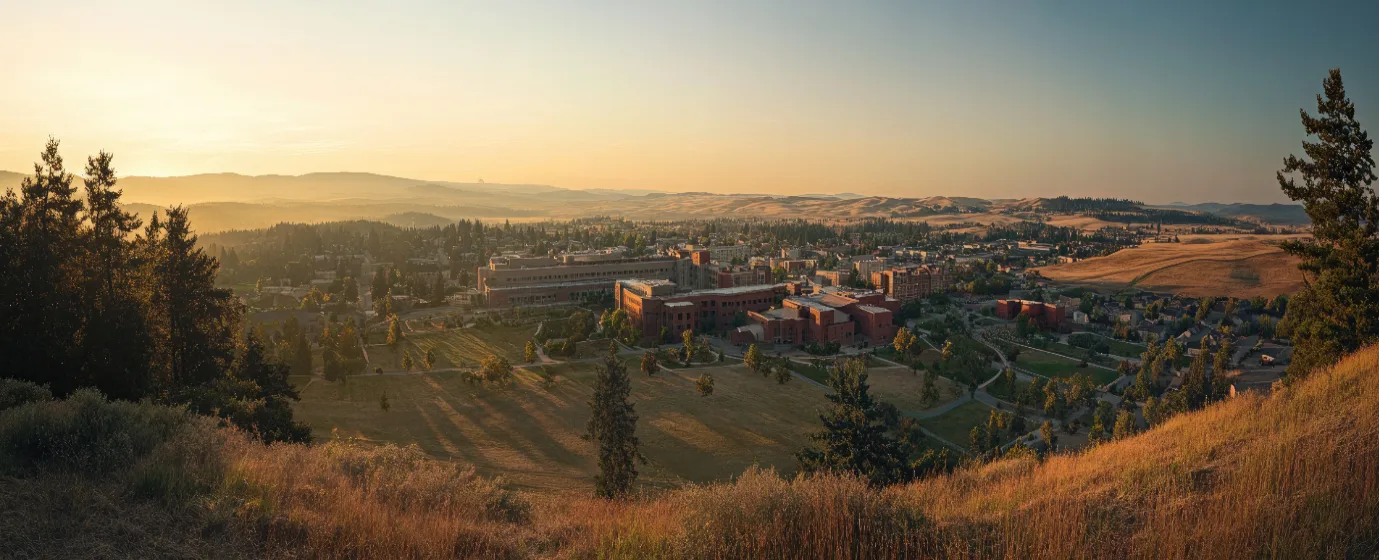
Eastern Washington · Washington
First-Time Home Buyer Guide for Pullman (2026)
There's a moment every first-time buyer in Pullman hits — usually somewhere between getting pre-approved and losing their second offer — when the process stops feeling theoretical and starts feeling real. You've been saving, you've been watching Zillow, you've told yourself you're ready. Then you're sitting across from an agent who's explaining earnest money and inspection contingencies and appraisal gaps, and you realize the spreadsheet you made three months ago only covers about half of what's actually about to happen. Pullman is absolutely worth the effort. With Washington State University anchoring the local economy, a school district rated among the best in the state, and home prices that are genuinely accessible by Washington standards, this is one of the more compelling places in the Pacific Northwest for someone buying their first home.
The median home price in Pullman sits at $429,000 — and understanding what that number actually means is step one. At that price point, you're looking at a three-bedroom home in reasonable condition, likely on the older side (much of Pullman's housing stock dates from the 1960s through the 1990s), in a neighborhood like Pioneer Hill or Sunnyside Hill. Entry-level detached homes — the two-bedroom, one-bath situations in Military Hill or along the Downtown fringe — start closer to $300,000 to $330,000. The gap between renting and owning here is real but narrowing: with WSU driving persistent rental demand, rents for a two-bedroom apartment commonly run $1,100 to $1,500 per month, and a mortgage on a $350,000 home can land in a comparable monthly range depending on your down payment and rate.
This guide walks you through the entire first-time buying process as it actually plays out in Pullman — from what your budget realistically gets you at each price tier, to the credit and income reality, to the five specific mistakes buyers make in this market. If you've been reading generic Washington real estate advice and feeling like it doesn't quite apply to your situation, it's because it probably doesn't. Pullman has its own rhythms.

Compared to most cities in Washington state, Pullman is genuinely buyer-friendly at the entry level — and that matters when you're stretching to make a first purchase work. The $429,000 median puts Pullman well below Seattle ($900K+), Spokane proper ($320K–$380K with less housing quality at the entry tier), and Tri-Cities, which has seen sharper appreciation pressure in recent years. For the price, you get a real city: a nationally ranked university, a hospital, a top-rated school district, and enough economic infrastructure that the job market isn't entirely dependent on any one sector outside of WSU itself. That said, WSU is the engine here, and buyers who aren't connected to the university — either as employees or through a spouse — should think clearly about long-term employment stability in a market this tied to one institution.
The realistic first-time buyer entry points are Military Hill and the neighborhoods along the northern and western city fringe, where older two-bedroom homes regularly close in the $300,000 to $340,000 range. Pioneer Hill and Sunnyside Hill offer more character and stronger resale fundamentals, but you'll typically be starting at $370,000 or higher for a move-in-ready three-bedroom. The inventory picture in Pullman is tighter than most buyers expect — only about 15 homes sold in January 2026, which means in any given month, there may be fewer than 20 active listings worth serious consideration. First-time buyers who've been told "take your time" by well-meaning family members often learn the hard way that the right property doesn't wait.
| Price Range | What You Typically Find | Neighborhood Examples | Competition Level |
|---|---|---|---|
| Under $350K | 2BR/1BA, older stock (1940s–1970s), 900–1,400 sq ft, may need cosmetic updating | Military Hill, Downtown fringe, NW Pullman streets | Moderate — longer days on market |
| $350K–$450K | Entry-level 3BR/2BA, some townhomes/condos, move-in ready or light update needed | Pioneer Hill, College Hill edges, Sunnyside Hill entry | Moderate to competitive |
| $450K–$550K | 3BR/2BA solid condition, 1,400–1,800 sq ft, good lot, established neighborhoods | Sunnyside Hill, Pioneer Hill mid-range, Whispering Hills | Competitive — multiple offers possible |
| $550K–$650K | Updated 3–4BR, larger square footage, newer construction or renovated | Whispering Hills, upper Sunnyside Hill | Less competition, fewer listings |
| $650K+ | Newer construction, 4BR+, premium views or larger lots | Whispering Hills new builds, custom homes | Limited inventory, buyer-friendly negotiation |
The gap between list price and sold price is worth understanding before you write your first offer. Homes in Pullman are selling at roughly 98% of asking price on average, and hot properties in the $380,000 to $480,000 range can still draw multiple offers and close above list. Buyers who assume they'll "low-ball their way in" in a market of this size often find that the seller simply waits for a more realistic offer — inventory is limited enough that sellers here aren't desperate.
| Step | What Happens | Typical Timeline | What First-Timers Get Wrong |
|---|---|---|---|
| Get finances in order | Pull credit, reduce debt, document income and assets | 1–3 months before searching | Waiting until they find a house to start |
| Pre-approval | Lender reviews credit, income, and assets; issues a letter | 1–3 business days | Confusing pre-qualification with pre-approval |
| Find an agent | Interview 1–2 local agents with Pullman-specific experience | Before active search | Using a Spokane agent unfamiliar with Whitman County norms |
| Active search | Tour homes, track market, understand neighborhood differences | 2–8 weeks | Shopping only online; not touring early enough |
| Making offers | Submit offer with earnest money, terms, and contingencies | Hours to 24 hours after finding the right home | Writing weak offers on strong properties |
| Under contract | Both parties sign; earnest money deposited; clock starts | Within 3 days of acceptance | Not understanding what's binding and what isn't |
| Inspection | Licensed inspector reviews the property | Within 5–10 days of contract | Skipping inspection to be "competitive" on older homes |
| Appraisal | Lender orders independent valuation | 1–2 weeks into contract period | Not understanding what happens if it comes in low |
| Final walkthrough | Confirm condition hasn't changed | 24–48 hours before closing | Skipping it entirely |
| Closing | Sign documents, funds transfer, keys in hand | 30–45 days after contract | Not having cash-to-close funds ready and accessible |
Inspection is non-negotiable on older Pullman housing stock. A meaningful share of the homes in the $300,000 to $400,000 range date from the 1960s through the 1980s, and issues like aging electrical panels, older plumbing, and insulation gaps are genuinely common. Some buyers have waived inspection to compete in tighter markets elsewhere in Washington — but in Pullman, where sellers are not facing the same frenzy as a Seattle suburb, there's rarely a reason to take that risk. A 10-day inspection period is standard and expected. Closings in Whitman County typically run 30 to 45 days from contract, which is consistent with statewide norms.

The floor for a conventional loan is a 620 credit score, but what most buyers don't realize is how much a credit score in the 680–740 range actually saves them over the life of the loan. On a $420,000 loan, the difference in rate between a 650 and a 740 score can translate to $80 to $130 per month in payment — which, compounded over 30 years, is tens of thousands of dollars. If your score is hovering in the low-to-mid 600s, spending 3 to 6 months improving it before applying isn't delay — it's strategy.
FHA loans allow a 580 minimum score with 3.5% down, making them genuinely accessible for buyers who haven't had time to build credit history. The catch is mortgage insurance, which adds to your monthly payment and stays for the life of the loan in most cases. To qualify for a $400,000 purchase, lenders typically want to see gross monthly income around $6,200 to $6,800 using the 28% front-end debt-to-income ratio (DTI) as the benchmark. At $500,000, that income threshold rises to roughly $7,800 to $8,400 monthly. DTI, in plain English, is the ratio of your monthly debt payments — housing plus car loans, student debt, minimum credit card payments — to your gross income. Most lenders want the total below 43–45%, and the lower that number, the more programs and rates you have access to.
One thing relocating buyers consistently underestimate is Washington's lack of a state income tax. If you're moving from Oregon, California, or any state with a meaningful income tax, your net take-home pay in Pullman will be noticeably higher than what you're used to — and that directly improves your qualifying ratios. A buyer earning $75,000 gross moving from Oregon could see $2,500 to $4,000 more per year in take-home pay, which lenders account for in DTI calculations.

As someone who works with buyers across the region, I can tell you that location within Pullman genuinely shapes how a home holds its value over time. Neighborhoods like College Hill and Pioneer Hill tend to attract consistent demand — partly because of their proximity to Washington State University and established community character. Sunnyside Hill has also drawn interest from first-time buyers looking for a foothold in a stable area. In my experience, well-priced homes in these neighborhoods don't sit long, and in Pullman that can mean days rather than weeks before something goes under contract.
Before you fall in love with a house during a tour, please talk with a lender first. Your pre-approval number tells you the maximum a lender will extend — it doesn't reflect what actually fits your life. Your real monthly obligation includes your loan payment, property taxes, homeowner's insurance, and potentially HOA dues, and that full picture can look meaningfully different from the headline number. Knowing your comfortable budget before you walk through doors means you're positioned to move with confidence when the right home in Pullman appears.
Mistake 1: Shopping at the top of their qualification. Getting pre-approved for $500,000 does not mean a $500,000 mortgage is comfortable to live with. In a town where a strong portion of the workforce is employed by WSU or the school district — both of which offer meaningful job stability but not explosive salary growth — buyers who stretch to the top of their range often feel the pinch by year two. A pre-approval is a ceiling, not a target.
Mistake 2: Treating the $429,000 median as an entry point. The median sold price reflects what's actually trading — not where you can get in. True entry-level inventory in Pullman starts in the low $300s, but at that price, you're often buying a two-bedroom home that will be difficult to grow into. Buyers who set their budget based on the median and then add $50,000 for "wiggle room" are thinking about this correctly; buyers who treat the median as their max are setting themselves up for disappointment.
Mistake 3: Underestimating Pullman's older housing stock. Military Hill, the Downtown fringe, and parts of College Hill have homes that are genuinely charming and well-located — and genuinely old. Deferred maintenance items like aging water heaters, outdated electrical panels, and foundation settling are common in homes built before 1980. Budget $8,000 to $15,000 in post-purchase repairs as a realistic contingency for anything under $370,000 in those areas, not as a worst case.
Mistake 4: Waiting for prices to drop. Pullman is a supply-constrained market. WSU enrollment drives persistent housing demand, and the pipeline of new construction is limited by both geography (the Palouse hills make development expensive) and the city's size. Buyers who've been "waiting to see what happens" since late 2024 have watched the Zillow middle-tier index climb 3% in a year. Waiting for a correction that the market fundamentals don't clearly support is a real cost, not a cautious strategy.
Mistake 5: Ignoring school district boundaries for resale. Even if you don't have children, school district boundaries directly affect resale value and buyer pool. Homes within the Pullman School District — rated A by Niche — command a premium over properties that technically touch Pullman but fall in neighboring districts. Before you write an offer, confirm which district the property is in. One street can make a meaningful difference in who will want to buy from you five years from now.
For buyers whose budget lands between $300,000 and $380,000, Military Hill is the most realistic starting point. The homes here are older and smaller, but the location is genuinely practical — close to downtown, on WSU bus routes, and near several of Pullman's K–12 schools. The catch is that you're buying into a neighborhood with heavier student rental density, which affects the long-term residential feel and can complicate resale to non-student buyers.
Pioneer Hill is where many first-time buyers end up once they stretch slightly above $370,000. The neighborhood has a mix of post-war and mid-century homes with reasonable lot sizes, and the community character is more established-residential than the student-heavy pockets near campus. Buyers here are often buying for the school proximity, the walkability to Sunnyside Park and the Bill Chipman Palouse Trail, and the sense that the neighborhood has real roots. Homes in Pioneer Hill with good bones and original character regularly trade in the $380,000 to $460,000 range, and the rehab potential in this price band is real.
Whispering Hills appeals to buyers who want newer construction and are willing to pay for it. Entry points here typically start above $500,000, which puts it outside the first-time buyer sweet spot for most Pullman households — but for buyers relocating from California or with dual incomes in the $120,000+ range, it offers a product that's difficult to find elsewhere in the city: homes built in the last 10 to 20 years with modern layouts, less deferred maintenance, and stronger energy efficiency.
For buyers who prioritize community feel and don't mind a longer renovation timeline, Sunnyside Hill offers some of the most character-rich housing in Pullman. The elevated location gives many homes views of the Palouse hills, and proximity to Sunnyside Park makes it appealing for buyers who plan to be outdoors regularly. Expect to pay $400,000 to $500,000 for a well-maintained three-bedroom here — with fixer opportunities occasionally appearing below that threshold for buyers willing to roll up their sleeves.
If the down payment is what's holding you back from moving forward, there's a program worth knowing about. Todd offers ONE+ by Rocket Mortgage — a genuine grant, not a deferred loan, not a second mortgage. Here's how it works: you put down 1% of the purchase price, and Rocket contributes a 2% grant (up to $7,000) that never needs to be repaid. That brings your total down payment to 3% without you having to come up with all of it. The maximum loan is $350,000, your income needs to be at or below approximately $80,000 for Whitman County, and the minimum credit score is 620. This is available to first-time and repeat buyers alike — and there's no second lien attached, no repayment trigger at sale, nothing owed back at any point. It's a grant.
To see if ONE+ might work for your income and purchase price, check out the full program details and eligibility guide →

Local Expert Takeaway: The single biggest mistake first-time buyers make in Pullman is treating this like a slow, forgiving market because it's a small college town. It isn't. Inventory regularly runs below 20 active listings, and the homes in Pioneer Hill and Sunnyside Hill that are priced right — $380,000 to $460,000, three bedrooms, good school proximity — move in under two weeks. Get your pre-approval locked before you start touring, build a relationship with a Pullman-based agent who knows which blocks are student-heavy and which aren't, and don't save your first serious offer for your third or fourth property. In this market, hesitation is a down payment on regret.
✅ Pullman's $429,000 median home price is accessible by Washington state standards, with true entry-level detached homes starting closer to $300,000 in Military Hill and the Downtown fringe.
⚠️ Inventory is thin — typically fewer than 20 active listings at any time — so first-time buyers need to be pre-approved and ready to move quickly when the right home appears.
📍 Pioneer Hill and Sunnyside Hill offer the best combination of neighborhood character, school proximity, and long-term resale potential for first-time buyers stretching into the $370,000–$460,000 range.
Can I buy a home in Pullman as a first-time buyer?
Yes — and Pullman is actually one of the more accessible markets in Washington for first-time buyers. With homes available starting in the low $300,000s, a top-rated school district, and stable employment anchored by WSU and Schweitzer Engineering, the fundamentals support homeownership for buyers who qualify. The main challenge is inventory, not price: you'll need to be prepared to move decisively when the right property appears.
How much do I need to buy my first home in Pullman?
With a 3% conventional down payment on a $380,000 home, you'd bring roughly $11,400 to the down payment plus closing costs that typically run 2–3% of the loan amount. Programs like ONE+ by Rocket Mortgage can reduce your out-of-pocket down payment to 1%, with Rocket contributing a 2% grant. At minimum, plan for total cash-to-close in the $12,000 to $20,000 range depending on your purchase price and loan program.
What credit score do I need to buy a house in Washington state?
Conventional loans require a minimum 620 score, and FHA loans are available at 580 with 3.5% down. That said, a score of 680 or higher gives you meaningfully better rate options and a stronger application in competitive situations. If your score is in the low 600s, a few targeted months of credit improvement — paying down utilization, clearing any collections — can save you thousands over the life of your loan.
Explore the full Pullman series: The Ultimate Pullman Relocation Guide · Is Pullman Safe? · Cost of Living in Pullman · Best Neighborhoods in Pullman · Pullman Schools & Family Life · Pullman Youth Sports · Pullman Parks & Recreation · Retiring in Pullman · 1031 Tax-Deferred Exchange in Pullman · Pullman First-Time Homebuyers Guide · Pullman Down Payment Assistance Guide · Moving to Pullman from California